The 2023 season of the Ankh-Hor project in retrospect

Today four weeks ago we closed the 2023 season of the Ankh-Hor project in Luxor. Time for a little review of a very successful season.

Work was conducted from September 5 to October 5, 2023, with our very helpful SCA Inspector Mahmoud Sayed Abdelhady. The major goal was to continue the cleaning, consolidation, and documentation of the large number of objects excavated in the 1970s from TT 414, the monumental tomb of Ankh-Hor, High Steward of the Divine Adora-trice Nitocris (26th Dynasty).

Several previously not identified pieces were newly recognised as matches to coffins documented by the Austrian mission in the 1970s. Some of these were joined by our conservators Mohamed and Karima to the already documented pieces. One example is Reg. No. 827 – Fig. 1 shows the state of documentation in the 1970s compared to 2023; this season, we found a small new piece matching to the instep of the lid. All pieces of Reg. No. 827 were cleaned and consolidated.
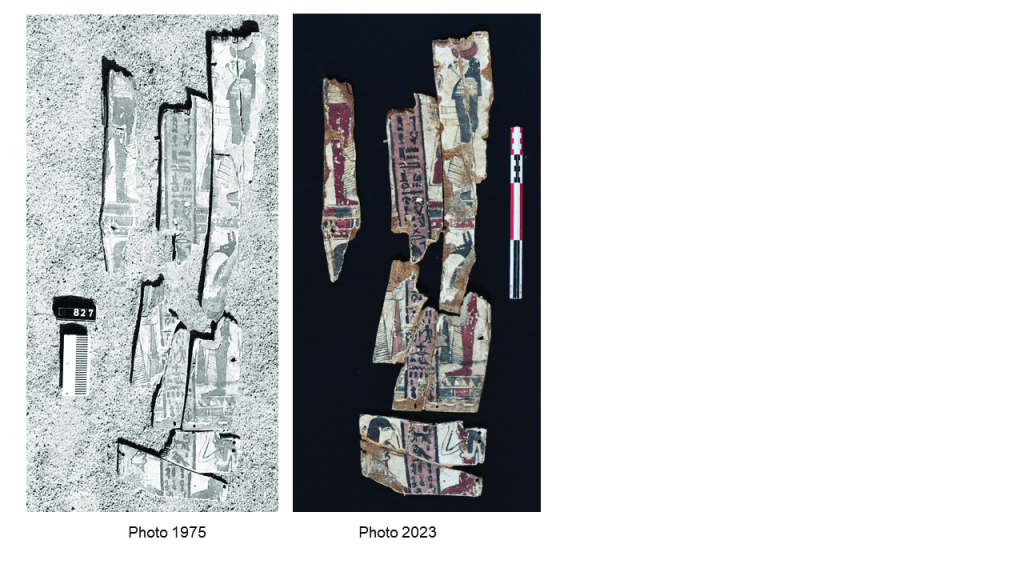
Fig. 1: Reg. 827, a fragmented Ptolemaic coffin lid. Left the state in 1975, to the right our new match in 2023.

In general, all finds studied in 2023 were digitally photographed and entered in a database, created by File Maker Pro. In total, more than 180 individual objects (mostly coffins and cartonnage elements) were studied and documented by more than 2400 photos. These new photos are suitable for publication and show the colours of the pieces, in contrast to the previous documentation in the 1970s (see Fig. 2).

Fig. 2: Reg. 521, one of the examples showing the benefits of high-resolution photography in full colour.

Since many the painted objects from TT 414 have darkened surface, infrared photography was used to make the original decoration visible (with a Sony Cybershot DSC-F828, an IR-filter and a small magnet). In 2023, this method was applied to a total of 95 objects.

We introduced a new method of documentation in 2023. The app Scaniverse (see https://scaniverse.com/) was used to capture objects in 3D. This photogrammetry application is ultrafast, highly accurate and very easy to use. 170 objects from TT 414 were captured with metrically accurate 3D models this season – simply fantastic!

Ashraf and I with the box of objects we transported in 2023 to the magazine (photo: P. Heindl).

One of the highlights of this season was the transport of objects to the magazine of the West Bank. In addition, we were able to work on coffins we transported to the magazine in earlier years. My personal highlight was the new documentation of one of my favourite coffins from TT 414, of Reg. 655, with infrared photography and with a 3D model.

3D model of coffin Reg. 655 created with the app Scaniverse

The conservators of the LMU Munich Ankh-Hor Project in the 2023 season were the specialists for wood, Mrs. Karima Mohamed Sadiq and Mr. Mahmoud Mohamed Mahmoud. They did a fantastic job, both at our site and in the magazine of the West Bank. A total of 108 wooden and painted objects, mostly coffins, comprising 294 individual pieces, were successfully cleaned and consolidated in 2023.

To conclude, the fifth season of the LMU Ankh-Hor Project was carried out successfully, with much progress regarding the consolidation and documentation of wood and cartonnage coffins from TT 414. Thanks to the transfer of objects to the magazine and the placement of studied finds in sugar bags in corridors of Tomb I, much space was gain in the mission’s magazine which is crucial for the future jigsaw puzzle of coffin fragments, both in wood and cartonnage. New genealogical information regarding coffin owners were unearthed and the stylistic assessment of Ptolemaic cartonnage coffins advanced in 2023 in many aspects, including reconstructing new cartonnage coffins.

The rich potential of our work on the cartonnage coffins can be illustrated with Reg. 23/04. I was able to match several fragments of the edge of the base of a cartonnage coffin which was previously not documented (Fig. 3). Based on the father’s name, the titles and the close similarity with Reg. 860, the coffin of Horakhbjt, I would like to propose to identify the owner of Reg. 23/04, Wesjrwer, as the previously unknown brother of Horakhbjt.

Fig. 3: Reconstruction of nine fragments of the edge of a cartonnage coffin of Wesjrwer.

Since not all fragments of wooden and cartonnage coffins from TT 414 are yet consolidated and documented, our work needs to be continued in the next season.

For now, I would like to express my gratitude to all of our Egyptian colleagues without whom work would not have been possible. I am very grateful to all team members of the 2023 season: Patrizia Heindl, Caroline Stadlmann, Ahmed Elmaklizi, all LMU Munich, and Karima Mohamed Sadiq and Mohamed Mahmoud Mohamed Mahmoud as the conservators of the Ministry of Antiquities and Tourism. Ashraf Hosni Teegi did another great job as the head of logistics. Many thanks to all and we are all very much looking forward to the next season!

The 2023 team of the LMU Ankh-Hor Project.

A short summary of the 2022 season

Winter has finally arrived in Germany and being back on the desk and in the classrooms at LMU, it is especially nice to reflect a bit on our 2022 season of the Ankh-Hor project in sunny Luxor. It was an extremely pleasant and productive season, and I am grateful to all team members!

The major goal of the 2022 season was to continue the cleaning, consolidation, and documentation of the large number of objects excavated from TT 414, the monumental tomb of Ankh-Hor, High Steward of the Divine Adoratrice Nitocris (26th Dynasty), by the Austrian mission directed by Manfred Bietak. The focus was on wooden coffins and cartonnage elements from TT 414 and included both Late Period pieces and Ptolemaic ones. Work was conducted from September 27 to October 27, 2021 (with our amazing SCA Inspector, Saad Kenawy Mohamed).

The detailed documentation of objects from TT 414 resulted, thanks to the great efforts of Hassan, Saad and Patrizia, in a total of 147 drawings during the 2022 season, comprising wooden objects, stamped mud bricks (deriving not from TT 414), shabtis and pottery.

Fig. 1: Saad, Patrizia and Hassan were a great and very effective drawing team (photo: J. Budka).

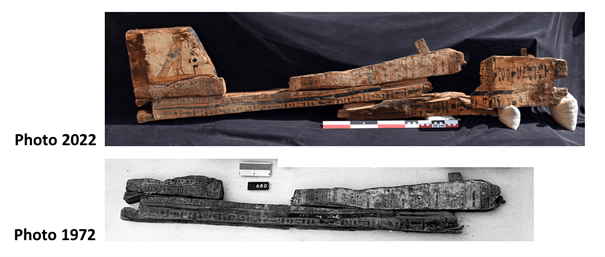
Much progress was also made in assigning previously not identified pieces of painted wooden coffins to specific coffins documented by the Austrian mission in the 1970s. One important example is Reg. 680 for which four new matching pieces were found. However, for this important coffin of the founder of the 30th Dynasty reuse of TT 414, Pa-di-Amun-neb-nesut-tawy I, there are still two missing pieces from the left side of the coffin and its foot part which were documented in the 1970s. Fig. 2 shows the comparison between the status of the right side of the upper part of the coffin in 1972 and in 2022 with three matching fragments. This coffin is thus a good example for the challenges in our work – there are still missing pieces for important coffins and the identification of all fragments is not yet fully accomplished.

Fig. 2: Comparison of part of coffin Reg. No. 680 between status in 1972 and 2022 – note three new matching pieces to the right side of the lid.

Many painted wooden coffin fragments were cleaned and consolidated in the 2022 season by our conservators Antje Zygalski and Noura Mustafa El-Taher. Noura did an amazing job in reconstructing free standing elements of coffins in the shape of djed-pillars and Isis-symbols.

Fig. 3: Noura working on the fragments of djed-pillars and Isis-symbols. She managed to reconstruct several pieces out of broken fragments (photo: J. Budka).
Fig. 4: Some examples of the newly reconstructed Isis-symbols (photo: J. Budka).

The best example that we were able to identify new owners of coffins during the 2022 is Reg. No. 689, found in the debris in the burial chamber of Ankh-Hor. The lady Takerheb is now confirmed as the owner of this piece.

During the 2022 season, also some new names of persons buried in TT 414 were identified. For the 26th Dynasty, a possible new female relative of Ankh-Hor was recorded. The fragment of a new anthropoid coffin, K07/243, gives the name Ta-dj-Iset (a common name in the 25th and 26th Dynasties), previously unknown from TT 414. Since there are several Pa-di-Iset attested in Ankh-Hor family, this new female might extend the family tree – for more information, I will need to identify matching pieces to this newly recorded coffin fragment.

In addition to the stylistic assessment of the cartonnages from TT 414, much progress was done this season in identifying the owners of these trappings. Thanks to infrared photography, some names and titles became readable and allow to attribute cartonnage elements to Ptolemaic individuals already known from other objects, for example a new cartonnage element is attested for G 148, Ta-sherit-Khonsw, with K08/85.

One particular important identification of a new cartonnage element is the one for Twt, an individual otherwise only attested by his outer anthropoid coffin in yellow-red on black-style (Reg. No. 510). This also offers us the possibility to compare the motifs and styles on coffins and cartonnages.

New coffins were also assigned to known persons buried in TT 414. As one example, the inner anthropoid coffin fragment of Imhotep (G 16) was identified with Reg. No. 19/04 and is now a new addition to his set of coffins with an outer coffin in black-yellow style, Reg. No. 759.

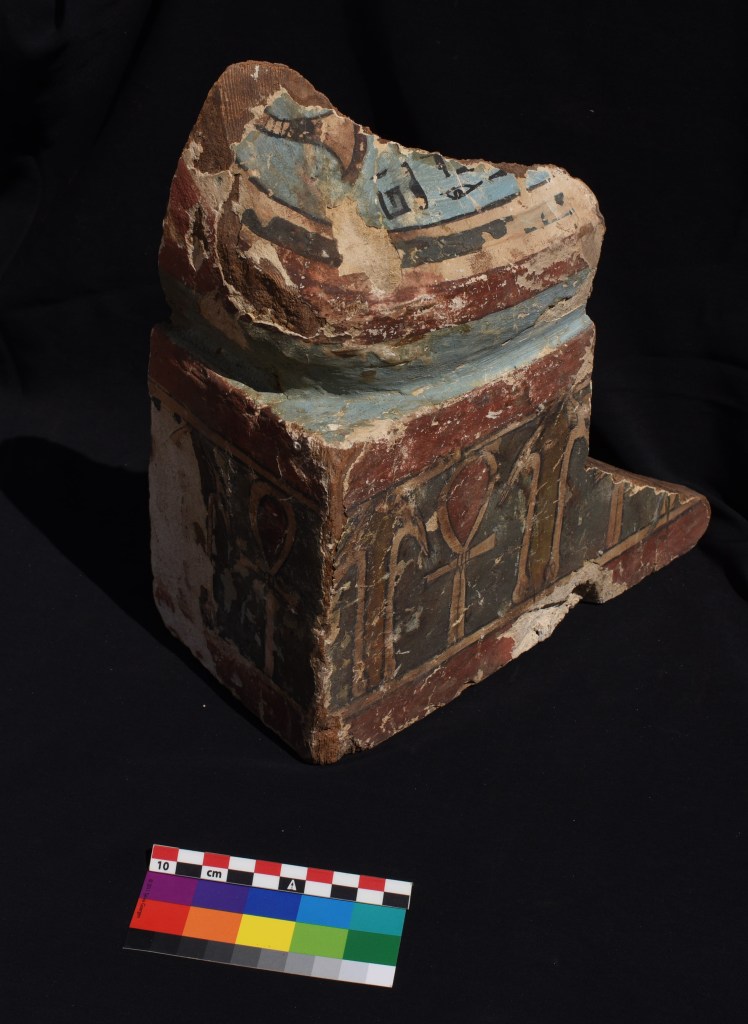
Fig. 5: Foot part of the inner coffin of Imhotep, already documented in 2019, but now newly assigned to its owner (photo: C. Geiger, ©Ankh-Hor Project).

To conclude, several new observations on the material from TT 414 are possible as direct results of the 2022 season, in particular in three main thematic fields, first of all because of the extended application of infrared photography: 1) genealogical information and new coffin owners, 2) additions to existing tomb groups as well as 3) a better understanding of the coffin design and the main motifs, also in relation to cartonnage elements.

Despite of all this progress, large amounts of fragments of coffins and cartonnage from the Late Period to Ptolemaic and also Roman times remain to be cleaned, are partly in need of reconstruction and of full documentation. Our work therefore needs to be continued in the next season. Our 2022 results hopefully show that these efforts are immensely worthwhile.

We proudly present: first tests with infrared photography

Back in 2018, the conservator of the Austrian Archaeological Institute, Daniel Oberndorfer, made some tests with infrared photography with very good results. In the case of painted coffins with stains on the surface or simply darkened surfaces, the original decoration became visible again. Sometimes these stains are also caused by bitumen applied to the surface. And since the pouring of bitumen above the coffin and the mummy was very common in Ptolemaic times, this seemed like a suitable way to deal with our large set of material from TT 414.

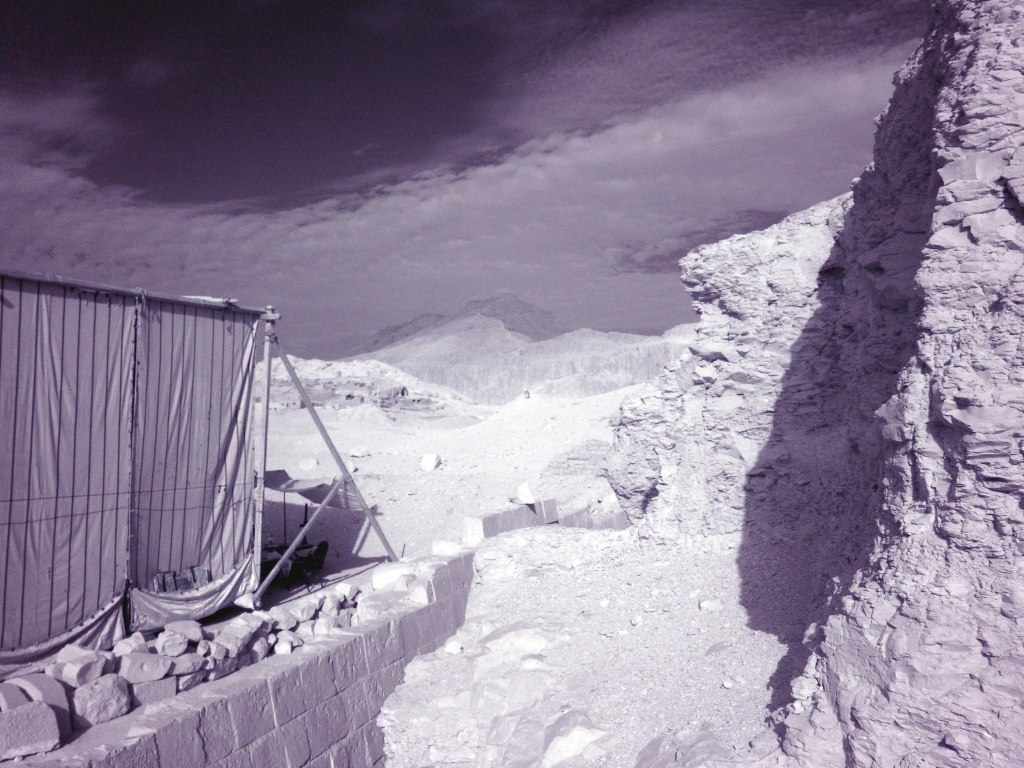
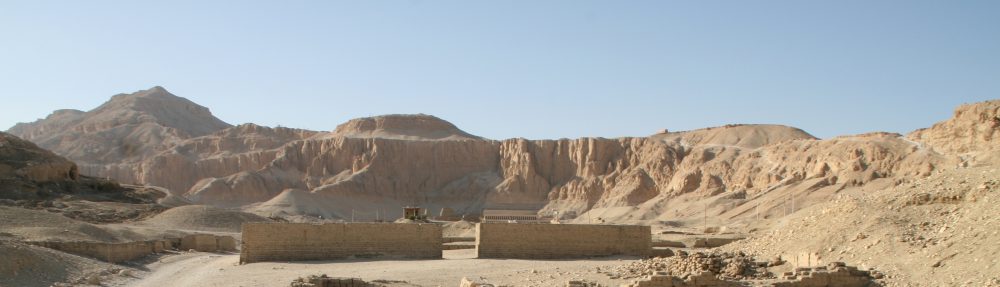
For the 2021 season, I therefore purchased a second-hand Sony Cybershot DSC-F828 camera. First tests with a magnet and the use of an IR-filter were extremely successful. The camera kit is also useful for landscape photography, site views turn out really nice – here is just a shot towards the mountain from our place of work.

But most importantly, for the wooden coffins, the photos are like magic and make things visible again! The decoration and the texts of some darkened pieces are much clearer and nicely readable. But also what appears as a “black coffin” because of its current surface, becomes visible as a formerly colourful piece completely covered with resin. The original JPGs and RAWs can be further processed and will assist us to fully document the design of the coffins from the tomb of Ankh-Hor.

I am very grateful to Daniel for introducing this new documentation method back in 2018 and super happy that I invested in my own new camera kit – the results are simply stunning! Especially for large fragments with important pieces of texts (and figurative panels) this will allow a fresh reassessment of the coffins from TT 414 – stay tuned for more very soon!

All set for the 2021 season

Tomorrow will be the day: we will open the 2021 season of the LMU Ankh-Hor project. Not all members of the field season have yet arrived but will do so in the next days.

Thanks to much help by kind colleagues both in Cairo and in Luxor, I was able to get all paperwork done well in time. In addition, I joined the South Asasif Conservation Project directed by Elena Pischikova and started to work on the amazing amounts of pottery they unearthed in newly discovered tombs! I will continue to work in part-time for this mission and I am looking much forward to such an opportunity of a direct comparison between the South and the North Asasif. The parallels are really intriguing!

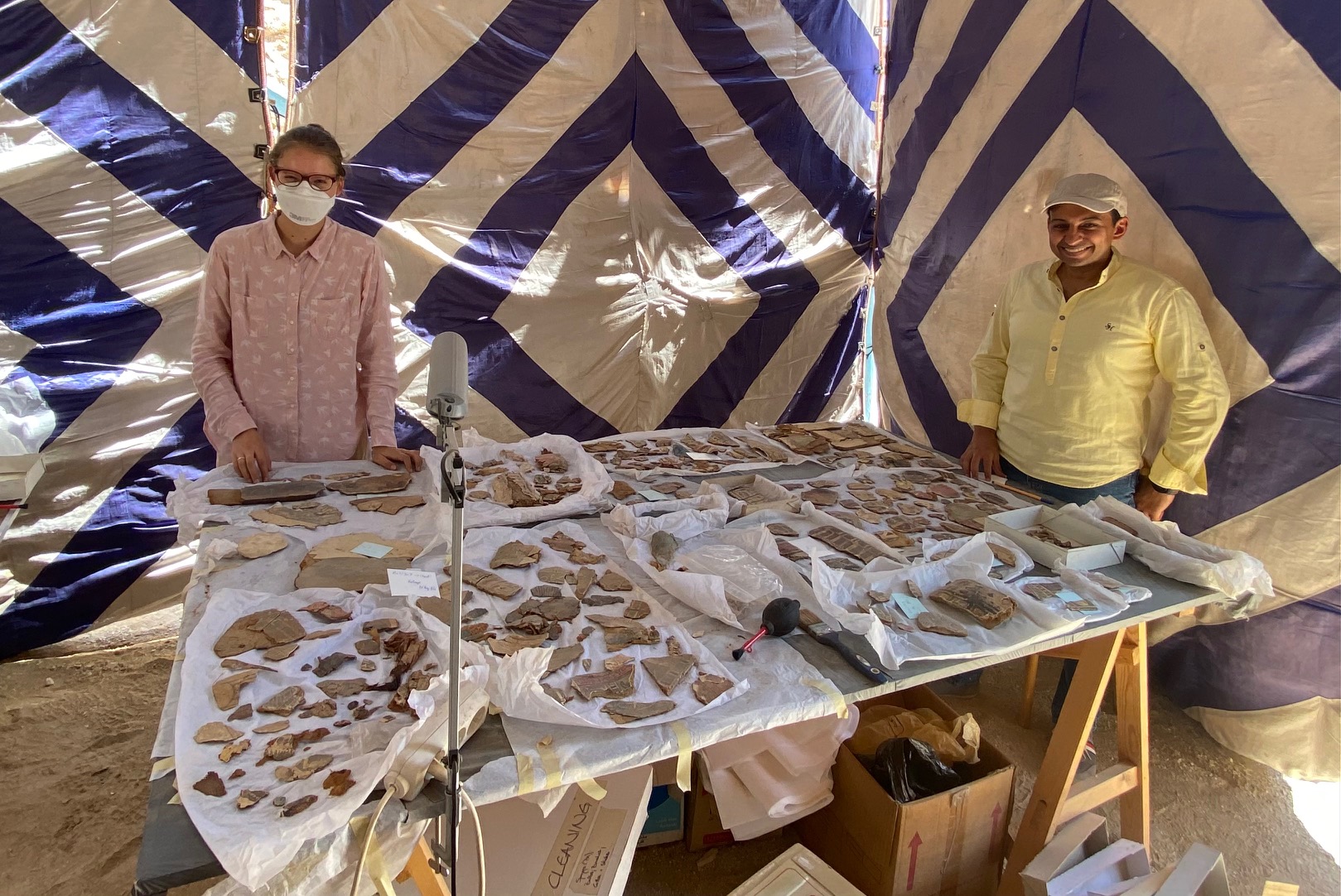
At our site in northern Asasif, we were already allowed to set up our beautiful conservation tent. Starting from tomorrow, this tent will be the centre of our conservation programme focusing on Ptolemaic wooden coffins and cartonages but including other painted objects as well.

We will keep you updated about our progress in the next four weeks!