Summary of the 2025 season

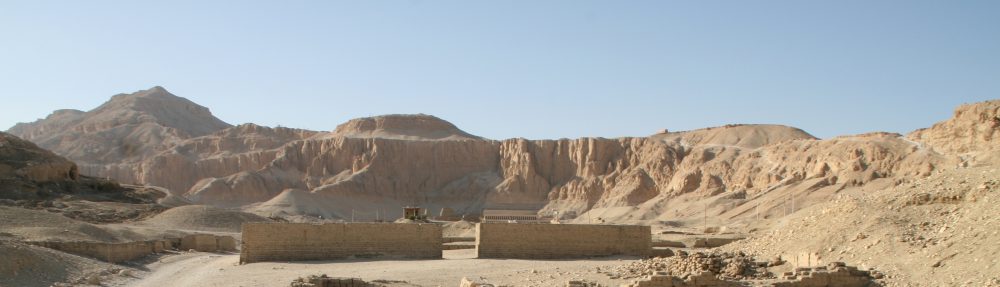
November has begun, and the 2025 season in the Asasif has already come to a close. Our work was carried out from 20 September to 16 October 2025. The main objective of the 2025 season was to continue cleaning, consolidating and documenting the large quantity of artefacts unearthed from TT 414, the impressive tomb of Ankh-Hor, High Steward of the Divine Adoratrice Nitocris (26th Dynasty). As in the 2024 season, the focus was on wooden coffins and cartonnage elements from TT 414, including pieces from both the Late and Ptolemaic periods.

This year, a number of fragments of cartonnage elements and cartonnage coffin fragments was consolidated. One example is K02/209 is a fragment of the back part of a head cover for the mummy with the common motif of Isis and Nephtys mourning Osiris as personalised Djed-Pillar.

Example of consolidated cartonnage fragment (to the left prior to cleaning/consolidation, to the right finished).

In general, significant progress has been made in the study of the cartonnage coffins from TT 414 – both regarding consolidation and matching pieces together. One of the most important results of the 2025 season was the identification of the lid of the cartonnage coffin of Wesjr-Wer (Reg. 23/05 fitting to Reg. 23/04). This now confirms that this new Wesjr-Wer III also had a bivalve cartonnage coffin with a zodiac on the inner part of the lid (see already an earlier blog post prior to the matching of the lid and the lower part).

On 14 October 2025, one box containing 30 wooden objects (34 individual pieces in total) was transported to the study magazine of the SCA. The objects were fully documented and 3D scans were taken prior to transportation.

Two days of work were carried out on the West Bank study magazine of the SCA. The aim of the documentation was to update the records of the objects in the magazine. A total of twelve objects were studied, primarily to document items transferred to the magazine using photogrammetry (3D scans with the Scaniverse app) and, where necessary, infrared photography. Five coffins transported in 2019 and seven other objects from one box transported in 2021 were studied.

A day’s work was carried out in the section of the magazine dedicated to registered finds. First, the register book of the Austrian Mission was examined, resulting in the creation of a priority list of all remaining objects from the tomb of Ankh-Hor (TT 414). A total of 22 object numbers were examined. Most of these derive from the intact, in-situ burial of Wah-ib-Re in Room 10.2 of TT 414.

For me, it was a very special moment to be able to study these important finds, which were published in exemplary fashion by Bietak and Reiser-Haslauer. However, it really makes a difference to hold them in your own hands, for example dozens of the shabtis of Wah-ib-Re!

These are some of the shabtis of Wah-in-Re that I had the honour of studying this season.

In conclusion, the seventh season of the LMU Ankh-Hor Project was a success, with significant progress made in the consolidation and documentation of wooden and cartonnage coffins from TT 414. However, as not all fragments have been consolidated and documented yet, our work will need to continue into the next season. Joining pieces together is particularly time-consuming, but worthwhile. It was also important to continue work on the study magazine and gain an overview of all objects from TT 414 currently stored in the registered area.

We would like to thank our inspector, Mr Hassan Khalil, for enabling us to work according to the programme of work and for all his support during the 2025 season. The same applies to our conservation inspector, Mrs Iman Ibrahim Zaghlol.
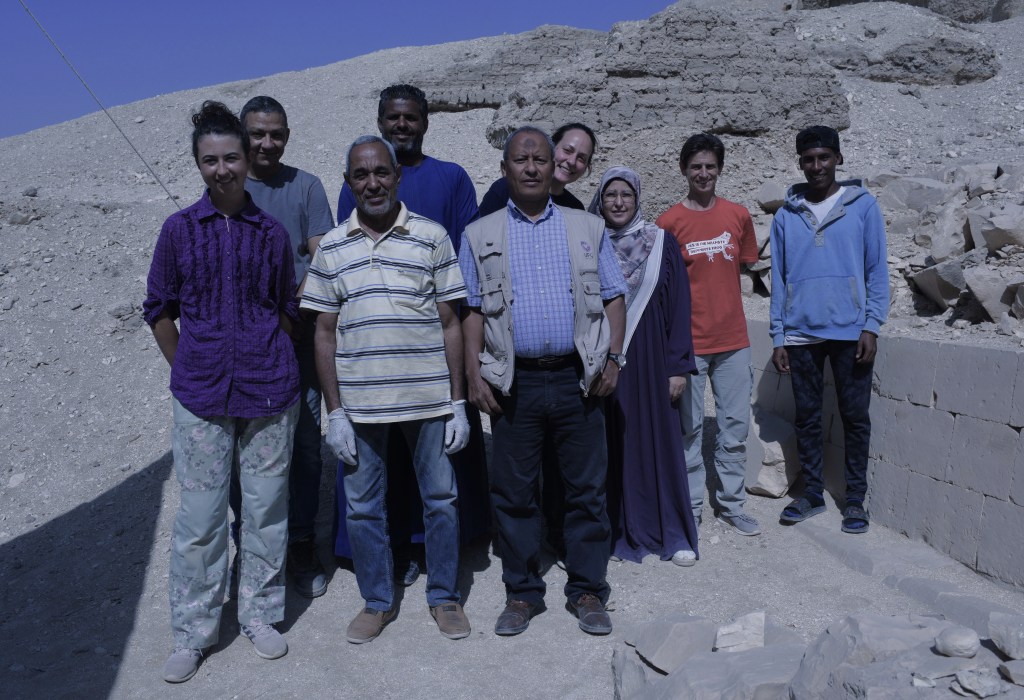
The 2025 team.

I would also like to thank all the team members who worked with us during the 2025 season: Hassan Aglan and Patrizia Heindl from LMU Munich, Ladina Soubeyrand from HU Berlin, and Iman Ibrahim Zaghlol and Mohamed Mahmoud Mohamed Mahmoud, who worked as conservators, as well as Ashraf Hosni Teegi, who was in charge of logistics.

I’m very much looking forward to our next season in 2026, which I’m sure will be great!

Putting together what belongs together: the tomb group of Istemkheb (G10) from TT 414

One of the main aims of the current Ankh-Hor Project is to reconstruct the original tomb groups of the persons buried in TT 414. Much progress was made in the 2022 season already, and the last days were extremely productive in this respect.

Our conservator Antje Zygalski finished the consolidation of a beautiful painted wooden inner anthropoid coffin (Reg. No. 657), the sistrum player of Amun, Isetemkheb. I managed to identify new joints to the previously registered pieces and together with new infrared photos (Fig. 1), we have now a rich data set for a detailed study of this fragmented coffin.

Fig. 1: Example of details from the fragmented coffin lid Reg. No. 657, now visible thanks to infrared photos.

The lady Isetemkheb was labelled as G10 by Elfriede Reiser-Haslauer in the genealogical register (Reiser-Haslauer 1982, 268). Thanks to the names of her parents, several objects can be attributed to her:

  • A beautiful and unusual Ptah-Sokar-Osiris statue – its pedestal is Reg. No. 695 and still here in Egypt, the statue was in Paris (Louvre N 670) and is now in Warsaw Inv.No. 143346 (Lipinska 2008)
  • A colourful painted canopic box in London (BM EA 8532, see Budka, Mekis & Bruwier 2013)
  • A gilded hypocephalus in Paris (Louvre N 3524, Mekis 2020, No. 1, 148-149)
  • A Book of the Dead papyus in Turin (cat.no. 1793, TM 57048)

Together with the inner coffin, this makes a substantial tomb group which finds close parallels with other 30th Dynasty/early Ptolemaic burial assemblages from the tomb of Ankh-Hor (Budka, Mekis & Bruwier 2013). The fact that her objects are distributed throughout European museums is also something we already know very well from other tombs groups from TT 414.

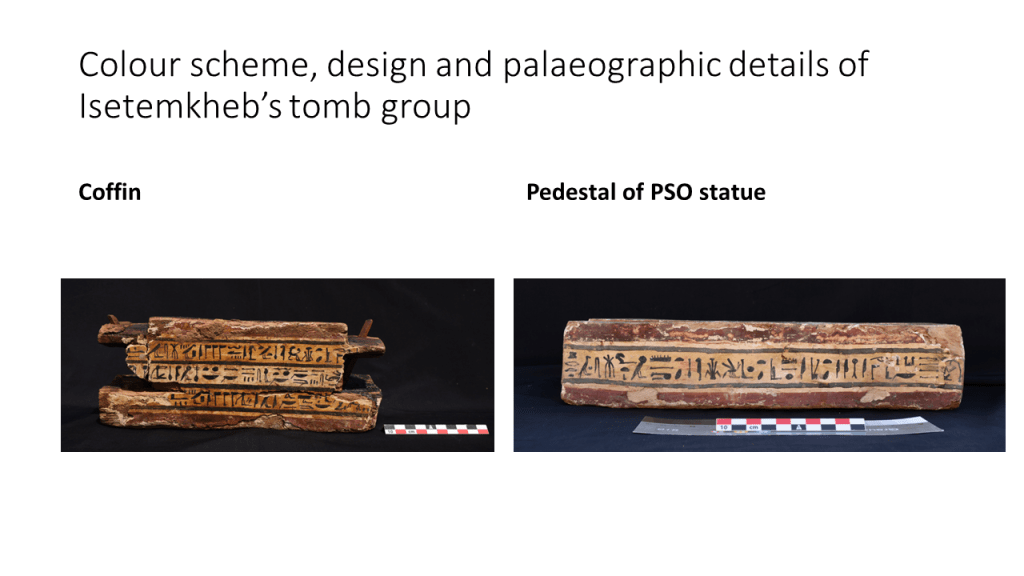
What I find especially remarkable are close parallels between the inner coffin, in particular the front panel of the foot part of the lid, and the pedestal of the Ptah-Sokar-Osiris statue (Fig. 2). This allows us to speculate that both objects were produced in the same workshop.

Fig. 2: A comparision between the foot part of the lid of the coffin of Isetemkheb and one side of her pedestal for the Ptah-Sokar-Osiris statue now in Warsaw.

The inner anthropoid coffin of Isetemkheb is in many respects remarkable – although the bier scene with the mummy is only partly preserved, it is very likely that we have another so-called Lamentation coffin (see Kucharek and Coenen 2021). Directly next to the bier on its left side, part of the speech of Isis is preserved, the typical phrase come to your house, “mj r pr=k”.

Coffin Reg. No. 657 is one of the eleven colourful painted coffins found in the debris in the burial chamber of Ankh-Hor. Here, a group of six female inner anthropoid coffins is especially noteworthy (Reg. Nos. 656, 657, 658, 659, 661 and 696). According to its design and colour scheme as well as the execution of its hieroglyphs, the coffin of Isetemkheb is very similar to the Reg. Nos. 656 and 658 as well as Reg. No. 655 of a male owner. These parallels seem relevant for dating the coffin as I will outline below.

After all these general comments on her tomb group, there is of course one essential question: who was this sistrum player Isetemkheb? This remained unclear for many years, no relatives other than her parents were known and her connection to the priestly family using TT 414 in early Ptolemaic times was mysterious. Back in 2017, Tamás Mekis and I proposed to identify her as the previously unknown wife of Wah-ib-Re I, the famous owner of the in situ burial in Room 10 of TT 414 (Budka and Mekis 2017). Tamás included an updated family tree of her and her husband in his PhD thesis, making it clear that Isetemkheb G11 of Elfriede Reiser-Haslauer is identical with our Isetemkheb G10 (Mekis 2020, 150). We can now reconstruct three of her sons and several descendants of these.

Although I still believe that this identification of Isetemkheb as the wife of Wah-ib-Re I is correct and built on strong evidence, a new look on her coffin raises several questions. This coffin is completely different from the coffin assemblage of her husband; rather, it finds a particular close parallel in the inner coffin of one of the nephews of her husband, Padias, Reg. No. 655 (Fig. 3). Could this imply that she survived Wah-ib-Re I for almost one generation? Could this maybe also explain why she was not buried in the same compartment?

Fig. 3: Comparison of the shoulder part of the lid of Isetemkheb with the one of Padias.

All in all, some of these questions might remain impossible to answer – but our new reassessment of the finds from TT 414 allows us to address them and to think further about the complexity of the reuse of the tomb of Ankh-Hor by the large Padiamunnebnesuttaui family.

References

Budka and Mekis 2017 = J. Budka and T. Mekis, The Family of Wah-ib-re I (TT 414) from Thebes, Ä&L 27 (2017), 219–239.

Budka, Mekis and Bruwier 2013 = J. Budka, T. Mekis and M.-C. Bruwier, Reuse of Saite temple tombs in the Assasif during the early Ptolemaic Time, Ä&L 22/23 (2013), 209–251.

Kucharek and Coenen 2021 = A. Kucharek and M. Coenen 2021. The Lamentations of Isis and Nephthys. Fragmentary Osirian papyri, Part I (The Carlsberg Papyri 16, CNI Publications 46). Copenhagen: Museum Tusculanum Press 2021.

Lipinska 2008 = J. Lipinska, An Unusual Wooden Statuette of Osiris, in S.H. D’Auria (ed.) Servant of Mut. Studies in Honor of Richard A. Fazzini (Probleme der Ägyptologie 28): 166–169. Leiden/Boston: Brill 2008.

Mekis 2020 = T. Mekis, The hypocephalus: an ancient Egyptian funerary amulet. Archaeopress Egyptology 25. Oxford: Archaeopress 2020.

Reiser-Haslauer 1982 = E. Reiser-Haslauer, IX. Genealogisches Register, 267–284, in: M. Bietak and E. Reiser-Haslauer, Das Grab des Anch-Hor, Obersthofmeister der Gottesgemahlin Nitokris, Band II. Mit Beiträgen von Joachim Boessneck, Angela von den Driesch, Jan Quaegebeur, Helga Liese-Kleiber und Helmut Schlichtherle und Relief- und Fundzeichnungen von Heinz Satzinger, UZK 5, Vienna 1982.

Totenbuchprojekt Bonn, TM 57048, <totenbuch.awk.nrw.de/objekt/tm57048>.

www.trismegistos.org/text/57048