Videos of the study day of the Ankh-Hor project

The first study day of the LMU Ankh-Hor Project was successfully held online using Zoom last week. We were very proud and happy that more than 120 colleagues and friends from several countries in Europe, from Egypt and even from the US were joining us! Many thanks, this wide interest is much appreciated and means a lot to us.

Although there were of course some technical problems – no surprise – all participants remained patient with us and our programme highlighted the challenges, achievements and problems connected with the study of TT 414.

I received much positive feedback and also a number of very useful comments and advice – again many thanks for this! Besides the scientific benefits, it was also just very pleasant to see so many colleagues and friends one hardly sees in person in these challenging times!

As promised, all presentations will be accessible as videos on LMU cast – for free of course. For now, the lectures by Cajetan and Patrizia are already available, more will follow soon.

Check out the video of Cajetan’s presentation to know about our applications of photography!

Cajetan spoke about technical aspects and logistics connected with photography of objects from TT 414. He also gave some comparisons with different set-ups in Sudan as we experienced in the framework of the AcrossBorders project.

Interested in archaeological drawing? Patrizia’s presentation will give you insights in practical details!

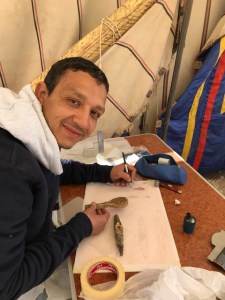
Patrizia highlighted our technical equipment, both hard- and software, for archaeological drawings from a large set of different objects from the tomb of Ankh-Hor. She also introduced our latest purchase in terms of graphics tablets.

An upate with more videos will follow shortly! And for sure this was not the last study day of the LMU Ankh-Hor project.

Announcing the first online study day of the Ankh-Hor project

I am very proud to announce the first study day of the LMU Ankh-Hor Project which will run online using Zoom on October 12 2020. This online format has many advantages – participation is free and we hope to reach many people worldwide interested in Theban archaeology, the Late Period and Ptolemaic times and funerary customs. Participants may also attend just individual time slots – just have a look at the preliminary programme. Please note that registration is mandatory via: https://eveeno.com/109463542

The main aim of the study day is to introduce the lines of research currently carried out by the LMU project working on TT 414 in the Asasif, high lightening the potential of this monumental Late Period tomb for our general understanding of the Theban necropolis.

I am especially delighted that the excavator of TT 414, Manfred Bietak, will present in a key lecture the discovery of the tomb in the 1970s – an exciting excursion back in time!

TT 414 throughout the decades: from its scientific discovery in the 1970s to the 2000s.

Research on TT 414 continues to bring interesting and highly relevant findings to light – we very much hope that despite of covid-19, we will soon be able to work again in the Asasif. Join us all on October 12 for a virtual tour through one of the intriguing monumental tombs of the Saite period in western Thebes with a complex life history!

New publication on the Ankh-Hor project

While the world and also Luxor with the Asasif necropolis all hold their breath because of the covid-19 crisis, a new issue of the journal Egypt & the Levant has been published in Vienna. I am proud that this volume also includes an update on the Ankh-Hor project (Budka 2019).

There are still plenty of information to unveil from the tomb of Ankh-Hor.

In this article, the most important results from the 2018 and 2019 seasons are summarised and future work is outlined, especially regarding the large corpus of coffins from TT 414. The focus is here on the numerous Ptolemaic coffins and the information they hold for patterns of re-use, but also for religious, cultic and iconographic aspects of Late Egyptian funerary tradition in Thebes.

Our permissions for the next season in the Asasif in fall 2020 were already granted – so let’s hope that we can also actually continue our consolidation and documentation work on the important finds from the tomb of Ankh-Hor. For now, of course the only priority is to stay safe and to stay home – the crisis will be over some day and we all have to stay patient!

Reference:

Budka 2019 = J. Budka, TT 414 revisited: New results about forgotten finds from the Asasif/Thebes based on the 2018 and 2019 seasons of the Ankh-Hor Project, Ägypten und Levante 29, 171‒188.

Getting ready for a study season in Luxor

Here in Munich, the summer seems to be coming to an end – at least in terms of weather and temperatures. It has been quite cool during the last days and it’s just about time to go to Egypt for more sun and heat ;-)!

I am therefore delighted that later this week, I will be travelling to Luxor – to join the South Asasif Conservation Project directed by Elena Pischikova for a short 2-weeks-study season of pottery. I’ve been studying the ceramics from the two fantastic, monumental Kushite tombs of Karakhamun and Karabasken, TT 223 and TT 391, in South Asasif since 2011. This season, my focus will be on new material from the tomb of Karabasken and I am very much looking forward to this. Besides the important material dating to the original use of the tomb, the 25th Dynasty, there is plenty of ceramics from later phases attesting to the re-use of the structure from the 26th Dynasty up to Coptic, Islamic and even modern times.

A large amount of the pottery from both TT 391 and TT 223 is datable to the 30th Dynasty and the Ptolemaic Period – and thus of much interest for my study of TT 414, the tomb of Ankh-Hor.

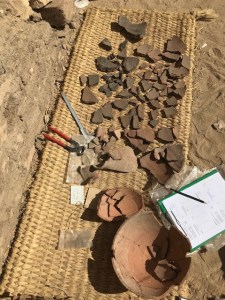
Nicely comparable pottery corpora from the re-use of Theban temple tombs: TT 414 to the left, TT 223 to the right.

The ceramics from South Asasif I am going to be working on in the next weeks provide perfect parallels for our material from the burial monument of Ankh-Hor in northern Asasif and illustrate the heyday of re-using monumental Theban Late Period tombs during the 4th and 3rd centuries BC.

Ankh-Hor in Vienna

I am currently back in my hometown in Vienna, busy with several things, first of all the Ankh-Hor Project and administrative but also scientific tasks related to our latest field season.

I am delighted that I got the chance to write about our work for the blog of the Young Academy here in Vienna – I tried to summarise the rich potential of the Ankh-Hor project, giving some examples of the intriguing use life of the tomb and its diverse users. So much work still to do, so many details to reconstruct and contextualise!

Closing of the 2019 season of the Ankh-Hor project

From Luxor back to Munich – it was not in particular a warm welcome yesterday, arriving at Munich airport with snow showers and much too low temperatures for March! Well, today it is quite sunny and time to resume the last day of work in Asasif.

My last sunrise at TT 414 for 2019…

We successfully closed our tomb magazine and the 2019 season on Sunday – it has been some very intense days full of work and things to organize. Our conservators provided me with a fully illustrated and concise report about the large amount of conservation work conducted in 2019 – in total, 61 objects, in particular coffins, including the five fragmented ones we transported to the magazine, were successfully cleaned and consolidated.

Hassan and Mona were also very productive, resulting in more than 80 drawings of wooden objects, small finds and ceramics. In addition to these drawing, more than 470 objects were photographed by Cajetan with our full-frame camera with very high resolution.

In the final days of work, I took some last photographs of objects, last coffin fragments were cleaned and consolidated. And of course I continued to organize the magazine. Since it always happens on excavations that something new and important turns up at the very last day of work, I was not surprised that I found some new fitting coffin fragments literally in the last minutes of work…. These new fragments are important because they belong to a fascinating, but unfortunately very fragmented coffin we documented earlier this season.

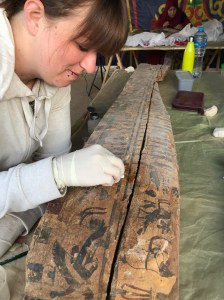
Reg. 661 are fragments of a nicely painted, inner anthropoid wooden coffin which was found as one of the secondary burials within the burial compartment of Ankh-Hor (Room 7.2). For our conservators, these fragments presented one of the biggest challenges this year: The soft wood fragments are partly blackened and burnt due to the looting of TT 414 and the respective damage to the tomb inventories.
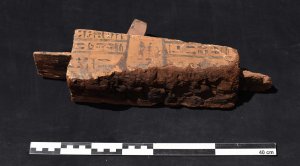
Part of Reg. 661 illustrating the bad condition of this coffin.

The owner of Reg. 661 was a female singer of Amun-Re from Karnak with the name Taremetjbastet. Since we know her family relations very well, we can date her death and burial to between 320 and 300 BCE.

The owner of Reg. 661 belongs to a well-attested family of Amun priests from Karnak buried in TT 414.

Of particular interest is the decoration of the foot part of the coffin – I have published first ideas about Reg. 661 already some years ago (Budka 2013). In the center of the foot board there is a sun disc flanked by a snake and a crocodile – this is nothing else than the opening scene of the Litany of Re, attested for the first time in the famous tomb of Sety I in the Valley of the Kings! To be best of my knowledge, there is only one parallel for this motif on foot boards of private coffins – and this is CG 29316, a stone sarcophagus from the 30th Dynasty (see Budka 2013).

Our wooden coffin Reg. 661 from TT 414 is exemplary for is the complex creation of decorated and inscribed coffins in Thebes during the 4th century BCE – Amun priests were extremely creative in combining various aspects, especially cosmogonic ones, using older texts and depictions and creating new ones, focusing on the resurrection of the deceased in conjunction with Re and Osiris. Still little is known about this fascinating creative work which is embodied in funerary objects like coffins, but also cartonage and canopic boxes – all of which are so plentiful from TT 414.

The lid fragments of Reg. 661 which I re-located in the last minutes of the 2019 season still need to be consolidated in the next season of the Ankh-Hor Project – like many other pieces, in particular of Ptolemaic and Roman coffins. Thus, Reg. 661 with its intriguing decoration nicely illustrates the already successful outcome and the scientific potential of the Ankh-Hor Project – but also the urgent need to continue our jigsaw puzzle reconstructing the complex burial processes in TT 414 and enlightening the intricate design of 30th Dynasty and Ptolemaic wooden Theban coffins.

Reference

Budka, Julia. 2013. Krokodil, Schlange und Kuhantilope: Ein frühptolemäischer Holzsarg aus dem Grab des Anchhor (TT 414), in: Florilegium Aegyptiacum ‒ Eine wissenschaftliche Blütenlese von Schülern und Freunden für Helmut Satzinger zum 75. Geburtstag am 21. Jänner 2013, ed. by Julia Budka, Roman Gundacker and Gabriele Pieke, Göttinger Miszellen Beihefte 14, Göttingen, 41–57.
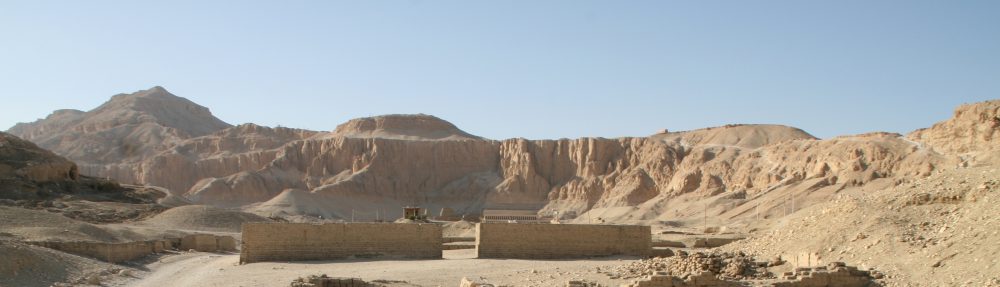
Summary of week 3 of the Ankh-Hor project

The end of our 2019 field season is rapidly approaching – the last team members will be leaving tomorrow, I will have some more days to organize the magazine and for last minute photography.

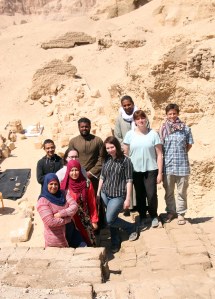
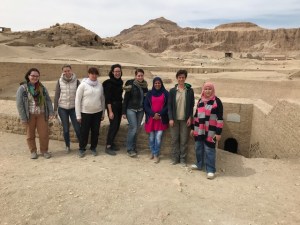
The remaining members of the Ankh-Hor Project team this week.

Like in week 1 and week 2, the main tasks this week were the cleaning and consolidation of Ptolemaic coffins from TT 414. Since most of the group of conservators already left earlier this week, Stefanie and Victoria focused on different pieces, with a large side board of a nicely painted coffin from the shaft of room 10 as one of the highlights.


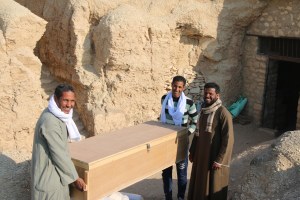
Most importantly, we succeeded in transporting four boxes with five coffins from the tomb of Ankh-Hor to the study magazine here on the West Bank.

This allows me to re-organise our tomb magazine further; urgently needed space for more coffin fragments to be consolidated and studied is now available.

While I documented the newly consolidated coffin fragments with photos, Mona and Hassan were busy drawing pottery fragments and small finds. Hassan documented in particular wooden objects like lids of shrines and fragments of Ptah-Sokar-Osiris statues. Mona was also working on some nice Middle Kingdom pottery – both from Tomb I, the saff tomb functioning as our magazine at the site, and from 12th Dynasty shaft tombs excavated in the 1970s.
The final phase of our 2019 season has already begun, I will be busy writing the report over the weekend and I am much looking forward to the last days of work next week.

Coffin transport accomplished

Week 3 passed by even faster than the first two weeks of our field season. The closing of the 2019 season of the Ankh-Hor Project is already approaching and today we finished one major task thanks to a lot of people involved.

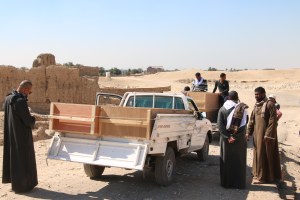
As planned, we transported today four large wooden boxes with five fully documented and consolidated coffins from TT 414 to the magazine of the Ministry here at the West Bank – including Mr. Twt’s coffin and the 26th Dynasty coffin of Iret-her-rw, re-used by Wah-ib-Re in Ptolemaic times. The moving of large sized objects successfully cleaned and studied is urgently necessary in order to have more space in our temporary magazine here in Asasif, in Tomb I.

Although it’s always a bit strange for me to say goodbye to objects we spent so much time with, today’s accomplishment is of course completely positive and nicely illustrates the successful outcome of this season. After all the hard and enthusiastic work by our team of conservators and the hundreds of photos taken for photographic documentation, moving the nicely painted coffins from TT 414 after 45 years of excavation to a proper storage place is very satisfying.

Today, I think most happy of all of us were our workmen Ashraf, Mohammed and Mahmoud – after handling these heavy boxes almost daily during the last 3 weeks, carrying them in and out, in and out again, they were smiling a lot once the boxes were on top of the cars and then gone.

Finally, special thanks go to our inspector Hannan and to all of the local inspectorate for making today’s transport so smooth and easy – much appreciated!

And of course I already have plans for the new space now available in Tomb I – I will be busy with re-arranging things in the next days, there is still so much to do.

The complex history of the Asasif beyond TT 414

Week 3 of the Ankh-Hor Project is well underway. Since the summer term at university back home in Vienna has already started on March 1, we had to say goodbye to several team members: Irina, Cajetan, Magdalena and Jessica have left already, but did a great job within the last two weeks.

Yesterday, I gave a small tour through the tomb of Ankh-Hor, especially for the conservators who joined us for the first time this year – and it’s of course always great to visit TT 414 and to see the diverse find spots of the objects we are currently studying. The team was really impressed as I was of course hoping – the preserved relief decoration within the “Lichthof” was liked especially and the deep shaft leading to Ankh-Hor’s burial chamber got some ‘wows’ as well.

While Stefanie, Victoria and Iman are still busy with consolidating Ptolemaic coffins from TT 414, Hassan started drawing some small finds and here particularly wooden objects.

Mona and I turned to a slightly different task – I was busy with re-organising the ceramics in our magazine, most of which have been already fully documented. Today, I studied the last remaining assemblages dating back to the Middle Kingdom which are now getting drawn by Mona. Of course this pottery does not come from the tomb of Ankh-Hor, but from earlier shaft tombs excavated by the Austrian mission in the late 1960s.

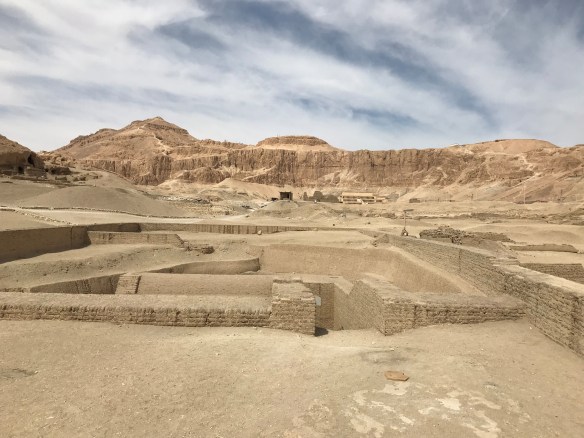
The earliest remains in the Austrian concession area date to the 11th Dynasty and include the causeway of Mentuhotep Nebhepetre to the beautiful temple of this king at Deir el-Bahari and contemporaneous non-royal tombs. Tombs of high officials of the 11th and 12th Dynasties were dug into the rock along the royal causeway as well as into the cliffs of Deir el-Bahari. The types of rock-cut tombs found in the Asasif are Middle Kingdom saff tombs and also shaft tombs. The former type is nicely illustrated by the large Tomb I that functions as the magazine for all the finds we are currently working on.

As much as I really like the large jigsaw puzzle with all of the broken coffins from TT 414, it was quite a pleasant change (also for my identity as ceramic expert ;-)) to return today to an earlier period, in particular to the late 12th Dynasty and the occupation of one of the large shaft tombs. Especially because I found a lot of joining pieces and could reconstruct complete profiles of pottery vessels after searching for a while. These important ceramics are mostly large bowls and beer bottles, typical burial pottery of that time – they are highly relevant for the early period of use of the Asasif necropolis, 1200 years before the Late Period monumental temple tombs like TT 414 of Ankh-Hor were erected.

Summary of week 2 of the Ankh-Hor Project

Another week of our 2019 season just ended – and was altogether again very successful.

The main tasks this week were the cleaning and consolidation of Ptolemaic coffins from TT 414. Our group of conservators was busy with both black-yellow-red outer anthropoid Ptolemaic coffins like the one of Twt and nicely multi-coloured painted coffins like the one of Iret-Hor dating to the 26th Dynasty.

Re-organising the magazine is also well in progress; I am currently sorting the large number of coffins which are still in urgent need of consolidation according to priorities.

Photographing objects and in particular the consolidated coffins and coffin fragments also continued and required some sportive activity as well as creative solutions regarding the photo-set up by Cajetan.

Thanks to Mona and Hassan, a number of both Late Period and Ptolemaic pottery vessels from TT 414 was successfully drawn, nicely rounding up our concise study of all objects from all periods of use of the tomb of Ankh-Hor.

Last but definitely not least, many thanks go to Mohammed, Mahmoud and Ashraf – without our workmen the work which requires handling and carrying large boxes and heavy wooden pieces would not be possible.


I am, as always, very grateful to all team members and looking much forward to week 3 starting on Saturday, now wishing a nice weekend to everybody – here in Egypt and beyond!