Depictions of pairs of jackals on wooden coffins from TT 414

When you photograph numerous fragments of coffins every day and hold them in your hand, your eye for small details becomes sharper. One example for this is a small observation I made over the last days, and which I would like to share. It concerns the execution of individual motifs within designs arranged symmetrically along a central axis on Ptolemaic coffins from TT 414. More specifically, I am talking about pairs of jackals and the way they are represented on the same coffin. Three examples out of a larger set of coffins will hopefully illustrate why I am intrigued by these figures.

In general, two jackals, arranged symmetrically on various pieces of ancient Egyptian funerary art, are very common motifs, especially as guardian figures on coffins but also on stelae. In Thebes, the typical design of the coffin lid on the upper surface of the feet during the Late Period and Ptolemaic times shows two jackal-shaped Wep-wawet deities recumbent on a shrine on each side. The jackals commonly have a scepter between their paws and a flail above their back.

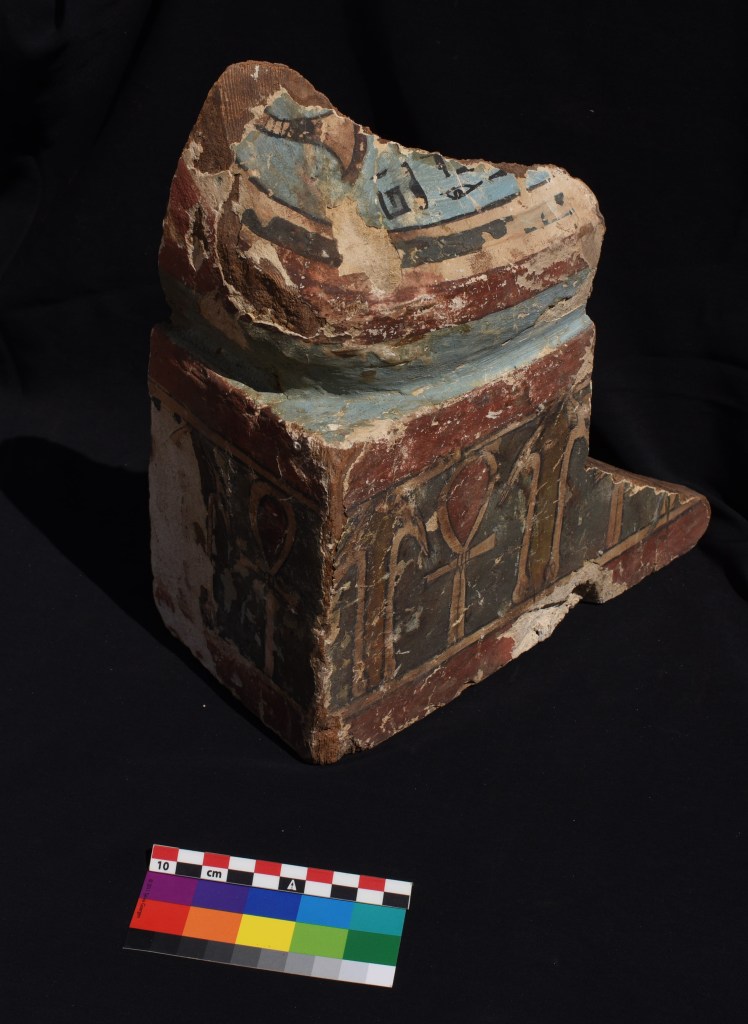
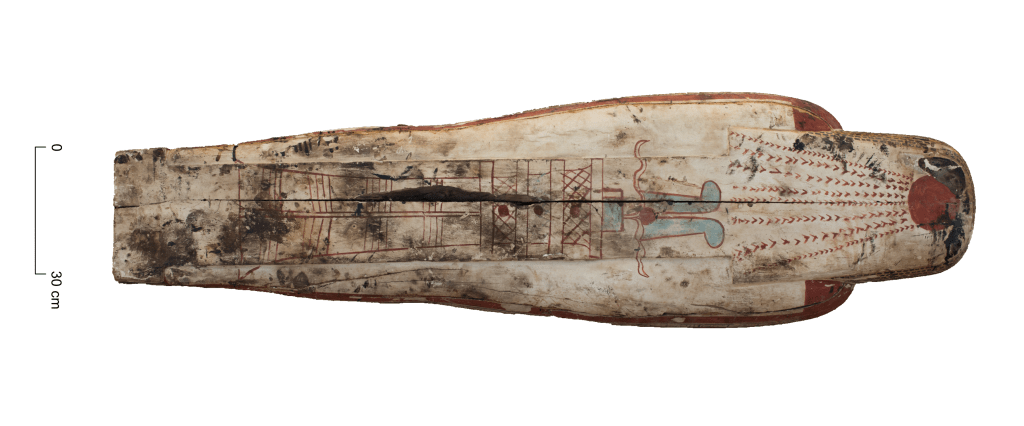
Let’s now have a look at my examples from TT 414. K07/125 is the lid of the top part of the feet of a Ptolemaic coffin. The pair of recumbent jackals flank a central vertical line of text which mentions Wep-wawet. The shrines of the jackals are not preserved, but above the jackal figures on each side are five uraei with sun discs on their head – representing the toes of the deceased.

The jackals themselves are depicted very differently – in particular the shape of the heads and snouts as well as the size and shape of the visible eye are very different. That this is not a unique feature becomes obvious when we look at two other examples. Two fragments of two qrsw-type coffins show pairs of jackals in a similar arrangement – in one case recumbent, in the other sitting – flanking the central sun disc and vertical text line, very similar to the design of stelae.
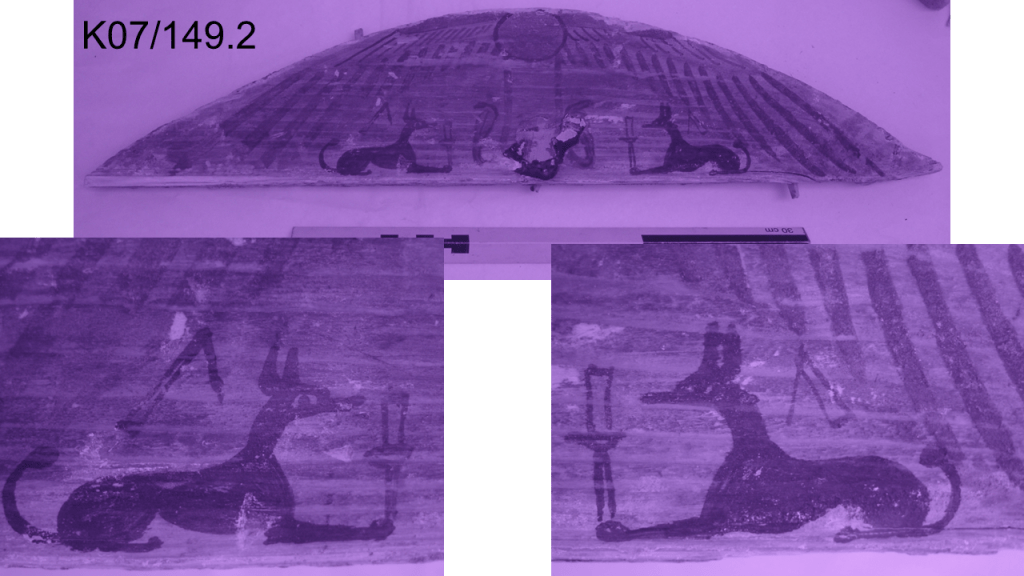
The figures I have compose illustrate how different the jackals are on the left sides to the one on the right sides. It’s mostly again differences regarding the shape of the head, snout and eye, but on K07/149 the right jackal also shows a much stockier body. If I would show you the pictures isolated – would you have guessed that it comes from the same object? This piece also shows small differences in the execution of the uraei and the space arrangement of the scenes differ slightly.

How can we explain these differences? It seems rather unlikely that different painters were involved in these minor motifs but of course this is a possibility. Perhaps there was a lot of freedom in how exactly standard motifs had to be executed on coffins during Ptolemaic times, perhaps not much accuracy was given to small details but rather to the complete design of coffins. Or could the deviations also be related to simply “natural” differences that depend on the direction of painting (animals facing to the right or to the left)?

Be it as it might, the pairs of jackals on coffins from TT 414 illustrate the complexity of coffin design in Ptolemaic Thebes and that a symmetrically arranged motif is executed in anything but the same way. This makes the study of these objects such a fascinating task.

First exciting news in Week 1

We successfully opened the 2023 season of the LMU Ankh-Hor project earlier this week. Although we only had three working days in Week 1, we made great progress with our prime working tasks. Ashraf and Hassan cleaned the area and many boxes with objects from the tomb of Ankh-Hor (TT 414), Mohammed and Karima consolidated already 20 pieces of painted coffins.

One particular challenge for Mohammed was a fragment of a 26th Dynasty qrsw-coffin (a coffin in the shape of a shrine with vaulted lid and corner posts). This piece (Fig. 1) was reused as building material in the Lichthof of TT 414 in the later reconstruction phase of this part of the tomb during the 30th Dynasty. The builders in the 4th century BCE used mainly mud bricks and wood – and for the latter, plenty of broken 26th Dynasty coffins were available as suitable building material (especially as architraves).

Fig. 1: The consolidated fragment of a qrsw-coffin from TT 414.

Thus, although the original object Mohammed consolidated is in a very pure condition and we cannot identify its owner, the piece tells us a lot about the life history of TT 414.

I was busy in the last days sorting the coffin fragments according to priorities for consolidation and cleaning. Several of them are still not assignable – find labels are missing and the texts are not readable. Some of the fragments we are dealing with were never registered before and require full documentation. For the unclear pieces because they are not readable, I take infrared photos and try to identify the objects back home with the help of the database. We are using this technique since 2021 and have wonderful results – for most of the painted coffins with stains on the surface or darkened surfaces, the original decoration becomes visible again.

I had a particularly successful experience yesterday: A piece whose inscriptions I could not read until yesterday suddenly became clear (Fig. 2). Based on the texts (especially the name of its owner), it was an easy task to identify the coffin fragment as Reg. 762. It also turned out that this coffin was actually much nicer decorated than a first glance of the darkened surface would indicate.

Fig. 2: Reg. 762 – working photo and detail with infrared photo. Note the difference infrared photography makes in tracing the original decoration of this piece.

Furthermore, and this shows the enormous potential of infrared photography for the LMU Ankh-Hor project, more genealogical data became available for the owner of this coffin. Back in the 1970s, the names of the parents were not readable. But now they are! And it seems as if we have another, previously unknown family member of the famous Hor and Kalutj/Nes-Khonsu family! But this is so exciting that I have to ask all of you for a little patience – there will be a separate blog post about this (soon insha’allah).

Successful start of the 2023 season

Today was the opening day of our 2023 season of the LMU Ankh-Hor Project. All went very smooth, thanks to the great colleagues in the inspectorate in Luxor and on the west bank and first of all our wonderful inspector Mahmoud Sayed. We are currently a small team, but more team members will arrive next week. This year’s focus will be on conservation and documentation of wooden painted coffins and cartonnage cases from TT 414, the tomb of Ankh-Hor.

All set up for work in the Asasif – our conservation tent early in the morning.

Like in the last years, we have again a very comfortable, spacious conservation tent set up as well as smaller tents for documentation and drawing of objects. All working steps are by now already routine – I started sorting Late Period and Ptolemaic coffins according to priorities and took first photos of selected pieces.

I am very happy that our two Egyptian conservators, Mohammed Mahmoud and Karima, started their work already today. Both are experts for wood and have an extensive working experience here in Thebes but also at other sites in Egypt. Mohammed has worked with us already in 2021 and is thus very familiar with the material from TT 414.

Mohammed set up the working spaces and continued seamlessly with his conservation work from 2021.
Karima is joing us for the first time and had a great first day like all of us!

Today, already several fragmented Ptolemaic coffins were successfully cleaned and consolidated – a wonderful start and a very nice outlook for the next weeks!

Presenting the Ankh-Hor Project at the ICE 2023 in Leiden

It has been a wonderful week so far – more than 800 Egyptologists are gathering for the 13th International Congress of Egyptologists in the beautiful city of Leiden! Many congrats to the organizers for a fantastic job – there are multiple sessions and several workshops as well as outreach lectures and receptions. Recent finds and results from the field are presented as well as crucial questions addressed and innovative methods and theories discussed.

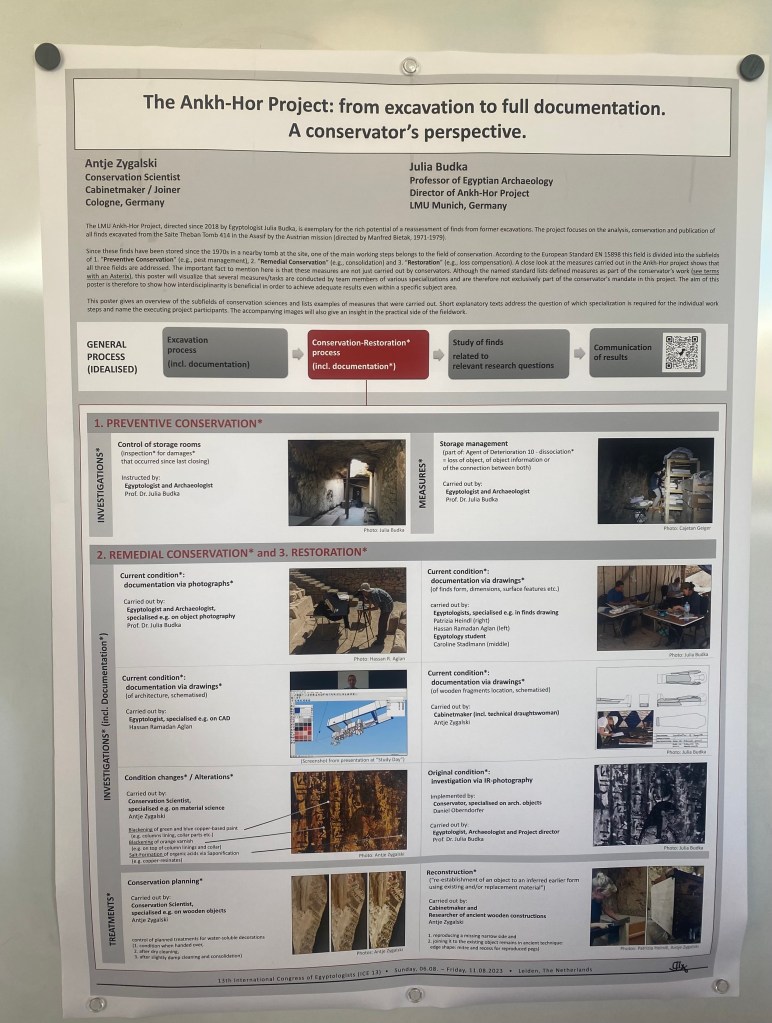
Today is the day for the poster presentations. I am very happy that Antje Zygalski prepared a poster about the Ankh-Hor Project: “From excavation to full documentation. A conservator’s perspective” aims to show the benefit of interdisciplinary approaches in the field, of bringing together various fields of expertise and different skills in the overall workflow.

Our poster is exhibited in the P.J. Veth Building and will be accessible until the end of the congress.

For those of you who are in Leiden – we will be presenting the poster this afternoon and are looking much forward to any questions or feedback.

Presenting the Ankh-Hor project in Munich

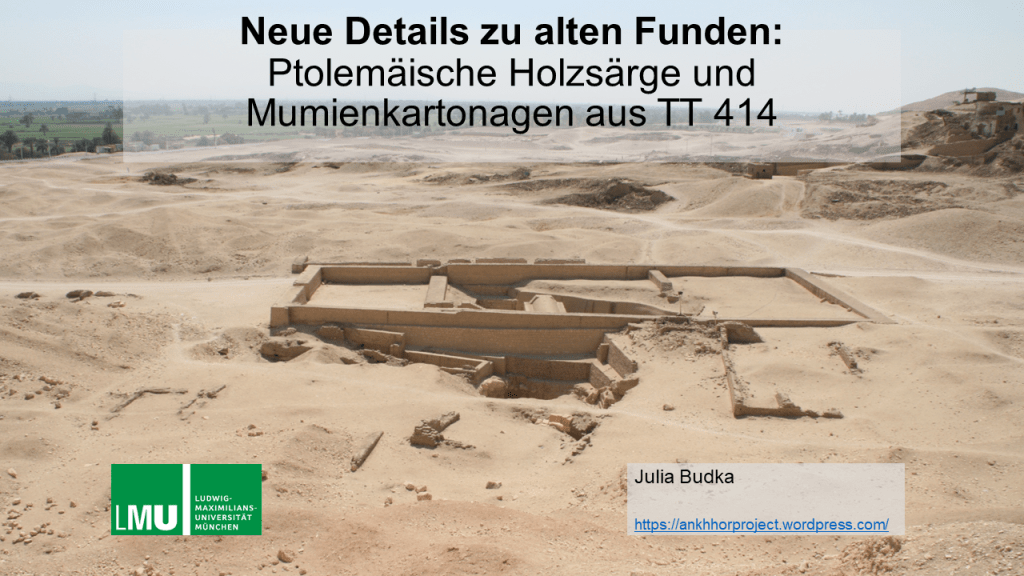
It is a great pleasure to have been invited by the Collegium Aegyptium, the friends of the Institute of Egyptology and Coptology at LMU Munich to give a lecture about my Ankh-Hor Project.

My talk later today will be in German and focuses on the questions of Ptolemaic wooden coffins and cartonnage fragments from TT 414.

It is the first time that I present some preliminary remarks on the cartonnage cases from the tomb of Ankh-Hor. There is evidence for various types of cartonnages from the 30th Dynasty well into the Ptolemaic era. I will discuss some of the results from the 2022 season.

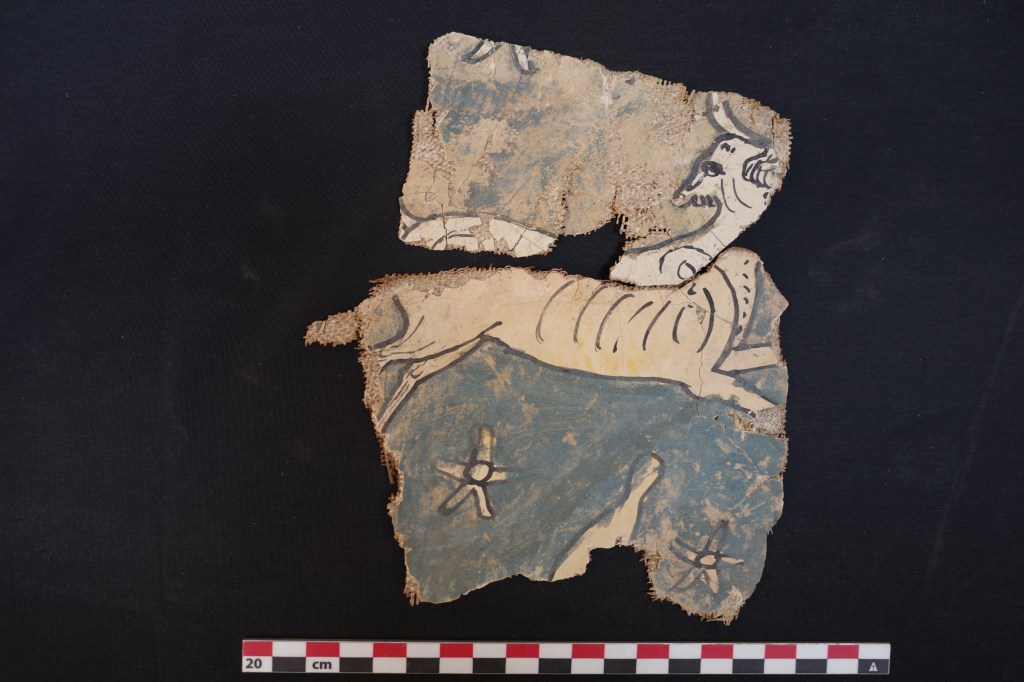
One particularly interesting topic, that I will briefly mention today in my lecture is the appearance of zodiac representations on the interior of lids of cartonnage coffins.

Interior decoration of the lid of a cartonnage coffin from TT 414 with the Taurus zodiac sign.

The recent publication by Daniela Mendel (2022) is an excellent collection and comparison of representations of astronomical ceilings and zodiacs in Ptolemaic and Roman temples, coffins and sarcophagi as well as tombs. Due to the poor state of publication on Ptolemaic cartonnage coffins from Thebes, there is no reference in the book to cartonnage examples of zodiac representations. It is well known that the wooden coffins of the famous Soter family from Thebes include representations of the sky with zodiac – but as the material from TT 414 shows, there were already examples well before the Roman era.

There is still so much work and research to be done – and hopefully we will be back in Luxor for the 2023 season of the Ankh-Hor Project soon. For now, I am very much looking forward to tonight’s lecture and hope for some constructive feedback and questions.

Reference

Mendel, D. 2022. Die Geographie des Himmels: eine Untersuchung zu den Deckendekorationen in ägyptischen Tempeln der griechisch-römischen Zeit und zeitgleichen Darstellungen auf Särgen und in Gräbern. 3 vols. Studien zur spätägyptischen Religion 37. Wiesbaden: Harrassowitz

A short summary of the 2022 season

Winter has finally arrived in Germany and being back on the desk and in the classrooms at LMU, it is especially nice to reflect a bit on our 2022 season of the Ankh-Hor project in sunny Luxor. It was an extremely pleasant and productive season, and I am grateful to all team members!

The major goal of the 2022 season was to continue the cleaning, consolidation, and documentation of the large number of objects excavated from TT 414, the monumental tomb of Ankh-Hor, High Steward of the Divine Adoratrice Nitocris (26th Dynasty), by the Austrian mission directed by Manfred Bietak. The focus was on wooden coffins and cartonnage elements from TT 414 and included both Late Period pieces and Ptolemaic ones. Work was conducted from September 27 to October 27, 2021 (with our amazing SCA Inspector, Saad Kenawy Mohamed).

The detailed documentation of objects from TT 414 resulted, thanks to the great efforts of Hassan, Saad and Patrizia, in a total of 147 drawings during the 2022 season, comprising wooden objects, stamped mud bricks (deriving not from TT 414), shabtis and pottery.

Fig. 1: Saad, Patrizia and Hassan were a great and very effective drawing team (photo: J. Budka).

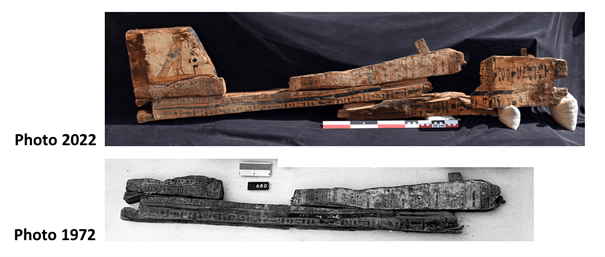
Much progress was also made in assigning previously not identified pieces of painted wooden coffins to specific coffins documented by the Austrian mission in the 1970s. One important example is Reg. 680 for which four new matching pieces were found. However, for this important coffin of the founder of the 30th Dynasty reuse of TT 414, Pa-di-Amun-neb-nesut-tawy I, there are still two missing pieces from the left side of the coffin and its foot part which were documented in the 1970s. Fig. 2 shows the comparison between the status of the right side of the upper part of the coffin in 1972 and in 2022 with three matching fragments. This coffin is thus a good example for the challenges in our work – there are still missing pieces for important coffins and the identification of all fragments is not yet fully accomplished.

Fig. 2: Comparison of part of coffin Reg. No. 680 between status in 1972 and 2022 – note three new matching pieces to the right side of the lid.

Many painted wooden coffin fragments were cleaned and consolidated in the 2022 season by our conservators Antje Zygalski and Noura Mustafa El-Taher. Noura did an amazing job in reconstructing free standing elements of coffins in the shape of djed-pillars and Isis-symbols.

Fig. 3: Noura working on the fragments of djed-pillars and Isis-symbols. She managed to reconstruct several pieces out of broken fragments (photo: J. Budka).
Fig. 4: Some examples of the newly reconstructed Isis-symbols (photo: J. Budka).

The best example that we were able to identify new owners of coffins during the 2022 is Reg. No. 689, found in the debris in the burial chamber of Ankh-Hor. The lady Takerheb is now confirmed as the owner of this piece.

During the 2022 season, also some new names of persons buried in TT 414 were identified. For the 26th Dynasty, a possible new female relative of Ankh-Hor was recorded. The fragment of a new anthropoid coffin, K07/243, gives the name Ta-dj-Iset (a common name in the 25th and 26th Dynasties), previously unknown from TT 414. Since there are several Pa-di-Iset attested in Ankh-Hor family, this new female might extend the family tree – for more information, I will need to identify matching pieces to this newly recorded coffin fragment.

In addition to the stylistic assessment of the cartonnages from TT 414, much progress was done this season in identifying the owners of these trappings. Thanks to infrared photography, some names and titles became readable and allow to attribute cartonnage elements to Ptolemaic individuals already known from other objects, for example a new cartonnage element is attested for G 148, Ta-sherit-Khonsw, with K08/85.

One particular important identification of a new cartonnage element is the one for Twt, an individual otherwise only attested by his outer anthropoid coffin in yellow-red on black-style (Reg. No. 510). This also offers us the possibility to compare the motifs and styles on coffins and cartonnages.

New coffins were also assigned to known persons buried in TT 414. As one example, the inner anthropoid coffin fragment of Imhotep (G 16) was identified with Reg. No. 19/04 and is now a new addition to his set of coffins with an outer coffin in black-yellow style, Reg. No. 759.

Fig. 5: Foot part of the inner coffin of Imhotep, already documented in 2019, but now newly assigned to its owner (photo: C. Geiger, ©Ankh-Hor Project).

To conclude, several new observations on the material from TT 414 are possible as direct results of the 2022 season, in particular in three main thematic fields, first of all because of the extended application of infrared photography: 1) genealogical information and new coffin owners, 2) additions to existing tomb groups as well as 3) a better understanding of the coffin design and the main motifs, also in relation to cartonnage elements.

Despite of all this progress, large amounts of fragments of coffins and cartonnage from the Late Period to Ptolemaic and also Roman times remain to be cleaned, are partly in need of reconstruction and of full documentation. Our work therefore needs to be continued in the next season. Our 2022 results hopefully show that these efforts are immensely worthwhile.

Week 3 of field season 2022: a short update

We have just completed week 3 of our field season 2022. We managed to make good progress on many of our work tasks. I had to go back to Germany for other important tasks, but thanks to Patrizia, Hassan and Ashraf as well as the support from the local authorities, the remote supervision from Munich is really easy.

Most importantly, Patrizia arrived last weekend and started her work in week 3 which focuses this year on drawing special objects like stamped bricks and unclear painted mud fragments.

Patrizia and Hassan busy drawing various kinds of small finds.

Strengthened by Hassan Ramadan and our inspector Saad Knawy, the drawing team of this season is extremely effective and covers all categories of small finds – from ceramics to mud shabtis, faience shabtis, wooden statues and boxes as well as a few selected coffin fragments.

Our inspector Saad is making great progress in drawing small finds (photo: P. Heindl).

The conservation team continued its work – Antje Zygalski focused on the reconstruction of a Middle Kingdom rectangular coffin which was found in one of the shaft tombs in the Austrian concession while Noura was busy cleaning Ptolemaic coffin fragments from TT 414.

Antje working on the Middle Kingdom coffin (photo: P. Heindl).
Our Egyptian colleague Noura cleaning Ptolemaic coffin fragments (photo: P. Heindl).

I managed to complete the documentation of the most important boxes with cartonnage fragments – there are already some exciting new data gained from this which I will share in a separate blog post. Much progress was also made in documenting Ptolemaic wooden coffins by photography. It was already highlighted that one of my most favourite coffins from TT 414, Reg. No. 657, is adding fresh ideas about the tomb group of Isetemkheb and the family of Wahibre I.

The conservation, cleaning, photography and drawing of the rich material from the tomb of Ankh-Hor in the 2022 season has already provided very interesting results – and we have two more weeks to go, so stay tuned for more exciting news!

New dissemination article about our 2021 season

I am delighted that a new dissemination article was just published about our first field season since the covid 19-pandemic. I stressed in particular the advances due to infrared photography and the continuation of our conservation programme. The material from TT 414, and here especially the large corpus of painted coffins, has so much potential to answer various open questions about Late Period and Ptolemaic funerary archaeology in Thebes. In particular, the rich coffin material as well as cartonnages, canopic boxes, shrines, hypocephali and other elements of the tomb groups illustrate key aspects of Late Egyptian religious iconography which continues to fascinate me, and which will keep us busy during postprocessing the large amount of new data from the 2021 season.

The rich material from TT 414 in Asasif is still far from being processed in its totality.

Reference

Julia Budka 2021. Back to Egypt: The 2021 season of the Ankh-Hor Project in Luxor. The Project Repository journal 11. Oct. 2021, 8-11https://www.europeandissemination.eu/project-repository-journal-volume-11-october-2021/17509 https://doi.org/10.54050/PRJ1117674

Closing of the 2021 season

Times flies by – we worked in the Asasif from September 16 to October 14, 2021, closed the mission last Thursday and are now back in Germany and Austria.

All set for the transport of our boxes with coffins to the study magazine!

As one of the highlights of the 2021 season, the transport of three fragmented coffins from TT 414 to the study magazine on the West Bank was realized on October 13. These are two early Ptolemaic coffins and one 26th Dynasty coffin, all of them lower parts of wooden anthropoid ones. All three were fully consolidated and documented during our mission.

Three lower parts of coffins from TT 414 and a box with fragmentary statues, shrines, stelae and coffin boards was transported to the study magazine.

Each of these coffins shows very special features – I especially like the base of Reg. No. 656, owned by the temple singer Aset-em-Akhbit III. The back pillar of her coffin is decorated with a Djed-pillar and a sun disc.

The colourful base with the back pillar of Reg. No. 656.

Although the composition as a whole is appealing, the individual strokes and proportions, especially of the ram horns below the feather crown, show signs of a very quick execution. Since several family members of Aset-em-Akhbit III were buried in TT 414 and are also attested by wooden coffins, we will compare the style of coffin painting on Reg. No. 656 with contemporaneous coffins. Tracing specific Ptolemaic coffin workshops based on the material from TT 414 is one of the future goals of the project.

Much material and many new data were collected in the last weeks and will keep us busy post-processing the very successful 2021 season!

Finally: preparing the 2021 season

After a long break because of the pandemic, it is finally happening again: we are preparing our next season for the Ankh-Hor project in Luxor, Asasif. Because of the covid-19 crisis, the season will be a bit shorter and the team smaller than originally envisaged – nevertheless I am very excited and happy to soon be back in Egypt! We will start by mid-September for four weeks. I also plan to join the South Asasif conservation project and document the new ceramics the team found this year and in 2020.

For the Ankh-Hor project, the goals of the 2021 season are to continue what was sucessfully started in the 2019 season: the large-scale conservation programme and our detailed documentation of finds from the tomb of Ankh-Hor (TT 414). A fresh team of young conservators, both students and graduates from the University of Applied Arts in Vienna, will join us for the consolidation work. This season, we will focus besides the wooden coffin fragments also on a large number of cartonnage pieces of which many are still unregistered.

These fragments, covering a large time span and showing various styles and colouring schemes, will potentially reveal important prosopographic information on the persons buried in TT 414 starting from the 4th century BCE. My hope is that we can find new evidence on such cartonnage cases for the names of fathers or mothers of persons holding the same name (and sometimes the same titles) to identify specific individuals. There is no doubt that this will be again a challenging jigsaw puzzle and of course we will keep you updated about the process and the results.