Mid-season update from the field

It’s gone by in the blink of an eye – we’ve already reached the mid-season point after two weeks of work in the Asasif. We’ve been super busy with wooden and cartonnage coffins from TT 414, both from the 26th Dynasty and the Ptolemaic period.

Ladina did a great job of documenting a really interesting wooden shrine coffin – the complete cornice of which has survived, allowing us to reconstruct its dimensions. This piece offers much to discover! We can highlight details of the woodworking, such as markings for dowel holes. Ladina has therefore also produced detailed pencil drawings of the individual elements.

Ladina busy drawing one of the beautifully carved peices of a wooden shrine coffin.

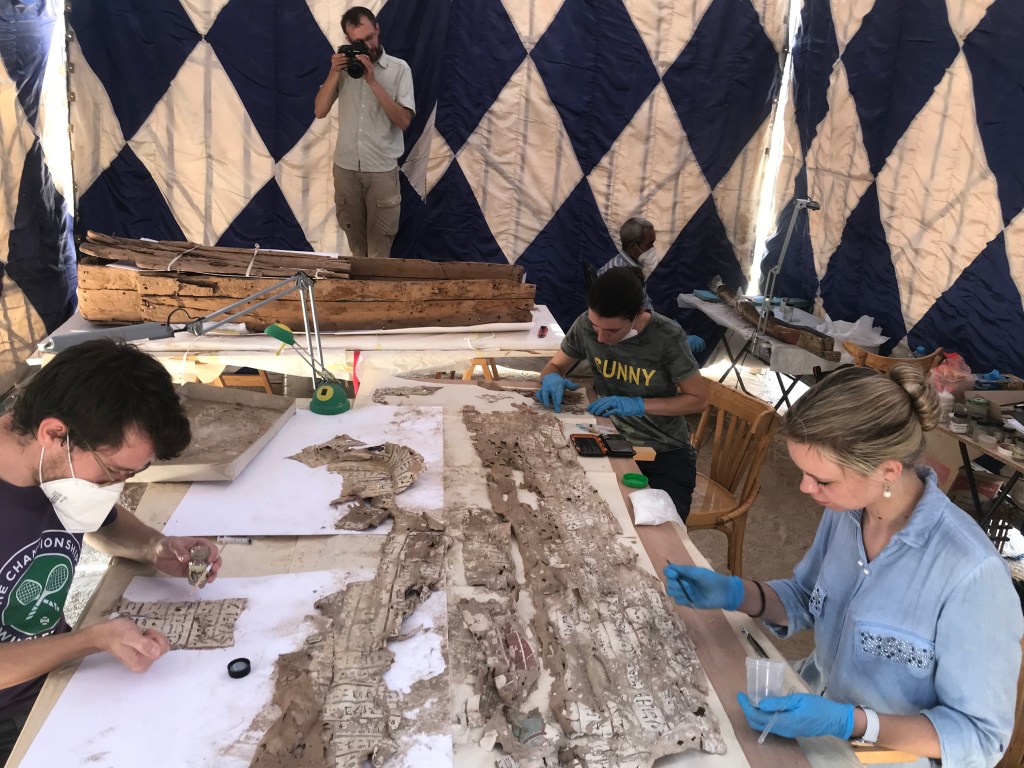
Mohamed Mahmoud and Iman Ibrahim Zaghlol, our conservators, did a great job over the last two weeks, cleaning and consolidating a large number of fragments.

Iman working on a 26th Dynasty fragment.

Mohamed’s work on fragile cartonnage pieces is really something else. He’s done some amazing stuff here, transforming broken and fragile pieces into stable objects again.
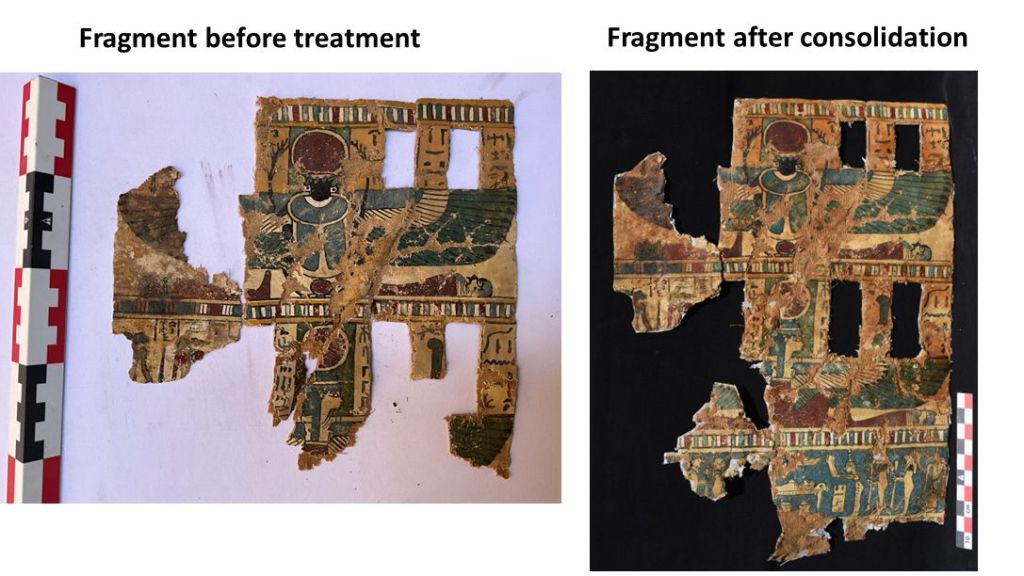
The fragment here shows that we’ve also got ‘openwork’ cartonnage coffins like the famous one by the Ptolemaic Theban priest Djed-Hor, which is now in the Leiden Museum and was recently published in a great new book by Maarten Raven (Raven 2025).

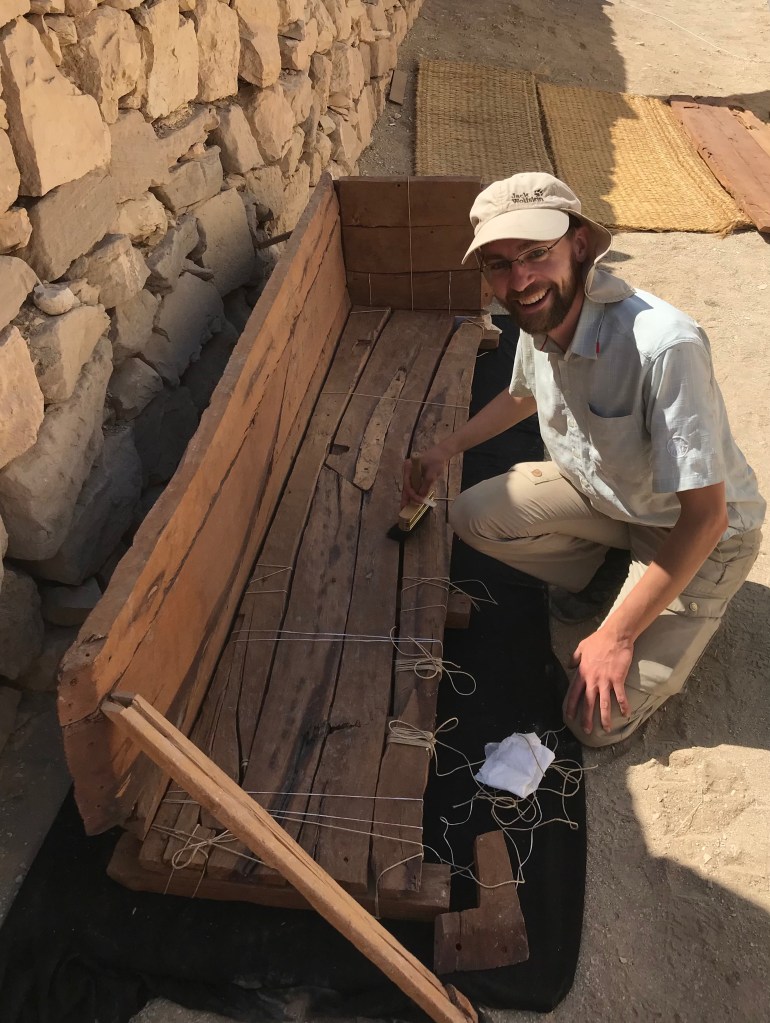
This piece from TT 414 and the cartonnage of Djed-Hor show that this type of cartonnage only covered the front and sides of the mummy. However, we also found bivalve cartonnage coffins from TT 414 in the last few seasons (check out last year’s reconstruction of the lower part of the cartonnage coffin Reg. No. 08/05). I’ve been working on these this week, trying to find joints between lower parts and upper parts of pieces that are similar stylistically.

This is me working on one of the beautifully painted bivalve cartonnage coffins from TT 414.

Hassan Aglan, who got here earlier this week, has a special task to finish up on in the next few days. He started documenting infant coffins from Tomb VII in the Austrian concession in great detail. This is a small family tomb used by a Kushite family (see Budka 2010 with references). The Austrian mission directed by Manfred Bietak found several burials in situ, including three infants. We’re currently photographing and scanning the coffins and human remains. As tragic as the children’s early passing must have been for their family, these burials are of significant importance. They are securely dated to the 25th Dynasty, so we’re doing everything we can to meticulously document them.

This is one of the infant coffins from Tomb VII. It’s still not cleaned and in poor condition (here with Ladina happy in the background) (photo: Hassan Aglan).

There’s loads of work waiting for us, starting with tomorrow and the start of week 3! But with all these great new advances, I’m really looking forward to getting back to the site.

References

Budka 2010 = J. Budka, Bestattungsbrauchtum und Friedhofsstruktur im Asasif. Eine Untersuchung der spätzeitlichen Befunde anhand der Ergebnisse der österreichischen Ausgrabungen in den Jahren 1969-1977, Untersuchungen der Zweigstelle Kairo des Österreichischen Archäologischen Institutes 34, Vienna 2010.

Raven 2025 = M. J. Raven, The Lost Mummy of Djedhor. Reconstructing the burial of a Ptolemaic priest from Thebes, Leiden 2025.
Summary of week 3: more than TT 414

A very busy and successful week just came to an end – more team members have left today, and we will finish off the 2021 season in a small group with one more week to go!

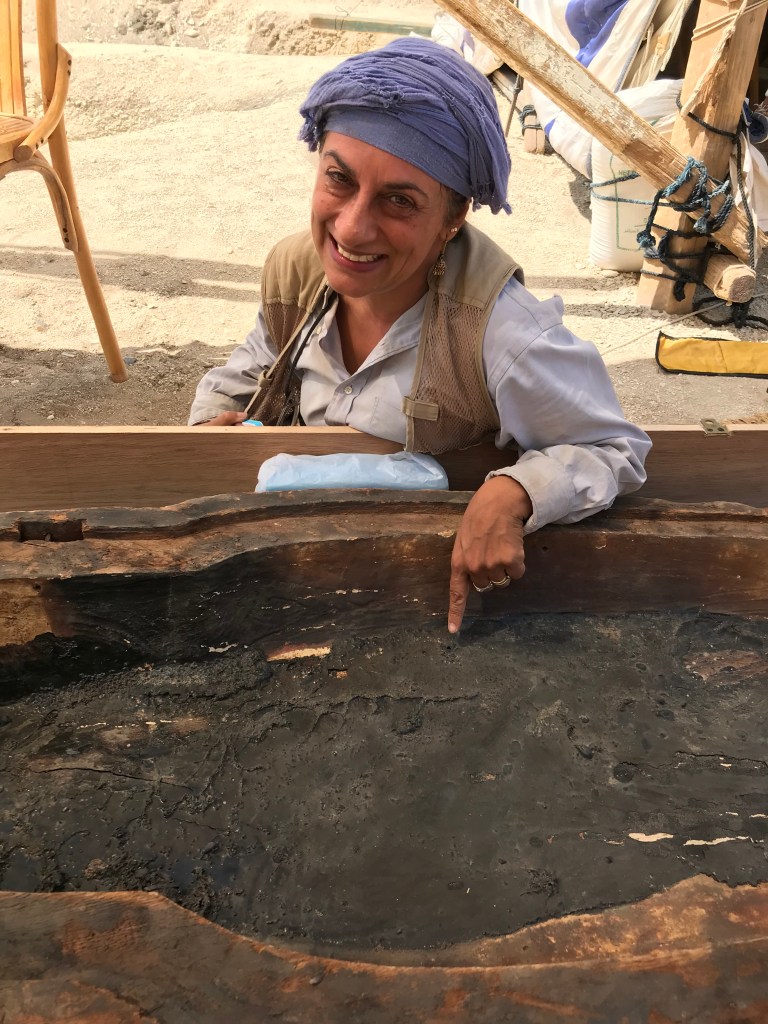
We started into the week with a very pleasant and productive visit by my dear friend and colleague Salima Ikram. We have been working together on some embalming deposits this season for the South Asasif Conservation Project. Salima kindly passed by to have a look at the black goo – bitumen and resin – in the interiors of our coffins from TT 414. One lower part of an anthropoid Ptolemaic coffin was particularly interesting.

Salima and our “beetle coffin”.

A number of beetles were stuck into the resin/bitumen – did they enter the coffin together with the mummy? According to Salima, these are darkling beetles, Pimelia nilotica in Egypt. Since these feed on animal (and human) tissue, it is indeed likely that they entered the coffin when the mummy was put there, presumably before the funerary ceremony when the pouring of the black goo took place. However, many questions are still open, and we cannot exclude a reuse of this coffin and a more complex story behind the “coffin beetles”. This is even more true since we documented smaller fragments of lower bases of coffins with similar findings – less well preserved, but also with clear remains of beetles stuck to the resin in the coffin.

The focus of this week was preparing the coffins and other objects which we will transport to the study magazine of the Egyptian authorities next week. Here, one particular challenging piece is the once beautiful 26th Dynasty coffin of Psammetik-men-em-Waset, Reg. No. 591. He bears the same name like one of the brothers of Ankh-Hor, but belongs to the family of Nes-Menw which is closely related to the family of Ankh-Hor. Maybe the owner of our coffin was the grand-nephew of Ankh-Hor, making his coffin set of an inner anthropoid coffin and a qrsw-coffin extremely relevant for understanding late 26th Dynasty tomb groups. The piece we are currently working on is an anthropoid wooden coffin with a layer of linen which was painted in white and decorated with texts in blue and green. Unfortunately, the linen was almost completely detached from the wood and the painted layer has suffered much in the last decades in the provisional storage place.

Our team of conservators is still busy with consolidating this important piece from TT 414.
Many challenges in the conservation tent: the painted linen/cartonnage of the 26th Dynasty coffin in the front, the undecorated 25th Dynasty Kushite coffin in the back.

However, this week was also occupied with documentation work of coffins which were not found in TT 414 and are dating to other periods than the 26th Dynasty to Ptolemaic times. One of them was a poorly preserved 25th Dynasty wooden coffin of an anonymous Kushite lady found in Tomb VII – one of the most important findings within the Austrian concession with intact burials of Kushites (for details see one of my earlier articles). The coffin fully consolidated this season was found in burial chamber 3 together with three infant coffins and one painted and inscribed coffin of a Kushite male with the name Irw.

In situ situation in Tomb VII of the Austrian concession with a pile of Kushite coffins (after Budka 2007), including the one of an anonymous female consolidated this year.

Another important find from the Austrian mission was made in 1971 in one of the Middle Kingdom shaft tombs in the bed of the causeway of Thutmose III. It is a complete, undecorated Middle Kingdom rectangular coffin which was a big challenge to photograph. Cajetan managed to put the piece together and assembled the coffin box with the help of some external supports for photography.

Last, but not least, several new joints to Ptolemaic coffins from TT 414 were made this week based on new infrared photography. One of my favourite pieces belongs to a woman with the name of Mutirdis – we knew already some fragments of her lid and side boards, but I managed to identify three additional pieces from the pedestal and foot part. Like it is the case for several other Ptolemaic pieces, reconstructing this beautifully decorated coffin will clearly take another season but is full of potential!

One of the newly identifed pieces of a Polemaic coffin of Mutirdis.

For now, I am very happy and thankful to all the team and looking forward to our last week which will focus on consolidation work and reorganising the space within the provisional magazine.