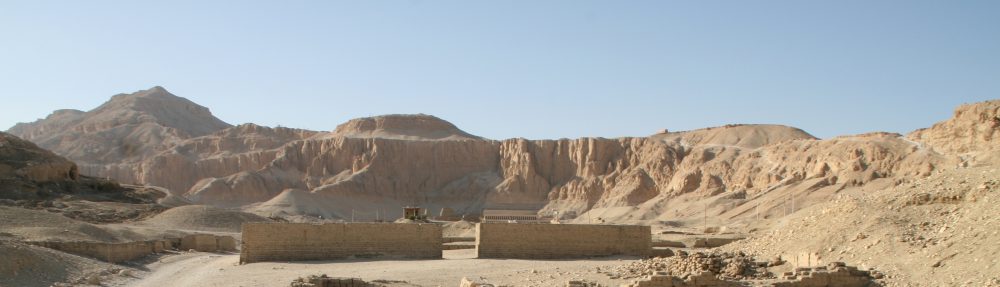
Work progress on the coffins of TT 414

Week 3 has just started and Ladina and Hassan are busy with documenting 30th Dynasty/early Ptolemaic coffins from the tomb of Ankh-Hor (TT 414), while Karima and Mohamed continue with some later Ptolemaic painted fragments.

Ashraf, Hassan and Ladina are busy sorting, cleaning and documenting coffin fragments.

Week 2 brought a lot of progress; I was able to make numerous joints of small fragments to known, registered pieces. My focus was on Ptolemaic coffins around the family of Wesjr-wer – and here, in addition to the painted wooden coffins, also on the cartonnage coffins. A real challenge are both wooden and cartonnage coffins, where the text fields have unfortunately remained empty, so we have no information about the owners.
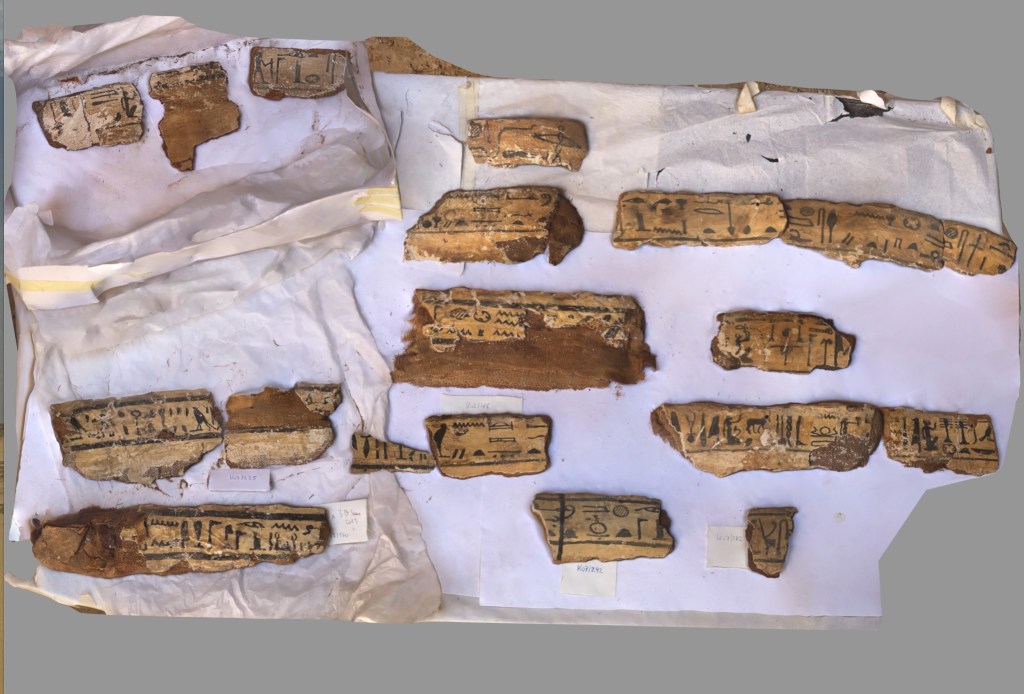
The white painted with black text outer surfaces of the lower parts of bivalve cartonnage coffins are still a big puzzle – but I have already found many joints!

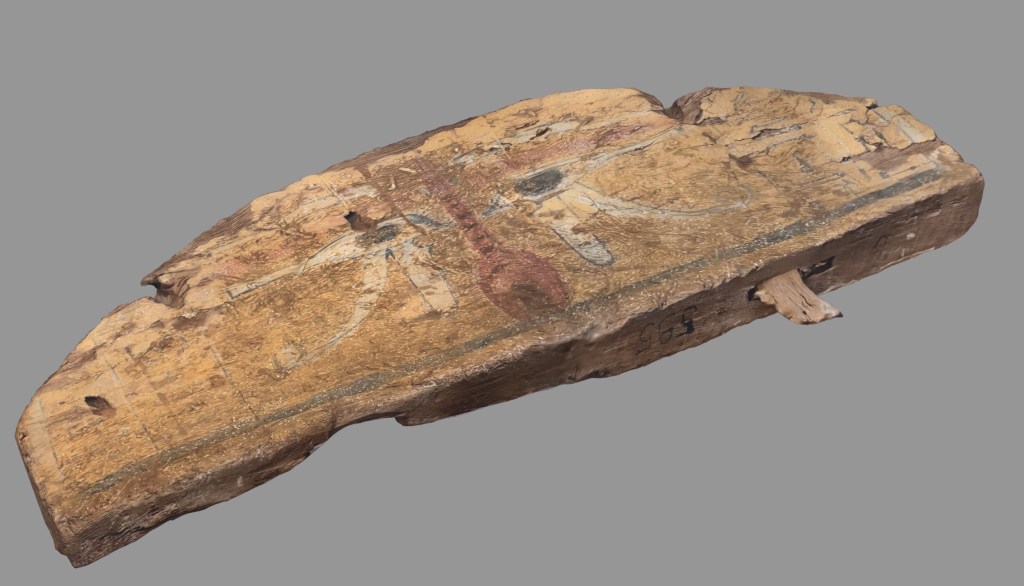
As a special highlight, I also documented the qrsw coffin of one of Ankh-Hor’s relatives, Psametik-men-em-Waset, Reg. 595, in 3D. The piece of which several boards and the front side are preserved had already been documented with our full-frame camera in 2018, but I wanted to take full advantage of the new possibilities offered by the rapid development of video-based photogrammetry with LiDAR sensors on mobile devices and the Scaniverse app developed by Toolbox AI. The scans also allow us to highlight technological features and details of the wood structure.
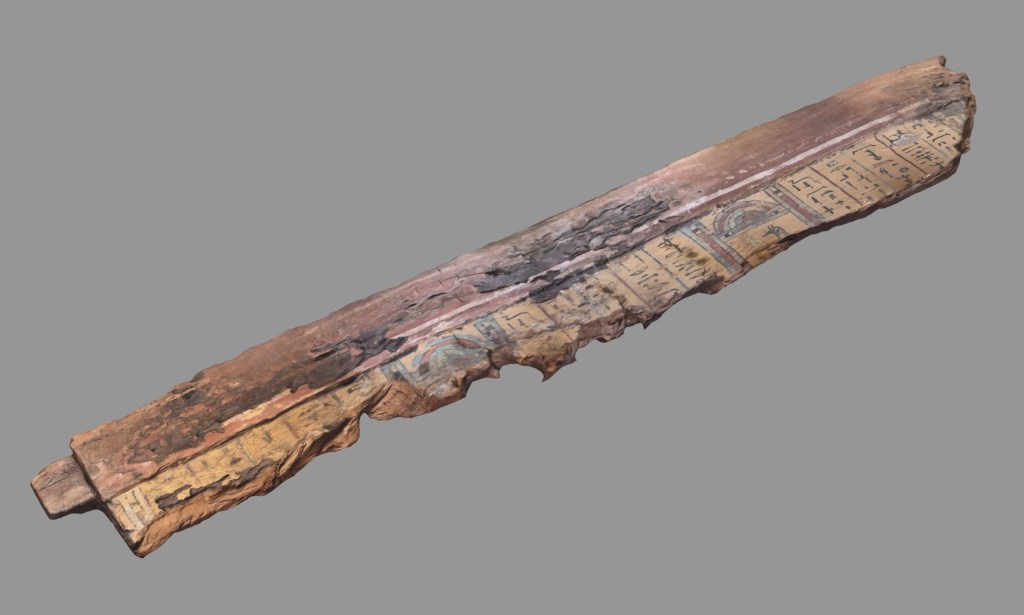
Screenshot of 3D scan of one of the lateral sides of Reg. 595 which shows nicely the damages of the wood and painted surface.
Sceenshot of the 3D scan of the front side of the vaulted lid of the qrsw coffin Reg. 595.

Last but not least, Hassan and Ladina made detailed drawings of fragments of canopic boxes from TT 414. These drawings will be used in the final publication and perfectly complement our photographic documentation and the 3D scans.
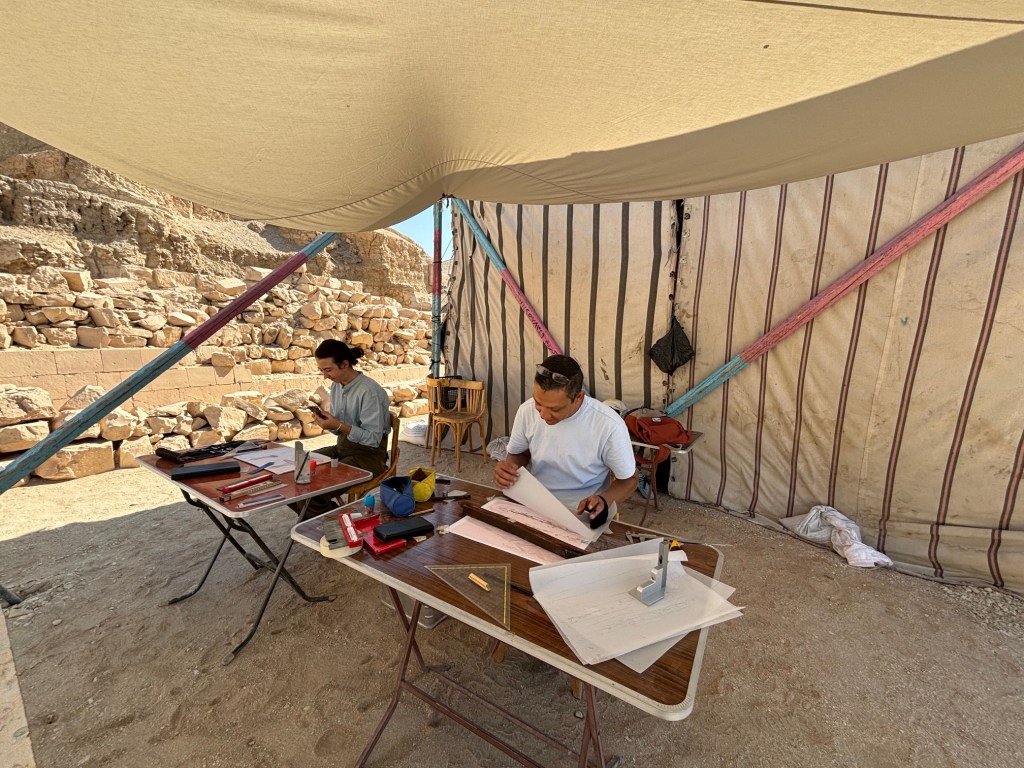
Technical drawings remain necessary for some selected wooden pieces from TT 414.

All in all, our 2024 season continues to be very productive, and I am grateful to all team members for their commitment and enthusiasm. There are some really great objects we are working on and there are still a lot of them waiting for us in the coming weeks!

First exciting news in Week 1

We successfully opened the 2023 season of the LMU Ankh-Hor project earlier this week. Although we only had three working days in Week 1, we made great progress with our prime working tasks. Ashraf and Hassan cleaned the area and many boxes with objects from the tomb of Ankh-Hor (TT 414), Mohammed and Karima consolidated already 20 pieces of painted coffins.

One particular challenge for Mohammed was a fragment of a 26th Dynasty qrsw-coffin (a coffin in the shape of a shrine with vaulted lid and corner posts). This piece (Fig. 1) was reused as building material in the Lichthof of TT 414 in the later reconstruction phase of this part of the tomb during the 30th Dynasty. The builders in the 4th century BCE used mainly mud bricks and wood – and for the latter, plenty of broken 26th Dynasty coffins were available as suitable building material (especially as architraves).

Fig. 1: The consolidated fragment of a qrsw-coffin from TT 414.

Thus, although the original object Mohammed consolidated is in a very pure condition and we cannot identify its owner, the piece tells us a lot about the life history of TT 414.

I was busy in the last days sorting the coffin fragments according to priorities for consolidation and cleaning. Several of them are still not assignable – find labels are missing and the texts are not readable. Some of the fragments we are dealing with were never registered before and require full documentation. For the unclear pieces because they are not readable, I take infrared photos and try to identify the objects back home with the help of the database. We are using this technique since 2021 and have wonderful results – for most of the painted coffins with stains on the surface or darkened surfaces, the original decoration becomes visible again.

I had a particularly successful experience yesterday: A piece whose inscriptions I could not read until yesterday suddenly became clear (Fig. 2). Based on the texts (especially the name of its owner), it was an easy task to identify the coffin fragment as Reg. 762. It also turned out that this coffin was actually much nicer decorated than a first glance of the darkened surface would indicate.

Fig. 2: Reg. 762 – working photo and detail with infrared photo. Note the difference infrared photography makes in tracing the original decoration of this piece.

Furthermore, and this shows the enormous potential of infrared photography for the LMU Ankh-Hor project, more genealogical data became available for the owner of this coffin. Back in the 1970s, the names of the parents were not readable. But now they are! And it seems as if we have another, previously unknown family member of the famous Hor and Kalutj/Nes-Khonsu family! But this is so exciting that I have to ask all of you for a little patience – there will be a separate blog post about this (soon insha’allah).