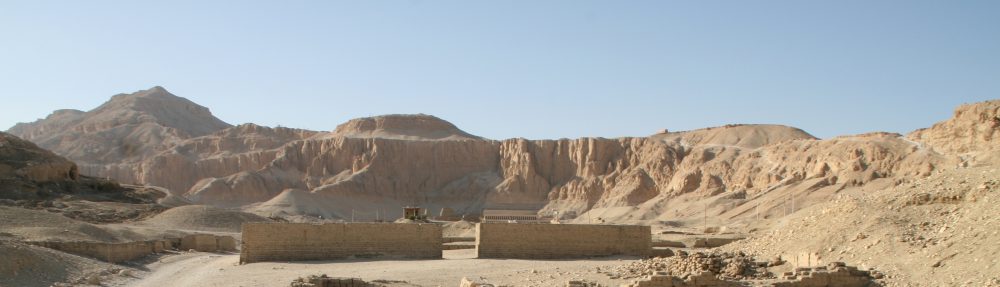
To all who celebrate around the world, a very happy Mawlid an-Nabi! Because of this holiday, our week 4 ended already yesterday and we could catch up with some paperwork working today from home.
In week 4, our conservators Karima and Mohammed continued with the consolidation and cleaning of coffins from TT 414, focusing on Ptolemaic pieces. They managed to clean fragments of 16 coffins this week, comprising partly a large number of individual pieces. Like last week, puzzling with the fragments and gluing them back together after cleaning was very time consuming. One of my favourite coffins they finished this week is Reg. 829 – the beautiful base of a wooden anthropoid coffin showing a felid skin on the exterior.
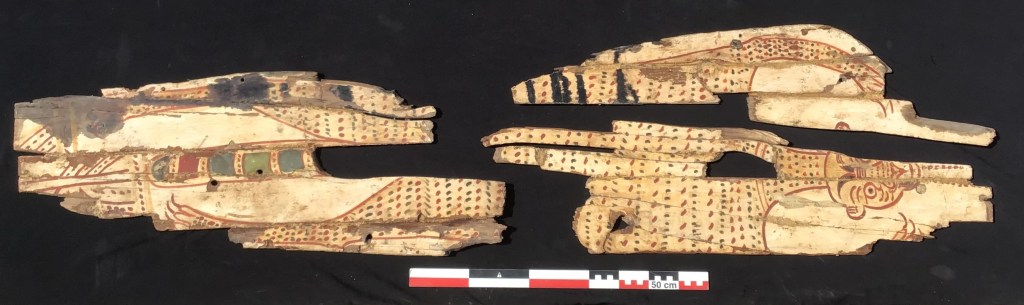
I am particularly proud that I managed to relocate the fragments of the edges of the coffin – this is new information which was not yet recorded in the previous documentation in the 1970s.

Not only the coffin is remarkable, but also its owner. Reg. 829 was owned by the god’s father and prophet of Amun in Karnak, sakh-wedjat and prophet of Sobek who dwells in Qus Hor-pa-bjk. He belongs to a very interesting, but also quite complicated priestly family which was active most probably during mid-Ptolemaic time. All the family members buried in TT 414 had very similar wooden coffins as well as cartonnage coffins – this produces several challenges in identifying the individuals. Both the female and male members of the family show a little variety of titles but share very common names; this caused already confusion in the 1970s when Elfriede Reiser-Haslauer tried to reconstruct the family tree.
Very interesting is the connection of the family to Sobek of Qus – this is something we can trace already since the time of Pa-di-Amun-neb-nesut-tawy I who started reusing TT 414 in the fourth century BCE (Budka and Mekis 2022). Tamas Mekis and I have proposed that maybe the ancestors of Pa-di-Amun-neb-nesut-tawy I moved to Qus during the Second Persian Period and returned to Thebes during the Nectanebid Period, bringing the cult of the gods of Gesy with them. The cult of Sobek in Karnak is both connected to Amun as well as to Osiris (see Budka and Mekis 2022 with references; for Sobek and his cult in general see Kockelmann 2017) – and, as Hor-pa-bjk illustrates, the Sobek cult was an integral part of the duties of the Karnak priests reusing TT 414, even many generations after Pa-di-Amun-neb-nesut-tawy I.
Coming back to the coffin assemblage of Hor-pa-bjk, I completely agree with Reiser-Haslauer (1982) – although final proof is still lacking, it is very tempting to identify Hor-pa-bjk as the brother of Hor-akh-bjt, owner of the cartonnage coffin Reg. 860, which shows a very similar felid skin on the bottom in an almost identical style.
We know that Hor-pa-bjk also had a cartonnage coffin like his presumed brother (and his father, mother and sister-in-law…) – it most probably also showed a zodiac on the interior of the lid. Since the cartonnage coffins from TT 414 are even stronger fragmented than the wooden ones, I am still sorting through fragments and trying to make sense of this large jigsaw puzzle.

As one of the most important results this week, I believe that I managed to identify another brother of Hor-pa-bjk and Hor-akh-bjt by means of a very fragmented cartonnage coffin which is again similar to Reg. 860. This would most probably be the eldest son of Nes-ba-neb-Djedet – a previously unrecorded Wesjr-wer III, named after his grandfather Wesjr-wer II. Thus, with the family tree around Hor-pa-bjk increasing, I am positive that we will soon be able to answer some of the open questions.
This small case study hopefully illustrates why all this work with the gigantic puzzle of fragments from the tomb of Ankh-Hor is worth doing – not only to reconstruct the actual objects from TT 414, but also to gain more information about the priesthood of Karnak in Ptolemaic times.
References:
Budka, J. and T. Mekis 2022. The family of Pa-di-Amun-neb-nesut-tawy from Thebes (TT 414) revisited. The case study of Kalutj/Nes-Khonsu (G108 + G137) (with contributions by Marc Etienne and Malcolm Jr. Mosher), Archaeopress Egyptology 42, Oxford [open access].
Kockelmann, H. 2017. Der Herr der Seen, Sümpfe und Flußläufe. Untersuchungen zum Gott Sobek und den ägyptischen Krokodilgötter-Kulten von den Anfängen bis zur Römerzeit. Ägyptologische Abhandlungen 74, Wiesbaden.
Reiser-Haslauer, E. 1982, C. Die Familien um Wsjr-wr und Ns-bA-nb-Ddt (spätptolemäisch), 257, in: M. Bietak and E. Reiser-Haslauer, Das Grab des Anch-Hor, Obersthofmeister der Gottesgemahlin Nitokris, Band II. Mit Beiträgen von Joachim Boessneck, Angela von den Driesch, Jan Quaegebeur, Helga Liese-Kleiber und Helmut Schlichtherle und Relief- und Fundzeichnungen von Heinz Satzinger, Untersuchungen der Zweigstelle Kairo 5, Wien.

 In the final days of work, I took some last photographs of objects, last coffin fragments were cleaned and consolidated. And of course I continued to organize the magazine. Since it always happens on excavations that something new and important turns up at the very last day of work, I was not surprised that I found some new fitting coffin fragments literally in the last minutes of work…. These new fragments are important because they belong to a fascinating, but unfortunately very fragmented coffin we documented earlier this season.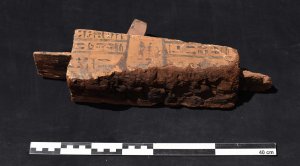

 The Ankh-Hor Project