A short summary of our 2024 season

It’s now a week since we returned to Europe from beautiful Luxor. Not only from the very successful 2024 Ankh-Hor project campaign, but also from a splendid Thebes in the First Millennium BCE conference with a rich programme of lectures and site visits.

Our 5 weeks of work on objects from the tomb of Ankh-Hor, TT 414, were very intensive. I will try to briefly summarise the most important aspects below.

The major goal of the 2024 season was to continue the cleaning, consolidation, and documentation of the large number of objects excavated from TT 414, the monumental tomb of Ankh-Hor, High Steward of the Divine Adoratrice Nitocris (26th Dynasty). Like in the 2023 season, the focus was on wooden coffins and cartonnage elements from TT 414 and included both Late Period pieces and Ptolemaic ones. Work was conducted from September 28 to October 31, 2024 (SCA Inspector: Shaima Abdelkarim).

Some fragmented coffins from TT 414 were identified for the first time and correlated with the documentation from the 1970s. Some additional material was recorded for the first time. In addition, several previously not identified pieces were newly recognised as matches to coffins documented by the Austrian mission in the 1970s. Some of these were joined by our conservators to the already documented pieces. One important example is Reg. No. 857. Whereas in the 1970s, only a small fragment of the edge and some base fragments of this lower case of a coffin were documented (Fig. 1 bottom left), new joining pieces allowed to reconstruct the entire length of the coffin (Fig. 1). With just 120cm in length, this is a coffin for an infant, not an adult. This raises various questions since the owner of the coffin is identified as Iset-em-akhbjt who holds the title jHjt n wja Ra (singer of the bark of Re).

Fig. 1: New pieces of Reg. No. 857 allow to identify it as an infant coffin

All finds studied in 2024 were digitally photographed and entered in a database, created by File Maker Pro. In total, more than 110 individual objects (mostly coffins and cartonnage elements) were studied and documented by full-format photos in high resolution. These new photos are suitable for publication and show the colours of the pieces, in contrast to the previous documentation in the 1970s. A total of 35 drawings of 14 important objects were produced in 2024 by Hassan and Ladina, comprising fragments wooden statues, canopic shrines and painted mud plaster.
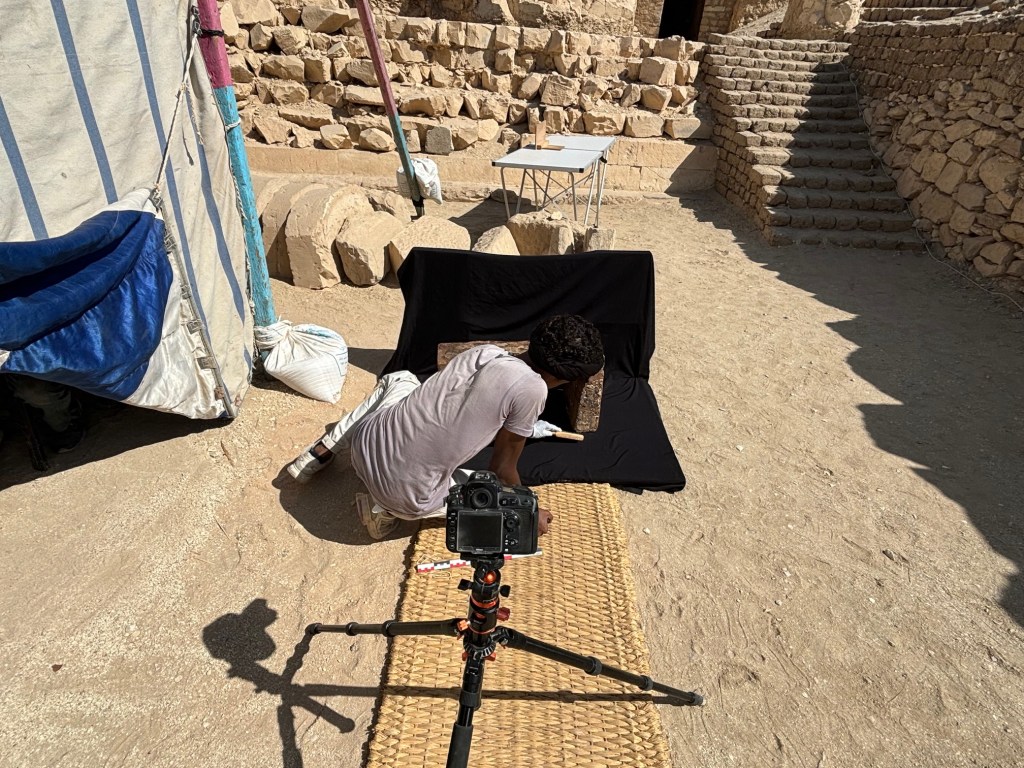
Fig. 2: Photographing our coffin fragments sometimes required individual settings; here Islam helps me with the preparation.

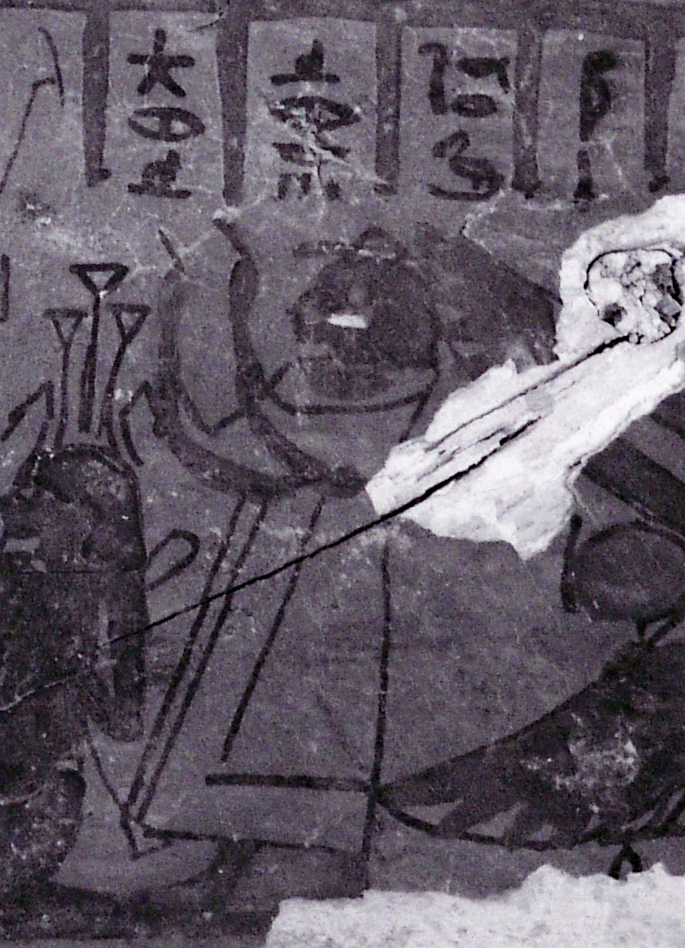
Since many the painted objects from TT 414 have darkened surface, infrared photography was used to make the original decoration visible (with a Sony Cybershot DSC-F828, an IR-filter and a small magnet). In 2024, this method was applied to a total of 70 objects.
A new method of documentation was introduced in 2023 for the Ankh-Hor project. The app Scaniverse was used to capture objects in 3D. This photogrammetry application is ultrafast, highly accurate and very easy to use. 207 objects from TT 414 were captured with metrically accurate 3D models this season. This technique was mainly used for work recordings when sorting cartonnage coffins (Fig. 3).
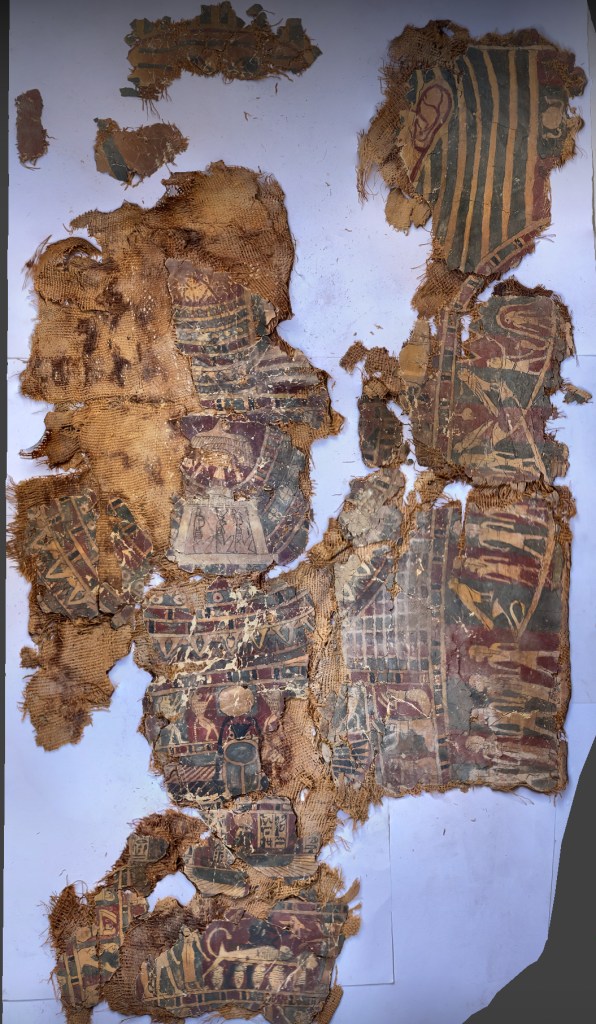
Fig. 3: Screenshot of 3D model of the newly reconstructed, fragmented cartonnage coffin lid Reg. 24/04. Since no texts with names and titles are preserved, the ownership is still unclear. The general colour scheme is rather unusual within the corpus of cartonnage coffins from TT 414.

The conservators of the LMU Munich Ankh-Hor Project in the 2023 season were the specialists for wood, Mrs. Karima Mohamed Sadiq and Mr. Mohamed Mahmoud Mohamed Mahmoud. All consolidated objects were documented photographically before and after conservation. Every object is documented in a list, containing the observed damages and the conservation measures. A total of more than 150 wooden and painted objects, mostly coffins, comprising c. 400 individual pieces, were successfully cleaned and consolidated in 2024.

One of the major accomplishments of the consolidation work this year was the reconstruction of the lower part of the cartonnage coffin Reg. No. 08/05. Before consolidation, it was broken in several pieces and very fragmented (Fig. 4).

Fig. 4: Part of Reg. No. 08/05 before consolidation work.
Fig. 5: Work in progress – Mohamed is consolidating the very fragile cartonnage coffin Reg. No. 08/05.

At the end of our season, these fragments, including the newly found foot part, were joint to each other, and Reg. No. 08/05 reconstructed as best as possible (Fig. 6). Simply a great job by Karima and Mohamed!

Fig. 6: Interior of Reg. No. 08/05 after consolidation work.

Apart from the consolidation work, the study of the cartonnage coffins supported some conclusions about certain people buried in TT 414 during Ptolemaic times, for example about the Wesjrwer family. We now know that Horpabjk was the owner of the wooden coffin Reg. 829 and also of the newly recosntructed cartonnage coffin Reg. 08/05 (Figs. 4-6). In 2023, he was tentatively identified as a brother of Horakhbjt, owner of the cartonnage coffin Reg. No. 860. With his own cartonnage coffin now beautifully reconstructed and identified, which shows close parallels to Reg. No. 860, this family relation and identification is now based on solid grounds. More research is needed to fully understand this important family.

That we can now study sets of coffins in wood and cartonnage together is a considerable step towards reconstructing actual tomb groups in TT 414.

Since not all fragments of wooden and cartonnage coffins from TT 414 are yet consolidated and documented, our work needs to be continued in the next season. The finding of joining pieces is in particular time-consuming but definitly worthwhile.

Finally, I would like to thank all the team members and the local authorities – it was not only a successful season, but also a really enjoyable one and I am really looking forward to the next one with hopefully a very similar line-up!

Reunion with well-known coffins: working in the magazine of the West Bank

Just one week ago, I had the pleasure of working on coffins from the tomb of Ankh-Hor in the main magazine of the Egyptian authorities on the West Bank – we brought them there in the 2000s and I had the chance to open some boxes for the first time since 15 years. This really was exciting!

All in all, thanks to the support of our Egyptian colleagues, I spent three days of work (Oct. 1-3, 2023) in the magazine of the West Bank. The main aim was to join newly found fragments to coffins which were transported in previous years to the magazine. This was one Ptolemaic painted coffin transported in 2007, Reg. 655. One joining piece could be fitted to the inner part of the shoulder of this coffin. I also relocated several loose fragments of the lid in our magazine, but these are not matching to each other, illustrating the destruction of the lid of the coffin when looters removed by force the mummy from within.

Mohamed Mahmoud showing the match of the coffin fragment to the shoulder of Reg. 655.

I documented the complete coffin Reg. 655, owned by a Ptolemaic priest with the name of Padiaes, using infrared photography – a technique I did not use back in 2007 and which is therefore a great complementary documentation. This allowed to trace not only all the texts but also small details of the drawings of the figures. Like in 2007, I am just really thrilled by the execution of these details!

Detail of the kneeling figures of Padiaes on a new infrared photo.

Using the app Scaniverse, the coffin of Padiaes was also captured in 3D. I made one scan with the fitting face part of the coffin lid, comprising of mask and wig, and one without it. These 3D models will allow us to digitally reconstruct the complete coffin, ideally also placing the not-fitting fragments of the lid in their original position.

Screenshot of 3D model of Reg. 655.

The second coffin for which matching pieces were found in the past years is Reg. 656, the beautiful coffin of the temple singer Aset-em-Akhbit III transported to the magazine just in 2021. Our conservators joined one fitting piece to the lateral side of the lid. Reg. 656 was, like Reg. 655, scanned in 3D and documented in its new shape with our full-frame camera.

Karima Mohamed joining the two fragments of Reg. 656 together.
Documentation of the new shape of Reg. 656 after placement of the new matching fragment.

Apart from the matching of joining pieces to these two coffins, our goal for the work in the magazine was to update the documentation of the objects. I managed to study a total of 18 objects, making high-resolution photos, 3D scans and infrared photography. My personal highlight was the reunion with the inner coffin of Wakhibre, one of the rare in situ burials of the 30th Dynasty excavated in Thebes and a very special piece.

For facilitating this important work in the magazine of the West Bank, I am very thankful to Ahmed Hassan, Chief Director of the Magazines of the West Bank as well as to Ahmed Ezz, Director of the Magazine. I am grateful to our conservators Karima Mohamed and Mohamed Mahmoud for their excellent job fitting the joining pieces to Reg.655 and Reg. 656. I would also like to thank Nefisa Elazab Mohamed who functioned as an inspector during my work in the magazine and was very helpful. I hope to be back there in the next season – 3D scans and infrared photos are waiting for other objects from the tomb of Ankh-Hor!

First exciting news in Week 1

We successfully opened the 2023 season of the LMU Ankh-Hor project earlier this week. Although we only had three working days in Week 1, we made great progress with our prime working tasks. Ashraf and Hassan cleaned the area and many boxes with objects from the tomb of Ankh-Hor (TT 414), Mohammed and Karima consolidated already 20 pieces of painted coffins.

One particular challenge for Mohammed was a fragment of a 26th Dynasty qrsw-coffin (a coffin in the shape of a shrine with vaulted lid and corner posts). This piece (Fig. 1) was reused as building material in the Lichthof of TT 414 in the later reconstruction phase of this part of the tomb during the 30th Dynasty. The builders in the 4th century BCE used mainly mud bricks and wood – and for the latter, plenty of broken 26th Dynasty coffins were available as suitable building material (especially as architraves).

Fig. 1: The consolidated fragment of a qrsw-coffin from TT 414.

Thus, although the original object Mohammed consolidated is in a very pure condition and we cannot identify its owner, the piece tells us a lot about the life history of TT 414.

I was busy in the last days sorting the coffin fragments according to priorities for consolidation and cleaning. Several of them are still not assignable – find labels are missing and the texts are not readable. Some of the fragments we are dealing with were never registered before and require full documentation. For the unclear pieces because they are not readable, I take infrared photos and try to identify the objects back home with the help of the database. We are using this technique since 2021 and have wonderful results – for most of the painted coffins with stains on the surface or darkened surfaces, the original decoration becomes visible again.

I had a particularly successful experience yesterday: A piece whose inscriptions I could not read until yesterday suddenly became clear (Fig. 2). Based on the texts (especially the name of its owner), it was an easy task to identify the coffin fragment as Reg. 762. It also turned out that this coffin was actually much nicer decorated than a first glance of the darkened surface would indicate.

Fig. 2: Reg. 762 – working photo and detail with infrared photo. Note the difference infrared photography makes in tracing the original decoration of this piece.

Furthermore, and this shows the enormous potential of infrared photography for the LMU Ankh-Hor project, more genealogical data became available for the owner of this coffin. Back in the 1970s, the names of the parents were not readable. But now they are! And it seems as if we have another, previously unknown family member of the famous Hor and Kalutj/Nes-Khonsu family! But this is so exciting that I have to ask all of you for a little patience – there will be a separate blog post about this (soon insha’allah).

Presenting the Ankh-Hor Project at the ICE 2023 in Leiden

It has been a wonderful week so far – more than 800 Egyptologists are gathering for the 13th International Congress of Egyptologists in the beautiful city of Leiden! Many congrats to the organizers for a fantastic job – there are multiple sessions and several workshops as well as outreach lectures and receptions. Recent finds and results from the field are presented as well as crucial questions addressed and innovative methods and theories discussed.

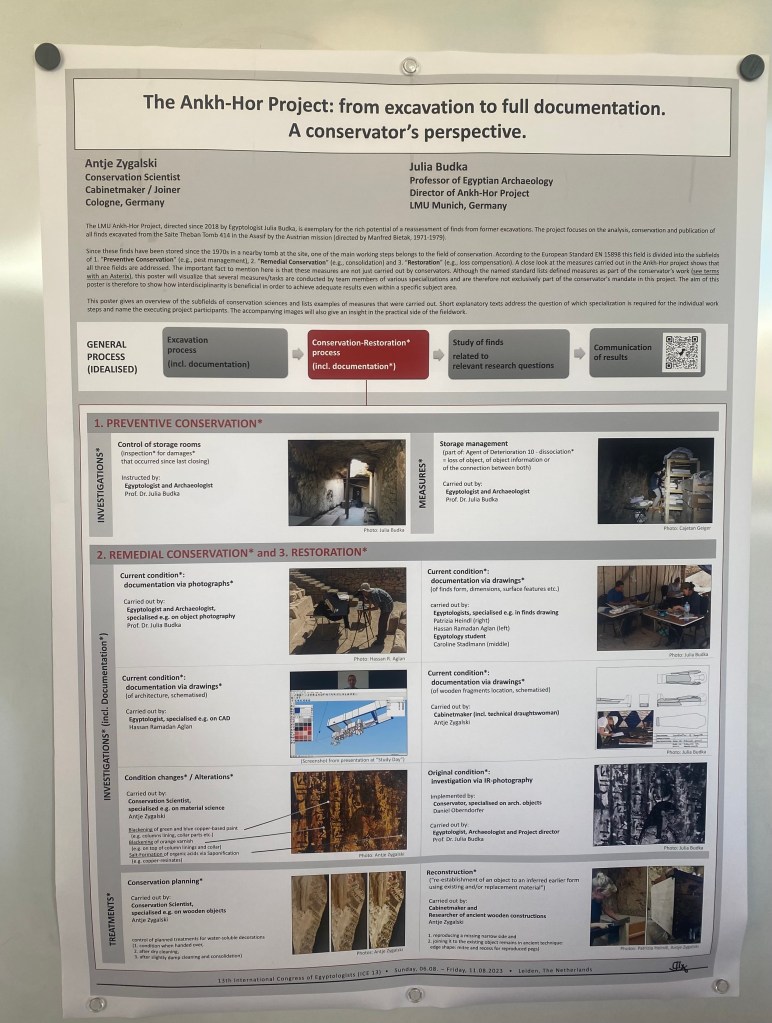
Today is the day for the poster presentations. I am very happy that Antje Zygalski prepared a poster about the Ankh-Hor Project: “From excavation to full documentation. A conservator’s perspective” aims to show the benefit of interdisciplinary approaches in the field, of bringing together various fields of expertise and different skills in the overall workflow.

Our poster is exhibited in the P.J. Veth Building and will be accessible until the end of the congress.

For those of you who are in Leiden – we will be presenting the poster this afternoon and are looking much forward to any questions or feedback.

Highlights of Week 1, Season 2022

Our 2022 season was opened on Tuesday and thus we only have worked three days in the magazine in the Asasif. We cleaned all the area and our workplaces were set up including new tents. Hassan Ramadan is already busy with drawing small finds – jar stoppers, clay figurines, shabtis and wooden objects are waiting for him this season.

Hassan at his workplace while drawing.

I was organising coffin fragments according to priorities for the conservation programme which will start next week. While sorting the material, I took a considerable number of infrared photos – this method allowed us already last year to identify several pieces because the decoration and the texts becomes much clearer and nicely readable. Amazingly, already on the first day I could identify three coffins by means of such photos!

In total, I could detect seven previously unidentified fragments as belonging to registered coffins in just two days. In addition to this great progress, the reading of the text and decoration also adds new information to several pieces.

The best example here is Reg. No. 689, found in the debris in the burial chamber of Ankh-Hor. It is the front part of a pedestal of an inner anthropoid painted wooden coffin with an unusual decoration, showing three cartouches of Osiris, Isis and Horus above the binding of the heraldic plants of Upper and Lower Egypt. A ba bird is shown in adoration of the cartouches to the left; a human adoring figure is traceable on the right. Unfortunately, this side of the coffin board is very darkened, and the painting is difficult to see on an ordinary photograph.

Regular photo of Reg. No. 689.

When Elfriede Reiser-Haslauer studied this coffin in the 1970s, she therefore could not read the name of the human figure. She also made a question mark behind her identification as a male deceased, being unsecure of the gender of the darkened figure. Thus, this coffin was never included in the genealogical register of TT 414 created by Reiser-Haslauer (1982).

And here comes the magic moment 50 years later thanks to infrared photography. The decoration and texts become visible, and the name of the deceased is very clear: it is the nb.t pr Takerheb.

Detail of the infrared photo of Reg. No. 689 showing the newly identifed female owner of the coffin.

This lady is already attested from TT 414 by means of fragments of an outer anthropoid coffin in the typical early Ptolemaic black-and-yellow style, Reg. No. 780, also found in the debris of the burial chamber of Ankh-Hor. Thus, we now have new evidence of her complete set of coffins, the inner colourful painted one (Reg. No. 689) and the outer black-yellow one (Reg. No. 780). Her outer coffin also gives the title of a sistrum-player of Amun-Re and the names of her parents (see Reiser Haslauer 1982, G152).

This example hopefully illustrates both the great potential of our current work on the finds from TT 414 as well as the challenges we are facing – loads of material still need to be studied in detail! Thankfully we are just at the beginning of our 2022 season.

Reference:

Reiser-Haslauer 1982 = E. Reiser-Haslauer, IX. Genealogisches Register, 267–284, in: M. BIETAK/E. REISER-HASLAUER, Das Grab des Anch-Hor, Obersthofmeister der Gottesgemahlin Nitokris, Band II. Mit Beiträgen von Joachim Boessneck, Angela von den Driesch, Jan Quaegebeur, Helga Liese-Kleiber und Helmut Schlichtherle und Relief- und Fundzeichnungen von Heinz Satzinger, UZK 5, Vienna 1982.

New dissemination article about our 2021 season

I am delighted that a new dissemination article was just published about our first field season since the covid 19-pandemic. I stressed in particular the advances due to infrared photography and the continuation of our conservation programme. The material from TT 414, and here especially the large corpus of painted coffins, has so much potential to answer various open questions about Late Period and Ptolemaic funerary archaeology in Thebes. In particular, the rich coffin material as well as cartonnages, canopic boxes, shrines, hypocephali and other elements of the tomb groups illustrate key aspects of Late Egyptian religious iconography which continues to fascinate me, and which will keep us busy during postprocessing the large amount of new data from the 2021 season.

The rich material from TT 414 in Asasif is still far from being processed in its totality.

Reference

Julia Budka 2021. Back to Egypt: The 2021 season of the Ankh-Hor Project in Luxor. The Project Repository journal 11. Oct. 2021, 8-11https://www.europeandissemination.eu/project-repository-journal-volume-11-october-2021/17509 https://doi.org/10.54050/PRJ1117674

We proudly present: first tests with infrared photography

Back in 2018, the conservator of the Austrian Archaeological Institute, Daniel Oberndorfer, made some tests with infrared photography with very good results. In the case of painted coffins with stains on the surface or simply darkened surfaces, the original decoration became visible again. Sometimes these stains are also caused by bitumen applied to the surface. And since the pouring of bitumen above the coffin and the mummy was very common in Ptolemaic times, this seemed like a suitable way to deal with our large set of material from TT 414.

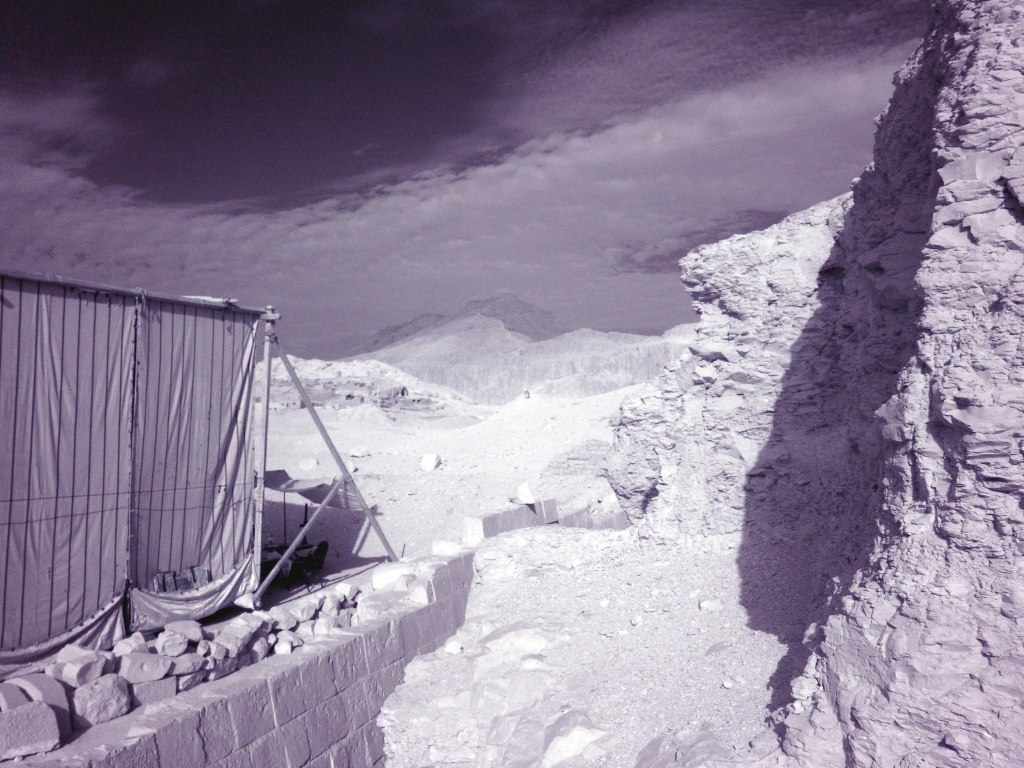
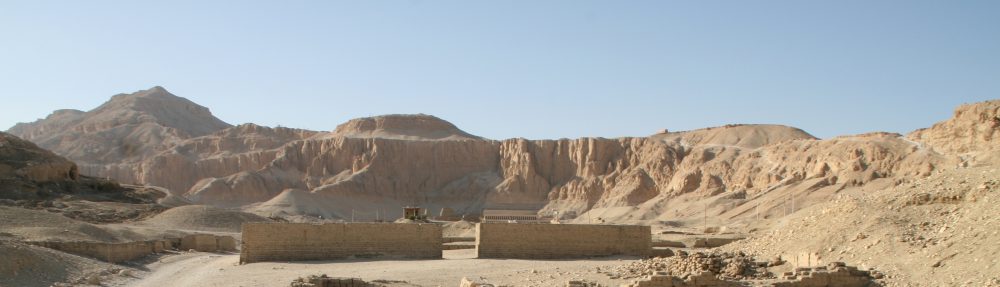
For the 2021 season, I therefore purchased a second-hand Sony Cybershot DSC-F828 camera. First tests with a magnet and the use of an IR-filter were extremely successful. The camera kit is also useful for landscape photography, site views turn out really nice – here is just a shot towards the mountain from our place of work.

But most importantly, for the wooden coffins, the photos are like magic and make things visible again! The decoration and the texts of some darkened pieces are much clearer and nicely readable. But also what appears as a “black coffin” because of its current surface, becomes visible as a formerly colourful piece completely covered with resin. The original JPGs and RAWs can be further processed and will assist us to fully document the design of the coffins from the tomb of Ankh-Hor.

I am very grateful to Daniel for introducing this new documentation method back in 2018 and super happy that I invested in my own new camera kit – the results are simply stunning! Especially for large fragments with important pieces of texts (and figurative panels) this will allow a fresh reassessment of the coffins from TT 414 – stay tuned for more very soon!