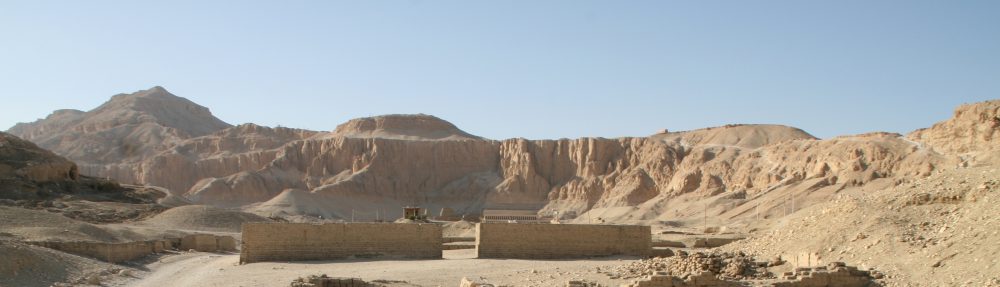
Among the mass of coffin fragments from TT 414, the tomb of Ankh-Hor, one stands out in particular: a coffin of a woman with both demotic and hieroglyphic inscriptions.
Reg. 770 was published by one of the experts on Demotic, Jan Quaegebeur in Anch-Hor II. He focused on the front board of the foot section, which shows the demotic inscription. However, the board of the corresponding coffin lid – with a vertical hieroglyphic inscription line – was not published as a drawing or photo.
This season, our conservator Mohamed cleaned and fixed the very fragile lid fragment and I could document it together with the foot part. Our aim is to present this unique piece in the planned publication of all coffins from TT 414.
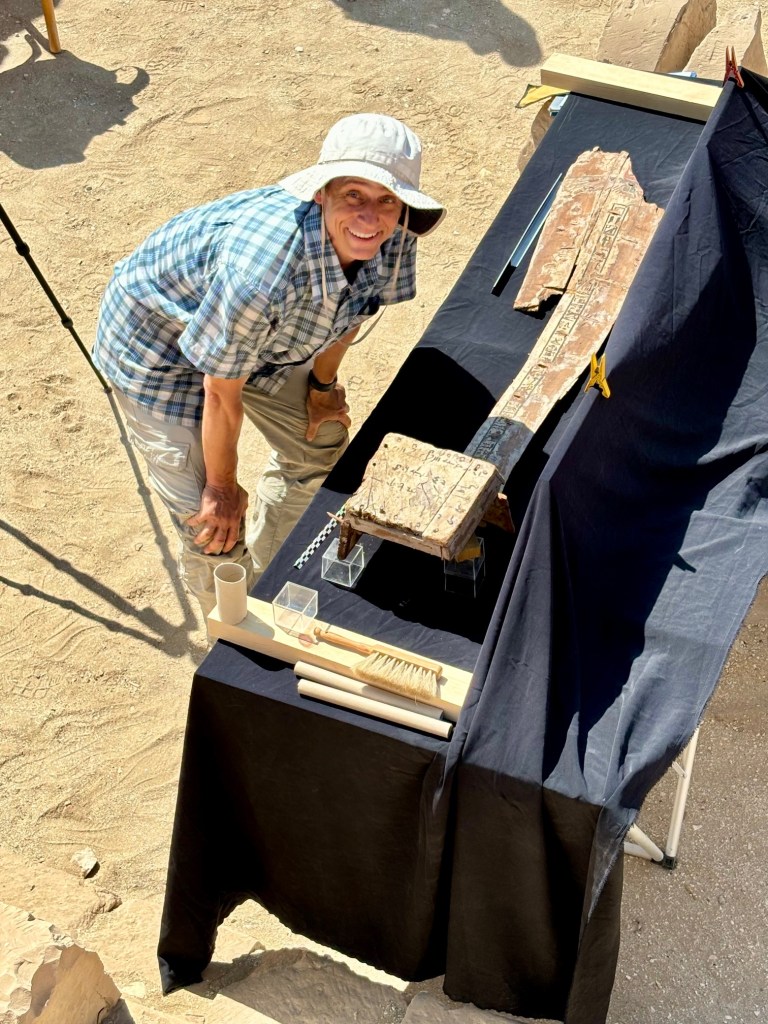
The coffin owner is a woman with the typical Theban name T3-khj-bj3t, daughter of Wesjr-wer/Osoroeris and T3-njt-Khonsw/Tachonsis. This filiation is given in the demotic text, translated by Quaegebeur (1982, 259) as follows:
“May your Ba live in eternity and forever: T3-khj-bj3t daughter of Osoroeris born of Tachonsis”.
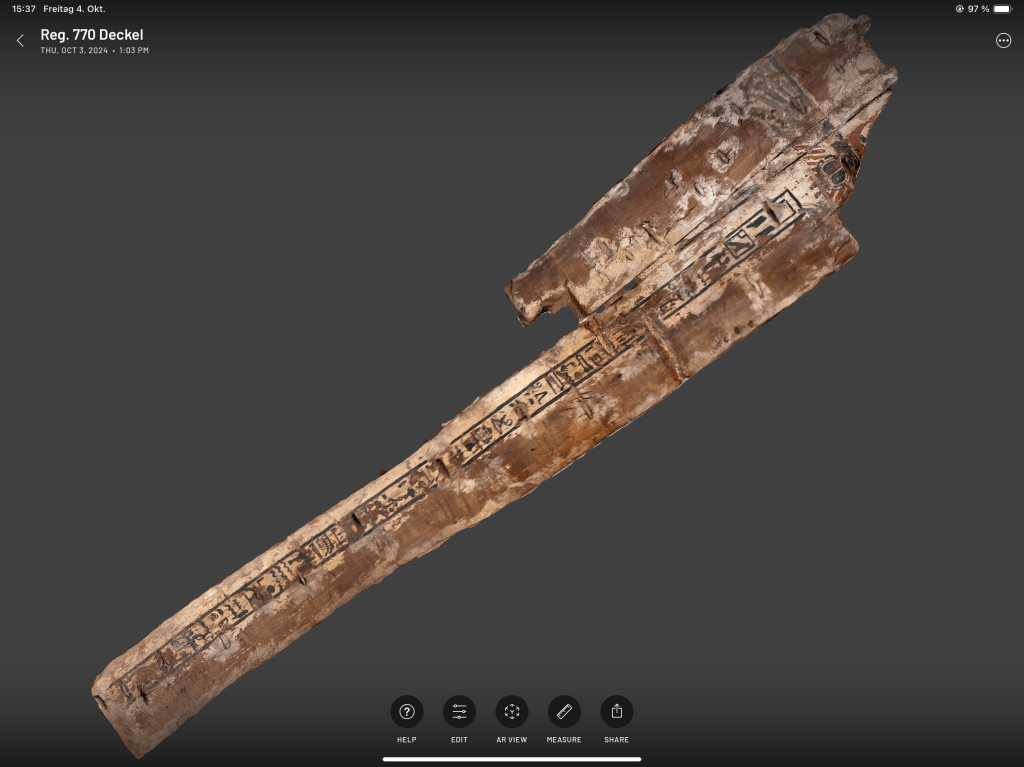
The vertical text on the lid only mentions the mother’s name, not the father’s.
T3-khj-bj3t belongs to a Ptolemaic family attested by several wooden painted coffins from TT 414, especially Reg. 800 and Reg. 828 with hieroglyphic texts. However, there is one problem: we do not know whether our coffin owner of Reg. 770 was the wife or the granddaughter of the owner of Reg. 800, Wesjr-wer. It is possible that a woman named Ta-Khonsu, daughter of T3-khj-bj3t, named her own daughter after her mother. Quaegebeur has also expressed the opinion that the ‘granddaughter’ scenario is perhaps more likely than that of the wife, since Reg. 770, unlike Reg. 800 (and Reg. 828), also bears a demotic inscription in addition to the hieroglyphic one and might thus be of later date.
Well – as I will also be working on Reg. 800 this season, perhaps a solution will emerge. I am also very much hoping for additional information based on cartonage coffins that have not yet been included in the scenario, but which are attested for several members of this family.
Whether wife or granddaughter – the coffin Reg. 770 still raises exciting questions today and I am very pleased that we have now documented it in the best possible way. A more precise dating will hopefully be possible soon.
Reference
Quaegebeur 1982 = Jan Quaegebeur, VIII. Demotic Inscriptions on Wood from the Tomb of Anch-Hor, in: M. Bietak/E. Reiser-Haslauer, Das Grab des Anch-Hor II, Vienna 1982, 259-266.
 The Ankh-Hor Project