A short summary of our 2024 season

It’s now a week since we returned to Europe from beautiful Luxor. Not only from the very successful 2024 Ankh-Hor project campaign, but also from a splendid Thebes in the First Millennium BCE conference with a rich programme of lectures and site visits.

Our 5 weeks of work on objects from the tomb of Ankh-Hor, TT 414, were very intensive. I will try to briefly summarise the most important aspects below.

The major goal of the 2024 season was to continue the cleaning, consolidation, and documentation of the large number of objects excavated from TT 414, the monumental tomb of Ankh-Hor, High Steward of the Divine Adoratrice Nitocris (26th Dynasty). Like in the 2023 season, the focus was on wooden coffins and cartonnage elements from TT 414 and included both Late Period pieces and Ptolemaic ones. Work was conducted from September 28 to October 31, 2024 (SCA Inspector: Shaima Abdelkarim).

Some fragmented coffins from TT 414 were identified for the first time and correlated with the documentation from the 1970s. Some additional material was recorded for the first time. In addition, several previously not identified pieces were newly recognised as matches to coffins documented by the Austrian mission in the 1970s. Some of these were joined by our conservators to the already documented pieces. One important example is Reg. No. 857. Whereas in the 1970s, only a small fragment of the edge and some base fragments of this lower case of a coffin were documented (Fig. 1 bottom left), new joining pieces allowed to reconstruct the entire length of the coffin (Fig. 1). With just 120cm in length, this is a coffin for an infant, not an adult. This raises various questions since the owner of the coffin is identified as Iset-em-akhbjt who holds the title jHjt n wja Ra (singer of the bark of Re).

Fig. 1: New pieces of Reg. No. 857 allow to identify it as an infant coffin

All finds studied in 2024 were digitally photographed and entered in a database, created by File Maker Pro. In total, more than 110 individual objects (mostly coffins and cartonnage elements) were studied and documented by full-format photos in high resolution. These new photos are suitable for publication and show the colours of the pieces, in contrast to the previous documentation in the 1970s. A total of 35 drawings of 14 important objects were produced in 2024 by Hassan and Ladina, comprising fragments wooden statues, canopic shrines and painted mud plaster.
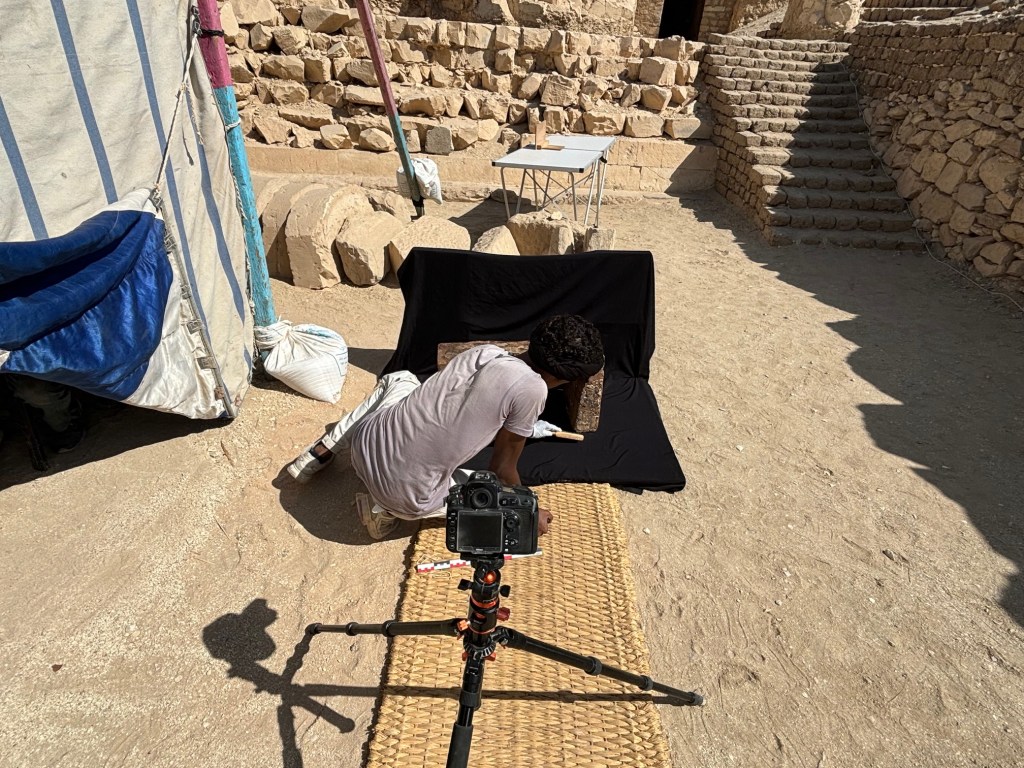
Fig. 2: Photographing our coffin fragments sometimes required individual settings; here Islam helps me with the preparation.

Since many the painted objects from TT 414 have darkened surface, infrared photography was used to make the original decoration visible (with a Sony Cybershot DSC-F828, an IR-filter and a small magnet). In 2024, this method was applied to a total of 70 objects.
A new method of documentation was introduced in 2023 for the Ankh-Hor project. The app Scaniverse was used to capture objects in 3D. This photogrammetry application is ultrafast, highly accurate and very easy to use. 207 objects from TT 414 were captured with metrically accurate 3D models this season. This technique was mainly used for work recordings when sorting cartonnage coffins (Fig. 3).
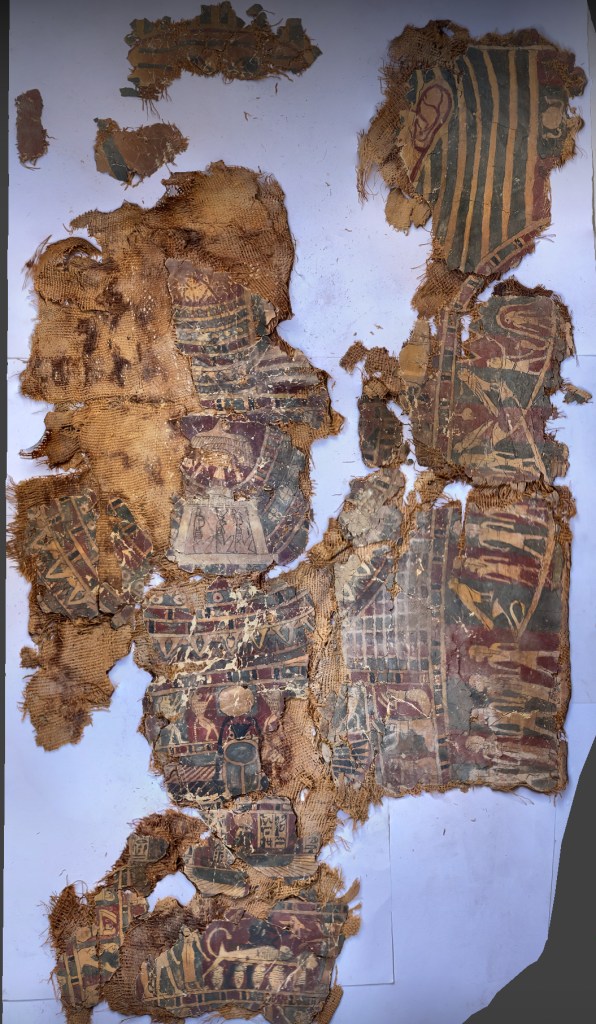
Fig. 3: Screenshot of 3D model of the newly reconstructed, fragmented cartonnage coffin lid Reg. 24/04. Since no texts with names and titles are preserved, the ownership is still unclear. The general colour scheme is rather unusual within the corpus of cartonnage coffins from TT 414.

The conservators of the LMU Munich Ankh-Hor Project in the 2023 season were the specialists for wood, Mrs. Karima Mohamed Sadiq and Mr. Mohamed Mahmoud Mohamed Mahmoud. All consolidated objects were documented photographically before and after conservation. Every object is documented in a list, containing the observed damages and the conservation measures. A total of more than 150 wooden and painted objects, mostly coffins, comprising c. 400 individual pieces, were successfully cleaned and consolidated in 2024.

One of the major accomplishments of the consolidation work this year was the reconstruction of the lower part of the cartonnage coffin Reg. No. 08/05. Before consolidation, it was broken in several pieces and very fragmented (Fig. 4).

Fig. 4: Part of Reg. No. 08/05 before consolidation work.
Fig. 5: Work in progress – Mohamed is consolidating the very fragile cartonnage coffin Reg. No. 08/05.

At the end of our season, these fragments, including the newly found foot part, were joint to each other, and Reg. No. 08/05 reconstructed as best as possible (Fig. 6). Simply a great job by Karima and Mohamed!

Fig. 6: Interior of Reg. No. 08/05 after consolidation work.

Apart from the consolidation work, the study of the cartonnage coffins supported some conclusions about certain people buried in TT 414 during Ptolemaic times, for example about the Wesjrwer family. We now know that Horpabjk was the owner of the wooden coffin Reg. 829 and also of the newly recosntructed cartonnage coffin Reg. 08/05 (Figs. 4-6). In 2023, he was tentatively identified as a brother of Horakhbjt, owner of the cartonnage coffin Reg. No. 860. With his own cartonnage coffin now beautifully reconstructed and identified, which shows close parallels to Reg. No. 860, this family relation and identification is now based on solid grounds. More research is needed to fully understand this important family.

That we can now study sets of coffins in wood and cartonnage together is a considerable step towards reconstructing actual tomb groups in TT 414.

Since not all fragments of wooden and cartonnage coffins from TT 414 are yet consolidated and documented, our work needs to be continued in the next season. The finding of joining pieces is in particular time-consuming but definitly worthwhile.

Finally, I would like to thank all the team members and the local authorities – it was not only a successful season, but also a really enjoyable one and I am really looking forward to the next one with hopefully a very similar line-up!

Much progress in week 3 of the 2023 season

This week just flew by very quickly – we made much progress in many respects.

The consolidation and cleaning of coffins from TT 414 was carried out continuously by our conservators Karima and Mohammed. They managed to clean seven additional coffins this week, comprised of more than 60 individual pieces. Very time consuming was therefore the puzzling with the fragments and gluing them back together after cleaning.

This week, Mohammed and Karima had to fit many pieces of fragmented coffins together.

One case study of these working tasks is shown here – Reg. 825 is a nice example of a looted inner anthropoid coffins with clear damages caused by the robbers. Karima and Mohammed managed to fit the fragments back together in a way that also the original shape of the lid becomes visible again.

Reg. 825 was one of the coffins successfully cleaned, glued and documented in week 3.

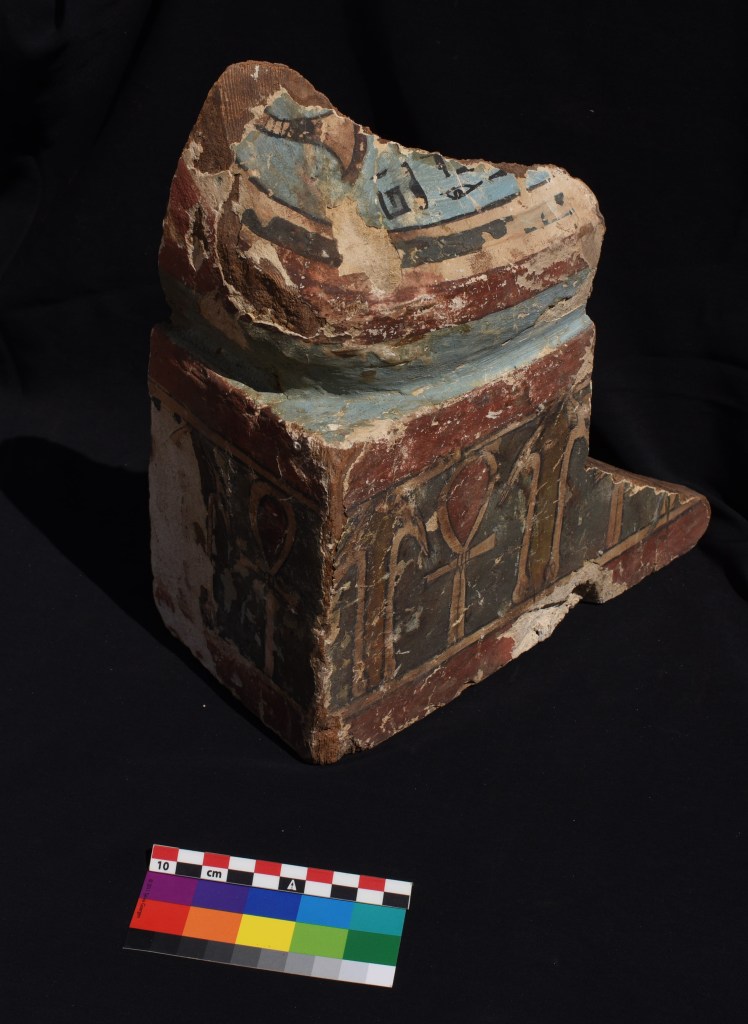
Another great achievement in terms of consolidation was the work by Mohammed on a very fragile pedestal of a 26th Dynasty Ptah-Sokar-Osiris statue from the tomb of Ankh-Hor. The piece is not inscribed, but covered with linen and painted in yellow, red and blue. Mohammed fixed all of the remaining painted parts. The 3D model I created of the object with Scaniverse shows in great accuracy the “footprint” of the statue – the tenon hole, but also the shape of the lower base of the figure. The almost square cavity in front of the pedestal was closed with a lid on which we traced the negative of a falcon statue.

3D model of Reg. 23/02 (created with Scaniverse) showing all the details of this 26th Dynasty Ptah-Sokar-Osiris-pedestal. The small lid of the cavity was removed for this scan.

This week the work on the cartonnage coffins from TT 414 really picked up speed. To begin, Ahmed and Caroline, our student assistants, searched and sorted through several boxes of fragments. We focused on the reconstruction of a wonderful two-part coffin of the Ptolemaic Amun priest Horakhbjt, Reg. 860- its painting is exquisite and large fragments were documented back in the 1970s. However, we realised that most of these fragments are currently missing. The good news is: I have now been able to relocate numerous pieces; they were scattered in dozens of boxes in the magazine.

Ahmed and Caroline did a great job sorting through boxes with cartonnage fragments from TT 414.

I show you here a particularly charming fragment from the lid: just check out the details of the figure of Anubis and the way he is here depicted bent over the mummy on the lion bed.

One small fragment from the lid of Reg. 860 – unusual is the representation of Anubis in this scene with the mummy bier.

I did anticipate that work on Reg. 860 will be time-consuming – maybe not as much as it turned out to be, but I am still optimistic that we will manage to document much of this important piece during this season. In addition, I managed to find matching pieces to a lot of other cartonnage coffins. The most exciting one is maybe the beautiful lid of the cartonnage of the priest Twt. Just last year, I managed to identify this cartonnage coffin and now we have a full representation of Twt kneeling in front of an offering table in delicate painting.

New matching pieces of the cartonnage coffin of Mr. Twt – the lower part of the Ba-bird and of Twt himself were newly found this week.

Last but not least, this week was also very successful in using 3D scanning with Scaniverse to document objects, fragments of cartonnage coffins and wooden coffins from TT 414. More than 50 3D scans now complement our documentation and will allow us to continue the jigsaw puzzle also back home after the season.

Capturing objects from TT 414 in 3D – first stunning results

On the last day of week 2 of the 2023 season of the Ankh-Hor Project, there was much excitement! Inspired by my colleagues from the South Asasif Conservation Project, I played a bit with my newly installed app Scaniverse – a wonderful tool to capture objects in 3D. With all my experience using photogrammetry in the past years in Sudan (and some earlier trials for material from TT 414), this was a stunning exercise – Scaniverse is ultrafast, highly accurate and very easy to use. It offers new perspectives of how we document our objects from TT 414 – in addition to ordinary 2D images, now capturing the objects with metrically accurate 3D models becomes feasible with little time expenditure. Simply fantastic!

My trial piece is also a scientifically important object. This week, Mohammed and Karima cleaned and consolidated two parts of the fragmentarily preserved tomb group of an important family member of Ankh-Hor, the lady Her-Aset. We do not know the name of her husband, but his title – based on the known facts, it is very likely that she married one of Ankh-Hor brothers and was thus closely related to the original owner of TT 414. This of course explains why she was buried in TT 414 as well.

Her-Aset had a nice wooden stela as part of her funerary equipment. The larger part of this stela is now in the British Museum – see my earlier post on the conservation of this piece back in 2018.

Now in 2023, we are back working on Her-Aset’s tomb group. The first piece our conservators consolidated from this group is a fragment of the inner anthropoid coffin of Her-Aset, Reg. 536.

Unfortunately, little is left of the once beautiful inner coffin of Her-Aset. Reg. 536 is the only fragment found in TT 414.

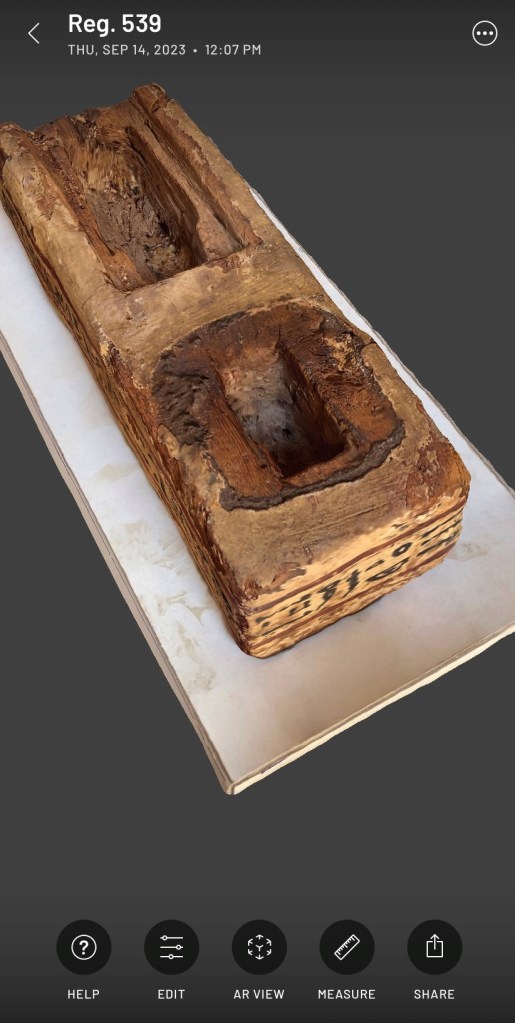
The other object is the nicely coloured and inscribed pedestal of a Ptah-Sokar-Osiris statue of Her-Aset. Reg. 539 gives her name and title within the framework of an offering formula. Karima and Mohammed finished its consolidation (it was in a very fragile state) just today and after I took the standard 2D photos, I thought that this would be the perfect trial piece for the app mentioned above.

Screenshot of my app with the 3D model of Reg. 539.

The result is great (see also the video of Reg. 539 captured with Scaniverse on an iPhone 11 and processed with Detail Mode) – and please keep in mind that it was the first time ever I used the app and that it only took a few seconds to take the photos for this model. In addition to the ordinary photos, the shape and especially the cavities on the top side of the pedestal are now captured in a detail way and in 3D. One cavity is of course the tenon hole for the now lost funerary figure of the god Ptah-Sokar-Osiris – should we ever be able to relocate this statue in one of the museums around the world, we could join it with our 3D model 😉. The larger cavity is mummy-shaped and nicely shows that Ptah-Sokar-Osiris statuettes in the Late Period sometimes contained a package of viscera/mummification material and are closely related to corn mummies.

We will explore the application of Scaniverse to document our finds from TT 414 further and will keep you of course posted!

First exciting news in Week 1

We successfully opened the 2023 season of the LMU Ankh-Hor project earlier this week. Although we only had three working days in Week 1, we made great progress with our prime working tasks. Ashraf and Hassan cleaned the area and many boxes with objects from the tomb of Ankh-Hor (TT 414), Mohammed and Karima consolidated already 20 pieces of painted coffins.

One particular challenge for Mohammed was a fragment of a 26th Dynasty qrsw-coffin (a coffin in the shape of a shrine with vaulted lid and corner posts). This piece (Fig. 1) was reused as building material in the Lichthof of TT 414 in the later reconstruction phase of this part of the tomb during the 30th Dynasty. The builders in the 4th century BCE used mainly mud bricks and wood – and for the latter, plenty of broken 26th Dynasty coffins were available as suitable building material (especially as architraves).

Fig. 1: The consolidated fragment of a qrsw-coffin from TT 414.

Thus, although the original object Mohammed consolidated is in a very pure condition and we cannot identify its owner, the piece tells us a lot about the life history of TT 414.

I was busy in the last days sorting the coffin fragments according to priorities for consolidation and cleaning. Several of them are still not assignable – find labels are missing and the texts are not readable. Some of the fragments we are dealing with were never registered before and require full documentation. For the unclear pieces because they are not readable, I take infrared photos and try to identify the objects back home with the help of the database. We are using this technique since 2021 and have wonderful results – for most of the painted coffins with stains on the surface or darkened surfaces, the original decoration becomes visible again.

I had a particularly successful experience yesterday: A piece whose inscriptions I could not read until yesterday suddenly became clear (Fig. 2). Based on the texts (especially the name of its owner), it was an easy task to identify the coffin fragment as Reg. 762. It also turned out that this coffin was actually much nicer decorated than a first glance of the darkened surface would indicate.

Fig. 2: Reg. 762 – working photo and detail with infrared photo. Note the difference infrared photography makes in tracing the original decoration of this piece.

Furthermore, and this shows the enormous potential of infrared photography for the LMU Ankh-Hor project, more genealogical data became available for the owner of this coffin. Back in the 1970s, the names of the parents were not readable. But now they are! And it seems as if we have another, previously unknown family member of the famous Hor and Kalutj/Nes-Khonsu family! But this is so exciting that I have to ask all of you for a little patience – there will be a separate blog post about this (soon insha’allah).

A short summary of the 2022 season

Winter has finally arrived in Germany and being back on the desk and in the classrooms at LMU, it is especially nice to reflect a bit on our 2022 season of the Ankh-Hor project in sunny Luxor. It was an extremely pleasant and productive season, and I am grateful to all team members!

The major goal of the 2022 season was to continue the cleaning, consolidation, and documentation of the large number of objects excavated from TT 414, the monumental tomb of Ankh-Hor, High Steward of the Divine Adoratrice Nitocris (26th Dynasty), by the Austrian mission directed by Manfred Bietak. The focus was on wooden coffins and cartonnage elements from TT 414 and included both Late Period pieces and Ptolemaic ones. Work was conducted from September 27 to October 27, 2021 (with our amazing SCA Inspector, Saad Kenawy Mohamed).

The detailed documentation of objects from TT 414 resulted, thanks to the great efforts of Hassan, Saad and Patrizia, in a total of 147 drawings during the 2022 season, comprising wooden objects, stamped mud bricks (deriving not from TT 414), shabtis and pottery.

Fig. 1: Saad, Patrizia and Hassan were a great and very effective drawing team (photo: J. Budka).

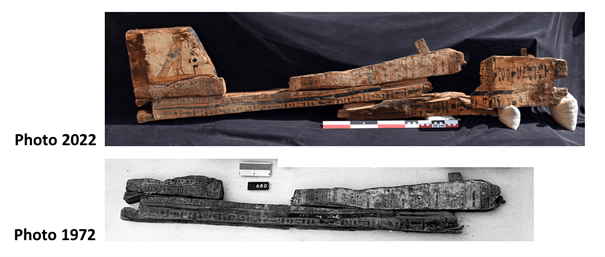
Much progress was also made in assigning previously not identified pieces of painted wooden coffins to specific coffins documented by the Austrian mission in the 1970s. One important example is Reg. 680 for which four new matching pieces were found. However, for this important coffin of the founder of the 30th Dynasty reuse of TT 414, Pa-di-Amun-neb-nesut-tawy I, there are still two missing pieces from the left side of the coffin and its foot part which were documented in the 1970s. Fig. 2 shows the comparison between the status of the right side of the upper part of the coffin in 1972 and in 2022 with three matching fragments. This coffin is thus a good example for the challenges in our work – there are still missing pieces for important coffins and the identification of all fragments is not yet fully accomplished.

Fig. 2: Comparison of part of coffin Reg. No. 680 between status in 1972 and 2022 – note three new matching pieces to the right side of the lid.

Many painted wooden coffin fragments were cleaned and consolidated in the 2022 season by our conservators Antje Zygalski and Noura Mustafa El-Taher. Noura did an amazing job in reconstructing free standing elements of coffins in the shape of djed-pillars and Isis-symbols.

Fig. 3: Noura working on the fragments of djed-pillars and Isis-symbols. She managed to reconstruct several pieces out of broken fragments (photo: J. Budka).
Fig. 4: Some examples of the newly reconstructed Isis-symbols (photo: J. Budka).

The best example that we were able to identify new owners of coffins during the 2022 is Reg. No. 689, found in the debris in the burial chamber of Ankh-Hor. The lady Takerheb is now confirmed as the owner of this piece.

During the 2022 season, also some new names of persons buried in TT 414 were identified. For the 26th Dynasty, a possible new female relative of Ankh-Hor was recorded. The fragment of a new anthropoid coffin, K07/243, gives the name Ta-dj-Iset (a common name in the 25th and 26th Dynasties), previously unknown from TT 414. Since there are several Pa-di-Iset attested in Ankh-Hor family, this new female might extend the family tree – for more information, I will need to identify matching pieces to this newly recorded coffin fragment.

In addition to the stylistic assessment of the cartonnages from TT 414, much progress was done this season in identifying the owners of these trappings. Thanks to infrared photography, some names and titles became readable and allow to attribute cartonnage elements to Ptolemaic individuals already known from other objects, for example a new cartonnage element is attested for G 148, Ta-sherit-Khonsw, with K08/85.

One particular important identification of a new cartonnage element is the one for Twt, an individual otherwise only attested by his outer anthropoid coffin in yellow-red on black-style (Reg. No. 510). This also offers us the possibility to compare the motifs and styles on coffins and cartonnages.

New coffins were also assigned to known persons buried in TT 414. As one example, the inner anthropoid coffin fragment of Imhotep (G 16) was identified with Reg. No. 19/04 and is now a new addition to his set of coffins with an outer coffin in black-yellow style, Reg. No. 759.

Fig. 5: Foot part of the inner coffin of Imhotep, already documented in 2019, but now newly assigned to its owner (photo: C. Geiger, ©Ankh-Hor Project).

To conclude, several new observations on the material from TT 414 are possible as direct results of the 2022 season, in particular in three main thematic fields, first of all because of the extended application of infrared photography: 1) genealogical information and new coffin owners, 2) additions to existing tomb groups as well as 3) a better understanding of the coffin design and the main motifs, also in relation to cartonnage elements.

Despite of all this progress, large amounts of fragments of coffins and cartonnage from the Late Period to Ptolemaic and also Roman times remain to be cleaned, are partly in need of reconstruction and of full documentation. Our work therefore needs to be continued in the next season. Our 2022 results hopefully show that these efforts are immensely worthwhile.