The 2023 season of the Ankh-Hor project in retrospect

Today four weeks ago we closed the 2023 season of the Ankh-Hor project in Luxor. Time for a little review of a very successful season.

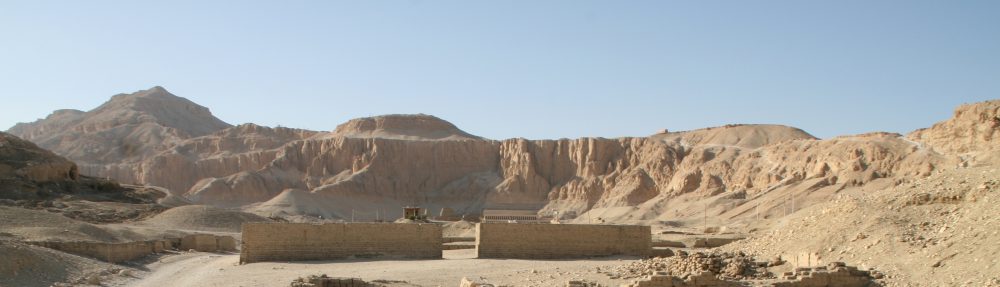
Work was conducted from September 5 to October 5, 2023, with our very helpful SCA Inspector Mahmoud Sayed Abdelhady. The major goal was to continue the cleaning, consolidation, and documentation of the large number of objects excavated in the 1970s from TT 414, the monumental tomb of Ankh-Hor, High Steward of the Divine Adora-trice Nitocris (26th Dynasty).

Several previously not identified pieces were newly recognised as matches to coffins documented by the Austrian mission in the 1970s. Some of these were joined by our conservators Mohamed and Karima to the already documented pieces. One example is Reg. No. 827 – Fig. 1 shows the state of documentation in the 1970s compared to 2023; this season, we found a small new piece matching to the instep of the lid. All pieces of Reg. No. 827 were cleaned and consolidated.
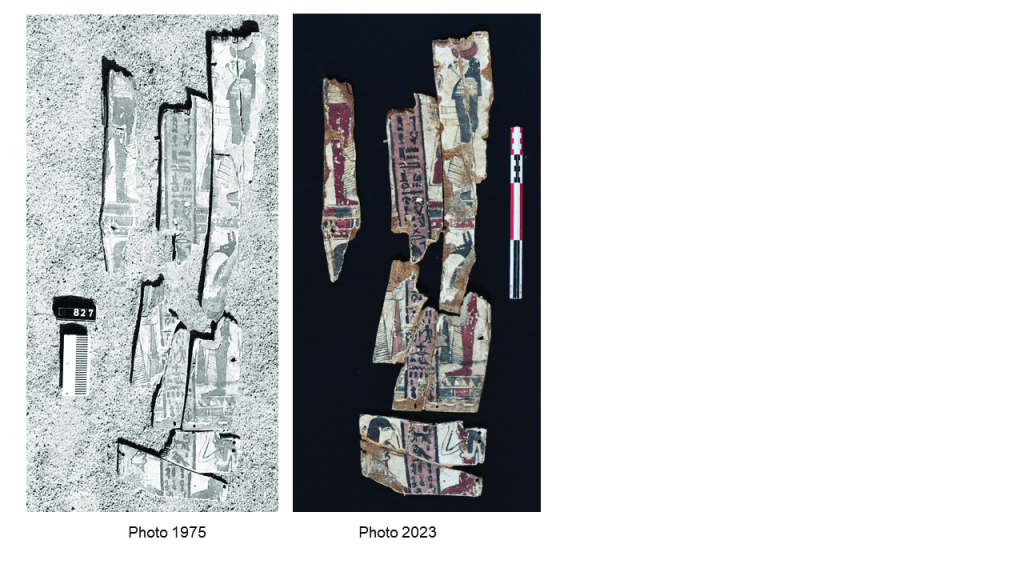
Fig. 1: Reg. 827, a fragmented Ptolemaic coffin lid. Left the state in 1975, to the right our new match in 2023.

In general, all finds studied in 2023 were digitally photographed and entered in a database, created by File Maker Pro. In total, more than 180 individual objects (mostly coffins and cartonnage elements) were studied and documented by more than 2400 photos. These new photos are suitable for publication and show the colours of the pieces, in contrast to the previous documentation in the 1970s (see Fig. 2).

Fig. 2: Reg. 521, one of the examples showing the benefits of high-resolution photography in full colour.

Since many the painted objects from TT 414 have darkened surface, infrared photography was used to make the original decoration visible (with a Sony Cybershot DSC-F828, an IR-filter and a small magnet). In 2023, this method was applied to a total of 95 objects.

We introduced a new method of documentation in 2023. The app Scaniverse (see https://scaniverse.com/) was used to capture objects in 3D. This photogrammetry application is ultrafast, highly accurate and very easy to use. 170 objects from TT 414 were captured with metrically accurate 3D models this season – simply fantastic!

Ashraf and I with the box of objects we transported in 2023 to the magazine (photo: P. Heindl).

One of the highlights of this season was the transport of objects to the magazine of the West Bank. In addition, we were able to work on coffins we transported to the magazine in earlier years. My personal highlight was the new documentation of one of my favourite coffins from TT 414, of Reg. 655, with infrared photography and with a 3D model.

3D model of coffin Reg. 655 created with the app Scaniverse

The conservators of the LMU Munich Ankh-Hor Project in the 2023 season were the specialists for wood, Mrs. Karima Mohamed Sadiq and Mr. Mahmoud Mohamed Mahmoud. They did a fantastic job, both at our site and in the magazine of the West Bank. A total of 108 wooden and painted objects, mostly coffins, comprising 294 individual pieces, were successfully cleaned and consolidated in 2023.

To conclude, the fifth season of the LMU Ankh-Hor Project was carried out successfully, with much progress regarding the consolidation and documentation of wood and cartonnage coffins from TT 414. Thanks to the transfer of objects to the magazine and the placement of studied finds in sugar bags in corridors of Tomb I, much space was gain in the mission’s magazine which is crucial for the future jigsaw puzzle of coffin fragments, both in wood and cartonnage. New genealogical information regarding coffin owners were unearthed and the stylistic assessment of Ptolemaic cartonnage coffins advanced in 2023 in many aspects, including reconstructing new cartonnage coffins.

The rich potential of our work on the cartonnage coffins can be illustrated with Reg. 23/04. I was able to match several fragments of the edge of the base of a cartonnage coffin which was previously not documented (Fig. 3). Based on the father’s name, the titles and the close similarity with Reg. 860, the coffin of Horakhbjt, I would like to propose to identify the owner of Reg. 23/04, Wesjrwer, as the previously unknown brother of Horakhbjt.

Fig. 3: Reconstruction of nine fragments of the edge of a cartonnage coffin of Wesjrwer.

Since not all fragments of wooden and cartonnage coffins from TT 414 are yet consolidated and documented, our work needs to be continued in the next season.

For now, I would like to express my gratitude to all of our Egyptian colleagues without whom work would not have been possible. I am very grateful to all team members of the 2023 season: Patrizia Heindl, Caroline Stadlmann, Ahmed Elmaklizi, all LMU Munich, and Karima Mohamed Sadiq and Mohamed Mahmoud Mohamed Mahmoud as the conservators of the Ministry of Antiquities and Tourism. Ashraf Hosni Teegi did another great job as the head of logistics. Many thanks to all and we are all very much looking forward to the next season!

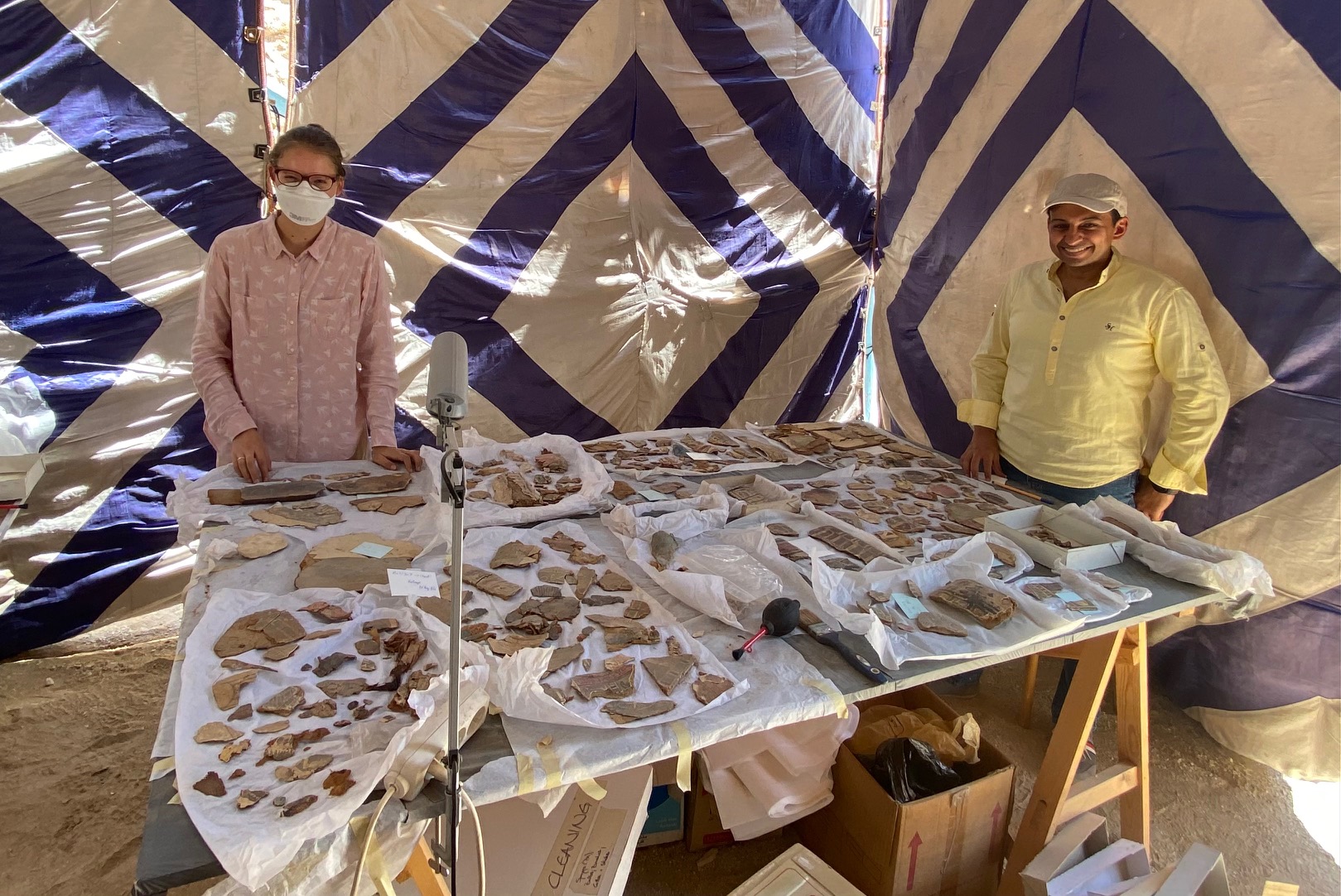
The 2023 team of the LMU Ankh-Hor Project.

Summary of week 2 of the 2023 season

This week has been extremely productive, and we made much progress in our work tasks. In terms of conservation, the consolidation and cleaning of objects from TT 414 progressed very well thanks for the efforts of our conservators Karima and Mohammed. The focus was on Ptolemaic painted coffins and for many of them, matching pieces could be glued together. Despite of this time-consuming task of gluing, already 38 registered numbers with more than 70 individual pieces have been treated by our conservation team until today.

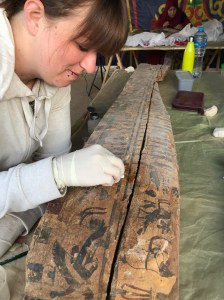
Mohammed fitting together two broken pieces of a Ptolemaic coffin lid.
Karima cleaning and consolidating another fragment from this coffin lid.

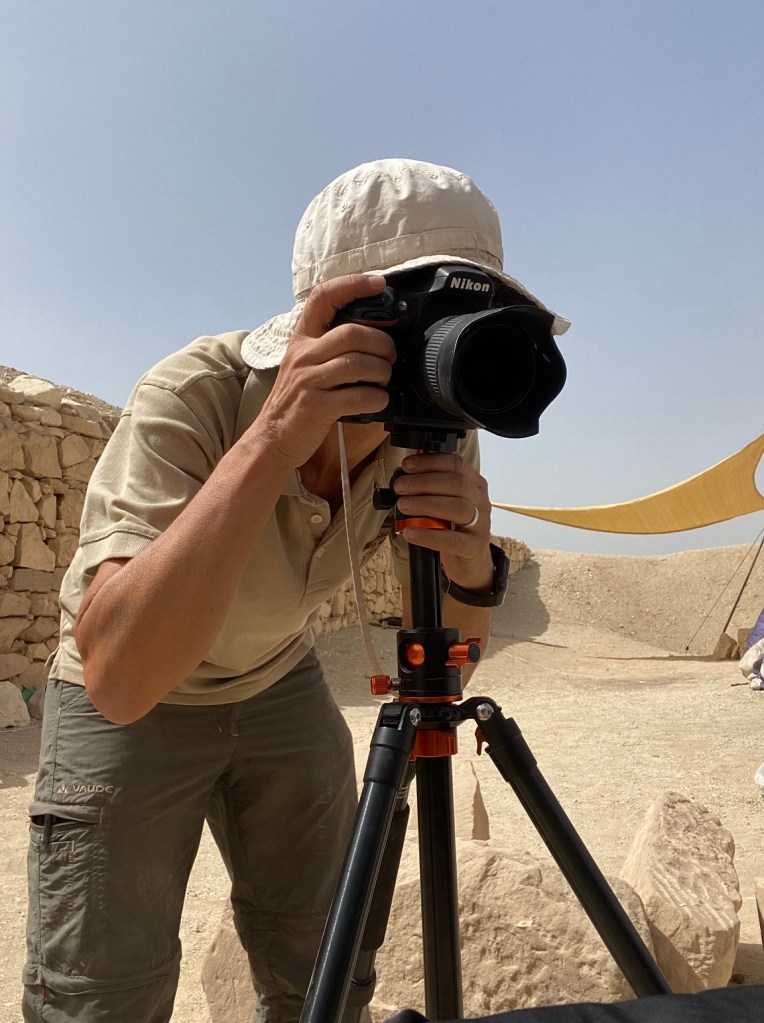
My tasks are currently to prepare the objects chosen for consolidation according to priorities, photographing them (with our full-frame camera for high resolution photos as well as with infrared photography where necessary) and identifying fragments without object numbers.

Photographing is one of the main steps of documentation in our project.
Reg. 07/58, the lower part of a Ptolemaic coffin after cleaning.

For one coffin fragment, the base of an inner anthropoid coffin (Reg. 07/58), I noticed a very interesting detail. There is a substantial amount of black goo (bitumen/resin) on the interior of this coffin – a common feature in our corpus, especially for the Ptolemaic coffins. Although this substance partially obscures the decoration of painted pieces, it is also an interesting archive of information in itself. For example, back in 2021, we documented the so-called “beetle coffin”, where a number of beetles were stuck into the resin/bitumen. There are other examples in which the negative traces of the mummy and/or of rolls of papyrus are traceable in the black goo. For Reg. 07/58, we can reconstruct that the mummy was covered in a bead net and this net has left an imprint in the resinous substance.

Detail of imprint of bead net in the black goo covering the interior of Reg. 07/58.

Thus, although only very fragmentarily preserved, this coffin fragment offers quite some interesting information on the burial which was once placed in it and got looted prior to the excavation of TT 414.

Newly documented pieces are getting measured and described as well. With the exciting new possibility of 3D scanning with Scaniverse, we will complement our documentation with this useful asset.

Finally, despite of all the digital documentation, we also use traditional methods like drawing for small objects and wooden pieces where the illustration of the construction is highly relevant. This working task was started during week 2 as well, thanks to the arrival of Patrizia Heindl.

First drawings of objects from TT 414 were realised this week thanks to Patrizia.

More team members will arrive later today, and I am very much looking forward to week 3 of our 2023 season.

Successful start of the 2023 season

Today was the opening day of our 2023 season of the LMU Ankh-Hor Project. All went very smooth, thanks to the great colleagues in the inspectorate in Luxor and on the west bank and first of all our wonderful inspector Mahmoud Sayed. We are currently a small team, but more team members will arrive next week. This year’s focus will be on conservation and documentation of wooden painted coffins and cartonnage cases from TT 414, the tomb of Ankh-Hor.

All set up for work in the Asasif – our conservation tent early in the morning.

Like in the last years, we have again a very comfortable, spacious conservation tent set up as well as smaller tents for documentation and drawing of objects. All working steps are by now already routine – I started sorting Late Period and Ptolemaic coffins according to priorities and took first photos of selected pieces.

I am very happy that our two Egyptian conservators, Mohammed Mahmoud and Karima, started their work already today. Both are experts for wood and have an extensive working experience here in Thebes but also at other sites in Egypt. Mohammed has worked with us already in 2021 and is thus very familiar with the material from TT 414.

Mohammed set up the working spaces and continued seamlessly with his conservation work from 2021.
Karima is joing us for the first time and had a great first day like all of us!

Today, already several fragmented Ptolemaic coffins were successfully cleaned and consolidated – a wonderful start and a very nice outlook for the next weeks!

Presenting the Ankh-Hor Project at the ICE 2023 in Leiden

It has been a wonderful week so far – more than 800 Egyptologists are gathering for the 13th International Congress of Egyptologists in the beautiful city of Leiden! Many congrats to the organizers for a fantastic job – there are multiple sessions and several workshops as well as outreach lectures and receptions. Recent finds and results from the field are presented as well as crucial questions addressed and innovative methods and theories discussed.

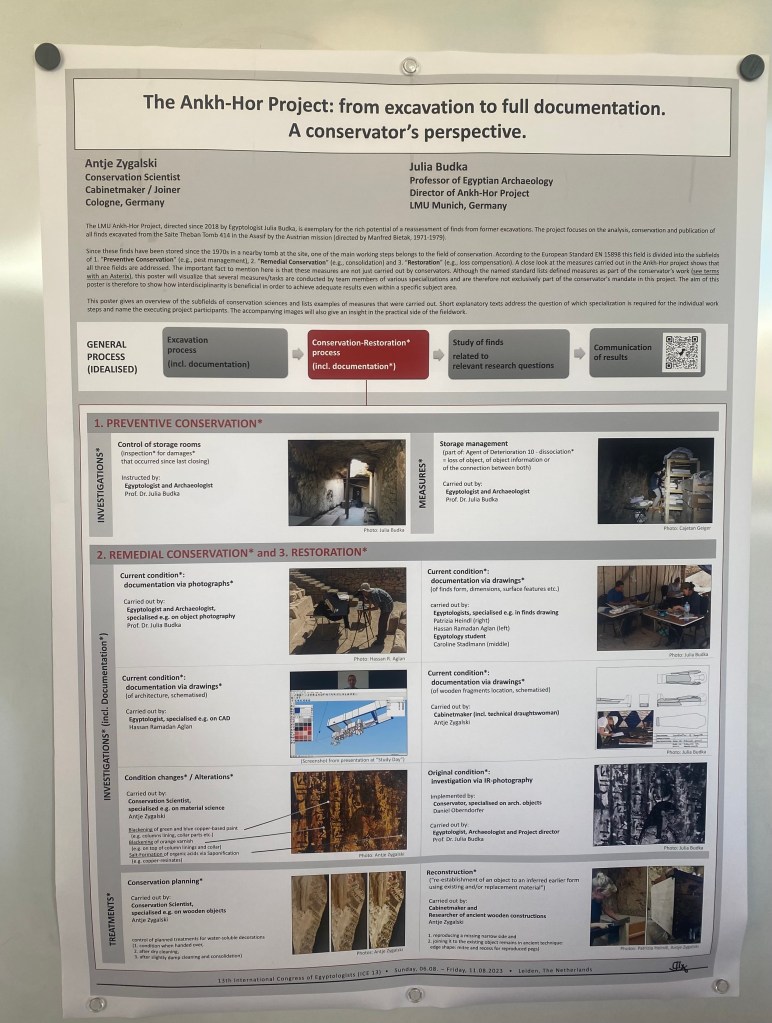
Today is the day for the poster presentations. I am very happy that Antje Zygalski prepared a poster about the Ankh-Hor Project: “From excavation to full documentation. A conservator’s perspective” aims to show the benefit of interdisciplinary approaches in the field, of bringing together various fields of expertise and different skills in the overall workflow.

Our poster is exhibited in the P.J. Veth Building and will be accessible until the end of the congress.

For those of you who are in Leiden – we will be presenting the poster this afternoon and are looking much forward to any questions or feedback.

Week 3 of field season 2022: a short update

We have just completed week 3 of our field season 2022. We managed to make good progress on many of our work tasks. I had to go back to Germany for other important tasks, but thanks to Patrizia, Hassan and Ashraf as well as the support from the local authorities, the remote supervision from Munich is really easy.

Most importantly, Patrizia arrived last weekend and started her work in week 3 which focuses this year on drawing special objects like stamped bricks and unclear painted mud fragments.

Patrizia and Hassan busy drawing various kinds of small finds.

Strengthened by Hassan Ramadan and our inspector Saad Knawy, the drawing team of this season is extremely effective and covers all categories of small finds – from ceramics to mud shabtis, faience shabtis, wooden statues and boxes as well as a few selected coffin fragments.

Our inspector Saad is making great progress in drawing small finds (photo: P. Heindl).

The conservation team continued its work – Antje Zygalski focused on the reconstruction of a Middle Kingdom rectangular coffin which was found in one of the shaft tombs in the Austrian concession while Noura was busy cleaning Ptolemaic coffin fragments from TT 414.

Antje working on the Middle Kingdom coffin (photo: P. Heindl).
Our Egyptian colleague Noura cleaning Ptolemaic coffin fragments (photo: P. Heindl).

I managed to complete the documentation of the most important boxes with cartonnage fragments – there are already some exciting new data gained from this which I will share in a separate blog post. Much progress was also made in documenting Ptolemaic wooden coffins by photography. It was already highlighted that one of my most favourite coffins from TT 414, Reg. No. 657, is adding fresh ideas about the tomb group of Isetemkheb and the family of Wahibre I.

The conservation, cleaning, photography and drawing of the rich material from the tomb of Ankh-Hor in the 2022 season has already provided very interesting results – and we have two more weeks to go, so stay tuned for more exciting news!

Week 2 of field season 2022 in pictures

It is always a miracle that the time on an excavation goes by even faster than at home. Week 2 of our field season 2022 just ended and was very successful in many respects.

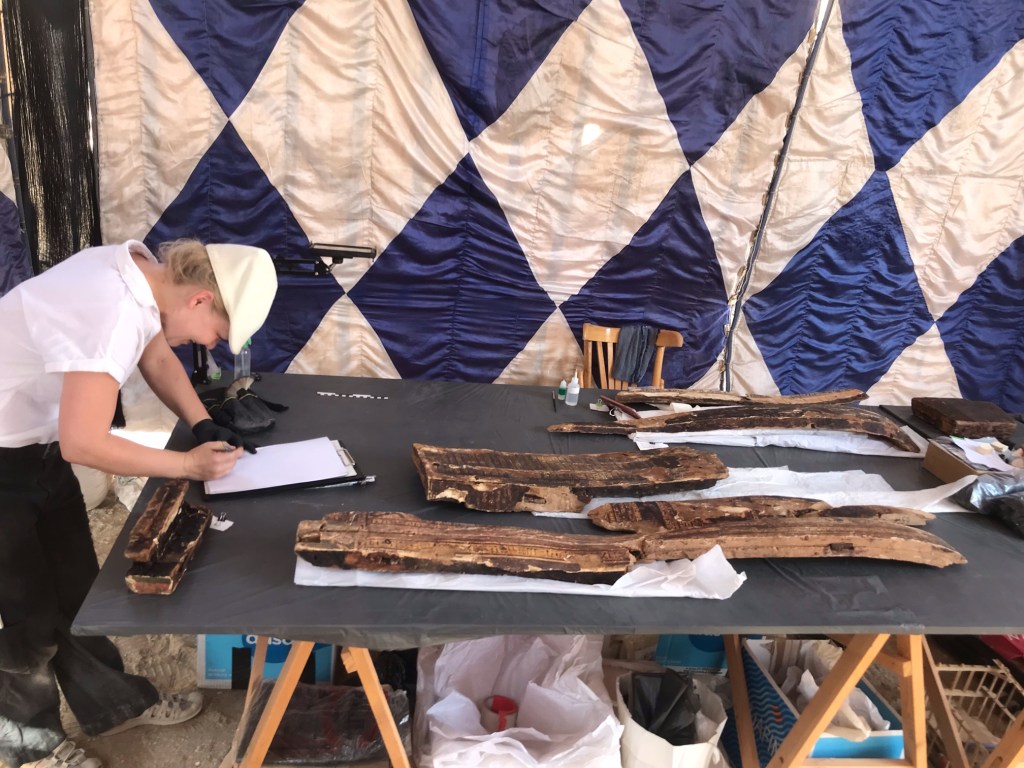
Most importantly, the new conservator of the project has arrived and joined the team this week. Antje Zygalski is a researching conservator for archaeological wooden objects (furniture, sculptures, panel paintings etc.) and a preventive conservator for archaeological and historical objects. She has started her work and is now very productive cleaning and consolidating coffin fragments from TT 414.

Antje busy documenting already cleaned pieces from a Ptolemaic wooden painted coffin.

We also have an Egyptian conservator, Noura, as a new team member who is helping us with the cleaning of the large number of objects (I need to take a working pic of her next week 😉).

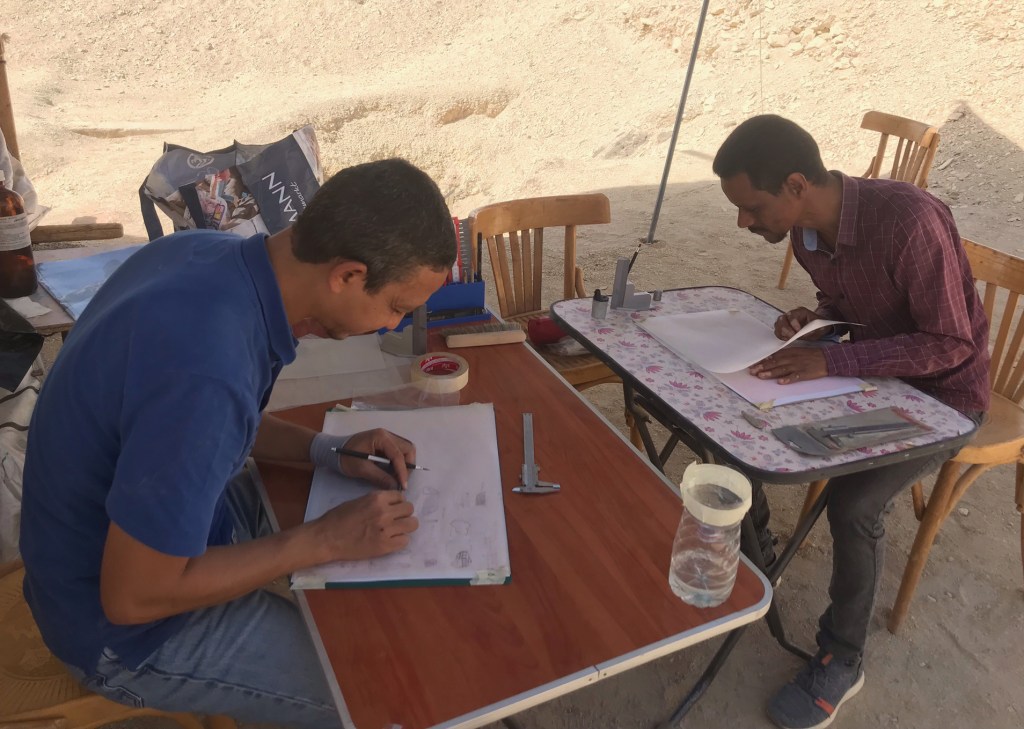
Hassan Ramadan continued the documentation of various small finds by drawing in week 2. He also introduced our inspector Saad Knawy to the archaeological illustration of objects – Saad got an intense training with Late Period clay shabtis and is already making great progress.

Hassan and Saad produced a considerable amount of drawings of objects in week 2.

From now until the end of the season, Hassan will focus mostly on wooden objects like shrines and pedestals for stelae – he has already much experience with this kind of material from TT 414.

Fragmented shrines and other wooden objects are documented in detail by Hassan.

I started the week with finding more fitting pieces of coffins as well as identifying unnumbered ones and photographing these. I then proceeded to study and document fragmented Ptolemaic cartonnages. There are many boxes with small and sometimes larger pieces for which the challenge is to identify related pieces originally belonging to the same cartonnage element. Many of the pieces represent funerary masks of a well-known Theban Ptolemaic type. Larger fragments covering the body of the mummy are often decorated on both sides, with very interesting designs of the sky and deities on the interior.

The typical content of one of the dozens of boxes of cartonnage elements – here, there are mostly fragments from Ptolmaic funerary masks.

Infrared photography works perfect for pieces of cartonnage with darkened surfaces and I could identify some names and titles using this method. This allows me to attribute cartonnage elements to persons buried in TT 414 who are already known from their wooden coffins. In the 1970s, the fragmented cartonnage pieces could not be studied because of time restrictions – therefore this new study is of key importance to reconstruct the former burial assemblages. Apart from this great advancement in attributing cartonnage elements to Ptolemaic individuals using the tomb of Ankh-Hor as a burial place, the stylistic assessment, and the comparison of the design of cartonnages with the one of coffins is extremely promising and will take more time and a detailed study.

For now, we are very much looking forward to week 3 of our 2022 season! Conservation, cleaning, photography, study and drawing of the rich material from the tomb of Ankh-Hor will of course continue.

All set for the 2021 season

Tomorrow will be the day: we will open the 2021 season of the LMU Ankh-Hor project. Not all members of the field season have yet arrived but will do so in the next days.

Thanks to much help by kind colleagues both in Cairo and in Luxor, I was able to get all paperwork done well in time. In addition, I joined the South Asasif Conservation Project directed by Elena Pischikova and started to work on the amazing amounts of pottery they unearthed in newly discovered tombs! I will continue to work in part-time for this mission and I am looking much forward to such an opportunity of a direct comparison between the South and the North Asasif. The parallels are really intriguing!

At our site in northern Asasif, we were already allowed to set up our beautiful conservation tent. Starting from tomorrow, this tent will be the centre of our conservation programme focusing on Ptolemaic wooden coffins and cartonages but including other painted objects as well.

We will keep you updated about our progress in the next four weeks!

Finally: preparing the 2021 season

After a long break because of the pandemic, it is finally happening again: we are preparing our next season for the Ankh-Hor project in Luxor, Asasif. Because of the covid-19 crisis, the season will be a bit shorter and the team smaller than originally envisaged – nevertheless I am very excited and happy to soon be back in Egypt! We will start by mid-September for four weeks. I also plan to join the South Asasif conservation project and document the new ceramics the team found this year and in 2020.

For the Ankh-Hor project, the goals of the 2021 season are to continue what was sucessfully started in the 2019 season: the large-scale conservation programme and our detailed documentation of finds from the tomb of Ankh-Hor (TT 414). A fresh team of young conservators, both students and graduates from the University of Applied Arts in Vienna, will join us for the consolidation work. This season, we will focus besides the wooden coffin fragments also on a large number of cartonnage pieces of which many are still unregistered.

These fragments, covering a large time span and showing various styles and colouring schemes, will potentially reveal important prosopographic information on the persons buried in TT 414 starting from the 4th century BCE. My hope is that we can find new evidence on such cartonnage cases for the names of fathers or mothers of persons holding the same name (and sometimes the same titles) to identify specific individuals. There is no doubt that this will be again a challenging jigsaw puzzle and of course we will keep you updated about the process and the results.

Closing of the 2019 season of the Ankh-Hor project

From Luxor back to Munich – it was not in particular a warm welcome yesterday, arriving at Munich airport with snow showers and much too low temperatures for March! Well, today it is quite sunny and time to resume the last day of work in Asasif.

My last sunrise at TT 414 for 2019…

We successfully closed our tomb magazine and the 2019 season on Sunday – it has been some very intense days full of work and things to organize. Our conservators provided me with a fully illustrated and concise report about the large amount of conservation work conducted in 2019 – in total, 61 objects, in particular coffins, including the five fragmented ones we transported to the magazine, were successfully cleaned and consolidated.

Hassan and Mona were also very productive, resulting in more than 80 drawings of wooden objects, small finds and ceramics. In addition to these drawing, more than 470 objects were photographed by Cajetan with our full-frame camera with very high resolution.

In the final days of work, I took some last photographs of objects, last coffin fragments were cleaned and consolidated. And of course I continued to organize the magazine. Since it always happens on excavations that something new and important turns up at the very last day of work, I was not surprised that I found some new fitting coffin fragments literally in the last minutes of work…. These new fragments are important because they belong to a fascinating, but unfortunately very fragmented coffin we documented earlier this season.
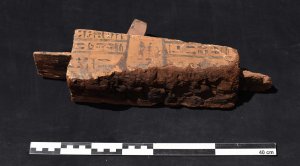

Reg. 661 are fragments of a nicely painted, inner anthropoid wooden coffin which was found as one of the secondary burials within the burial compartment of Ankh-Hor (Room 7.2). For our conservators, these fragments presented one of the biggest challenges this year: The soft wood fragments are partly blackened and burnt due to the looting of TT 414 and the respective damage to the tomb inventories.

Part of Reg. 661 illustrating the bad condition of this coffin.

The owner of Reg. 661 was a female singer of Amun-Re from Karnak with the name Taremetjbastet. Since we know her family relations very well, we can date her death and burial to between 320 and 300 BCE.

The owner of Reg. 661 belongs to a well-attested family of Amun priests from Karnak buried in TT 414.

Of particular interest is the decoration of the foot part of the coffin – I have published first ideas about Reg. 661 already some years ago (Budka 2013). In the center of the foot board there is a sun disc flanked by a snake and a crocodile – this is nothing else than the opening scene of the Litany of Re, attested for the first time in the famous tomb of Sety I in the Valley of the Kings! To be best of my knowledge, there is only one parallel for this motif on foot boards of private coffins – and this is CG 29316, a stone sarcophagus from the 30th Dynasty (see Budka 2013).

Our wooden coffin Reg. 661 from TT 414 is exemplary for is the complex creation of decorated and inscribed coffins in Thebes during the 4th century BCE – Amun priests were extremely creative in combining various aspects, especially cosmogonic ones, using older texts and depictions and creating new ones, focusing on the resurrection of the deceased in conjunction with Re and Osiris. Still little is known about this fascinating creative work which is embodied in funerary objects like coffins, but also cartonage and canopic boxes – all of which are so plentiful from TT 414.

The lid fragments of Reg. 661 which I re-located in the last minutes of the 2019 season still need to be consolidated in the next season of the Ankh-Hor Project – like many other pieces, in particular of Ptolemaic and Roman coffins. Thus, Reg. 661 with its intriguing decoration nicely illustrates the already successful outcome and the scientific potential of the Ankh-Hor Project – but also the urgent need to continue our jigsaw puzzle reconstructing the complex burial processes in TT 414 and enlightening the intricate design of 30th Dynasty and Ptolemaic wooden Theban coffins.

Reference

Budka, Julia. 2013. Krokodil, Schlange und Kuhantilope: Ein frühptolemäischer Holzsarg aus dem Grab des Anchhor (TT 414), in: Florilegium Aegyptiacum ‒ Eine wissenschaftliche Blütenlese von Schülern und Freunden für Helmut Satzinger zum 75. Geburtstag am 21. Jänner 2013, ed. by Julia Budka, Roman Gundacker and Gabriele Pieke, Göttinger Miszellen Beihefte 14, Göttingen, 41–57.

Summary of week 3 of the Ankh-Hor project

The end of our 2019 field season is rapidly approaching – the last team members will be leaving tomorrow, I will have some more days to organize the magazine and for last minute photography.

The remaining members of the Ankh-Hor Project team this week.

Like in week 1 and week 2, the main tasks this week were the cleaning and consolidation of Ptolemaic coffins from TT 414. Since most of the group of conservators already left earlier this week, Stefanie and Victoria focused on different pieces, with a large side board of a nicely painted coffin from the shaft of room 10 as one of the highlights.


Most importantly, we succeeded in transporting four boxes with five coffins from the tomb of Ankh-Hor to the study magazine here on the West Bank.

This allows me to re-organise our tomb magazine further; urgently needed space for more coffin fragments to be consolidated and studied is now available.

While I documented the newly consolidated coffin fragments with photos, Mona and Hassan were busy drawing pottery fragments and small finds. Hassan documented in particular wooden objects like lids of shrines and fragments of Ptah-Sokar-Osiris statues. Mona was also working on some nice Middle Kingdom pottery – both from Tomb I, the saff tomb functioning as our magazine at the site, and from 12th Dynasty shaft tombs excavated in the 1970s.

The final phase of our 2019 season has already begun, I will be busy writing the report over the weekend and I am much looking forward to the last days of work next week.