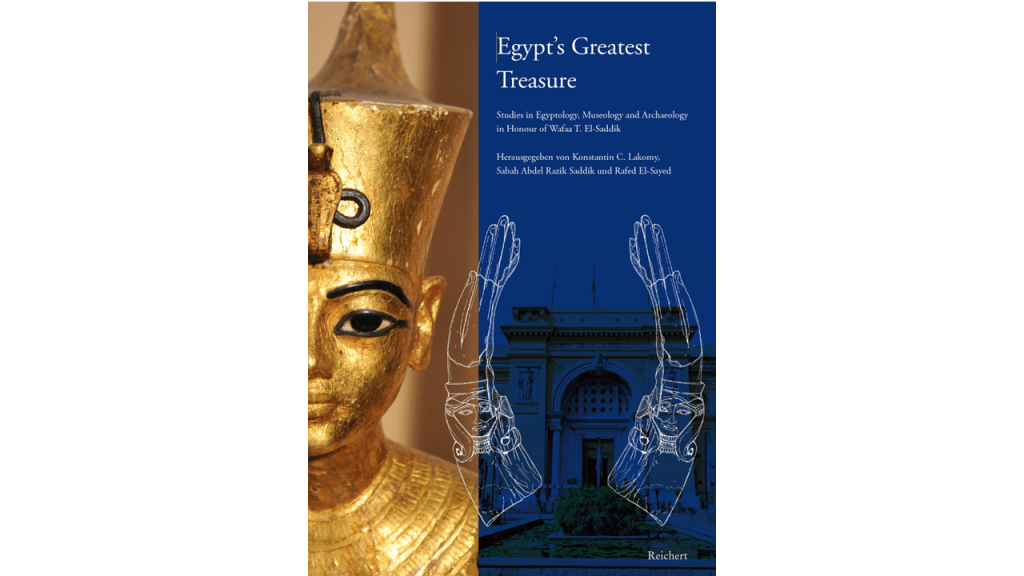
I am delighted to announce the publication of further material from TT 414. The splendid Festschrift for my dear colleague, Wafaa El-Saddik, brings together a wide range of studies in Egyptology, museology, and archaeology. Among them is a short article on the lesser-known cartonnages from the tomb of Ankh-Hor (in German).
I hope this article emphasises the importance of analysing the neglected cartonnage coffins of the Ptolemaic era in Thebes, and to compare them with the better-researched wooden coffins. Significant similarities and differences emerge in terms of motifs and style, in particular. Sets consisting of both types of coffin, such as those belonging to the Wesjr-wer family whose members were buried in TT 414, provide a valuable opportunity to gain a more comprehensive understanding of Ptolemaic coffin production in Thebes (see already an earlier blog post).
I would especially like to thank the editors of the Festschrift for enabling the last-minute incorporation of the most recent results from the 2025 season!
The material from TT 414 is ideally suited to demonstrating the benefits of analysing materials, decoration, texts, and prosopographic data together. It also illustrates the value of time-consuming research across different locations and museums and of re-evaluating ‘old excavations’. Research which we are keen to continue in 2026.
Reference:
Julia Budka, Spurensuche zwischen Wien, Kairo und Theben: Neues zu Kartonagen aus dem Asasif, in: Konstantin C. Lakomy, Sabah Abdel Razik Saddik & Rafed El-Sayed (eds.), Egypt’s Greatest Treasure. Studies in Egyptology, Museology and Archaeology inHonour of Wafaa T. El-Saddik, Wiesbaden, 175‒186.
It’s been almost a year since we closed the 2024 season, and I’m thrilled and grateful that we opened for the 2025 season of the LMU Ankh-Hor Project yesterday.
As with last year, our focus will be on sorting, documenting and consolidating the fragmented wooden and cartonnage coffins from TT 414. Thanks to our kind inspector, Hassan Khalil, and our excellent workmen, supervised by Ahshraf Teegi, setting up was incredibly straightforward this year.
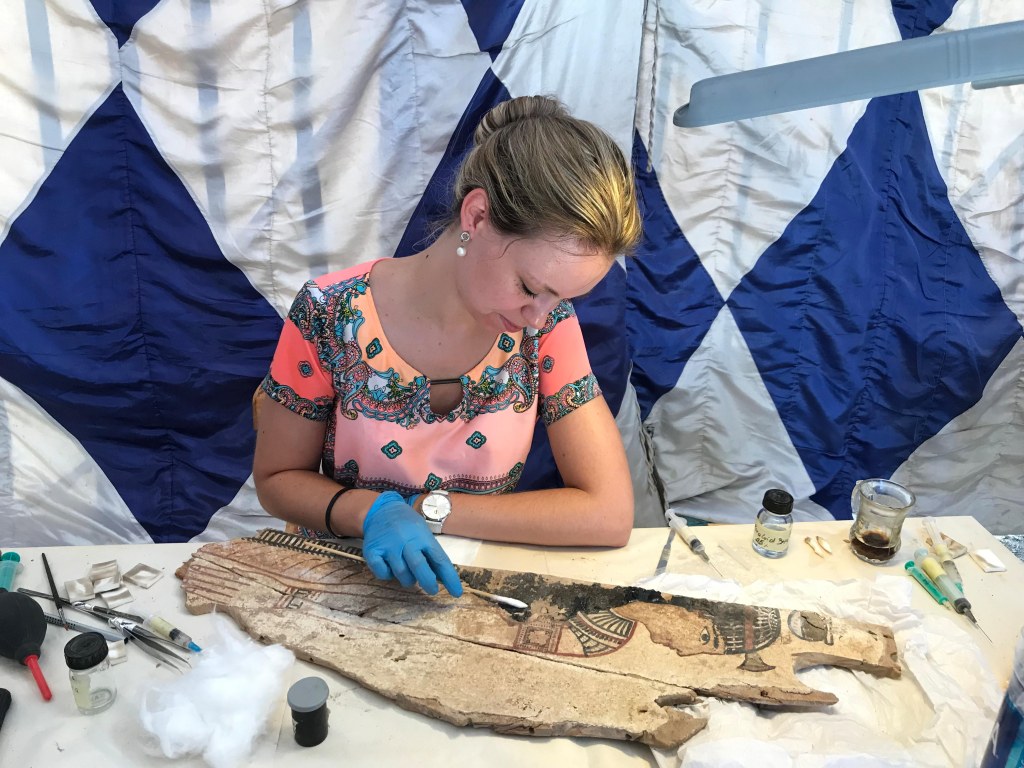
Our excellent conservator, Mohamed Mahmoud, has already got to work. Having joined us a few years ago, he is very familiar with both our workflow and the materials from TT 414. Mohamed has finished cleaning and consolidating some wooden pieces, as well as the first fragile cartonnage fragments for this season. Here he is working on one of the smaller pieces that he has fixed so nicely.
I continue to document the newly consolidated pieces using both our full-frame camera and the Scaniverse app to create 3D scans. The latter produces high-quality 3D models, as can be seen in this video of another cartonnage fragment consolidated by Mohamed.
One example of the newly cleaned cartonnage fragments from TT 414.
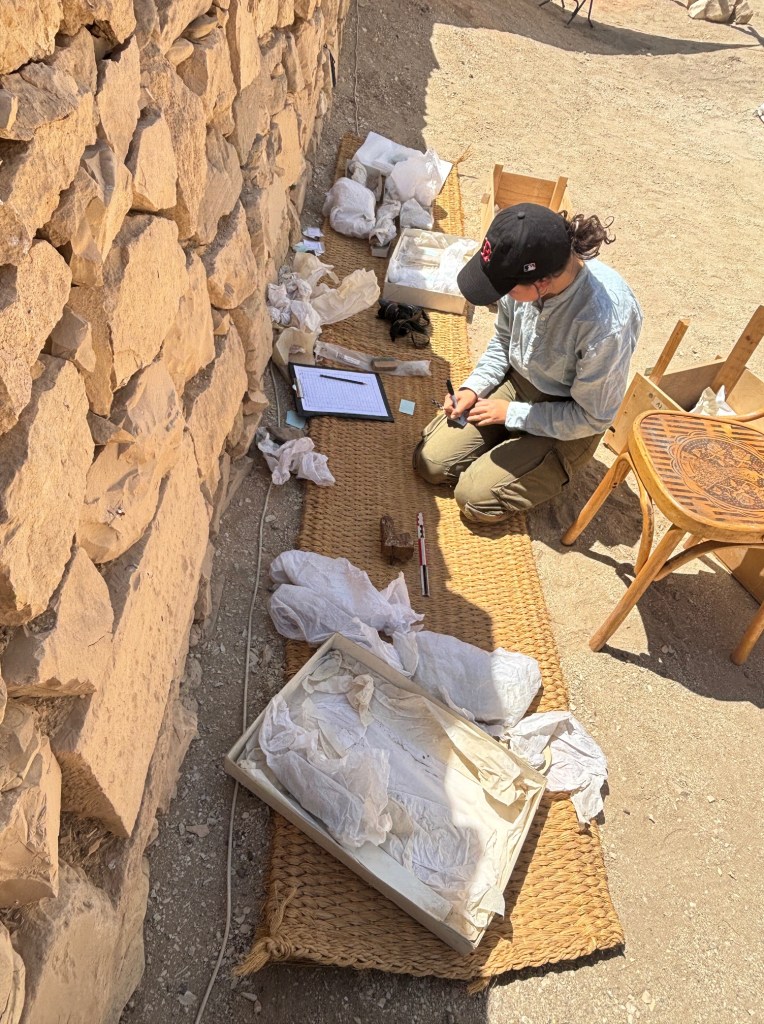
Furthermore, I have already succeeded in finding several pieces that can be joined to coffin fragments that have already been documented and registered in earlier season. This shows that all our efforts with the large quantity of finds from TT 414 are worthwhile.
Sorting through boxes of coffin fragments and adding photos and notes to their documentation is something that Ladina Soubeyrand is doing, just like she did last year. I am extremely grateful that she is joining us again this season!
Overall, the last two days were busy and successful, and we are looking forward to the rest of the season. We will, of course, update you with further blog posts, including photos, videos and more information!
We have just completed week 3 of our field season 2022. We managed to make good progress on many of our work tasks. I had to go back to Germany for other important tasks, but thanks to Patrizia, Hassan and Ashraf as well as the support from the local authorities, the remote supervision from Munich is really easy.
Most importantly, Patrizia arrived last weekend and started her work in week 3 which focuses this year on drawing special objects like stamped bricks and unclear painted mud fragments.
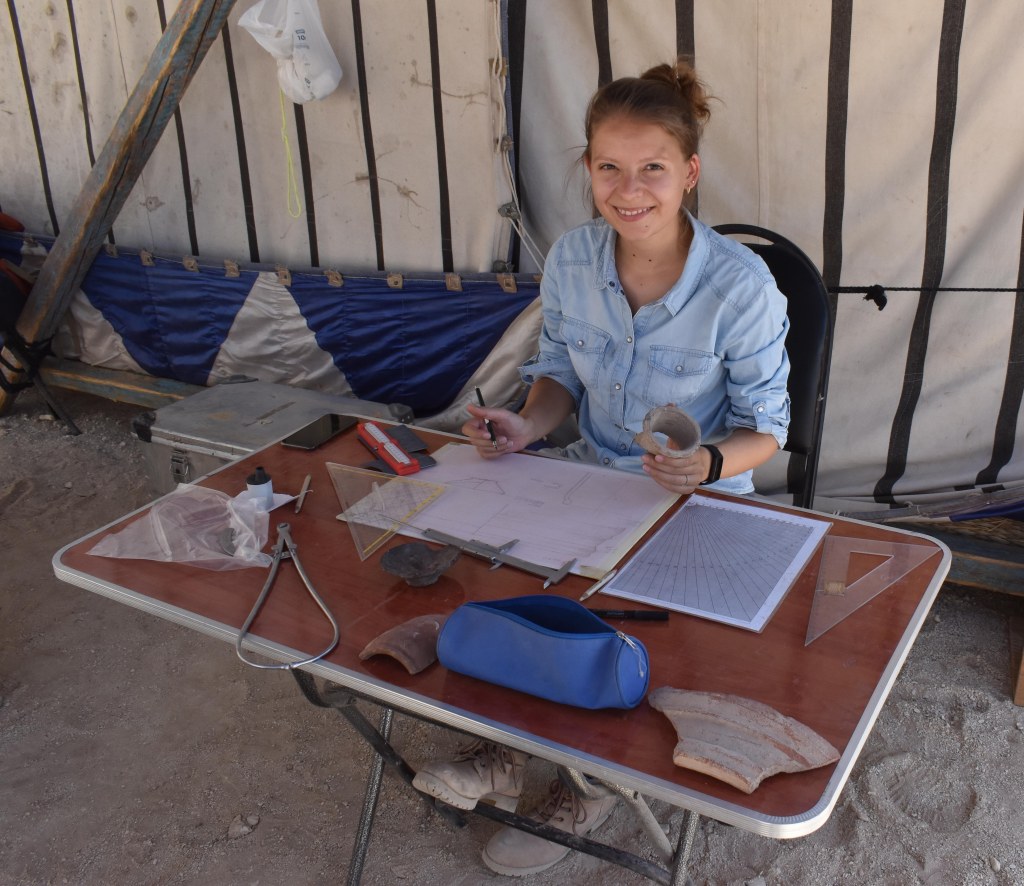
Patrizia and Hassan busy drawing various kinds of small finds.
Strengthened by Hassan Ramadan and our inspector Saad Knawy, the drawing team of this season is extremely effective and covers all categories of small finds – from ceramics to mud shabtis, faience shabtis, wooden statues and boxes as well as a few selected coffin fragments.
Our inspector Saad is making great progress in drawing small finds (photo: P. Heindl).
The conservation team continued its work – Antje Zygalski focused on the reconstruction of a Middle Kingdom rectangular coffin which was found in one of the shaft tombs in the Austrian concession while Noura was busy cleaning Ptolemaic coffin fragments from TT 414.
Antje working on the Middle Kingdom coffin (photo: P. Heindl).
I managed to complete the documentation of the most important boxes with cartonnage fragments – there are already some exciting new data gained from this which I will share in a separate blog post. Much progress was also made in documenting Ptolemaic wooden coffins by photography. It was already highlighted that one of my most favourite coffins from TT 414, Reg. No. 657, is adding fresh ideas about the tomb group of Isetemkheb and the family of Wahibre I.
The conservation, cleaning, photography and drawing of the rich material from the tomb of Ankh-Hor in the 2022 season has already provided very interesting results – and we have two more weeks to go, so stay tuned for more exciting news!
I am delighted that a new dissemination article was just published about our first field season since the covid 19-pandemic. I stressed in particular the advances due to infrared photography and the continuation of our conservation programme. The material from TT 414, and here especially the large corpus of painted coffins, has so much potential to answer various open questions about Late Period and Ptolemaic funerary archaeology in Thebes. In particular, the rich coffin material as well as cartonnages, canopic boxes, shrines, hypocephali and other elements of the tomb groups illustrate key aspects of Late Egyptian religious iconography which continues to fascinate me, and which will keep us busy during postprocessing the large amount of new data from the 2021 season.
The rich material from TT 414 in Asasif is still far from being processed in its totality.
We just finished a first, very successful week of our 2021 season. We started off with cleaning, dusting, and sorting things and are now well underway to document small finds, ceramics, shrines as well as wooden and cartonnage coffins.
The painted coffins from TT 414 belong both to primary burials of the family of Ankh-Hor and to secondary burials of Amun priests, mostly dating to the 4th and 3rd centuries BCE, which appear as relatively wealthy. Most of the material derives from the secondary use of the tomb. I am still busy collecting fragments which can be dated stylistically and because of the technique to the 26th Dynasty – these are usually very small pieces, sometimes just small splitters of the painting.
Example of small fragments of 26th Dynasty coffins including a piece from the outer coffin of Ankh-Hor (bottom right).
These are nevertheless important to reconstruct the original burials in TT 414 – yesterday, I found one loose fragment of the foot pedestal of the outer coffin of Ankh-Hor himself. This foot part is in a very fragile condition and will be consolidated later this season, including fixing the loose fragments back in place. Among the most interesting finds is another 26th Dynasty coffin giving the female name of a Mutirdis – a common name in this era, but I still do not know to which specific person this coffin once belonged. During the Austrian excavations in the 1970s and 1980s, no Mutirdis from the 26th Dynasty was recognised in the material from TT 414 – another example why our current work is so important to understand the complete phases of use in the monumental tomb of Ankh-Hor!
Jessica working on one of the late Ptolemaic coffin fragments.
The Ptolemaic wooden and cartonnage coffins are much better preserved and are currently treated by our conservation team. Since 2018, our conservation programme is conducted in cooperation with the Austrian Archaeological Institute (OeAI) of the Austrian Academy of Sciences. This year, our team is comprised of four young conservators, all graduates including one current student of the University of Applied Arts in Vienna. We are kindly supported by one of the experienced Egyptian conservators from the West Bank. The team finished already a considerable number of pieces in week 1 and these objects are now ready for their final photographic documentation with a full-frame camera with high resolution (Nikon D810 with a 35mm objective lens).
In terms of documentation, the Egyptologists of our team concentrate on ceramics and small finds. This week, Hassan and Patrizia were both busy with funerary cones. Patrizia, who is about to finish her PhD about Late Period statuary, wrote some years ago her BA thesis about funerary cones and thus shares my own enthusiasm for these intriguing objects which still pose some questions in the Late Period. Drawing these cones (among others funerary cones of Monthemhat, Padineith and Pabasa), Patrizia does not only focus on the stamped end but also on technical features, remains of colours and other details.
Although very challenging objects to draw, we love Late Period funerary cones! And Patrizia is doing a perfect job here.
Our youngest Egyptologist is Caroline, a MA student from LMU Munich. She is very talented and enthusiastic and started with drawing Late Period and Ptolemaic vessels. Later this season, she will join me working for the South Asasif Conservation Project.
Caroline very quickly adapted to our “drawing office” at the site and made already a good number of pottery drawings in her first week.
It is wonderful that the two sites, Ankh-Hor and South Asasif, share so many similarities in terms of re-use – Caroline will thus be perfectly prepared, knowing the most common vessel types already from our mission.
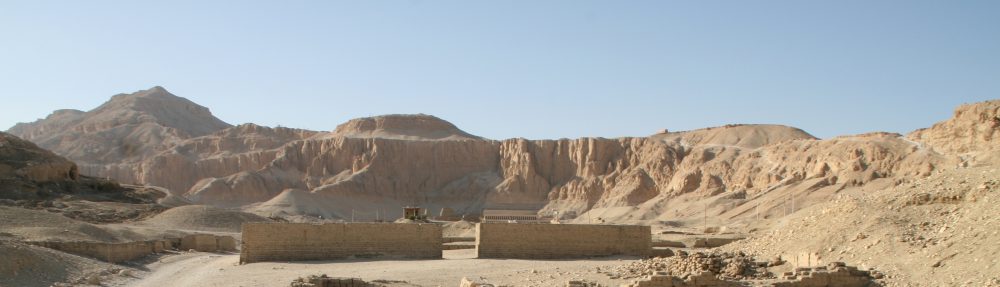
Today, the last team members will arrive, and we are all looking much forward to another exciting week starting on Saturday in the gorgeous setting of the Asasif in front of Deir el-Bahari.
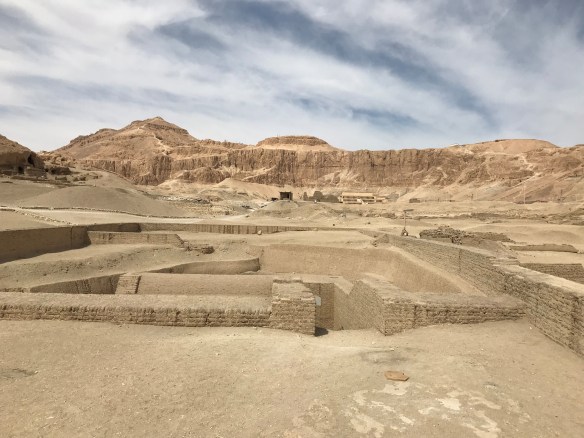
Our conservation tent and a view to the Theban mountains.
While the world and also Luxor with the Asasif necropolis all hold their breath because of the covid-19 crisis, a new issue of the journal Egypt & the Levant has been published in Vienna. I am proud that this volume also includes an update on the Ankh-Hor project (Budka 2019).
There are still plenty of information to unveil from the tomb of Ankh-Hor.
In this article, the most important results from the 2018 and 2019 seasons are summarised and future work is outlined, especially regarding the large corpus of coffins from TT 414. The focus is here on the numerous Ptolemaic coffins and the information they hold for patterns of re-use, but also for religious, cultic and iconographic aspects of Late Egyptian funerary tradition in Thebes.
Our permissions for the next season in the Asasif in fall 2020 were already granted – so let’s hope that we can also actually continue our consolidation and documentation work on the important finds from the tomb of Ankh-Hor. For now, of course the only priority is to stay safe and to stay home – the crisis will be over some day and we all have to stay patient!
Reference:
Budka 2019 = J. Budka, TT 414 revisited: New results about forgotten finds from the Asasif/Thebes based on the 2018 and 2019 seasons of the Ankh-Hor Project, Ägypten und Levante 29, 171‒188.
Good news within the summer break: Our study of neglected finds from the tomb of Ankh-Hor in Asasif, TT414, in Egypt is highlighted in the latest issue of the The Project Repository Journal (July 2019, pp. 42-43).
Our aimed reconstruction of the complete use life of the tomb from the 6th century BC until Roman and Coptic times will provide new information about the people buried in TT 414 and also allows high lightening important new aspects of Egyptian funerary customs throughout the ages.
TT 414 has a huge potential to serve as a case study to analyse various attitudes of later generations towards the original owners of monumental Theban burial places – this can be best illustrated by the recycling of coffins. For the understanding of the complete, very complex use life of TT 414 a more in depth study is therefore much needed and will be carried out in the next years. At present, large amounts of coffins, fragments of coffins and cartonnage from TT 414, dating from the Late Period to Ptolemaic and Roman times, still remain to be cleaned, consolidated and fully documented. These tasks require time and financial support, but will definitly contribute to writing a new chapter of Theban funerary archaeology.







 The Ankh-Hor Project
