Some aspects of the re-use of coffins in Ptolemaic Thebes

TT 414, the monumental tomb of Ankh-Hor, High Steward of the Divine Adoratrice Nitocris during the 26th Dynasty (6th century BCE), is one of the so-called temple tombs of the Late Period in Asasif with a temple-like superstructure and complex cultic rooms and halls.

Isometric plan TT 414

Within the current Ankh-Hor Project of LMU Munich we are focusing on the complete use-life of the tomb which lasted over centuries well into the Roman and Coptic periods. We also include the various ancient and more recent plundering phases of TT 414 which are well attested. One aspect is particularly noteworthy: TT 414 has the potential to serve as a case study to analyse various attitudes of later generations towards the original owners of Theban burial places. For example, several Late Period coffins had been found in the pillared hall of TT 414, thus not in their primary position within the burial chambers at the bottom of the various shafts, but within one of the cultic rooms or sanctuaries. In the entrance area to the pillared hall, a well preserved lower part of a coffin, Reg. No. 590, was discovered, seemingly out of place for a 26th Dynasty coffin.

Budka_Fig_7 neu

Location of Reg. No. 590 in Room 4 of TT 414 (after Budka 2010).

Already back in the 1970s, the excavators suspected that these coffins had just been re-used in the Ptolemaic period when people started to make use of the pillared hall as a burial place (in addition to the shafts). In 2009, I could confirm this by an exceptional in situ-find that came to light during the cleaning of the coffin Reg. No. 590 (Budka 2010): We discovered in the interior of this 26th Dynasty coffin for a man named Iret-her-rw, called Nes-ba-neb-djedet, an intact mummy label with a demotic docket (see Budka and Mekis 2017). This Ptolemaic mummy label identifies the mummy placed in this coffin as a man with the name Wah-ib-Re. Recently, I could trace together with my colleague Tamás Mekis a fragmentary cartonage in the Louvre (Louvre N 4603) which probably belongs to this person and must derive from TT 414 as well (Budka and Mekis 2017).

This allows tackling two important aspects:

1) The destroyed mummy placed in the coffin Reg. No. 590 illustrates the well-known fact that in the 19th century AD, Egyptian mummies were systematically damaged during the search for gilded parts, cartonages, amulets and other finds. Objects like the cartonage Louvre N 4603 came via antiquity dealers to large European museums. Like for Wah-ib-Re, it is therefore possible to find various objects from people buried in TT 414 in these museums (see, e.g. Budka, Mekis and Bruwier 2013).

2) The Ptolemaic mummy label found in the 26th Dynasty coffin in TT 414 attests to the re-use of wooden coffins from the original phase of use of monumental temple tombs like TT 414 some 300 years later. Whether this re-use had simply practical reasons and a financial motivation, or whether this recycling was also associated with a more complex set of meanings must remain open for now, providing a number of possible lines of further research.

IMG_3688

Final cleaning of Reg. No. 590 is well in progress.

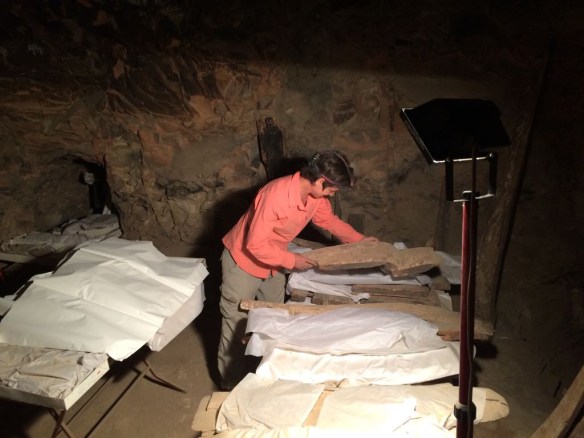
I am personally very delighted that this not only beautifully painted, but also intriguing coffin, Reg. No. 590, which already has had such a multifaceted biography, now entered another aspect of its life history: it is getting a last cleaning and consolidation in order to be transported to the main magazine here on the West Bank as final resting place.


References

Budka, Julia 2010.  Varianz im Regelwerk. Bestattungsabläufe im Monumentalgrab von Anch-Hor, Obersthofmeister der Gottesgemahlin Nitokris (TT 414), Ägypten & Levante 20, 49–66.

Budka, Julia, Tamás Mekis and Marie-Cécile Bruwier 2013. Re-use of Saite temple tombs in the Asasif during the early Ptolemaic time – the tomb group of Mw.t-Mnw from TT 414, Ägypten & Levante 22/23, 2012/2013, 209–251.

Budka, Julia and Mekis, Tamás 2017. The Family of Wah-ib-Re I (TT 414) from Thebes, Ägypten & Levante 27, 219‒240.

Summary of week 1 of the Ankh-Hor project

Time flies by as usual here in Luxor… Unbelievable that we opened our magazine and started the season already one week ago! Our first full week of work has now passed, we were very busy and also quite successful. We accomplished already a number of important tasks in week 1 of our 2019 season.

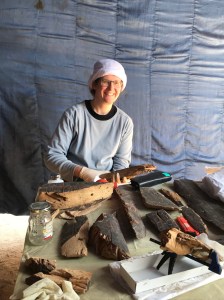
The main task this week was to set up the conservation programme – which worked out perfectly, thanks to the experience of Daniel Oberndorfer from last year and the enthusiastic conservators and students of conservation from the University of Applied Art in Vienna. The working places in our new luxury tent are well suitable, equipped with electricity and allow working on large boards of coffins.

The current focus of conservation is on Ptolemaic coffins – although I am already perfectly familiar with the rich variety of coffin styles from TT 414, this variability still amazes me. Our group of conservators was especially busy with two very common coffin styles, the black-yellow and black-yellow-red outer anthropoid coffins. They found some very nice new matches among the fragmented pieces, some of which could even be glued back together.

Examples of the more colourful Ptolemaic inner coffins were consolidated this week by our Egyptian colleague Iman Ibrahim Zaghlol.

I myself am still busy with re-organising the magazine, checking for joining pieces and sorting the objects according to priorities. Besides new additions to Roman coffins, one of the highlights is a new match to the foot part of a Ptolemaic coffin. It is the beautifully painted coffin of a female singer of Amun-Re with the name Iretru. More fragments of her coffin were already consolidated in 2008 and the new piece allows reconstructing the coffin further, especially once all the fragments will be cleaned.

Working picture of new joint to coffin Reg. 658

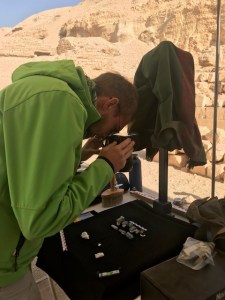
Another major task this season, like in 2018, is documenting the objects from TT 414 with our fullframe camera. Cajetan was busy this week photographing various groups of objects – mostly coffin fragments, but also shabtis, stelae fragments and wooden statues. The quality of these pictures is just amazing and perfectly suitable for publication! Mona helped with photography and also made some nice drawings of 26th Dynasty pottery from TT 414.


All in all, I am very satisfied with the results of this first week and grateful to all team members including our Egyptian workmen – now we’re all off to a well-deserved weekend with some sightseeing in beautiful Luxor, work will continue on Saturday, much looking forward to this!

Researching the second heyday of burials in Asasif

The reuse of monumental Theban temple tombs of the 25th and 26th Dynasties located in the Asasif flourished especially during the 4th and 3rd centuries BCE – among others this can be well illustrated by the example of TT 414. The Ankh-Hor Project is currently focusing on this particular time of use which still poses a number of open questions, highly relevant for a better understanding of the history of the Theban necropolis.

Conservation work and documentation of coffins and other finds from TT 414 is well underway and we are making much progress. In the last days, the very nice coffin assemblage of the lady Asetemakhbjt was successfully consolidated – both her inner and fragments of her outer coffin are excellent examples illustrating the second phase of burial activity in TT 414 during the 4th-3rd centuries BCE (30th Dynasty to Early Ptolemaic) which is linked to a group of Amun priests of the temple of Karnak who were also involved in cults for the god Osiris. This holds true for the father and one of the brothers of our lady Asetemakhbjt who were also buried in TT 414.

Many thanks go here especially to the Austrian Archaeological Institute’s conservator Daniel Oberndorfer who will unfortunately already leave us tomorrow – but his short stay for the Ankh-Hor Project was very productive and of course conservation work will continue in the next weeks by the team of newcomers from the University of Applied Arts Vienna, supported by Iman Ibrahim Zaghlol from the local inspectorate.

Getting ready for the 2019 season

The end of 2018 is approaching; the next season in Asasif, Egypt is getting closer! We will be working in February and March and there are still lots of things to prepare.

On Friday this week, I managed to meet a large proportion of the team members for 2019 in Vienna. Since conservation work will be the main focus of the upcoming season, all of them are conservators or students of conservation.

In 2018, the conservation work of the Ankh-Hor Project was successfully started thanks to cooperation with the Austrian Archaeological Institute. Daniel Oberndorfer got a first general overview of the material and collected a lot of data for a future conservation programme considering the state of the objects from TT 414 and also their large number. I am really happy that Daniel managed to bring together a group of very enthusiastic conservators/students from the University of Applied Arts Vienna who will all work on the wooden objects, especially coffins from the tomb of Ankh-Hor.

I am already very much looking forward to the 2019 season! For now, Season’s Greetings to all involved or interested in the Ankh-Hor Project, we will be back with information on our current and upcoming work in the New Year.


End of 2018 season: summary and outlook

IMG_1811

Our first, quite short season just ended yesterday – the magazine in the Asasif is sealed and closed again, some of the team members are already back in Vienna and Munich, three of us arrived this afternoon in Cairo and will leave in the next days.

Altogether, the first season was very successful and all goals were achieved. The focus was on documenting coffins and other objects from the long use-life of TT 414. More than 80 drawings were produced by Patrizia and Mona, comprising small finds (mostly Ptolemaic faience shabtis with texts bearing the names of their owners), wooden objects including a beautiful Ptolemaic Ptah-Sokar-Osiris statue and pottery (complete pottery vessels and fragments, mostly Ptolemaic from the re-use of TT414, but also some Saite vessels from the original phase of use).

In addition to these drawing, 360 objects were photographed in very high resolution with a full-frame camera by Cajetan. These objects were primarily coffin fragments, fragments of wooden shrines and boxes and again shabtis. With these new photos suitable for publication, most of the objects are now fully documented.

IMG_1791

The conservation work was successfully started thanks to cooperation with the Austrian Archaeological Institute.  Daniel Oberndorfer joined the project in the field and managed to get a first general overview of the material, its needs and specifications to develop a program for cleaning and consolidation. Conservation work focused during the 2018 season on wooden objects, especially on coffins and fragments of shrines and wooden statuettes (Ptah-Sokar-Osiris figures). It mainly comprised of consolidation and mechanical cleaning.

IMG_1799

A total of 23 wooden and painted objects were successfully cleaned, consolidated and photographed. Drawings of some selected pieces are planned for the next season. With the data and experience from the 2018, a larger-scale conservation programme can be designed for the next years, considering the individual properties of the material from TT 414. Conservation work will be the main focus of the upcoming seasons.

Related to this, I managed to reorganize the magazine according to priorities. The majority of the material still to be studied is the large amount of coffins – more than 180 coffins within the magazine are currently entered in our database, several dozen are still missing.

IMG-20180328-WA0000

Besides sorting the material regarding their state of preservation and thus the need of consolidation as well as of scientific importance (datable pieces, pieces of well-known persons buried in TT 414 etc.), the focus of this working tasks of the 2018 season was to find matches between the fragments preliminary registered under “K-numbers”. This proved very time consuming, but also quite successful – 16 new matches to registered coffins from the “K-numbers” were achieved. Furthermore, four newly identified registered coffin fragments can be noted and five additional parts to fragmented coffins were documented.

The importance of this search for joints, which will continue in the next season, can be illustrated by the examples of a new fragment of coffin of the daughter of Ankh-Hor and a newly identified black-and-yellow style Ptolemaic coffin as the outer coffin of a singer with the name Ta-net-Geb. More new names were noted on various fragments and still have to be added to our genealogical data and processed in detail.

The rich prospective of the detailed work on the complete set of finds from TT 414 became very clear during the 2018 season. But, in order to achieve major results and to support preliminary ideas with further evidence, work must continue in the near future and is planned for a next season in spring 2019. Large amounts of coffins, fragments of coffins and cartonage from the Late Period to Ptolemaic and Roman times still remain to be cleaned, consolidated and restored – and will for sure bring to light more new information about the use of the tomb of Ankh-Hor throughout the ages.

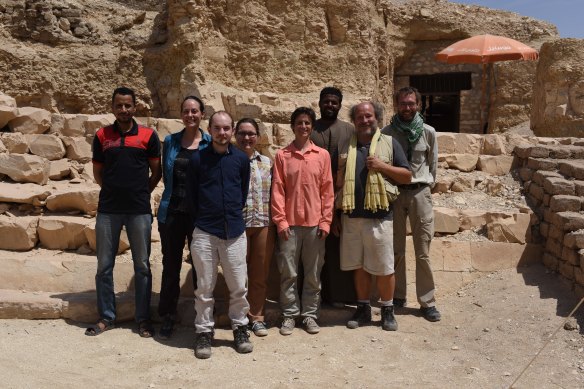
Group picture 2018

My deep thanks go to all team members for their enthusiasm for the project and making 2018 a great season! The photo gallery gives some impressions of all the various tasks achieved and also of how much fun we had working on this really interesting set of diverse objects. Of course, work would not have been possible without the support of the Egyptian authorities and especially of the local inspectorate on the West Bank; I am very grateful to a number of people, first of all to our inspector Zeinab Mohammed Elsayed for enabling us to work according to the working programme.

Looking already much forward to come back to Asasif next year! Updates about our processing of the data collected in 2018 will of course follow.

News about Merit-Neith, daughter of Ankh-Hor

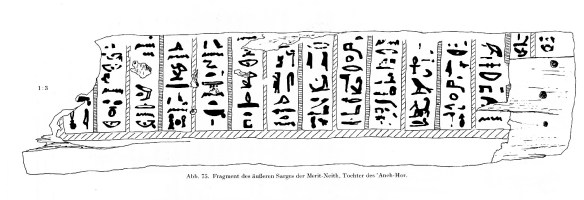
So-called qrsw coffins – rectangular outer coffins resembling a shrine for a god – were probably introduced in the 25th Dynasty and were still common for elite burials in the 26th Dynasty. Several wooden, painted fragments were also found in TT 414 – although not of high quality, the qrsw coffin of Merit-Neith is of particular importance. Merit-Neith was the daughter of Ankh-Hor and is for now the only child we know for our Chief Steward of the Divine Adoratrice Nitocris who built TT 414 as a family tomb.

Sargfragment Merit-Neith

Fragment of qrsw coffin of Merit-Neith (Anch-Hor vol. II, fig. 75)

The tomb group of Merit-Neith was, as all 26th Dynasty burials in TT414, heavily looted. The side board of the qrsw coffin which is already published (Anch-Hor vol. II, 176, fig. 75) was found in the debris of room 1, thus very close to the entrance (or exit, from the perspective of a looter…). A fragmented Ptah-Sokar-Osiris-statue of Merit-Neith was unearthed in room 2, associated with Ptolemaic pottery, so definitely dumped there at a late stage of re-use of the tomb.

Plan TT 414 Budka 2010

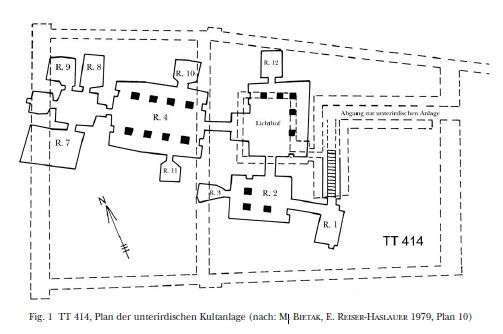
Plan of TT 414 (after Bietak/Reiser Haslauer; from Budka 2010)

In general, we know that the original burial compartments of the late Twenty-sixth Dynasty were reachable via the rooms 7, 8 and 9 – the rooms located at the western end of the subterranean cultic rooms of TT 414 (Budka 2010, 57). Ankh-Hor as the tomb owner was buried in the main chamber accessible from room 7 – but where was his daughter once put to rest?

A possible indication for the location of Merit-Neith’s burial chamber might have come to light today in the magazine. While re-sorting some coffin fragments, I noted a small fragment from the vaulted lid of a qrsw coffin showing an ordinary kheker-frieze. The style of painting and the colours immediately reminded me of Reg. No. 377b, the fragment with the name of Merit-Neith already published in 1982.

zu Reg 377b

New fragment of a qrsw coffin from TT 414 – possibly belonging to Merit-Neith’s coffin?

Fortunately, we know the find position for this new piece: it was found together with other fragments of 26th Dynasty qrsw coffins in the shaft filling from room 8. Of course, one has to be very careful in using find positions of objects in heavy-looted tombs like TT 414 as clear indication of its original location – several objects were scattered and distributed throughout the tomb (Budka 2010, 53-57). But in this case it is just very tempting to suggest the original burial place of Merit-Neith, daughter of Ankh-Hor, at the base of the shaft from room 8, thus directly opposite of her father’s burial chamber. For now, the possible new joint to Merit-Neith’s qrsw coffin will be cleaned by Daniel Oberndorfer and the search for more fragments of the same piece will of course continue.

References

Anch-Hor vol. II = M. Bietak/E. Reiser-Haslauer, Das Grab des Anch-Hor, Obersthofmeister der Gottesgemahlin Nitokris, vol. II, Denkschriften der Österreichischen Akademie der Wissenschaften 7, Untersuchungen der Zweigstelle Kairo 5, Vienna 1982.

Budka 2010 = J. Budka, Varianz im Regelwerk. Bestattungsabläufe im Monumentalgrab von Anch-Hor, Obersthof­meister der Gottes­gemahlin Nitokris (TT 414), Egypt & the Levant 20, 2010, 49–66.

More shabtis & more coffin matches

Week 3 started not at all perfect – yesterday was a very sandy & windy day, work outside was almost impossible, so we had to concentrate on tasks within the magazine, especially the cleaning and consolidation of coffins and other wooden objects.

Today was much better regarding the weather and all were back at their tasks: drawing, photographing and studying objects from TT 414. There are still more faience shabtis which need drawings – and strangely they are now met with just a little less enthusiasm than last week ;).

IMG_1767

Matching coffin fragments was again very successful – the jigsaw puzzle is getting more and more advanced. My personal highlight of today was the identification of a black-and-yellow style Ptolemaic coffin as the outer coffin of a singer with the name Ta-net-Geb. Until today, she was only known from the inner coffin of her son from TT 414 – now we can confirm that she was also buried in the tomb of Ankh-Hor, presumably with her husband Hor-Khonsu!

K07_219 Ta-nt-Geb

This enlarges not only our prosopographical data of people buried in TT 414, but is also relevant for questions of typologies and dating of Ptolemaic coffins. The next goal is now trying to find more matches to Ta-net-Geb’s coffin – the piece identified today is just a very small fragment from the lid of a once substantial anthropoid coffin. So much more to do with this simply amazing material from the tomb of Ankh-Hor!

Short summary of week 2

Week 2 of work on the finds from TT 414, the tomb of Ankh-Hor in Asasif, was just completed – it has been a very successful week with quite a number of tasks accomplished.

image1

Drawing of pottery and small finds continued – besides faience vessels, shabtis and amulets from bead nets, Patrizia also made beautiful drawings of some peculiar wooden fragments (of which we are still discussing the precise function). Right now, she is busy with the numerous faience shabtis from the family of Pa-di-Amun-neb-nesut-tawy.

IMG_1720

Mona worked primarily on Ptolemaic pottery from the “Lichthof” of Ankh-Hor – these pieces nicely illustrate the function of this part of TT 414 as offering place. Besides small offering cups and plates, fragments of so-called Hadra ware are notable.

IMG_8083

Photographing various groups of objects was continued by Cajetan – with today, we started focusing on larger coffin fragments. Besides, all pieces already consolidated by Daniel are also documented with photos of our full frame camera. Cleaning and consolidation is progressing were well, focusing both on 26th Dynasty objects like the stela of Her-Aset and qrsw-coffins and on Ptolemaic objects like Ptah-Sokar-Osiris figures and of course various coffin fragments.

IMG_1734

Furthermore, I am very happy that Philippe Martinez studied and photographed during this week the re-used New Kingdom blocks from the foundations of the Ramesses IV temple excavated by Manfred Bietak. Philippe kindly also documented small relief fragments from TT 414 stored in the magazine.

IMG_1719

Re-organising the magazine is also making much progress – I’ve just ordered more wooden boxes for a new storage system according to priorities which will be developed further next week.

We’re now off to a well-deserved weekend, many thanks to all team members and looking much forward to Saturday!

Conservation work started on objects from TT 414

Thanks to the support of the Austrian Archaeological Institute, the institute’s conservator Daniel Oberndorfer joined us and started his work on the wooden objects from TT 414 today.

Large amounts of coffin fragments and other wooden objects are in urgent need of cleaning and also consolidation – for now, I have made a list of priorities for Daniel according to both significance of the object and its state of preservation. In focus are some 26th Dynasty coffin remains which have not yet been studied in detail, but foremost several Ptolemaic fragments because of their significance for reconstructing genealogies and family trees.

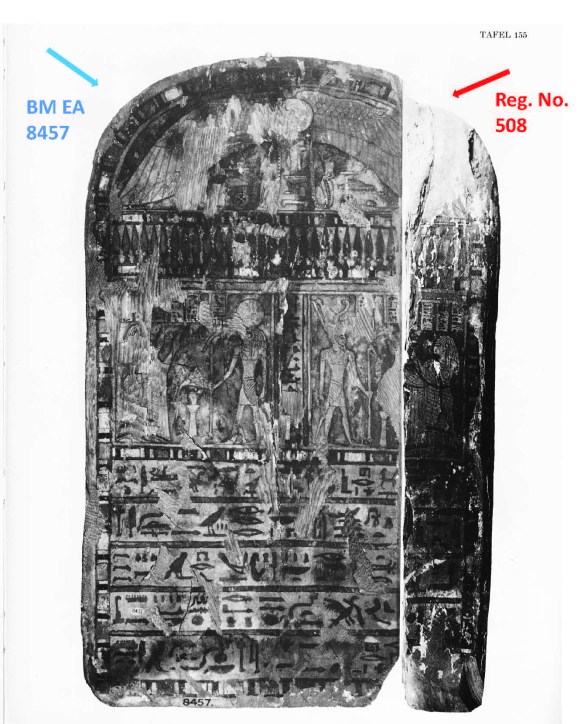
Some pieces are also highly significant of the history of exploration of TT 414: Daniel started working on the small fragment of the stela of Her-Aset (Reg. 508). Bietak and Reiser-Haslauer noted already that it belongs to the larger part of stela BM EA 8457 which came via Henry Salt to London (Bietak/Reiser-Haslauer 1982, pl. 155; Budka 2010, 56).

Stele heraset

Like for so many other objects from TT 414, this example illustrates how much information can be gained from a joint puzzle of data deriving from both, material excavated by the Austrian Mission in TT 414 and objects currently kept in European museums originating from non-scientific work in the tomb during the 19th century (see Budka/Mekis 2017). For the identification of further objects in museums and collections as coming originally from TT 414, conservation work of the still unpublished material stored here in the Asasif is of prime importance in order to document all relevant pieces in full detail for future comparison.

References

Bietak/Reiser-Haslauer 1982 = M. Bietak/E. Reiser-Haslauer, Das Grab des Anch-Hor, vol. II, Vienna 1982.

Budka 2010 = J. Budka, Varianz im Regelwerk. Bestattungsabläufe im Monumentalgrab von Anch-Hor, Obersthofmeister der Gottesgemahlin Nitokris (TT 414), Egypt & the Levant 20, 2010, 49-66.

Budka/Mekis 2017 = J. Budka and T. Mekis, The Family of Wah-ib-Re I (TT 414) from Thebes, Egypt & the Levant 27, 219‒240.

Starting week 2 with new matches

We just started week 2 of our 2018 season – drawing, photographing and studying the finds from TT 414 continued.

For time reasons, I do a lot of work of puzzling with the coffin fragments in the afternoon on the laptop, using photos, the original registration book of the Austrian mission and my notes from the tomb/magazine. Today was a very successful day for new matches! Not only did I manage to relocate some coffins in the magazine, but a new match worked virtually on the computer!

Reg. 682 new joint

The object in question is a beautiful, multi-coloured painted Ptolemaic coffin. The picture shows the successful match: at the top, there is a photo from 1974 of a piece which is currently still missing and which I only know by this photograph; the fragment below is actually a new joint – in 1974, it was not noted as belonging to the coffin, again stressing the rich potential of our current re-investigation of all finds from TT 414!

Reg. 682 is the board from the foot part of an outer anthropoid coffin; its decoration shows a figure of a winged goddess with a sun-disc on her head, standing on the “gold”-hieroglyph. The texts in the upper part give the name and titles as well as the filiation of the owner. And this owner is a well-known person from TT 414: the divine father and prophet of Amun in Karnak Pa-di-Amun-neb-nesut-tawy III, son of Pa-char-Chonsw II and grandson of Pa-di-Amun-neb-nesut-tawy I, the Amun priest who started the re-use of TT 414 in the 30th Dynasty (for the genealogy of this family see Reiser-Hauslauer 1982). Many more fragments of tomb equipment of Pa-di-Amun-neb-nesut-tawy III, his parents, uncles and cousins are still waiting to be studied and will keep us quite busy!

Reference

Reiser-Hauslauer 1982 = E. Reiser-Hauslauer, B. Familien aus der zweiten Belegungszeit des Grabes (ca. Zeit der 30. Dynastie und frühe Ptolemäerzeit), in: M. Bietak and E. Reiser-Haslauer, Das Grab des ‘Anch-Hor, Obersthofmeister der Gottesgemahlin Nitokris II, UZK 5, Vienna 1982, 252–256.