A short summary of our 2024 season

It’s now a week since we returned to Europe from beautiful Luxor. Not only from the very successful 2024 Ankh-Hor project campaign, but also from a splendid Thebes in the First Millennium BCE conference with a rich programme of lectures and site visits.

Our 5 weeks of work on objects from the tomb of Ankh-Hor, TT 414, were very intensive. I will try to briefly summarise the most important aspects below.

The major goal of the 2024 season was to continue the cleaning, consolidation, and documentation of the large number of objects excavated from TT 414, the monumental tomb of Ankh-Hor, High Steward of the Divine Adoratrice Nitocris (26th Dynasty). Like in the 2023 season, the focus was on wooden coffins and cartonnage elements from TT 414 and included both Late Period pieces and Ptolemaic ones. Work was conducted from September 28 to October 31, 2024 (SCA Inspector: Shaima Abdelkarim).

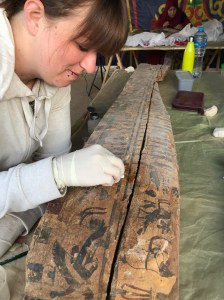
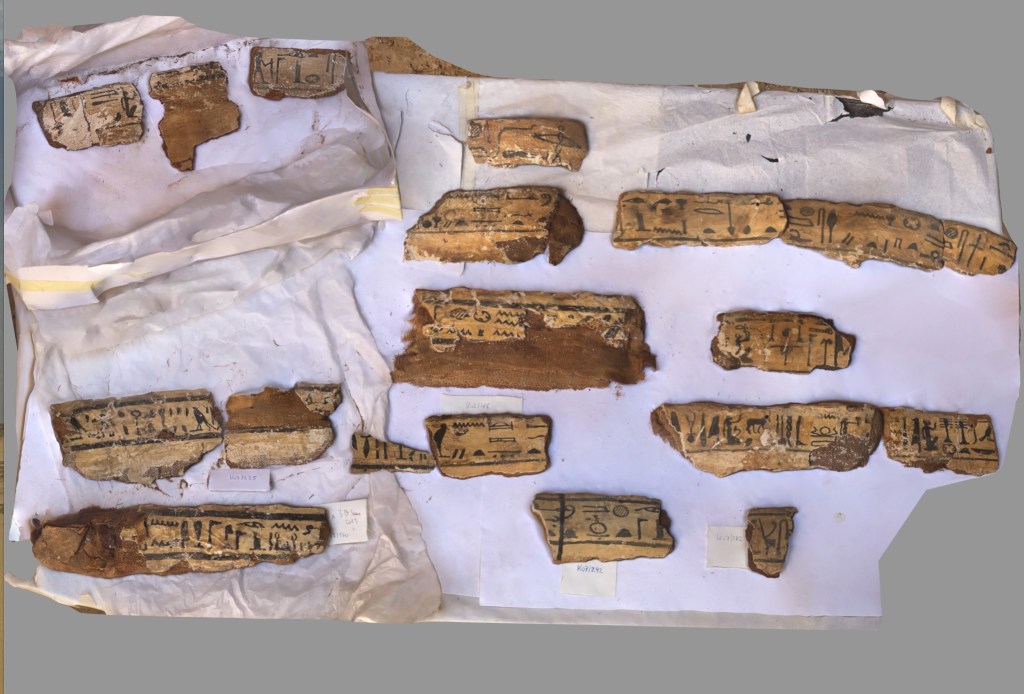
Some fragmented coffins from TT 414 were identified for the first time and correlated with the documentation from the 1970s. Some additional material was recorded for the first time. In addition, several previously not identified pieces were newly recognised as matches to coffins documented by the Austrian mission in the 1970s. Some of these were joined by our conservators to the already documented pieces. One important example is Reg. No. 857. Whereas in the 1970s, only a small fragment of the edge and some base fragments of this lower case of a coffin were documented (Fig. 1 bottom left), new joining pieces allowed to reconstruct the entire length of the coffin (Fig. 1). With just 120cm in length, this is a coffin for an infant, not an adult. This raises various questions since the owner of the coffin is identified as Iset-em-akhbjt who holds the title jHjt n wja Ra (singer of the bark of Re).

Fig. 1: New pieces of Reg. No. 857 allow to identify it as an infant coffin

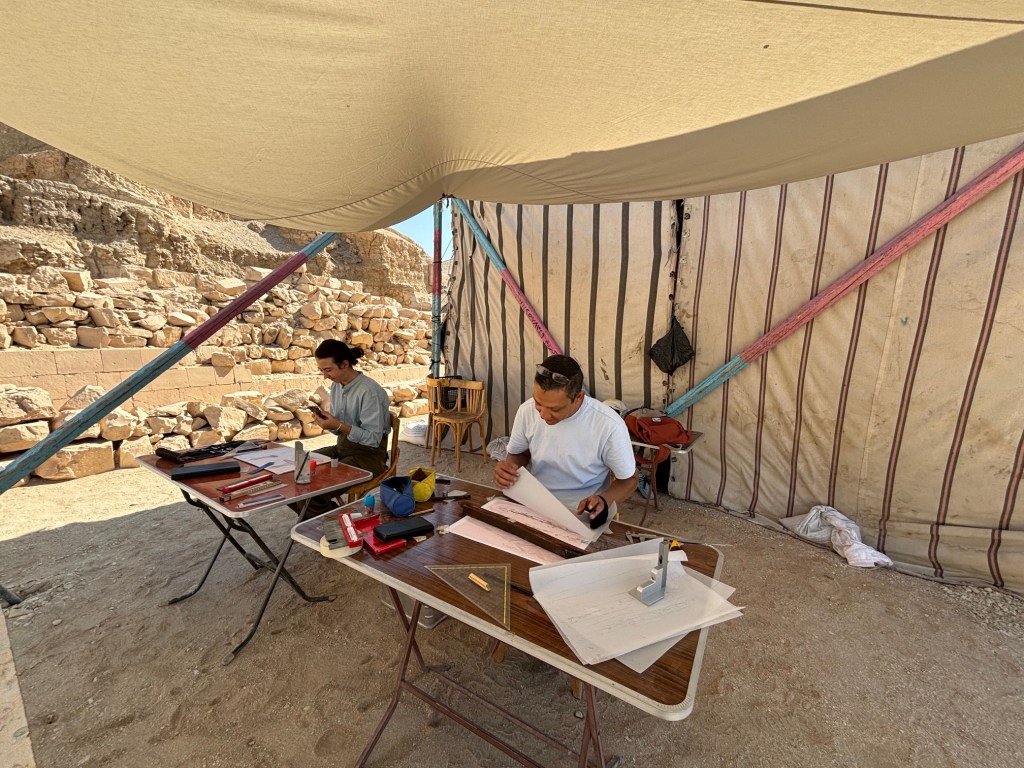
All finds studied in 2024 were digitally photographed and entered in a database, created by File Maker Pro. In total, more than 110 individual objects (mostly coffins and cartonnage elements) were studied and documented by full-format photos in high resolution. These new photos are suitable for publication and show the colours of the pieces, in contrast to the previous documentation in the 1970s. A total of 35 drawings of 14 important objects were produced in 2024 by Hassan and Ladina, comprising fragments wooden statues, canopic shrines and painted mud plaster.
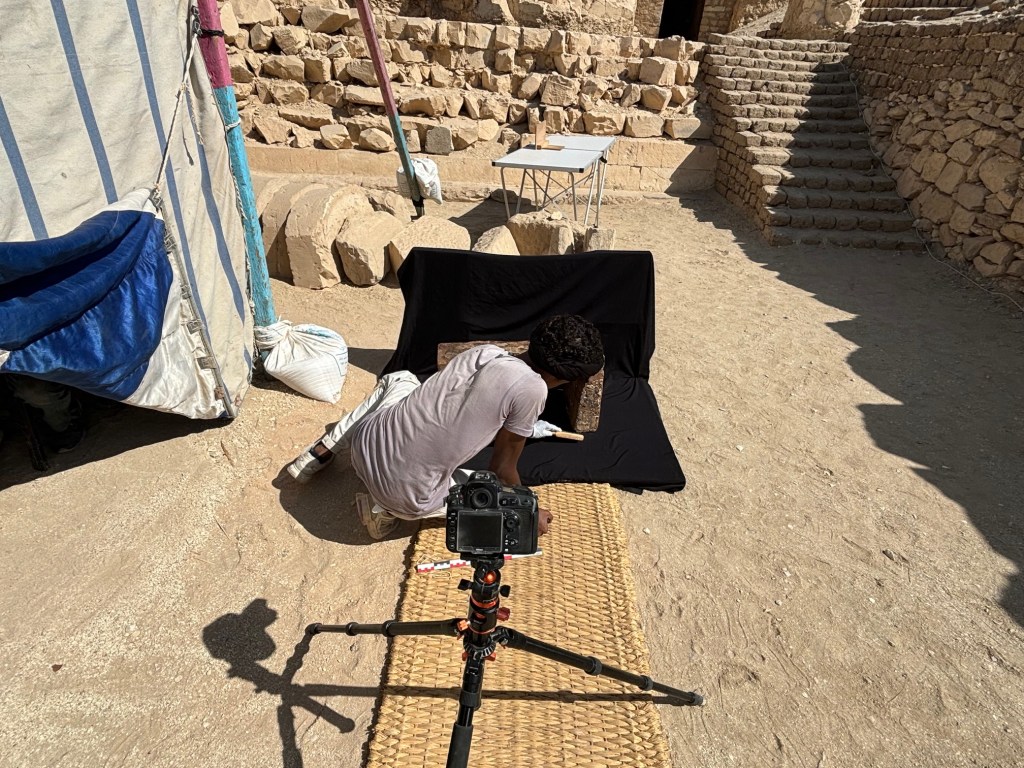
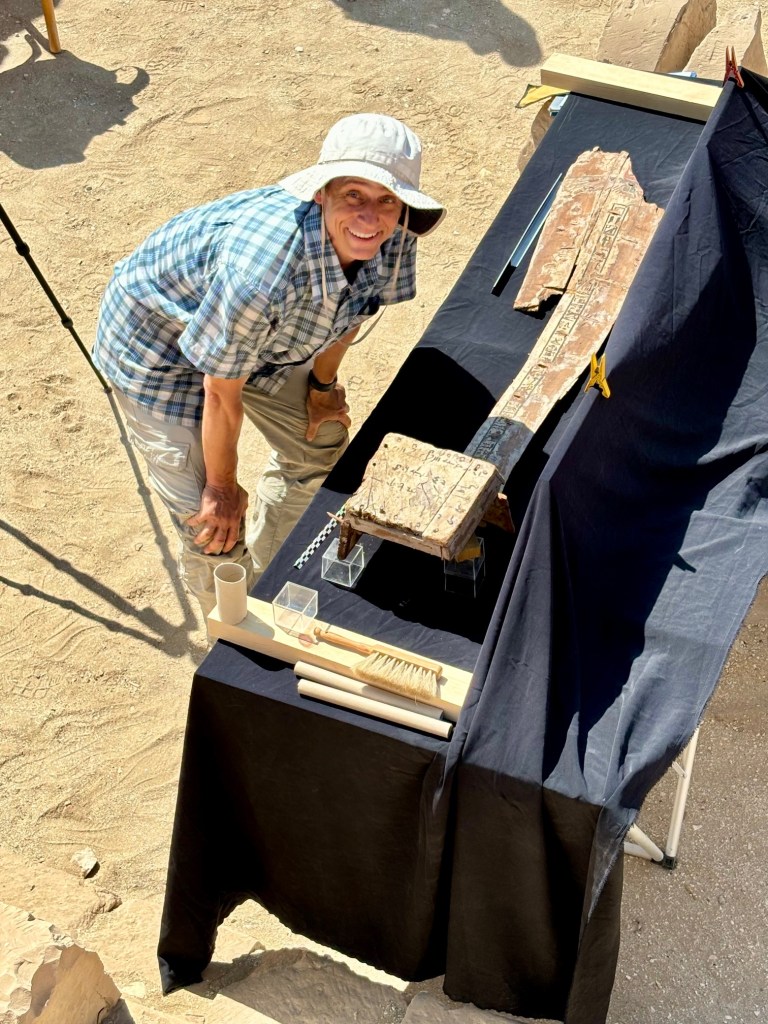
Fig. 2: Photographing our coffin fragments sometimes required individual settings; here Islam helps me with the preparation.

Since many the painted objects from TT 414 have darkened surface, infrared photography was used to make the original decoration visible (with a Sony Cybershot DSC-F828, an IR-filter and a small magnet). In 2024, this method was applied to a total of 70 objects.
A new method of documentation was introduced in 2023 for the Ankh-Hor project. The app Scaniverse was used to capture objects in 3D. This photogrammetry application is ultrafast, highly accurate and very easy to use. 207 objects from TT 414 were captured with metrically accurate 3D models this season. This technique was mainly used for work recordings when sorting cartonnage coffins (Fig. 3).
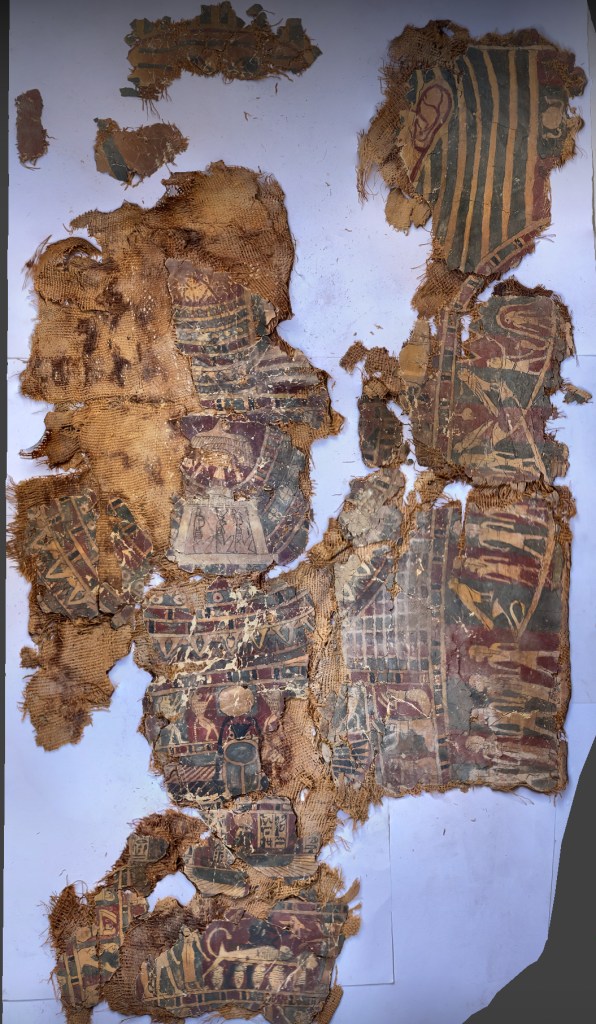
Fig. 3: Screenshot of 3D model of the newly reconstructed, fragmented cartonnage coffin lid Reg. 24/04. Since no texts with names and titles are preserved, the ownership is still unclear. The general colour scheme is rather unusual within the corpus of cartonnage coffins from TT 414.

The conservators of the LMU Munich Ankh-Hor Project in the 2023 season were the specialists for wood, Mrs. Karima Mohamed Sadiq and Mr. Mohamed Mahmoud Mohamed Mahmoud. All consolidated objects were documented photographically before and after conservation. Every object is documented in a list, containing the observed damages and the conservation measures. A total of more than 150 wooden and painted objects, mostly coffins, comprising c. 400 individual pieces, were successfully cleaned and consolidated in 2024.

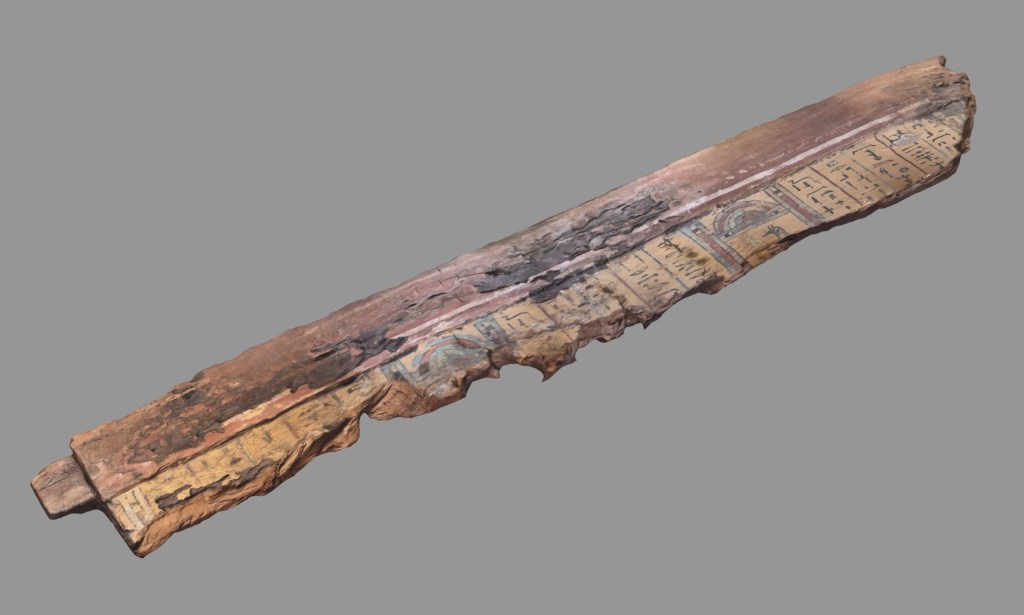
One of the major accomplishments of the consolidation work this year was the reconstruction of the lower part of the cartonnage coffin Reg. No. 08/05. Before consolidation, it was broken in several pieces and very fragmented (Fig. 4).

Fig. 4: Part of Reg. No. 08/05 before consolidation work.
Fig. 5: Work in progress – Mohamed is consolidating the very fragile cartonnage coffin Reg. No. 08/05.

At the end of our season, these fragments, including the newly found foot part, were joint to each other, and Reg. No. 08/05 reconstructed as best as possible (Fig. 6). Simply a great job by Karima and Mohamed!

Fig. 6: Interior of Reg. No. 08/05 after consolidation work.

Apart from the consolidation work, the study of the cartonnage coffins supported some conclusions about certain people buried in TT 414 during Ptolemaic times, for example about the Wesjrwer family. We now know that Horpabjk was the owner of the wooden coffin Reg. 829 and also of the newly recosntructed cartonnage coffin Reg. 08/05 (Figs. 4-6). In 2023, he was tentatively identified as a brother of Horakhbjt, owner of the cartonnage coffin Reg. No. 860. With his own cartonnage coffin now beautifully reconstructed and identified, which shows close parallels to Reg. No. 860, this family relation and identification is now based on solid grounds. More research is needed to fully understand this important family.

That we can now study sets of coffins in wood and cartonnage together is a considerable step towards reconstructing actual tomb groups in TT 414.

Since not all fragments of wooden and cartonnage coffins from TT 414 are yet consolidated and documented, our work needs to be continued in the next season. The finding of joining pieces is in particular time-consuming but definitly worthwhile.

Finally, I would like to thank all the team members and the local authorities – it was not only a successful season, but also a really enjoyable one and I am really looking forward to the next one with hopefully a very similar line-up!

Work progress on the coffins of TT 414

Week 3 has just started and Ladina and Hassan are busy with documenting 30th Dynasty/early Ptolemaic coffins from the tomb of Ankh-Hor (TT 414), while Karima and Mohamed continue with some later Ptolemaic painted fragments.

Ashraf, Hassan and Ladina are busy sorting, cleaning and documenting coffin fragments.

Week 2 brought a lot of progress; I was able to make numerous joints of small fragments to known, registered pieces. My focus was on Ptolemaic coffins around the family of Wesjr-wer – and here, in addition to the painted wooden coffins, also on the cartonnage coffins. A real challenge are both wooden and cartonnage coffins, where the text fields have unfortunately remained empty, so we have no information about the owners.

The white painted with black text outer surfaces of the lower parts of bivalve cartonnage coffins are still a big puzzle – but I have already found many joints!

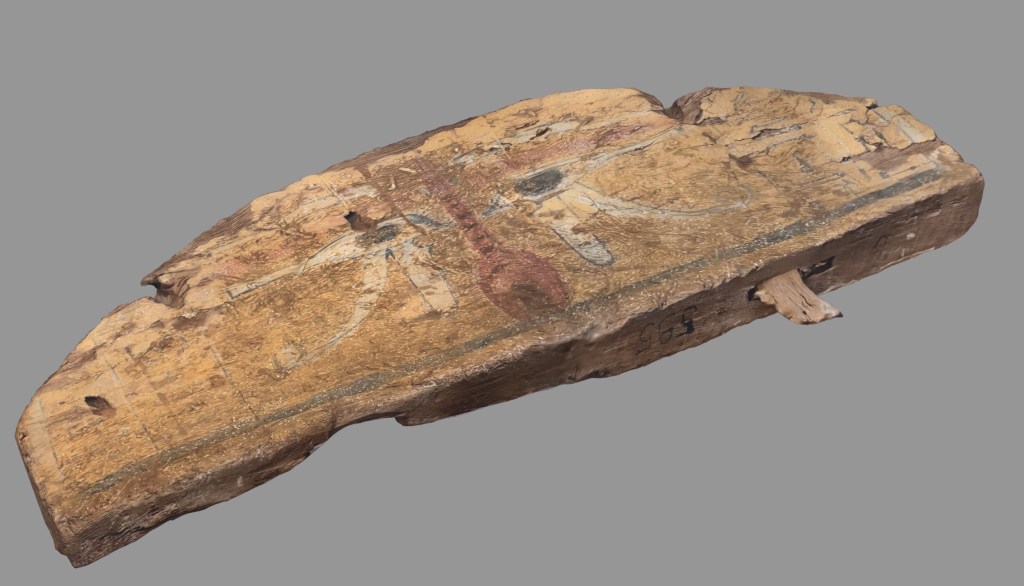
As a special highlight, I also documented the qrsw coffin of one of Ankh-Hor’s relatives, Psametik-men-em-Waset, Reg. 595, in 3D. The piece of which several boards and the front side are preserved had already been documented with our full-frame camera in 2018, but I wanted to take full advantage of the new possibilities offered by the rapid development of video-based photogrammetry with LiDAR sensors on mobile devices and the Scaniverse app developed by Toolbox AI. The scans also allow us to highlight technological features and details of the wood structure.

Screenshot of 3D scan of one of the lateral sides of Reg. 595 which shows nicely the damages of the wood and painted surface.
Sceenshot of the 3D scan of the front side of the vaulted lid of the qrsw coffin Reg. 595.

Last but not least, Hassan and Ladina made detailed drawings of fragments of canopic boxes from TT 414. These drawings will be used in the final publication and perfectly complement our photographic documentation and the 3D scans.

Technical drawings remain necessary for some selected wooden pieces from TT 414.

All in all, our 2024 season continues to be very productive, and I am grateful to all team members for their commitment and enthusiasm. There are some really great objects we are working on and there are still a lot of them waiting for us in the coming weeks!

Wife or Granddaughter? Who was T3-khj-bj3t?

Among the mass of coffin fragments from TT 414, the tomb of Ankh-Hor, one stands out in particular: a coffin of a woman with both demotic and hieroglyphic inscriptions.

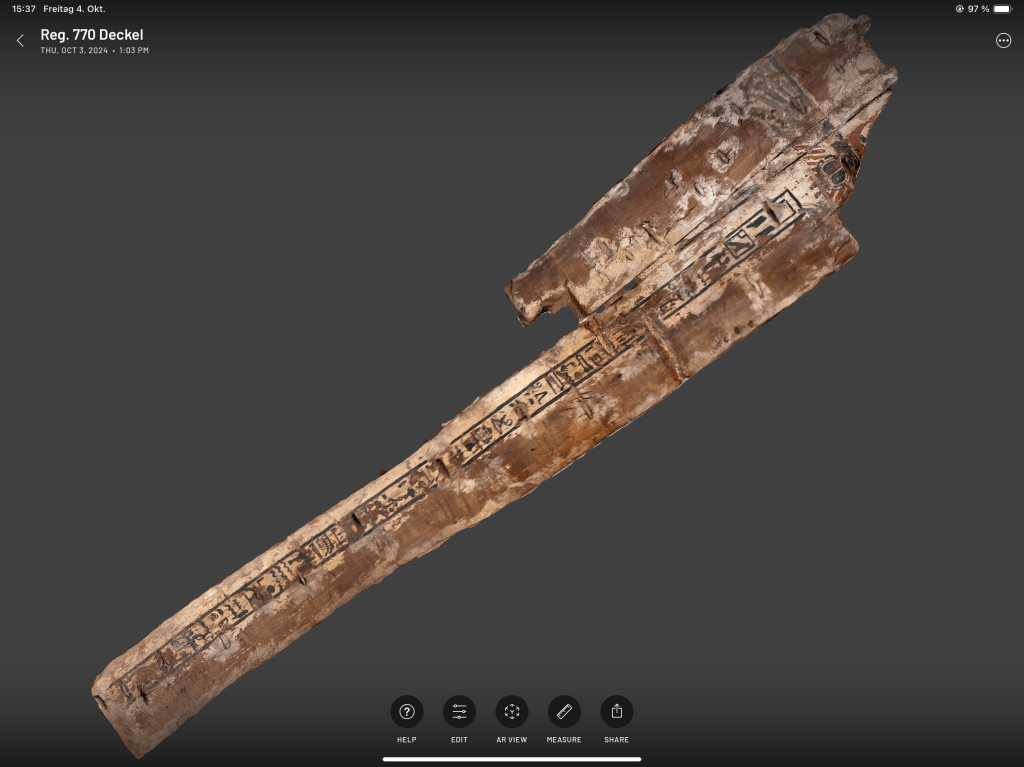
Reg. 770 was published by one of the experts on Demotic, Jan Quaegebeur in Anch-Hor II. He focused on the front board of the foot section, which shows the demotic inscription. However, the board of the corresponding coffin lid – with a vertical hieroglyphic inscription line – was not published as a drawing or photo.

This season, our conservator Mohamed cleaned and fixed the very fragile lid fragment and I could document it together with the foot part. Our aim is to present this unique piece in the planned publication of all coffins from TT 414.

Happy moment – joining the footpart of Reg. 770 with the lid fragment (photo: L. Soubeyrand).

The coffin owner is a woman with the typical Theban name T3-khj-bj3t, daughter of Wesjr-wer/Osoroeris and T3-njt-Khonsw/Tachonsis. This filiation is given in the demotic text, translated by Quaegebeur (1982, 259) as follows:

May your Ba live in eternity and forever: T3-khj-bj3t daughter of Osoroeris born of Tachonsis”.

Screenshot of the new 3D model of the lid fragment of Reg. 770 with the hieroglyphic inscription.

The vertical text on the lid only mentions the mother’s name, not the father’s.

T3-khj-bj3t belongs to a Ptolemaic family attested by several wooden painted coffins from TT 414, especially Reg. 800 and Reg. 828 with hieroglyphic texts. However, there is one problem: we do not know whether our coffin owner of Reg. 770 was the wife or the granddaughter of the owner of Reg. 800, Wesjr-wer. It is possible that a woman named Ta-Khonsu, daughter of T3-khj-bj3t, named her own daughter after her mother. Quaegebeur has also expressed the opinion that the ‘granddaughter’ scenario is perhaps more likely than that of the wife, since Reg. 770, unlike Reg. 800 (and Reg. 828), also bears a demotic inscription in addition to the hieroglyphic one and might thus be of later date.

Well – as I will also be working on Reg. 800 this season, perhaps a solution will emerge. I am also very much hoping for additional information based on cartonage coffins that have not yet been included in the scenario, but which are attested for several members of this family.

Whether wife or granddaughter – the coffin Reg. 770 still raises exciting questions today and I am very pleased that we have now documented it in the best possible way. A more precise dating will hopefully be possible soon.

Reference

Quaegebeur 1982 = Jan Quaegebeur, VIII. Demotic Inscriptions on Wood from the Tomb of Anch-Hor, in: M. Bietak/E. Reiser-Haslauer, Das Grab des Anch-Hor II, Vienna 1982, 259-266.

Presenting the Ankh-Hor project in Munich

It is a great pleasure to have been invited by the Collegium Aegyptium, the friends of the Institute of Egyptology and Coptology at LMU Munich to give a lecture about my Ankh-Hor Project.

My talk later today will be in German and focuses on the questions of Ptolemaic wooden coffins and cartonnage fragments from TT 414.

It is the first time that I present some preliminary remarks on the cartonnage cases from the tomb of Ankh-Hor. There is evidence for various types of cartonnages from the 30th Dynasty well into the Ptolemaic era. I will discuss some of the results from the 2022 season.

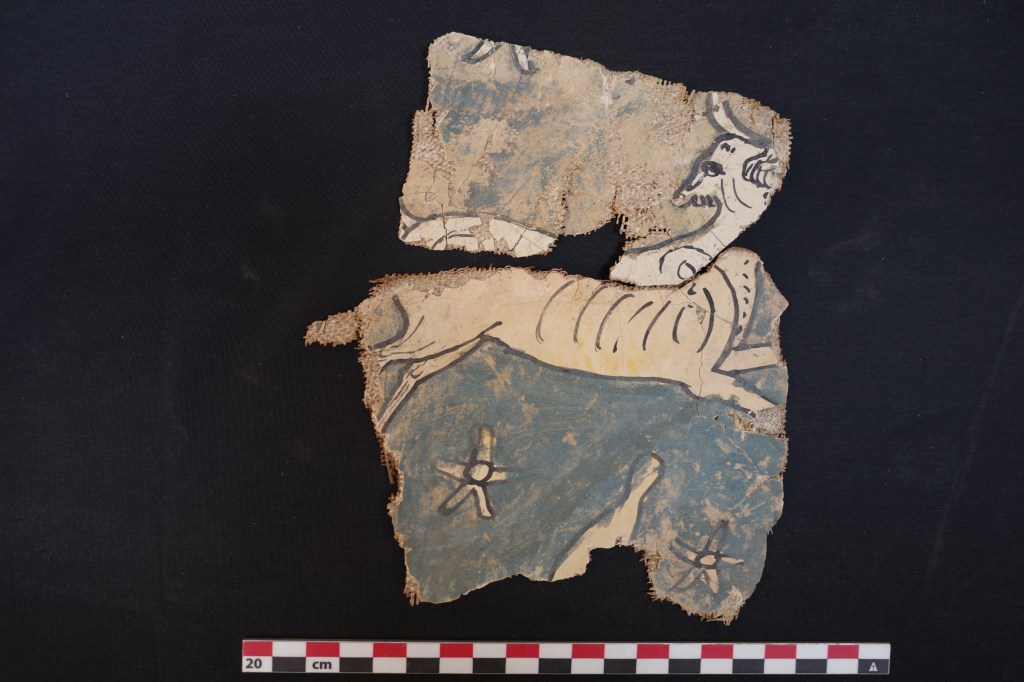
One particularly interesting topic, that I will briefly mention today in my lecture is the appearance of zodiac representations on the interior of lids of cartonnage coffins.

Interior decoration of the lid of a cartonnage coffin from TT 414 with the Taurus zodiac sign.

The recent publication by Daniela Mendel (2022) is an excellent collection and comparison of representations of astronomical ceilings and zodiacs in Ptolemaic and Roman temples, coffins and sarcophagi as well as tombs. Due to the poor state of publication on Ptolemaic cartonnage coffins from Thebes, there is no reference in the book to cartonnage examples of zodiac representations. It is well known that the wooden coffins of the famous Soter family from Thebes include representations of the sky with zodiac – but as the material from TT 414 shows, there were already examples well before the Roman era.

There is still so much work and research to be done – and hopefully we will be back in Luxor for the 2023 season of the Ankh-Hor Project soon. For now, I am very much looking forward to tonight’s lecture and hope for some constructive feedback and questions.

Reference

Mendel, D. 2022. Die Geographie des Himmels: eine Untersuchung zu den Deckendekorationen in ägyptischen Tempeln der griechisch-römischen Zeit und zeitgleichen Darstellungen auf Särgen und in Gräbern. 3 vols. Studien zur spätägyptischen Religion 37. Wiesbaden: Harrassowitz

Media coverage for the Ankh-Hor Project

Very proud and honoured: our work in the Asasif on the finds from the TT 414 has made it into an Austrian newspaper – an article in “Die Presse” presented some information about the Ankh-Hor project (print version 06/04/2019, online since 09/04/2019), based on an interview I gave in Vienna two weeks ago.

On this occasion, I stressed the rich potential about the coffins from the tomb of Ankh-Hor – not only for establishing a typology for Ptolemaic coffins and for discussing coffin workshops at Thebes, but especially for discussing the diverse re-use of TT 414, burial chambers and coffins. The best example is of course the 26th Dynasty coffin Reg. No. 590 of Iret-her-rw, which was re-used by Wah-ib-re in Ptolemaic times.

There are still plenty of information to unveil from the tomb of Ankh-Hor.

Media coverage like this article and also the recent blog post at DerStandard.at are very nice rewards for our busy and successful 2019 season – and it also helps to keep the motivation high. Among others, for writing proposals and applications which will keep me busy in the next months. Money does matter – not only for death and burials as you can read in the “Die Presse” article but also for researching complex burials like the multiple ones in TT 414.

Closing of the 2019 season of the Ankh-Hor project

From Luxor back to Munich – it was not in particular a warm welcome yesterday, arriving at Munich airport with snow showers and much too low temperatures for March! Well, today it is quite sunny and time to resume the last day of work in Asasif.

My last sunrise at TT 414 for 2019…

We successfully closed our tomb magazine and the 2019 season on Sunday – it has been some very intense days full of work and things to organize. Our conservators provided me with a fully illustrated and concise report about the large amount of conservation work conducted in 2019 – in total, 61 objects, in particular coffins, including the five fragmented ones we transported to the magazine, were successfully cleaned and consolidated.

Hassan and Mona were also very productive, resulting in more than 80 drawings of wooden objects, small finds and ceramics. In addition to these drawing, more than 470 objects were photographed by Cajetan with our full-frame camera with very high resolution.

In the final days of work, I took some last photographs of objects, last coffin fragments were cleaned and consolidated. And of course I continued to organize the magazine. Since it always happens on excavations that something new and important turns up at the very last day of work, I was not surprised that I found some new fitting coffin fragments literally in the last minutes of work…. These new fragments are important because they belong to a fascinating, but unfortunately very fragmented coffin we documented earlier this season.
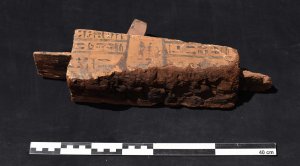

Reg. 661 are fragments of a nicely painted, inner anthropoid wooden coffin which was found as one of the secondary burials within the burial compartment of Ankh-Hor (Room 7.2). For our conservators, these fragments presented one of the biggest challenges this year: The soft wood fragments are partly blackened and burnt due to the looting of TT 414 and the respective damage to the tomb inventories.

Part of Reg. 661 illustrating the bad condition of this coffin.

The owner of Reg. 661 was a female singer of Amun-Re from Karnak with the name Taremetjbastet. Since we know her family relations very well, we can date her death and burial to between 320 and 300 BCE.

The owner of Reg. 661 belongs to a well-attested family of Amun priests from Karnak buried in TT 414.

Of particular interest is the decoration of the foot part of the coffin – I have published first ideas about Reg. 661 already some years ago (Budka 2013). In the center of the foot board there is a sun disc flanked by a snake and a crocodile – this is nothing else than the opening scene of the Litany of Re, attested for the first time in the famous tomb of Sety I in the Valley of the Kings! To be best of my knowledge, there is only one parallel for this motif on foot boards of private coffins – and this is CG 29316, a stone sarcophagus from the 30th Dynasty (see Budka 2013).

Our wooden coffin Reg. 661 from TT 414 is exemplary for is the complex creation of decorated and inscribed coffins in Thebes during the 4th century BCE – Amun priests were extremely creative in combining various aspects, especially cosmogonic ones, using older texts and depictions and creating new ones, focusing on the resurrection of the deceased in conjunction with Re and Osiris. Still little is known about this fascinating creative work which is embodied in funerary objects like coffins, but also cartonage and canopic boxes – all of which are so plentiful from TT 414.

The lid fragments of Reg. 661 which I re-located in the last minutes of the 2019 season still need to be consolidated in the next season of the Ankh-Hor Project – like many other pieces, in particular of Ptolemaic and Roman coffins. Thus, Reg. 661 with its intriguing decoration nicely illustrates the already successful outcome and the scientific potential of the Ankh-Hor Project – but also the urgent need to continue our jigsaw puzzle reconstructing the complex burial processes in TT 414 and enlightening the intricate design of 30th Dynasty and Ptolemaic wooden Theban coffins.

Reference

Budka, Julia. 2013. Krokodil, Schlange und Kuhantilope: Ein frühptolemäischer Holzsarg aus dem Grab des Anchhor (TT 414), in: Florilegium Aegyptiacum ‒ Eine wissenschaftliche Blütenlese von Schülern und Freunden für Helmut Satzinger zum 75. Geburtstag am 21. Jänner 2013, ed. by Julia Budka, Roman Gundacker and Gabriele Pieke, Göttinger Miszellen Beihefte 14, Göttingen, 41–57.

Summary of week 3 of the Ankh-Hor project

The end of our 2019 field season is rapidly approaching – the last team members will be leaving tomorrow, I will have some more days to organize the magazine and for last minute photography.

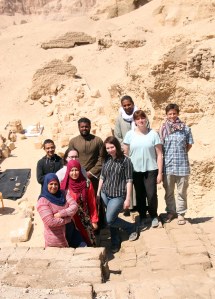
The remaining members of the Ankh-Hor Project team this week.

Like in week 1 and week 2, the main tasks this week were the cleaning and consolidation of Ptolemaic coffins from TT 414. Since most of the group of conservators already left earlier this week, Stefanie and Victoria focused on different pieces, with a large side board of a nicely painted coffin from the shaft of room 10 as one of the highlights.


Most importantly, we succeeded in transporting four boxes with five coffins from the tomb of Ankh-Hor to the study magazine here on the West Bank.

This allows me to re-organise our tomb magazine further; urgently needed space for more coffin fragments to be consolidated and studied is now available.

While I documented the newly consolidated coffin fragments with photos, Mona and Hassan were busy drawing pottery fragments and small finds. Hassan documented in particular wooden objects like lids of shrines and fragments of Ptah-Sokar-Osiris statues. Mona was also working on some nice Middle Kingdom pottery – both from Tomb I, the saff tomb functioning as our magazine at the site, and from 12th Dynasty shaft tombs excavated in the 1970s.
The final phase of our 2019 season has already begun, I will be busy writing the report over the weekend and I am much looking forward to the last days of work next week.

Coffin transport accomplished

Week 3 passed by even faster than the first two weeks of our field season. The closing of the 2019 season of the Ankh-Hor Project is already approaching and today we finished one major task thanks to a lot of people involved.

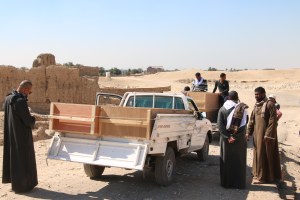
As planned, we transported today four large wooden boxes with five fully documented and consolidated coffins from TT 414 to the magazine of the Ministry here at the West Bank – including Mr. Twt’s coffin and the 26th Dynasty coffin of Iret-her-rw, re-used by Wah-ib-Re in Ptolemaic times. The moving of large sized objects successfully cleaned and studied is urgently necessary in order to have more space in our temporary magazine here in Asasif, in Tomb I.

Although it’s always a bit strange for me to say goodbye to objects we spent so much time with, today’s accomplishment is of course completely positive and nicely illustrates the successful outcome of this season. After all the hard and enthusiastic work by our team of conservators and the hundreds of photos taken for photographic documentation, moving the nicely painted coffins from TT 414 after 45 years of excavation to a proper storage place is very satisfying.

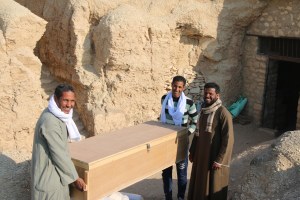
Today, I think most happy of all of us were our workmen Ashraf, Mohammed and Mahmoud – after handling these heavy boxes almost daily during the last 3 weeks, carrying them in and out, in and out again, they were smiling a lot once the boxes were on top of the cars and then gone.

Finally, special thanks go to our inspector Hannan and to all of the local inspectorate for making today’s transport so smooth and easy – much appreciated!

And of course I already have plans for the new space now available in Tomb I – I will be busy with re-arranging things in the next days, there is still so much to do.

Summary of week 2 of the Ankh-Hor Project

Another week of our 2019 season just ended – and was altogether again very successful.

The main tasks this week were the cleaning and consolidation of Ptolemaic coffins from TT 414. Our group of conservators was busy with both black-yellow-red outer anthropoid Ptolemaic coffins like the one of Twt and nicely multi-coloured painted coffins like the one of Iret-Hor dating to the 26th Dynasty.

Re-organising the magazine is also well in progress; I am currently sorting the large number of coffins which are still in urgent need of consolidation according to priorities.

Photographing objects and in particular the consolidated coffins and coffin fragments also continued and required some sportive activity as well as creative solutions regarding the photo-set up by Cajetan.

Thanks to Mona and Hassan, a number of both Late Period and Ptolemaic pottery vessels from TT 414 was successfully drawn, nicely rounding up our concise study of all objects from all periods of use of the tomb of Ankh-Hor.
Last but definitely not least, many thanks go to Mohammed, Mahmoud and Ashraf – without our workmen the work which requires handling and carrying large boxes and heavy wooden pieces would not be possible.


I am, as always, very grateful to all team members and looking much forward to week 3 starting on Saturday, now wishing a nice weekend to everybody – here in Egypt and beyond!

Mr. Twt and his outer anthropoid coffin

As conservation work and documentation of coffins from TT 414 is well in progress, I am proud to introduce today one of the little known person buried in the tomb of Ankh-Hor.

We just finished documenting the fully consolidated outer anthropoid coffin of a male person with the name Twt. Unfortunately, we only know little about Mr. Twt and his coffin is very fragmented. No titles are preserved and his mother is unknown. Thankfully his father who was also buried in TT 414 is attested and allows connecting our person of interest with the offsprings of the wider family of Mwt-Min (see Budka, Mekis and Bruwier 2013). The genealogical data suggest a dating of the death and burial of Twt around 150 BCE, so in the mid-2nd century BCE.

Of Twt himself only his outer anthropoid coffin has survived, no other items of his burial equipment are known until today. His father, Djehwtj-jr-djs, was buried in a similar outer coffin in TT 414; for him, fragments of a colourfully painted inner coffin have also survived.

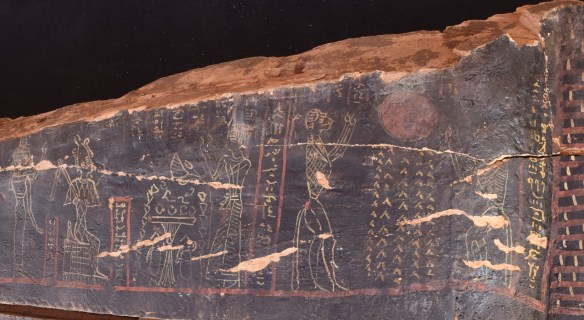
Both father and son used the well-known Ptolemaic coffin style of yellow and red decoration on black. Twt’s coffin, of which the left side, part of the feet and lower part have survived, shows some nice representations of gods and demons, mythological scenes and one particularly charming offering scene of the deceased in front of Osiris.

Detail of Twt’s coffin with the deceased before Osiris.

Although the chances could be higher, there is definitly hope that during the ongoing Ankh-Hor Project new data about little known Ptolemaic persons buried in TT 414 like Twt will be unearthed – I am personally convinced that some cartonage fragments will turn up within the large amounts of mid-to late Ptolemaic fragments which still need to be studied in detail. For now, documenting the only existing source for Twt in full detail is already an important step into the right direction.

Reference

Budka, Julia, Tamás Mekis and Marie-Cécile Bruwier 2013. Re-use of Saite temple tombs in the Asasif during the early Ptolemaic time – the tomb group of Mw.t-Mnw from TT 414, Egypt & Levant 22/23, 2012/2013, 209–251.