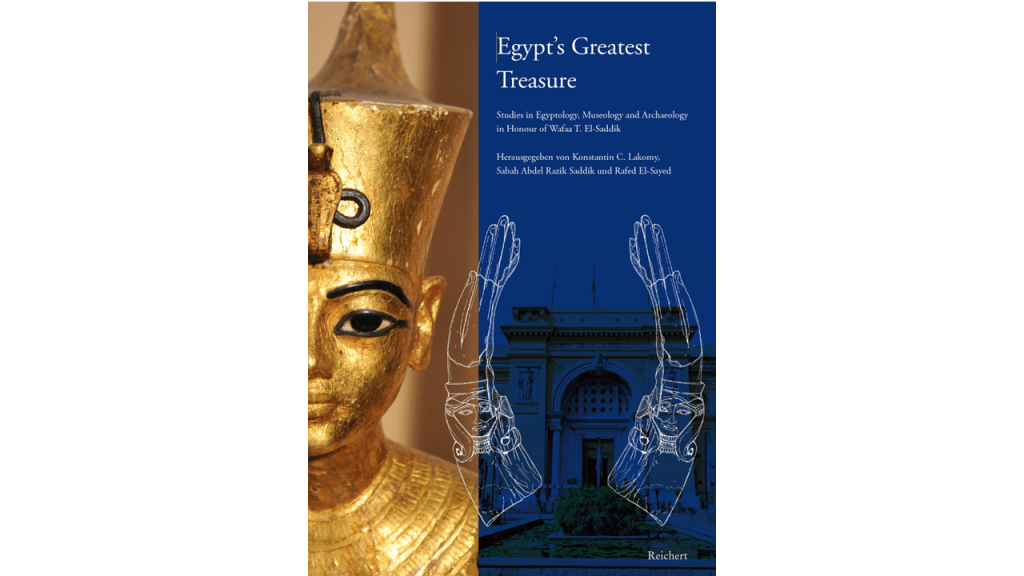
I am delighted to announce the publication of further material from TT 414. The splendid Festschrift for my dear colleague, Wafaa El-Saddik, brings together a wide range of studies in Egyptology, museology, and archaeology. Among them is a short article on the lesser-known cartonnages from the tomb of Ankh-Hor (in German).
I hope this article emphasises the importance of analysing the neglected cartonnage coffins of the Ptolemaic era in Thebes, and to compare them with the better-researched wooden coffins. Significant similarities and differences emerge in terms of motifs and style, in particular. Sets consisting of both types of coffin, such as those belonging to the Wesjr-wer family whose members were buried in TT 414, provide a valuable opportunity to gain a more comprehensive understanding of Ptolemaic coffin production in Thebes (see already an earlier blog post).
I would especially like to thank the editors of the Festschrift for enabling the last-minute incorporation of the most recent results from the 2025 season!
The material from TT 414 is ideally suited to demonstrating the benefits of analysing materials, decoration, texts, and prosopographic data together. It also illustrates the value of time-consuming research across different locations and museums and of re-evaluating ‘old excavations’. Research which we are keen to continue in 2026.
Reference:
Julia Budka, Spurensuche zwischen Wien, Kairo und Theben: Neues zu Kartonagen aus dem Asasif, in: Konstantin C. Lakomy, Sabah Abdel Razik Saddik & Rafed El-Sayed (eds.), Egypt’s Greatest Treasure. Studies in Egyptology, Museology and Archaeology inHonour of Wafaa T. El-Saddik, Wiesbaden, 175‒186.
November has begun, and the 2025 season in the Asasif has already come to a close. Our work was carried out from 20 September to 16 October 2025. The main objective of the 2025 season was to continue cleaning, consolidating and documenting the large quantity of artefacts unearthed from TT 414, the impressive tomb of Ankh-Hor, High Steward of the Divine Adoratrice Nitocris (26th Dynasty). As in the 2024 season, the focus was on wooden coffins and cartonnage elements from TT 414, including pieces from both the Late and Ptolemaic periods.
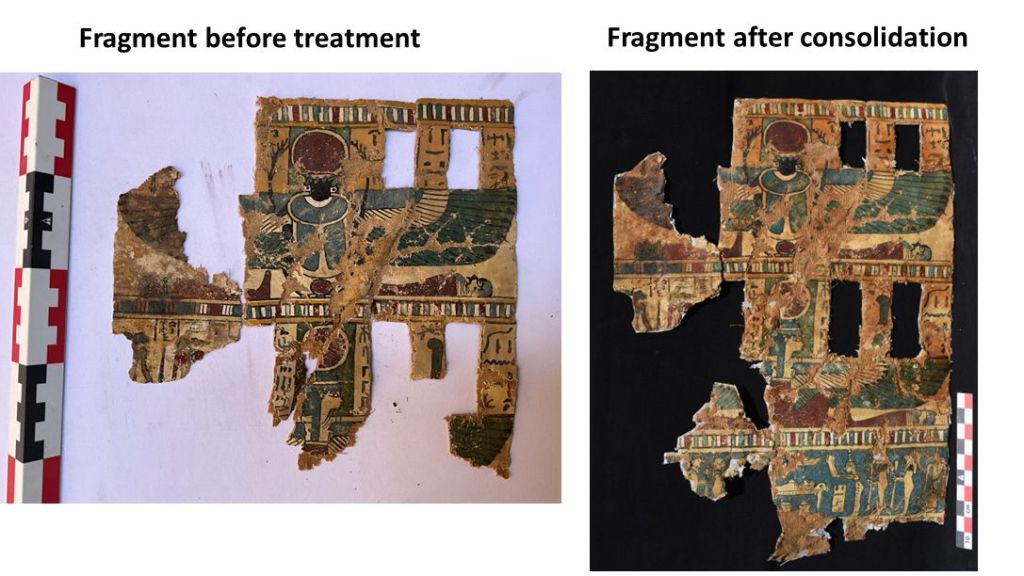
This year, a number of fragments of cartonnage elements and cartonnage coffin fragments was consolidated. One example is K02/209 is a fragment of the back part of a head cover for the mummy with the common motif of Isis and Nephtys mourning Osiris as personalised Djed-Pillar.
Example of consolidated cartonnage fragment (to the left prior to cleaning/consolidation, to the right finished).
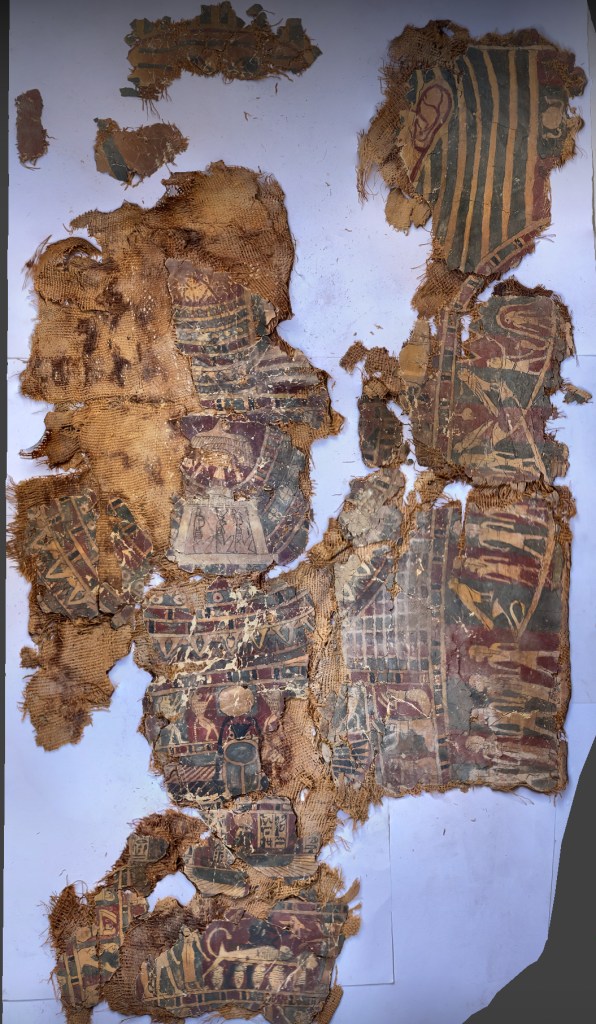
In general, significant progress has been made in the study of the cartonnage coffins from TT 414 – both regarding consolidation and matching pieces together. One of the most important results of the 2025 season was the identification of the lid of the cartonnage coffin of Wesjr-Wer (Reg. 23/05 fitting to Reg. 23/04). This now confirms that this new Wesjr-Wer III also had a bivalve cartonnage coffin with a zodiac on the inner part of the lid (see already an earlier blog post prior to the matching of the lid and the lower part).
On 14 October 2025, one box containing 30 wooden objects (34 individual pieces in total) was transported to the study magazine of the SCA. The objects were fully documented and 3D scans were taken prior to transportation.
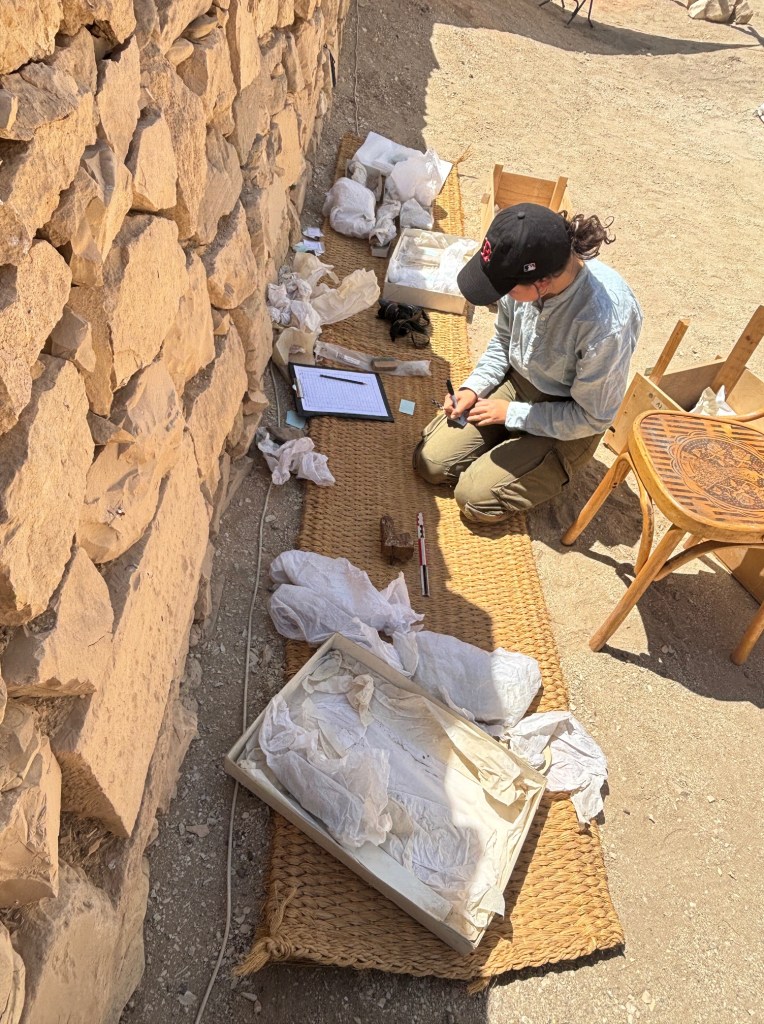
Two days of work were carried out on the West Bank study magazine of the SCA. The aim of the documentation was to update the records of the objects in the magazine. A total of twelve objects were studied, primarily to document items transferred to the magazine using photogrammetry (3D scans with the Scaniverse app) and, where necessary, infrared photography. Five coffins transported in 2019 and seven other objects from one box transported in 2021 were studied.
A day’s work was carried out in the section of the magazine dedicated to registered finds. First, the register book of the Austrian Mission was examined, resulting in the creation of a priority list of all remaining objects from the tomb of Ankh-Hor (TT 414). A total of 22 object numbers were examined. Most of these derive from the intact, in-situ burial of Wah-ib-Re in Room 10.2 of TT 414.
For me, it was a very special moment to be able to study these important finds, which were published in exemplary fashion by Bietak and Reiser-Haslauer. However, it really makes a difference to hold them in your own hands, for example dozens of the shabtis of Wah-ib-Re!
These are some of the shabtis of Wah-in-Re that I had the honour of studying this season.
In conclusion, the seventh season of the LMU Ankh-Hor Project was a success, with significant progress made in the consolidation and documentation of wooden and cartonnage coffins from TT 414. However, as not all fragments have been consolidated and documented yet, our work will need to continue into the next season. Joining pieces together is particularly time-consuming, but worthwhile. It was also important to continue work on the study magazine and gain an overview of all objects from TT 414 currently stored in the registered area.
We would like to thank our inspector, Mr Hassan Khalil, for enabling us to work according to the programme of work and for all his support during the 2025 season. The same applies to our conservation inspector, Mrs Iman Ibrahim Zaghlol.
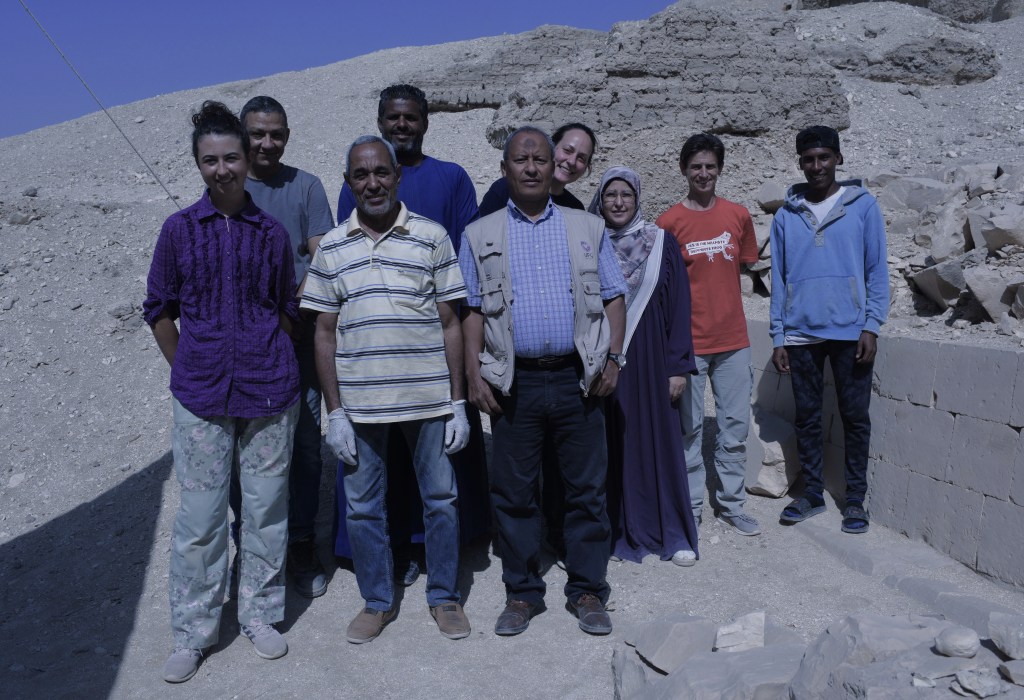
The 2025 team.
I would also like to thank all the team members who worked with us during the 2025 season: Hassan Aglan and Patrizia Heindl from LMU Munich, Ladina Soubeyrand from HU Berlin, and Iman Ibrahim Zaghlol and Mohamed Mahmoud Mohamed Mahmoud, who worked as conservators, as well as Ashraf Hosni Teegi, who was in charge of logistics.
I’m very much looking forward to our next season in 2026, which I’m sure will be great!
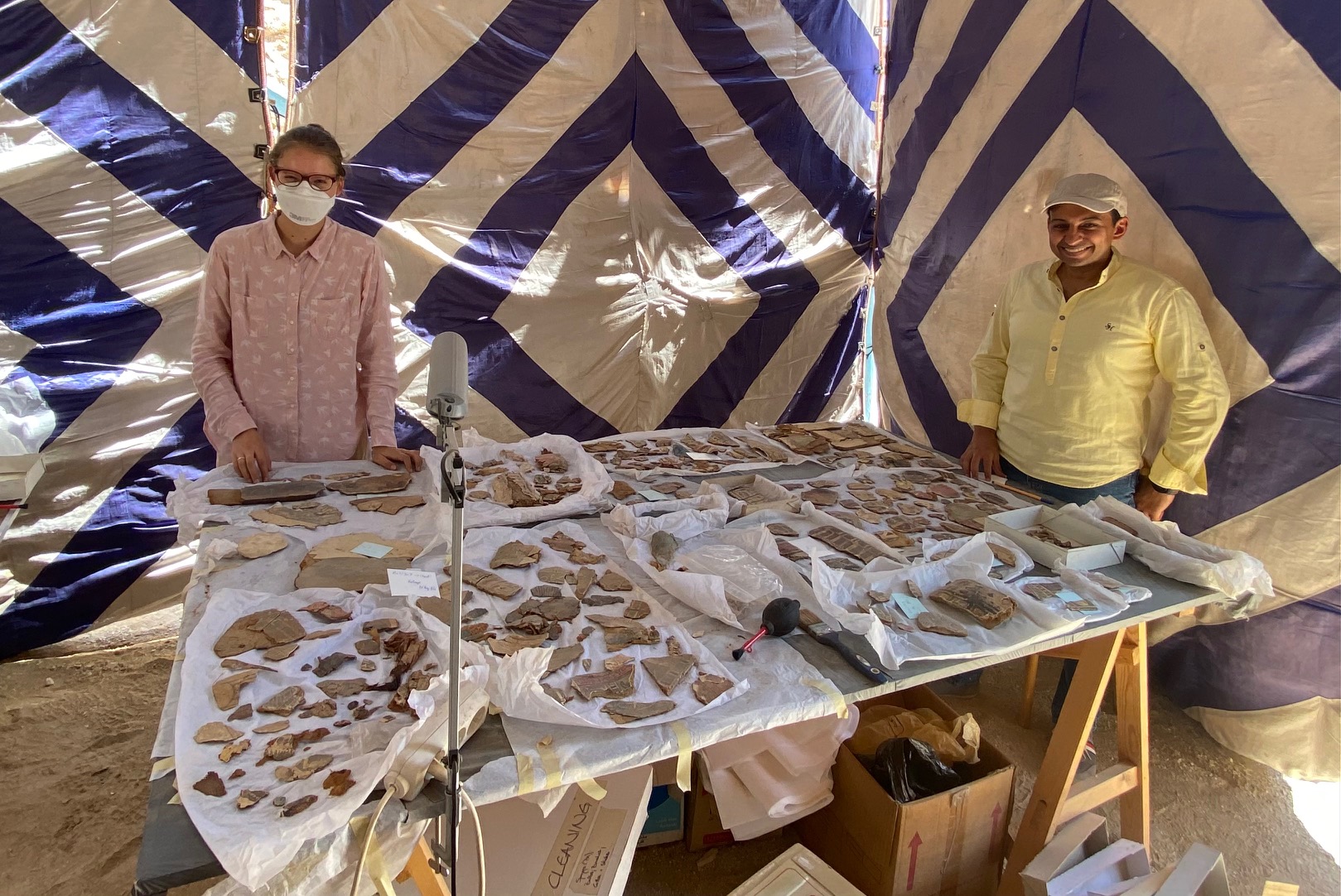
It’s gone by in the blink of an eye – we’ve already reached the mid-season point after two weeks of work in the Asasif. We’ve been super busy with wooden and cartonnage coffins from TT 414, both from the 26th Dynasty and the Ptolemaic period.
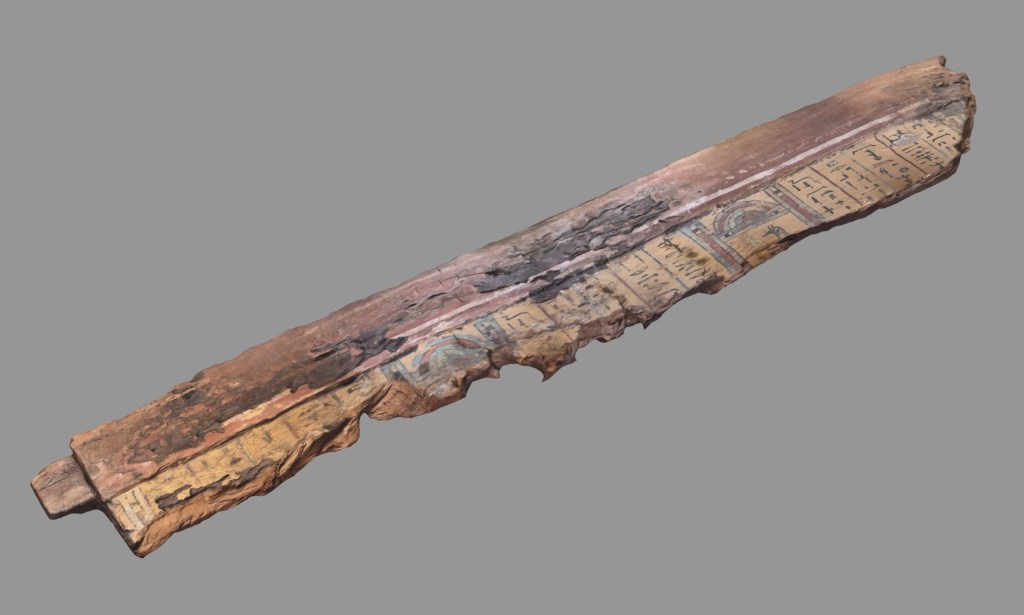
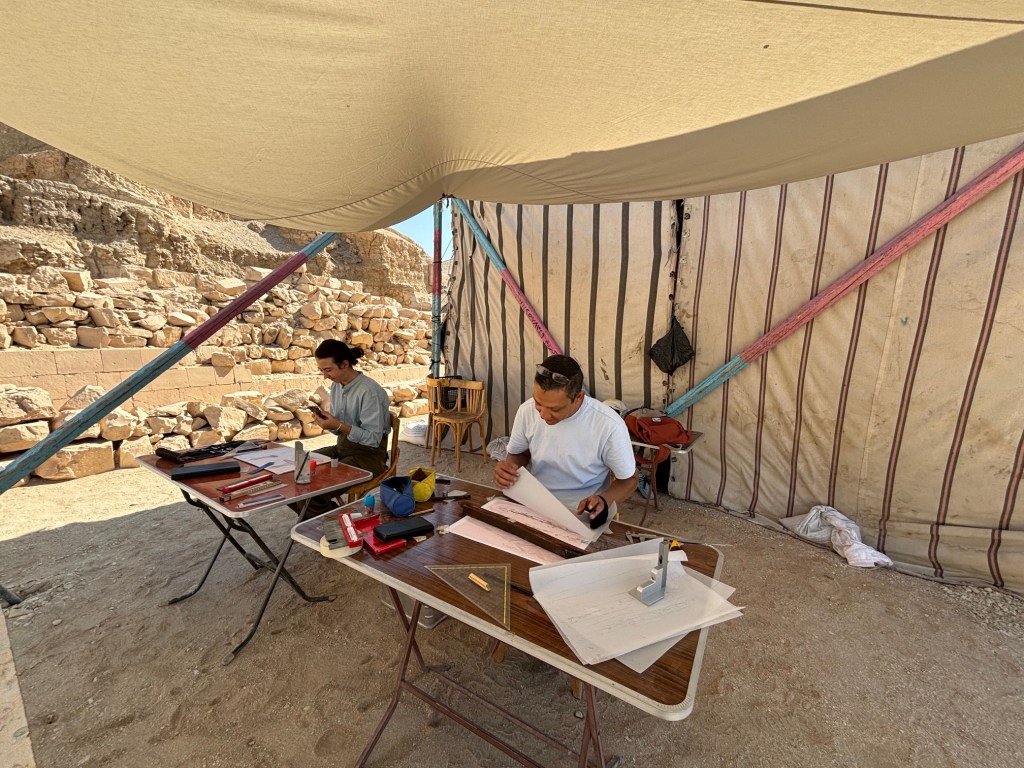
Ladina did a great job of documenting a really interesting wooden shrine coffin – the complete cornice of which has survived, allowing us to reconstruct its dimensions. This piece offers much to discover! We can highlight details of the woodworking, such as markings for dowel holes. Ladina has therefore also produced detailed pencil drawings of the individual elements.
Ladina busy drawing one of the beautifully carved peices of a wooden shrine coffin.
Mohamed Mahmoud and Iman Ibrahim Zaghlol, our conservators, did a great job over the last two weeks, cleaning and consolidating a large number of fragments.
Iman working on a 26th Dynasty fragment.
Mohamed’s work on fragile cartonnage pieces is really something else. He’s done some amazing stuff here, transforming broken and fragile pieces into stable objects again.
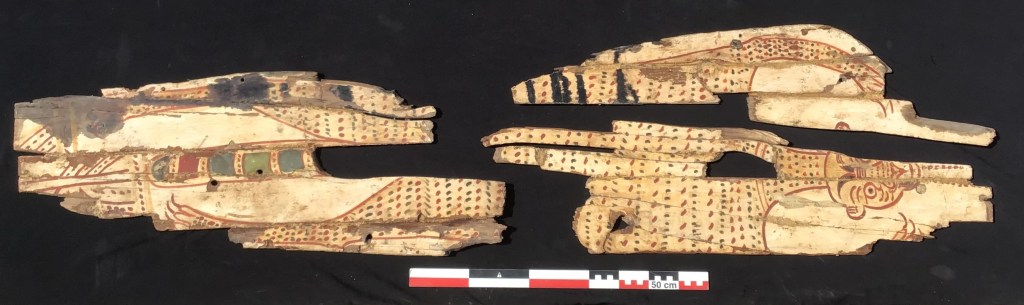
The fragment here shows that we’ve also got ‘openwork’ cartonnage coffins like the famous one by the Ptolemaic Theban priest Djed-Hor, which is now in the Leiden Museum and was recently published in a great new book by Maarten Raven (Raven 2025).
This piece from TT 414 and the cartonnage of Djed-Hor show that this type of cartonnage only covered the front and sides of the mummy. However, we also found bivalve cartonnage coffins from TT 414 in the last few seasons (check out last year’s reconstruction of the lower part of the cartonnage coffin Reg. No. 08/05). I’ve been working on these this week, trying to find joints between lower parts and upper parts of pieces that are similar stylistically.
This is me working on one of the beautifully painted bivalve cartonnage coffins from TT 414.
Hassan Aglan, who got here earlier this week, has a special task to finish up on in the next few days. He started documenting infant coffins from Tomb VII in the Austrian concession in great detail. This is a small family tomb used by a Kushite family (see Budka 2010 with references). The Austrian mission directed by Manfred Bietak found several burials in situ, including three infants. We’re currently photographing and scanning the coffins and human remains. As tragic as the children’s early passing must have been for their family, these burials are of significant importance. They are securely dated to the 25th Dynasty, so we’re doing everything we can to meticulously document them.
This is one of the infant coffins from Tomb VII. It’s still not cleaned and in poor condition (here with Ladina happy in the background) (photo: Hassan Aglan).
There’s loads of work waiting for us, starting with tomorrow and the start of week 3! But with all these great new advances, I’m really looking forward to getting back to the site.
References
Budka 2010 = J. Budka, Bestattungsbrauchtum und Friedhofsstruktur im Asasif. Eine Untersuchung der spätzeitlichen Befunde anhand der Ergebnisse der österreichischen Ausgrabungen in den Jahren 1969-1977, Untersuchungen der Zweigstelle Kairo des Österreichischen Archäologischen Institutes 34, Vienna 2010.
Raven 2025 = M. J. Raven, The Lost Mummy of Djedhor. Reconstructing the burial of a Ptolemaic priest from Thebes, Leiden 2025.
It’s been almost a year since we closed the 2024 season, and I’m thrilled and grateful that we opened for the 2025 season of the LMU Ankh-Hor Project yesterday.
As with last year, our focus will be on sorting, documenting and consolidating the fragmented wooden and cartonnage coffins from TT 414. Thanks to our kind inspector, Hassan Khalil, and our excellent workmen, supervised by Ahshraf Teegi, setting up was incredibly straightforward this year.
Our excellent conservator, Mohamed Mahmoud, has already got to work. Having joined us a few years ago, he is very familiar with both our workflow and the materials from TT 414. Mohamed has finished cleaning and consolidating some wooden pieces, as well as the first fragile cartonnage fragments for this season. Here he is working on one of the smaller pieces that he has fixed so nicely.
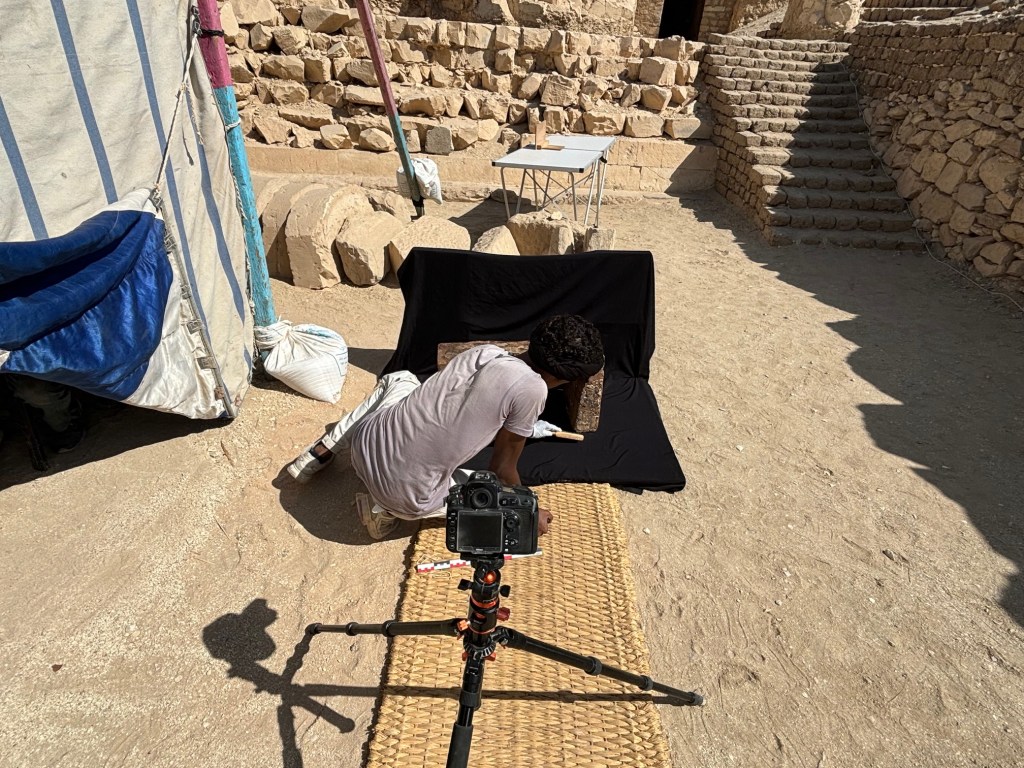
I continue to document the newly consolidated pieces using both our full-frame camera and the Scaniverse app to create 3D scans. The latter produces high-quality 3D models, as can be seen in this video of another cartonnage fragment consolidated by Mohamed.
One example of the newly cleaned cartonnage fragments from TT 414.
Furthermore, I have already succeeded in finding several pieces that can be joined to coffin fragments that have already been documented and registered in earlier season. This shows that all our efforts with the large quantity of finds from TT 414 are worthwhile.
Sorting through boxes of coffin fragments and adding photos and notes to their documentation is something that Ladina Soubeyrand is doing, just like she did last year. I am extremely grateful that she is joining us again this season!
Overall, the last two days were busy and successful, and we are looking forward to the rest of the season. We will, of course, update you with further blog posts, including photos, videos and more information!
It’s now a week since we returned to Europe from beautiful Luxor. Not only from the very successful 2024 Ankh-Hor project campaign, but also from a splendid Thebes in the First Millennium BCE conference with a rich programme of lectures and site visits.
Our 5 weeks of work on objects from the tomb of Ankh-Hor, TT 414, were very intensive. I will try to briefly summarise the most important aspects below.
The major goal of the 2024 season was to continue the cleaning, consolidation, and documentation of the large number of objects excavated from TT 414, the monumental tomb of Ankh-Hor, High Steward of the Divine Adoratrice Nitocris (26th Dynasty). Like in the 2023 season, the focus was on wooden coffins and cartonnage elements from TT 414 and included both Late Period pieces and Ptolemaic ones. Work was conducted from September 28 to October 31, 2024 (SCA Inspector: Shaima Abdelkarim).
Some fragmented coffins from TT 414 were identified for the first time and correlated with the documentation from the 1970s. Some additional material was recorded for the first time. In addition, several previously not identified pieces were newly recognised as matches to coffins documented by the Austrian mission in the 1970s. Some of these were joined by our conservators to the already documented pieces. One important example is Reg. No. 857. Whereas in the 1970s, only a small fragment of the edge and some base fragments of this lower case of a coffin were documented (Fig. 1 bottom left), new joining pieces allowed to reconstruct the entire length of the coffin (Fig. 1). With just 120cm in length, this is a coffin for an infant, not an adult. This raises various questions since the owner of the coffin is identified as Iset-em-akhbjt who holds the title jHjt n wja Ra (singer of the bark of Re).
Fig. 1: New pieces of Reg. No. 857 allow to identify it as an infant coffin
All finds studied in 2024 were digitally photographed and entered in a database, created by File Maker Pro. In total, more than 110 individual objects (mostly coffins and cartonnage elements) were studied and documented by full-format photos in high resolution. These new photos are suitable for publication and show the colours of the pieces, in contrast to the previous documentation in the 1970s. A total of 35 drawings of 14 important objects were produced in 2024 by Hassan and Ladina, comprising fragments wooden statues, canopic shrines and painted mud plaster.
Fig. 2: Photographing our coffin fragments sometimes required individual settings; here Islam helps me with the preparation.
Since many the painted objects from TT 414 have darkened surface, infrared photography was used to make the original decoration visible (with a Sony Cybershot DSC-F828, an IR-filter and a small magnet). In 2024, this method was applied to a total of 70 objects. A new method of documentation was introduced in 2023 for the Ankh-Hor project. The app Scaniverse was used to capture objects in 3D. This photogrammetry application is ultrafast, highly accurate and very easy to use. 207 objects from TT 414 were captured with metrically accurate 3D models this season. This technique was mainly used for work recordings when sorting cartonnage coffins (Fig. 3).
Fig. 3: Screenshot of 3D model of the newly reconstructed, fragmented cartonnage coffin lid Reg. 24/04. Since no texts with names and titles are preserved, the ownership is still unclear. The general colour scheme is rather unusual within the corpus of cartonnage coffins from TT 414.
The conservators of the LMU Munich Ankh-Hor Project in the 2023 season were the specialists for wood, Mrs. Karima Mohamed Sadiq and Mr. Mohamed Mahmoud Mohamed Mahmoud. All consolidated objects were documented photographically before and after conservation. Every object is documented in a list, containing the observed damages and the conservation measures. A total of more than 150 wooden and painted objects, mostly coffins, comprising c. 400 individual pieces, were successfully cleaned and consolidated in 2024.
One of the major accomplishments of the consolidation work this year was the reconstruction of the lower part of the cartonnage coffin Reg. No. 08/05. Before consolidation, it was broken in several pieces and very fragmented (Fig. 4).
Fig. 4: Part of Reg. No. 08/05 before consolidation work.Fig. 5: Work in progress – Mohamed is consolidating the very fragile cartonnage coffin Reg. No. 08/05.
At the end of our season, these fragments, including the newly found foot part, were joint to each other, and Reg. No. 08/05 reconstructed as best as possible (Fig. 6). Simply a great job by Karima and Mohamed!
Fig. 6: Interior of Reg. No. 08/05 after consolidation work.
Apart from the consolidation work, the study of the cartonnage coffins supported some conclusions about certain people buried in TT 414 during Ptolemaic times, for example about the Wesjrwer family. We now know that Horpabjk was the owner of the wooden coffin Reg. 829 and also of the newly recosntructed cartonnage coffin Reg. 08/05 (Figs. 4-6). In 2023, he was tentatively identified as a brother of Horakhbjt, owner of the cartonnage coffin Reg. No. 860. With his own cartonnage coffin now beautifully reconstructed and identified, which shows close parallels to Reg. No. 860, this family relation and identification is now based on solid grounds. More research is needed to fully understand this important family.
That we can now study sets of coffins in wood and cartonnage together is a considerable step towards reconstructing actual tomb groups in TT 414.
Since not all fragments of wooden and cartonnage coffins from TT 414 are yet consolidated and documented, our work needs to be continued in the next season. The finding of joining pieces is in particular time-consuming but definitly worthwhile.
Finally, I would like to thank all the team members and the local authorities – it was not only a successful season, but also a really enjoyable one and I am really looking forward to the next one with hopefully a very similar line-up!
Week 3 has just started and Ladina and Hassan are busy with documenting 30th Dynasty/early Ptolemaic coffins from the tomb of Ankh-Hor (TT 414), while Karima and Mohamed continue with some later Ptolemaic painted fragments.
Ashraf, Hassan and Ladina are busy sorting, cleaning and documenting coffin fragments.
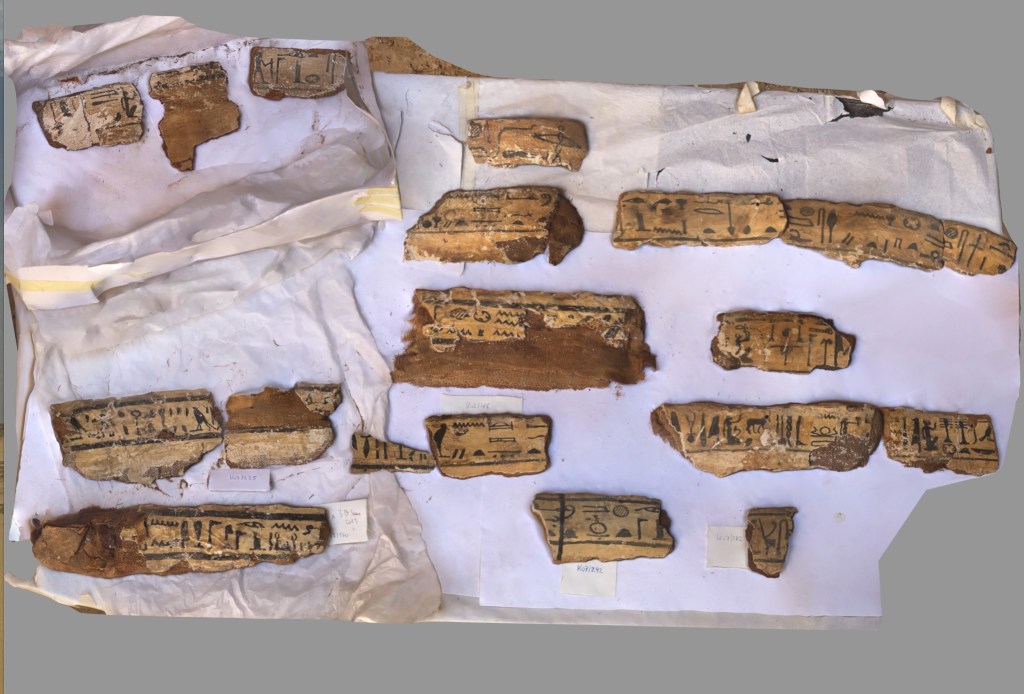
Week 2 brought a lot of progress; I was able to make numerous joints of small fragments to known, registered pieces. My focus was on Ptolemaic coffins around the family of Wesjr-wer – and here, in addition to the painted wooden coffins, also on the cartonnage coffins. A real challenge are both wooden and cartonnage coffins, where the text fields have unfortunately remained empty, so we have no information about the owners.
The white painted with black text outer surfaces of the lower parts of bivalve cartonnage coffins are still a big puzzle – but I have already found many joints!
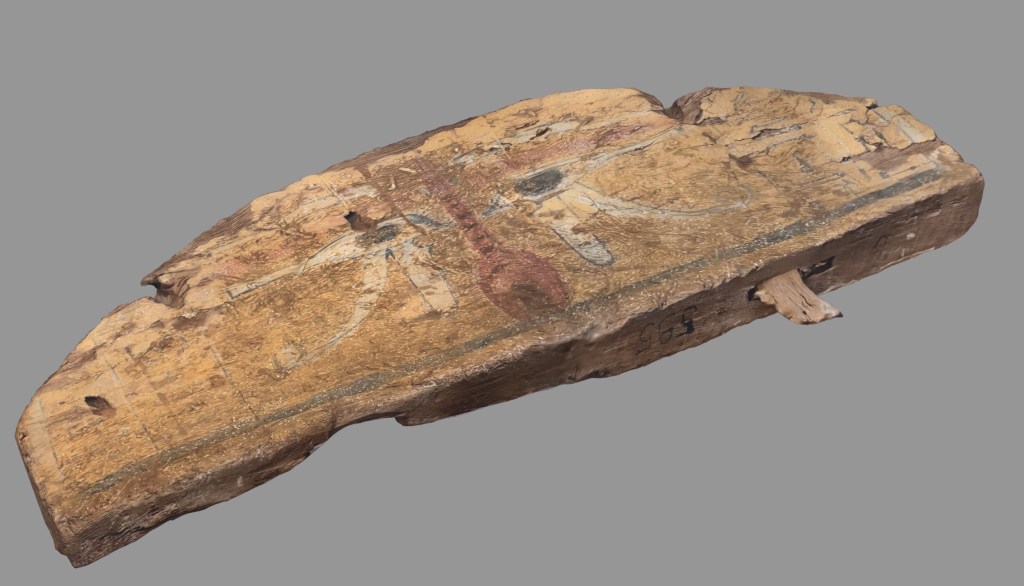
As a special highlight, I also documented the qrsw coffin of one of Ankh-Hor’s relatives, Psametik-men-em-Waset, Reg. 595, in 3D. The piece of which several boards and the front side are preserved had already been documented with our full-frame camera in 2018, but I wanted to take full advantage of the new possibilities offered by the rapid development of video-based photogrammetry with LiDAR sensors on mobile devices and the Scaniverse app developed by Toolbox AI. The scans also allow us to highlight technological features and details of the wood structure.
Screenshot of 3D scan of one of the lateral sides of Reg. 595 which shows nicely the damages of the wood and painted surface.Sceenshot of the 3D scan of the front side of the vaulted lid of the qrsw coffin Reg. 595.
Last but not least, Hassan and Ladina made detailed drawings of fragments of canopic boxes from TT 414. These drawings will be used in the final publication and perfectly complement our photographic documentation and the 3D scans.
Technical drawings remain necessary for some selected wooden pieces from TT 414.
All in all, our 2024 season continues to be very productive, and I am grateful to all team members for their commitment and enthusiasm. There are some really great objects we are working on and there are still a lot of them waiting for us in the coming weeks!
Today four weeks ago we closed the 2023 season of the Ankh-Hor project in Luxor. Time for a little review of a very successful season.
Work was conducted from September 5 to October 5, 2023, with our very helpful SCA Inspector Mahmoud Sayed Abdelhady. The major goal was to continue the cleaning, consolidation, and documentation of the large number of objects excavated in the 1970s from TT 414, the monumental tomb of Ankh-Hor, High Steward of the Divine Adora-trice Nitocris (26th Dynasty).
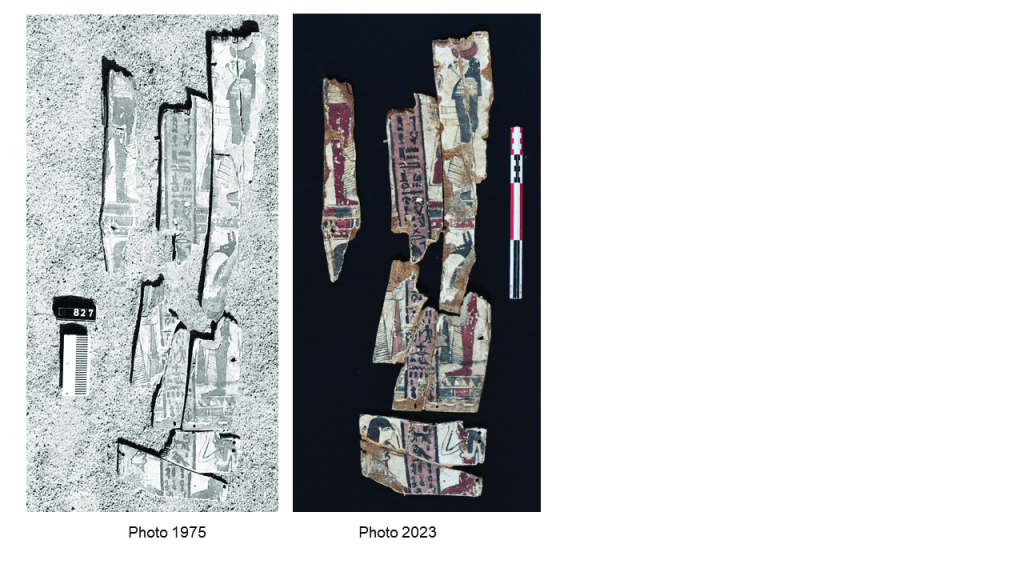
Several previously not identified pieces were newly recognised as matches to coffins documented by the Austrian mission in the 1970s. Some of these were joined by our conservators Mohamed and Karima to the already documented pieces. One example is Reg. No. 827 – Fig. 1 shows the state of documentation in the 1970s compared to 2023; this season, we found a small new piece matching to the instep of the lid. All pieces of Reg. No. 827 were cleaned and consolidated.
Fig. 1: Reg. 827, a fragmented Ptolemaic coffin lid. Left the state in 1975, to the right our new match in 2023.
In general, all finds studied in 2023 were digitally photographed and entered in a database, created by File Maker Pro. In total, more than 180 individual objects (mostly coffins and cartonnage elements) were studied and documented by more than 2400 photos. These new photos are suitable for publication and show the colours of the pieces, in contrast to the previous documentation in the 1970s (see Fig. 2).
Fig. 2: Reg. 521, one of the examples showing the benefits of high-resolution photography in full colour.
Since many the painted objects from TT 414 have darkened surface, infrared photography was used to make the original decoration visible (with a Sony Cybershot DSC-F828, an IR-filter and a small magnet). In 2023, this method was applied to a total of 95 objects.
We introduced a new method of documentation in 2023. The app Scaniverse (see https://scaniverse.com/) was used to capture objects in 3D. This photogrammetry application is ultrafast, highly accurate and very easy to use. 170 objects from TT 414 were captured with metrically accurate 3D models this season – simply fantastic!
Ashraf and I with the box of objects we transported in 2023 to the magazine (photo: P. Heindl).
One of the highlights of this season was the transport of objects to the magazine of the West Bank. In addition, we were able to work on coffins we transported to the magazine in earlier years. My personal highlight was the new documentation of one of my favourite coffins from TT 414, of Reg. 655, with infrared photography and with a 3D model.
3D model of coffin Reg. 655 created with the app Scaniverse
The conservators of the LMU Munich Ankh-Hor Project in the 2023 season were the specialists for wood, Mrs. Karima Mohamed Sadiq and Mr. Mahmoud Mohamed Mahmoud. They did a fantastic job, both at our site and in the magazine of the West Bank. A total of 108 wooden and painted objects, mostly coffins, comprising 294 individual pieces, were successfully cleaned and consolidated in 2023.
To conclude, the fifth season of the LMU Ankh-Hor Project was carried out successfully, with much progress regarding the consolidation and documentation of wood and cartonnage coffins from TT 414. Thanks to the transfer of objects to the magazine and the placement of studied finds in sugar bags in corridors of Tomb I, much space was gain in the mission’s magazine which is crucial for the future jigsaw puzzle of coffin fragments, both in wood and cartonnage. New genealogical information regarding coffin owners were unearthed and the stylistic assessment of Ptolemaic cartonnage coffins advanced in 2023 in many aspects, including reconstructing new cartonnage coffins.
The rich potential of our work on the cartonnage coffins can be illustrated with Reg. 23/04. I was able to match several fragments of the edge of the base of a cartonnage coffin which was previously not documented (Fig. 3). Based on the father’s name, the titles and the close similarity with Reg. 860, the coffin of Horakhbjt, I would like to propose to identify the owner of Reg. 23/04, Wesjrwer, as the previously unknown brother of Horakhbjt.
Fig. 3: Reconstruction of nine fragments of the edge of a cartonnage coffin of Wesjrwer.
Since not all fragments of wooden and cartonnage coffins from TT 414 are yet consolidated and documented, our work needs to be continued in the next season.
For now, I would like to express my gratitude to all of our Egyptian colleagues without whom work would not have been possible. I am very grateful to all team members of the 2023 season: Patrizia Heindl, Caroline Stadlmann, Ahmed Elmaklizi, all LMU Munich, and Karima Mohamed Sadiq and Mohamed Mahmoud Mohamed Mahmoud as the conservators of the Ministry of Antiquities and Tourism. Ashraf Hosni Teegi did another great job as the head of logistics. Many thanks to all and we are all very much looking forward to the next season!
To all who celebrate around the world, a very happy Mawlid an-Nabi! Because of this holiday, our week 4 ended already yesterday and we could catch up with some paperwork working today from home.
In week 4, our conservators Karima and Mohammed continued with the consolidation and cleaning of coffins from TT 414, focusing on Ptolemaic pieces. They managed to clean fragments of 16 coffins this week, comprising partly a large number of individual pieces. Like last week, puzzling with the fragments and gluing them back together after cleaning was very time consuming. One of my favourite coffins they finished this week is Reg. 829 – the beautiful base of a wooden anthropoid coffin showing a felid skin on the exterior.
The beautiful bottom side of the cartonnage coffin Reg. 829.
I am particularly proud that I managed to relocate the fragments of the edges of the coffin – this is new information which was not yet recorded in the previous documentation in the 1970s.
Interior of Reg. 829 with placement of fragments of the coffin edges.
Not only the coffin is remarkable, but also its owner. Reg. 829 was owned by the god’s father and prophet of Amun in Karnak, sakh-wedjat and prophet of Sobek who dwells in Qus Hor-pa-bjk. He belongs to a very interesting, but also quite complicated priestly family which was active most probably during mid-Ptolemaic time. All the family members buried in TT 414 had very similar wooden coffins as well as cartonnage coffins – this produces several challenges in identifying the individuals. Both the female and male members of the family show a little variety of titles but share very common names; this caused already confusion in the 1970s when Elfriede Reiser-Haslauer tried to reconstruct the family tree.
Very interesting is the connection of the family to Sobek of Qus – this is something we can trace already since the time of Pa-di-Amun-neb-nesut-tawy I who started reusing TT 414 in the fourth century BCE (Budka and Mekis 2022). Tamas Mekis and I have proposed that maybe the ancestors of Pa-di-Amun-neb-nesut-tawy I moved to Qus during the Second Persian Period and returned to Thebes during the Nectanebid Period, bringing the cult of the gods of Gesy with them. The cult of Sobek in Karnak is both connected to Amun as well as to Osiris (see Budka and Mekis 2022 with references; for Sobek and his cult in general see Kockelmann 2017) – and, as Hor-pa-bjk illustrates, the Sobek cult was an integral part of the duties of the Karnak priests reusing TT 414, even many generations after Pa-di-Amun-neb-nesut-tawy I.
Coming back to the coffin assemblage of Hor-pa-bjk, I completely agree with Reiser-Haslauer (1982) – although final proof is still lacking, it is very tempting to identify Hor-pa-bjk as the brother of Hor-akh-bjt, owner of the cartonnage coffin Reg. 860, which shows a very similar felid skin on the bottom in an almost identical style.
We know that Hor-pa-bjk also had a cartonnage coffin like his presumed brother (and his father, mother and sister-in-law…) – it most probably also showed a zodiac on the interior of the lid. Since the cartonnage coffins from TT 414 are even stronger fragmented than the wooden ones, I am still sorting through fragments and trying to make sense of this large jigsaw puzzle.
My workplace was very chaotic at times this week – just too many mixed up little fragments to sort through!
As one of the most important results this week, I believe that I managed to identify another brother of Hor-pa-bjk and Hor-akh-bjt by means of a very fragmented cartonnage coffin which is again similar to Reg. 860. This would most probably be the eldest son of Nes-ba-neb-Djedet – a previously unrecorded Wesjr-wer III, named after his grandfather Wesjr-wer II. Thus, with the family tree around Hor-pa-bjk increasing, I am positive that we will soon be able to answer some of the open questions.
This small case study hopefully illustrates why all this work with the gigantic puzzle of fragments from the tomb of Ankh-Hor is worth doing – not only to reconstruct the actual objects from TT 414, but also to gain more information about the priesthood of Karnak in Ptolemaic times.
References:
Budka, J. and T. Mekis 2022. The family of Pa-di-Amun-neb-nesut-tawy from Thebes (TT 414) revisited. The case study of Kalutj/Nes-Khonsu (G108 + G137) (with contributions by Marc Etienne and Malcolm Jr. Mosher), Archaeopress Egyptology 42, Oxford [open access].
Kockelmann, H. 2017. Der Herr der Seen, Sümpfe und Flußläufe. Untersuchungen zum Gott Sobek und den ägyptischen Krokodilgötter-Kulten von den Anfängen bis zur Römerzeit. Ägyptologische Abhandlungen 74, Wiesbaden.
Reiser-Haslauer, E. 1982, C. Die Familien um Wsjr-wr und Ns-bA-nb-Ddt (spätptolemäisch), 257, in: M. Bietak and E. Reiser-Haslauer, Das Grab des Anch-Hor, Obersthofmeister der Gottesgemahlin Nitokris, Band II. Mit Beiträgen von Joachim Boessneck, Angela von den Driesch, Jan Quaegebeur, Helga Liese-Kleiber und Helmut Schlichtherle und Relief- und Fundzeichnungen von Heinz Satzinger, Untersuchungen der Zweigstelle Kairo 5, Wien.
This week just flew by very quickly – we made much progress in many respects.
The consolidation and cleaning of coffins from TT 414 was carried out continuously by our conservators Karima and Mohammed. They managed to clean seven additional coffins this week, comprised of more than 60 individual pieces. Very time consuming was therefore the puzzling with the fragments and gluing them back together after cleaning.
This week, Mohammed and Karima had to fit many pieces of fragmented coffins together.
One case study of these working tasks is shown here – Reg. 825 is a nice example of a looted inner anthropoid coffins with clear damages caused by the robbers. Karima and Mohammed managed to fit the fragments back together in a way that also the original shape of the lid becomes visible again.
Reg. 825 was one of the coffins successfully cleaned, glued and documented in week 3.
Another great achievement in terms of consolidation was the work by Mohammed on a very fragile pedestal of a 26th Dynasty Ptah-Sokar-Osiris statue from the tomb of Ankh-Hor. The piece is not inscribed, but covered with linen and painted in yellow, red and blue. Mohammed fixed all of the remaining painted parts. The 3D model I created of the object with Scaniverse shows in great accuracy the “footprint” of the statue – the tenon hole, but also the shape of the lower base of the figure. The almost square cavity in front of the pedestal was closed with a lid on which we traced the negative of a falcon statue.
3D model of Reg. 23/02 (created with Scaniverse) showing all the details of this 26th Dynasty Ptah-Sokar-Osiris-pedestal. The small lid of the cavity was removed for this scan.
This week the work on the cartonnage coffins from TT 414 really picked up speed. To begin, Ahmed and Caroline, our student assistants, searched and sorted through several boxes of fragments. We focused on the reconstruction of a wonderful two-part coffin of the Ptolemaic Amun priest Horakhbjt, Reg. 860- its painting is exquisite and large fragments were documented back in the 1970s. However, we realised that most of these fragments are currently missing. The good news is: I have now been able to relocate numerous pieces; they were scattered in dozens of boxes in the magazine.
Ahmed and Caroline did a great job sorting through boxes with cartonnage fragments from TT 414.
I show you here a particularly charming fragment from the lid: just check out the details of the figure of Anubis and the way he is here depicted bent over the mummy on the lion bed.
One small fragment from the lid of Reg. 860 – unusual is the representation of Anubis in this scene with the mummy bier.
I did anticipate that work on Reg. 860 will be time-consuming – maybe not as much as it turned out to be, but I am still optimistic that we will manage to document much of this important piece during this season. In addition, I managed to find matching pieces to a lot of other cartonnage coffins. The most exciting one is maybe the beautiful lid of the cartonnage of the priest Twt. Just last year, I managed to identify this cartonnage coffin and now we have a full representation of Twt kneeling in front of an offering table in delicate painting.
New matching pieces of the cartonnage coffin of Mr. Twt – the lower part of the Ba-bird and of Twt himself were newly found this week.
Last but not least, this week was also very successful in using 3D scanning with Scaniverse to document objects, fragments of cartonnage coffins and wooden coffins from TT 414. More than 50 3D scans now complement our documentation and will allow us to continue the jigsaw puzzle also back home after the season.
It is a great pleasure to have been invited by the Collegium Aegyptium, the friends of the Institute of Egyptology and Coptology at LMU Munich to give a lecture about my Ankh-Hor Project.
My talk later today will be in German and focuses on the questions of Ptolemaic wooden coffins and cartonnage fragments from TT 414.
It is the first time that I present some preliminary remarks on the cartonnage cases from the tomb of Ankh-Hor. There is evidence for various types of cartonnages from the 30th Dynasty well into the Ptolemaic era. I will discuss some of the results from the 2022 season.
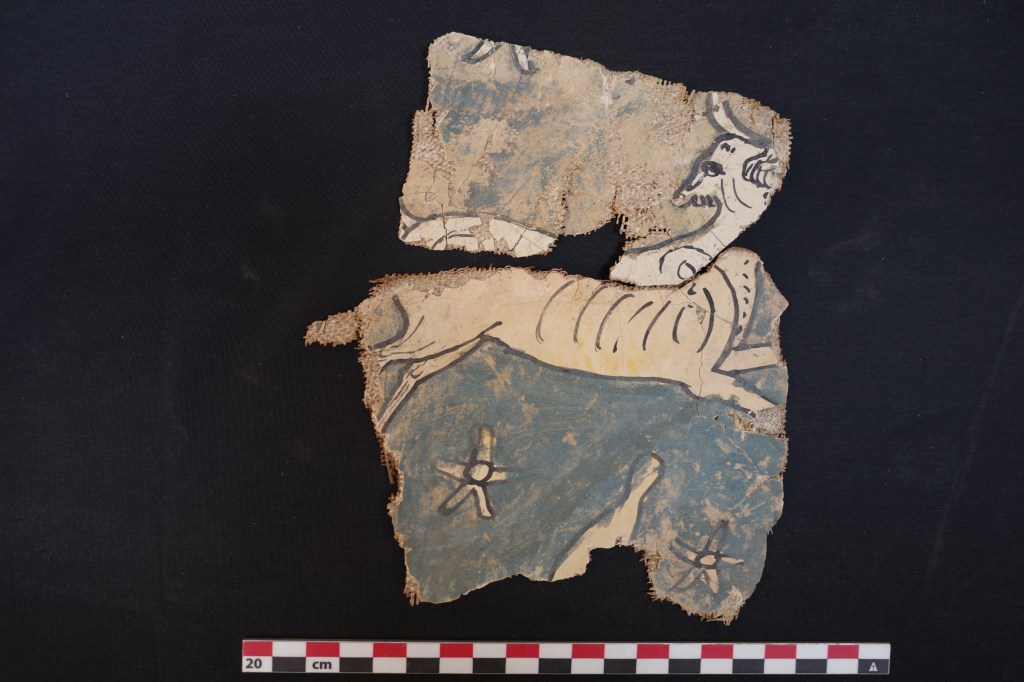
One particularly interesting topic, that I will briefly mention today in my lecture is the appearance of zodiac representations on the interior of lids of cartonnage coffins.
Interior decoration of the lid of a cartonnage coffin from TT 414 with the Taurus zodiac sign.
The recent publication by Daniela Mendel (2022) is an excellent collection and comparison of representations of astronomical ceilings and zodiacs in Ptolemaic and Roman temples, coffins and sarcophagi as well as tombs. Due to the poor state of publication on Ptolemaic cartonnage coffins from Thebes, there is no reference in the book to cartonnage examples of zodiac representations. It is well known that the wooden coffins of the famous Soter family from Thebes include representations of the sky with zodiac – but as the material from TT 414 shows, there were already examples well before the Roman era.
There is still so much work and research to be done – and hopefully we will be back in Luxor for the 2023 season of the Ankh-Hor Project soon. For now, I am very much looking forward to tonight’s lecture and hope for some constructive feedback and questions.
Reference
Mendel, D. 2022. Die Geographie des Himmels: eine Untersuchung zu den Deckendekorationen in ägyptischen Tempeln der griechisch-römischen Zeit und zeitgleichen Darstellungen auf Särgen und in Gräbern. 3 vols. Studien zur spätägyptischen Religion 37. Wiesbaden: Harrassowitz













 The Ankh-Hor Project