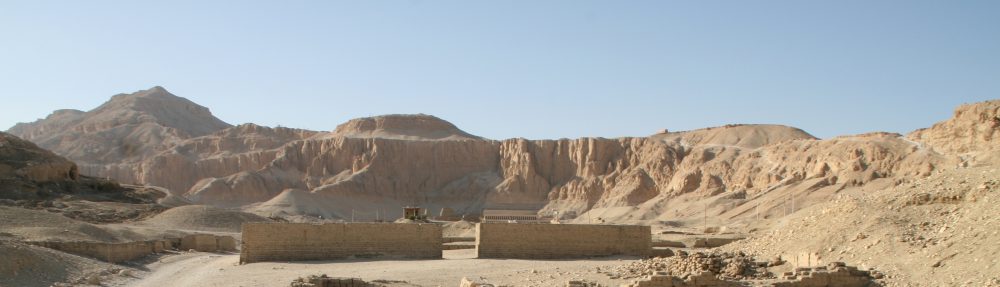
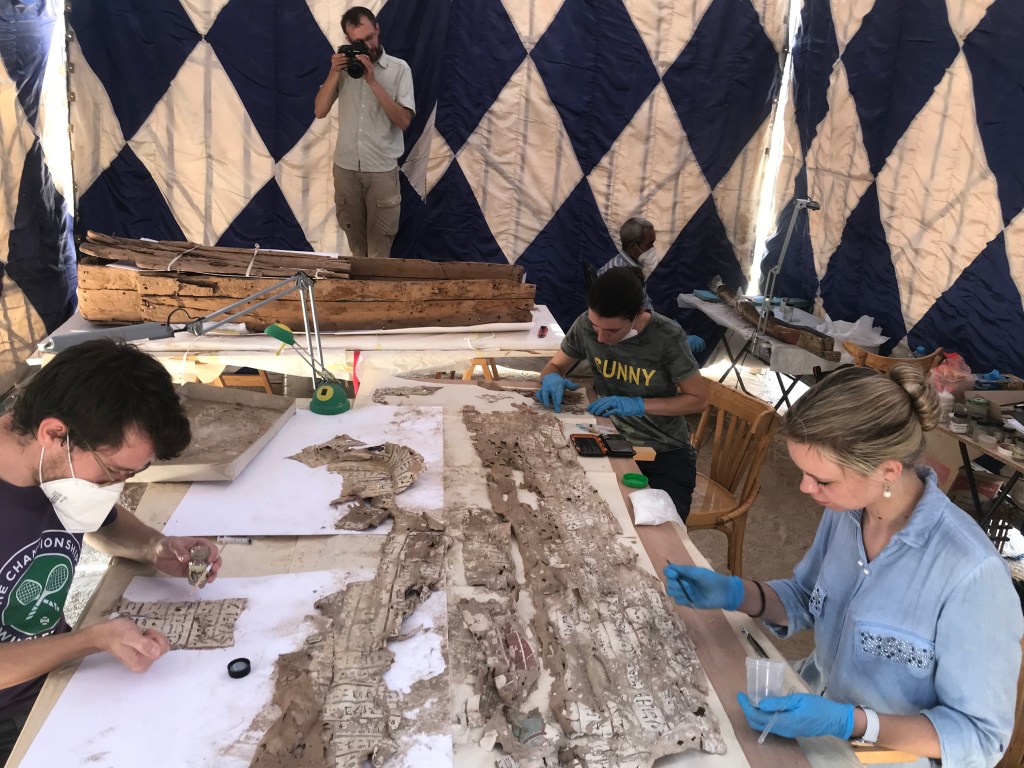
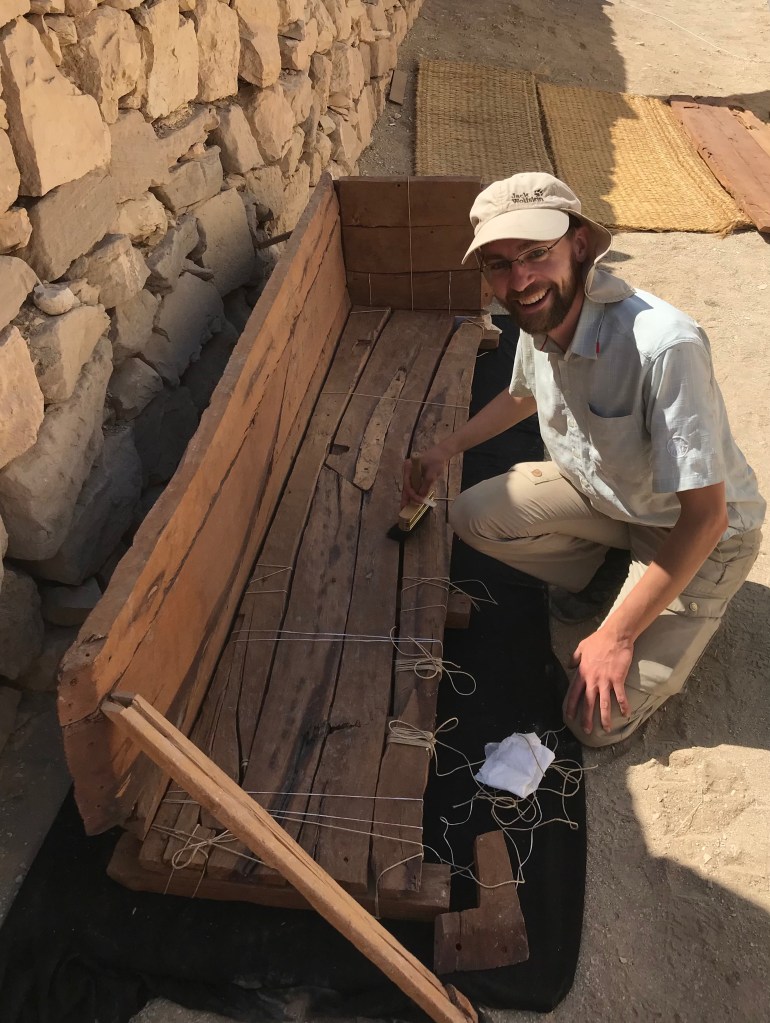
This week has been extremely productive, and we made much progress in our work tasks. In terms of conservation, the consolidation and cleaning of objects from TT 414 progressed very well thanks for the efforts of our conservators Karima and Mohammed. The focus was on Ptolemaic painted coffins and for many of them, matching pieces could be glued together. Despite of this time-consuming task of gluing, already 38 registered numbers with more than 70 individual pieces have been treated by our conservation team until today.


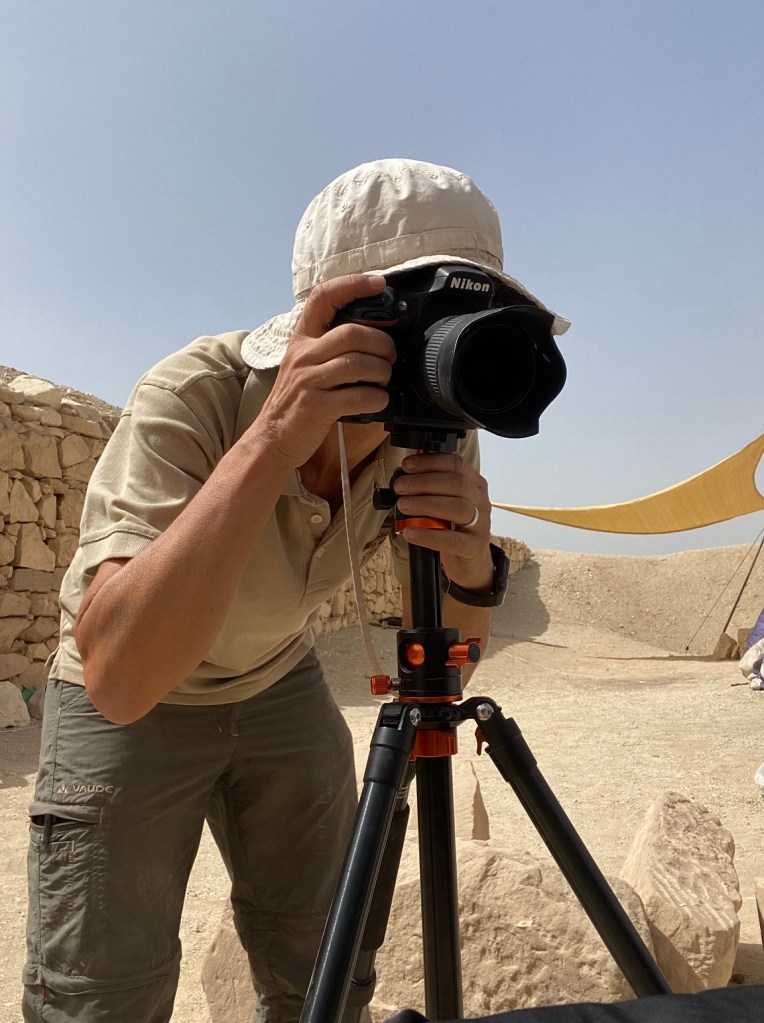
My tasks are currently to prepare the objects chosen for consolidation according to priorities, photographing them (with our full-frame camera for high resolution photos as well as with infrared photography where necessary) and identifying fragments without object numbers.

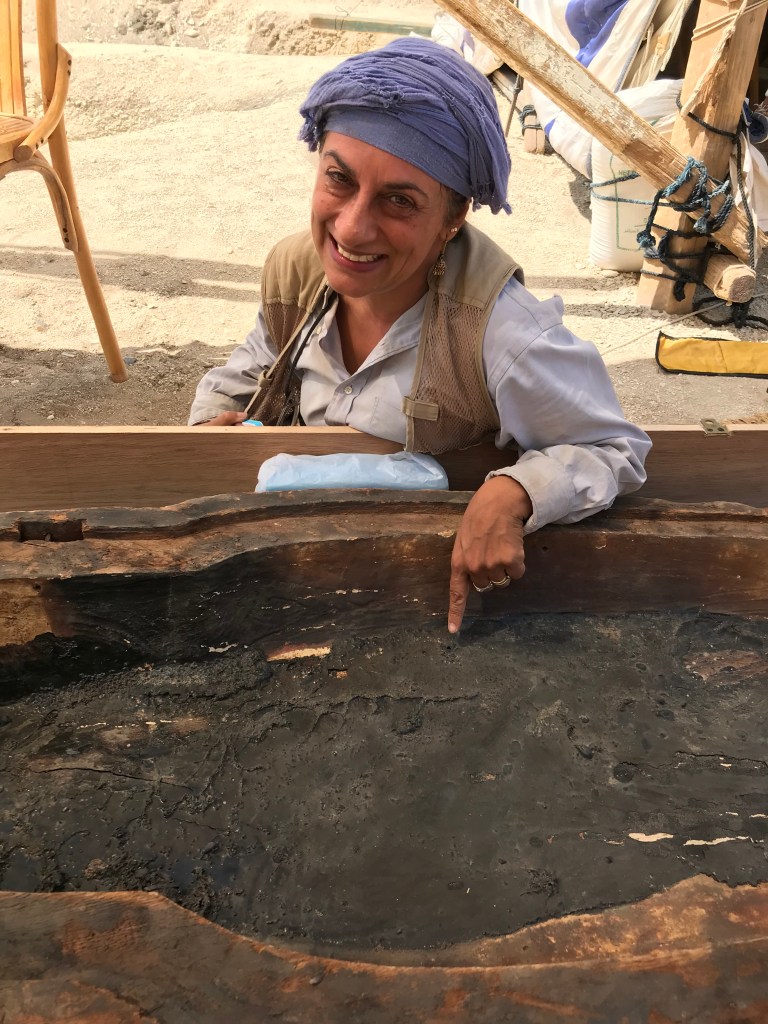
For one coffin fragment, the base of an inner anthropoid coffin (Reg. 07/58), I noticed a very interesting detail. There is a substantial amount of black goo (bitumen/resin) on the interior of this coffin – a common feature in our corpus, especially for the Ptolemaic coffins. Although this substance partially obscures the decoration of painted pieces, it is also an interesting archive of information in itself. For example, back in 2021, we documented the so-called “beetle coffin”, where a number of beetles were stuck into the resin/bitumen. There are other examples in which the negative traces of the mummy and/or of rolls of papyrus are traceable in the black goo. For Reg. 07/58, we can reconstruct that the mummy was covered in a bead net and this net has left an imprint in the resinous substance.

Thus, although only very fragmentarily preserved, this coffin fragment offers quite some interesting information on the burial which was once placed in it and got looted prior to the excavation of TT 414.
Newly documented pieces are getting measured and described as well. With the exciting new possibility of 3D scanning with Scaniverse, we will complement our documentation with this useful asset.
Finally, despite of all the digital documentation, we also use traditional methods like drawing for small objects and wooden pieces where the illustration of the construction is highly relevant. This working task was started during week 2 as well, thanks to the arrival of Patrizia Heindl.

More team members will arrive later today, and I am very much looking forward to week 3 of our 2023 season.




 The Ankh-Hor Project