Mid-season update from the field

It’s gone by in the blink of an eye – we’ve already reached the mid-season point after two weeks of work in the Asasif. We’ve been super busy with wooden and cartonnage coffins from TT 414, both from the 26th Dynasty and the Ptolemaic period.

Ladina did a great job of documenting a really interesting wooden shrine coffin – the complete cornice of which has survived, allowing us to reconstruct its dimensions. This piece offers much to discover! We can highlight details of the woodworking, such as markings for dowel holes. Ladina has therefore also produced detailed pencil drawings of the individual elements.

Ladina busy drawing one of the beautifully carved peices of a wooden shrine coffin.

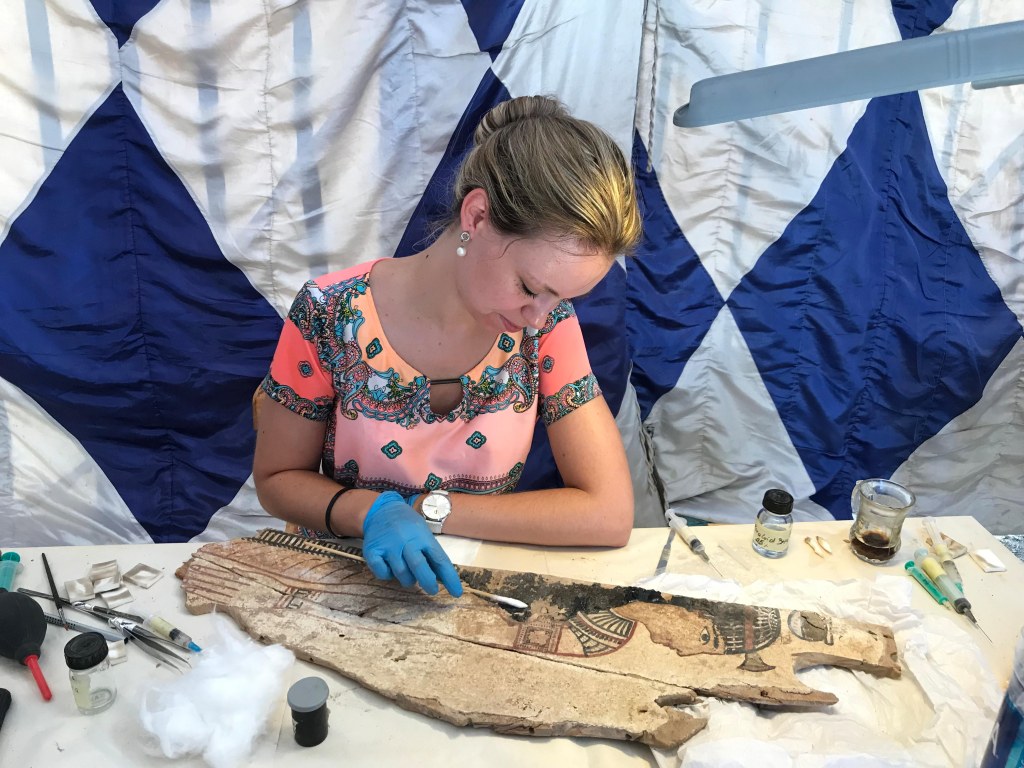
Mohamed Mahmoud and Iman Ibrahim Zaghlol, our conservators, did a great job over the last two weeks, cleaning and consolidating a large number of fragments.

Iman working on a 26th Dynasty fragment.

Mohamed’s work on fragile cartonnage pieces is really something else. He’s done some amazing stuff here, transforming broken and fragile pieces into stable objects again.
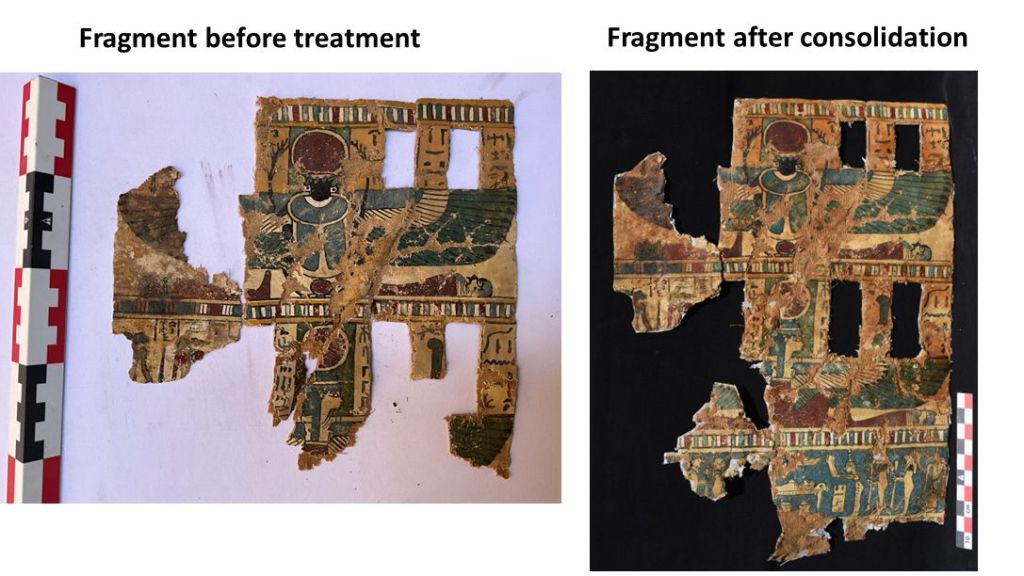
The fragment here shows that we’ve also got ‘openwork’ cartonnage coffins like the famous one by the Ptolemaic Theban priest Djed-Hor, which is now in the Leiden Museum and was recently published in a great new book by Maarten Raven (Raven 2025).

This piece from TT 414 and the cartonnage of Djed-Hor show that this type of cartonnage only covered the front and sides of the mummy. However, we also found bivalve cartonnage coffins from TT 414 in the last few seasons (check out last year’s reconstruction of the lower part of the cartonnage coffin Reg. No. 08/05). I’ve been working on these this week, trying to find joints between lower parts and upper parts of pieces that are similar stylistically.

This is me working on one of the beautifully painted bivalve cartonnage coffins from TT 414.

Hassan Aglan, who got here earlier this week, has a special task to finish up on in the next few days. He started documenting infant coffins from Tomb VII in the Austrian concession in great detail. This is a small family tomb used by a Kushite family (see Budka 2010 with references). The Austrian mission directed by Manfred Bietak found several burials in situ, including three infants. We’re currently photographing and scanning the coffins and human remains. As tragic as the children’s early passing must have been for their family, these burials are of significant importance. They are securely dated to the 25th Dynasty, so we’re doing everything we can to meticulously document them.

This is one of the infant coffins from Tomb VII. It’s still not cleaned and in poor condition (here with Ladina happy in the background) (photo: Hassan Aglan).

There’s loads of work waiting for us, starting with tomorrow and the start of week 3! But with all these great new advances, I’m really looking forward to getting back to the site.

References

Budka 2010 = J. Budka, Bestattungsbrauchtum und Friedhofsstruktur im Asasif. Eine Untersuchung der spätzeitlichen Befunde anhand der Ergebnisse der österreichischen Ausgrabungen in den Jahren 1969-1977, Untersuchungen der Zweigstelle Kairo des Österreichischen Archäologischen Institutes 34, Vienna 2010.

Raven 2025 = M. J. Raven, The Lost Mummy of Djedhor. Reconstructing the burial of a Ptolemaic priest from Thebes, Leiden 2025.
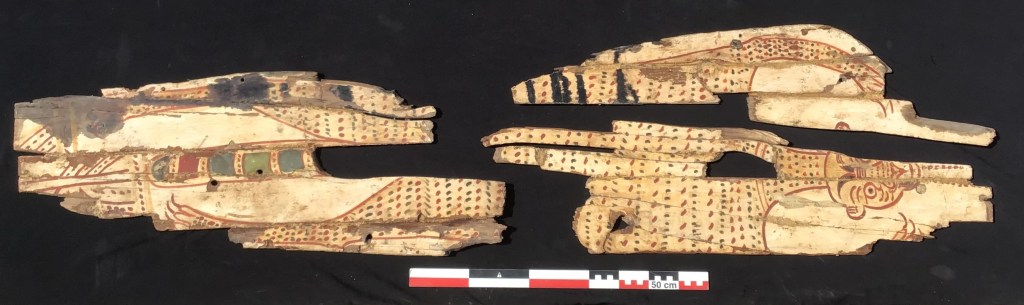
A puzzle of wooden coffins and cartonnage coffins from TT 414

To all who celebrate around the world, a very happy Mawlid an-Nabi! Because of this holiday, our week 4 ended already yesterday and we could catch up with some paperwork working today from home.

In week 4, our conservators Karima and Mohammed continued with the consolidation and cleaning of coffins from TT 414, focusing on Ptolemaic pieces. They managed to clean fragments of 16 coffins this week, comprising partly a large number of individual pieces. Like last week, puzzling with the fragments and gluing them back together after cleaning was very time consuming. One of my favourite coffins they finished this week is Reg. 829 – the beautiful base of a wooden anthropoid coffin showing a felid skin on the exterior.

The beautiful bottom side of the cartonnage coffin Reg. 829.

I am particularly proud that I managed to relocate the fragments of the edges of the coffin – this is new information which was not yet recorded in the previous documentation in the 1970s.

Interior of Reg. 829 with placement of fragments of the coffin edges.

Not only the coffin is remarkable, but also its owner. Reg. 829 was owned by the god’s father and prophet of Amun in Karnak, sakh-wedjat and prophet of Sobek who dwells in Qus Hor-pa-bjk. He belongs to a very interesting, but also quite complicated priestly family which was active most probably during mid-Ptolemaic time. All the family members buried in TT 414 had very similar wooden coffins as well as cartonnage coffins – this produces several challenges in identifying the individuals. Both the female and male members of the family show a little variety of titles but share very common names; this caused already confusion in the 1970s when Elfriede Reiser-Haslauer tried to reconstruct the family tree.

Very interesting is the connection of the family to Sobek of Qus – this is something we can trace already since the time of Pa-di-Amun-neb-nesut-tawy I who started reusing TT 414 in the fourth century BCE (Budka and Mekis 2022). Tamas Mekis and I have proposed that maybe the ancestors of Pa-di-Amun-neb-nesut-tawy I moved to Qus during the Second Persian Period and returned to Thebes during the Nectanebid Period, bringing the cult of the gods of Gesy with them. The cult of Sobek in Karnak is both connected to Amun as well as to Osiris (see Budka and Mekis 2022 with references; for Sobek and his cult in general see Kockelmann 2017) – and, as Hor-pa-bjk illustrates, the Sobek cult was an integral part of the duties of the Karnak priests reusing TT 414, even many generations after Pa-di-Amun-neb-nesut-tawy I.

Coming back to the coffin assemblage of Hor-pa-bjk, I completely agree with Reiser-Haslauer (1982) – although final proof is still lacking, it is very tempting to identify Hor-pa-bjk as the brother of Hor-akh-bjt, owner of the cartonnage coffin Reg. 860, which shows a very similar felid skin on the bottom in an almost identical style.

We know that Hor-pa-bjk also had a cartonnage coffin like his presumed brother (and his father, mother and sister-in-law…) – it most probably also showed a zodiac on the interior of the lid. Since the cartonnage coffins from TT 414 are even stronger fragmented than the wooden ones, I am still sorting through fragments and trying to make sense of this large jigsaw puzzle.

My workplace was very chaotic at times this week – just too many mixed up little fragments to sort through!

As one of the most important results this week, I believe that I managed to identify another brother of Hor-pa-bjk and Hor-akh-bjt by means of a very fragmented cartonnage coffin which is again similar to Reg. 860. This would most probably be the eldest son of Nes-ba-neb-Djedet – a previously unrecorded Wesjr-wer III, named after his grandfather Wesjr-wer II. Thus, with the family tree around Hor-pa-bjk increasing, I am positive that we will soon be able to answer some of the open questions.

This small case study hopefully illustrates why all this work with the gigantic puzzle of fragments from the tomb of Ankh-Hor is worth doing – not only to reconstruct the actual objects from TT 414, but also to gain more information about the priesthood of Karnak in Ptolemaic times.

References:

Budka, J. and T. Mekis 2022. The family of Pa-di-Amun-neb-nesut-tawy from Thebes (TT 414) revisited. The case study of Kalutj/Nes-Khonsu (G108 + G137) (with contributions by Marc Etienne and Malcolm Jr. Mosher), Archaeopress Egyptology 42, Oxford [open access].

Kockelmann, H. 2017. Der Herr der Seen, Sümpfe und Flußläufe. Untersuchungen zum Gott Sobek und den ägyptischen Krokodilgötter-Kulten von den Anfängen bis zur Römerzeit. Ägyptologische Abhandlungen 74, Wiesbaden.

Reiser-Haslauer, E. 1982, C. Die Familien um Wsjr-wr und Ns-bA-nb-Ddt (spätptolemäisch), 257, in: M. Bietak and E. Reiser-Haslauer, Das Grab des Anch-Hor, Obersthofmeister der Gottesgemahlin Nitokris, Band II. Mit Beiträgen von Joachim Boessneck, Angela von den Driesch, Jan Quaegebeur, Helga Liese-Kleiber und Helmut Schlichtherle und Relief- und Fundzeichnungen von Heinz Satzinger, Untersuchungen der Zweigstelle Kairo 5, Wien.

Presenting the Ankh-Hor Project at the ICE 2023 in Leiden

It has been a wonderful week so far – more than 800 Egyptologists are gathering for the 13th International Congress of Egyptologists in the beautiful city of Leiden! Many congrats to the organizers for a fantastic job – there are multiple sessions and several workshops as well as outreach lectures and receptions. Recent finds and results from the field are presented as well as crucial questions addressed and innovative methods and theories discussed.

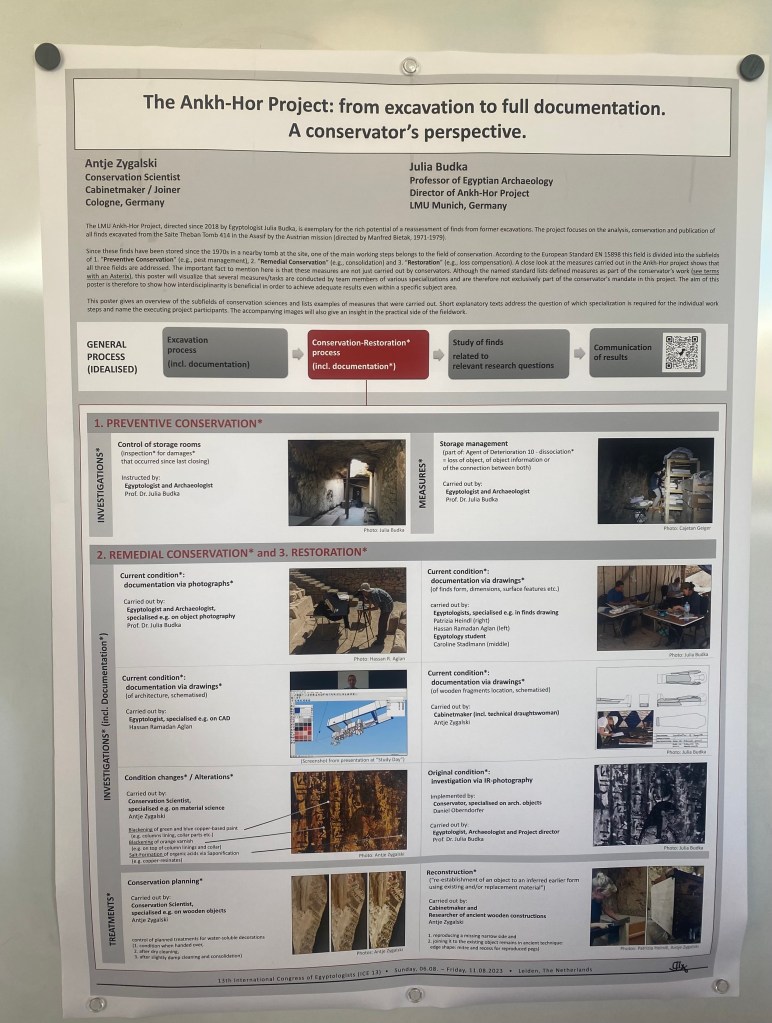
Today is the day for the poster presentations. I am very happy that Antje Zygalski prepared a poster about the Ankh-Hor Project: “From excavation to full documentation. A conservator’s perspective” aims to show the benefit of interdisciplinary approaches in the field, of bringing together various fields of expertise and different skills in the overall workflow.

Our poster is exhibited in the P.J. Veth Building and will be accessible until the end of the congress.

For those of you who are in Leiden – we will be presenting the poster this afternoon and are looking much forward to any questions or feedback.

Presenting the Ankh-Hor project in Munich

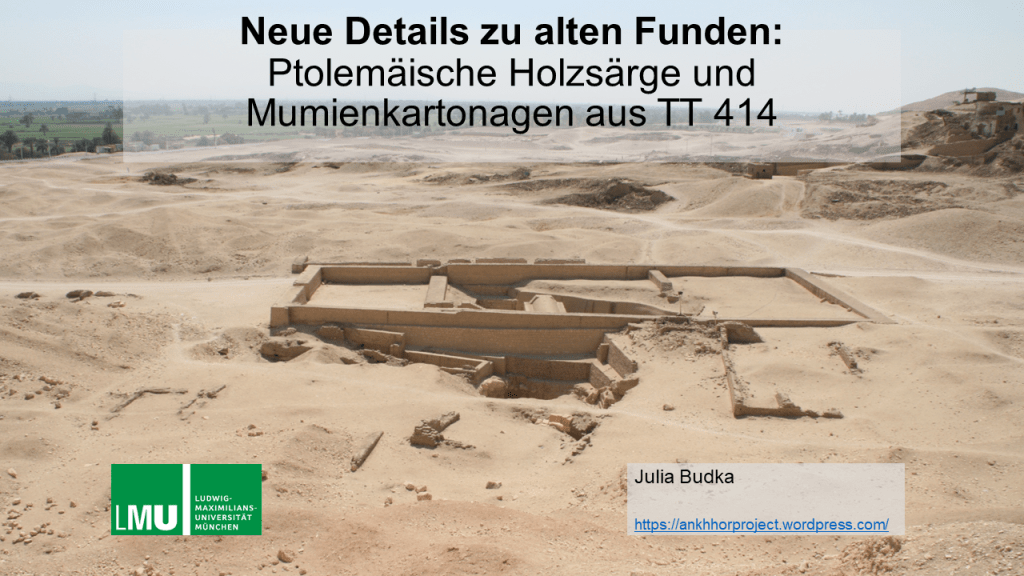
It is a great pleasure to have been invited by the Collegium Aegyptium, the friends of the Institute of Egyptology and Coptology at LMU Munich to give a lecture about my Ankh-Hor Project.

My talk later today will be in German and focuses on the questions of Ptolemaic wooden coffins and cartonnage fragments from TT 414.

It is the first time that I present some preliminary remarks on the cartonnage cases from the tomb of Ankh-Hor. There is evidence for various types of cartonnages from the 30th Dynasty well into the Ptolemaic era. I will discuss some of the results from the 2022 season.

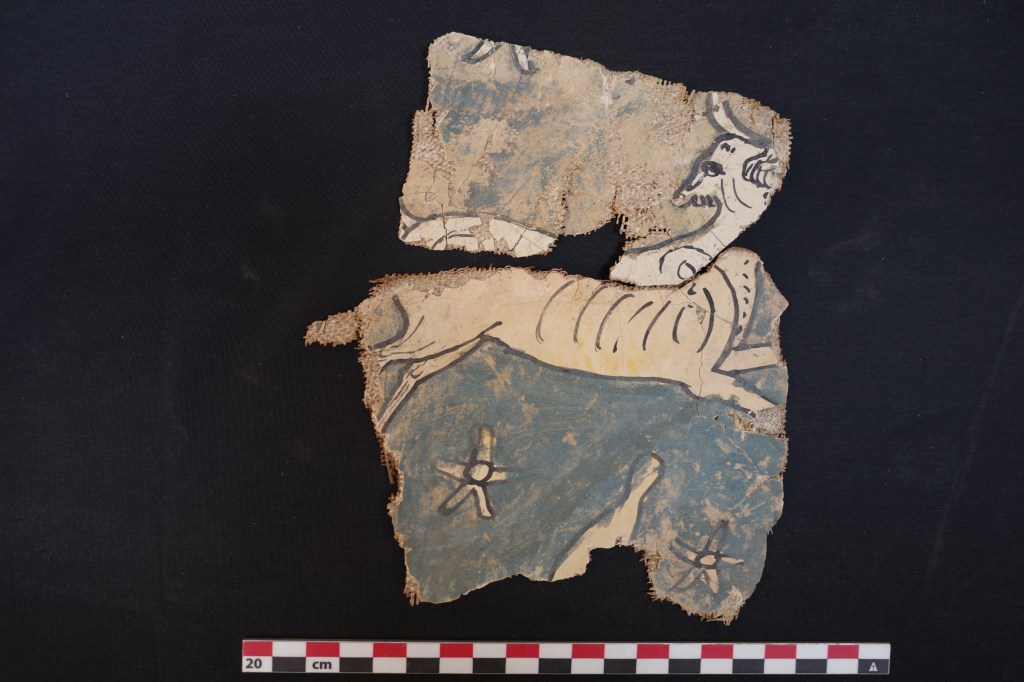
One particularly interesting topic, that I will briefly mention today in my lecture is the appearance of zodiac representations on the interior of lids of cartonnage coffins.

Interior decoration of the lid of a cartonnage coffin from TT 414 with the Taurus zodiac sign.

The recent publication by Daniela Mendel (2022) is an excellent collection and comparison of representations of astronomical ceilings and zodiacs in Ptolemaic and Roman temples, coffins and sarcophagi as well as tombs. Due to the poor state of publication on Ptolemaic cartonnage coffins from Thebes, there is no reference in the book to cartonnage examples of zodiac representations. It is well known that the wooden coffins of the famous Soter family from Thebes include representations of the sky with zodiac – but as the material from TT 414 shows, there were already examples well before the Roman era.

There is still so much work and research to be done – and hopefully we will be back in Luxor for the 2023 season of the Ankh-Hor Project soon. For now, I am very much looking forward to tonight’s lecture and hope for some constructive feedback and questions.

Reference

Mendel, D. 2022. Die Geographie des Himmels: eine Untersuchung zu den Deckendekorationen in ägyptischen Tempeln der griechisch-römischen Zeit und zeitgleichen Darstellungen auf Särgen und in Gräbern. 3 vols. Studien zur spätägyptischen Religion 37. Wiesbaden: Harrassowitz

Closing of the 2022 season

We successfully closed our 2022 season yesterday – Patrizia and Hassan are already on their way back to Germany, I will spend some more days here in Luxor, continuing my work for the South Asasif Conservation Project.

I am also busy with writing up the report of this fruitful season of the Ankh-Hor Project – so much work was done, almost 150 drawings of small finds were accomplished, dozens of objects were recorded for the first time, several new matching pieces were found to coffins, a large number of wooden objects was cleaned and hundreds of photographs taken. All this rich documentation will require post-season processing back home and I will also summarise the most important results in an upcoming blog post.

The last few days have proven it again – everything we have achieved here in 2022 has been great teamwork. Everyone thought along and not only did their job well, but also helped others like Patrizia and Hassan here with taking photos of reconstructed coffins (photo by H. Aglan).

I am very grateful to the entire team of the 2022 season and would like to say a special thank you to our inspector Saad and the Egyptian conservator Noura – it was a pleasure and an honour! To be continued, we’ll be back next year.

Summary of week 1 of the 2021 season

We just finished a first, very successful week of our 2021 season. We started off with cleaning, dusting, and sorting things and are now well underway to document small finds, ceramics, shrines as well as wooden and cartonnage coffins.

The painted coffins from TT 414 belong both to primary burials of the family of Ankh-Hor and to secondary burials of Amun priests, mostly dating to the 4th and 3rd centuries BCE, which appear as relatively wealthy. Most of the material derives from the secondary use of the tomb. I am still busy collecting fragments which can be dated stylistically and because of the technique to the 26th Dynasty – these are usually very small pieces, sometimes just small splitters of the painting.

Example of small fragments of 26th Dynasty coffins including a piece from the outer coffin of Ankh-Hor (bottom right).

These are nevertheless important to reconstruct the original burials in TT 414 – yesterday, I found one loose fragment of the foot pedestal of the outer coffin of Ankh-Hor himself. This foot part is in a very fragile condition and will be consolidated later this season, including fixing the loose fragments back in place. Among the most interesting finds is another 26th Dynasty coffin giving the female name of a Mutirdis – a common name in this era, but I still do not know to which specific person this coffin once belonged. During the Austrian excavations in the 1970s and 1980s, no Mutirdis from the 26th Dynasty was recognised in the material from TT 414 – another example why our current work is so important to understand the complete phases of use in the monumental tomb of Ankh-Hor!

Jessica working on one of the late Ptolemaic coffin fragments.

The Ptolemaic wooden and cartonnage coffins are much better preserved and are currently treated by our conservation team. Since 2018, our conservation programme is conducted in cooperation with the Austrian Archaeological Institute (OeAI) of the Austrian Academy of Sciences. This year, our team is comprised of four young conservators, all graduates including one current student of the University of Applied Arts in Vienna. We are kindly supported by one of the experienced Egyptian conservators from the West Bank. The team finished already a considerable number of pieces in week 1 and these objects are now ready for their final photographic documentation with a full-frame camera with high resolution (Nikon D810 with a 35mm objective lens).

In terms of documentation, the Egyptologists of our team concentrate on ceramics and small finds. This week, Hassan and Patrizia were both busy with funerary cones. Patrizia, who is about to finish her PhD about Late Period statuary, wrote some years ago her BA thesis about funerary cones and thus shares my own enthusiasm for these intriguing objects which still pose some questions in the Late Period. Drawing these cones (among others funerary cones of Monthemhat, Padineith and Pabasa), Patrizia does not only focus on the stamped end but also on technical features, remains of colours and other details.

Although very challenging objects to draw, we love Late Period funerary cones! And Patrizia is doing a perfect job here.

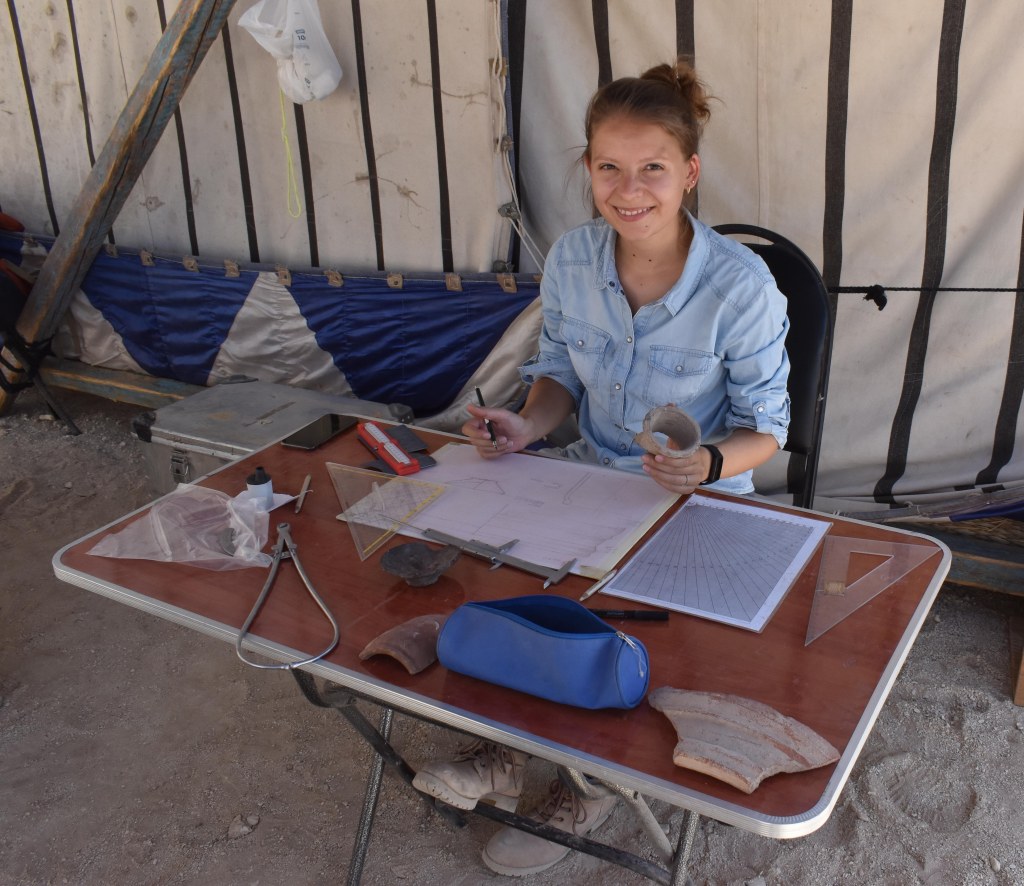
Our youngest Egyptologist is Caroline, a MA student from LMU Munich. She is very talented and enthusiastic and started with drawing Late Period and Ptolemaic vessels. Later this season, she will join me working for the South Asasif Conservation Project.

Caroline very quickly adapted to our “drawing office” at the site and made already a good number of pottery drawings in her first week.

It is wonderful that the two sites, Ankh-Hor and South Asasif, share so many similarities in terms of re-use – Caroline will thus be perfectly prepared, knowing the most common vessel types already from our mission.

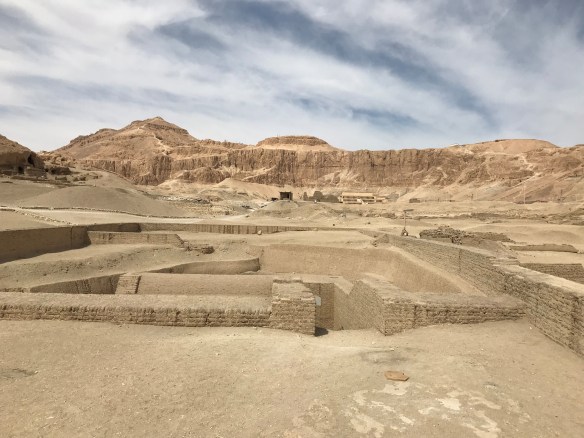
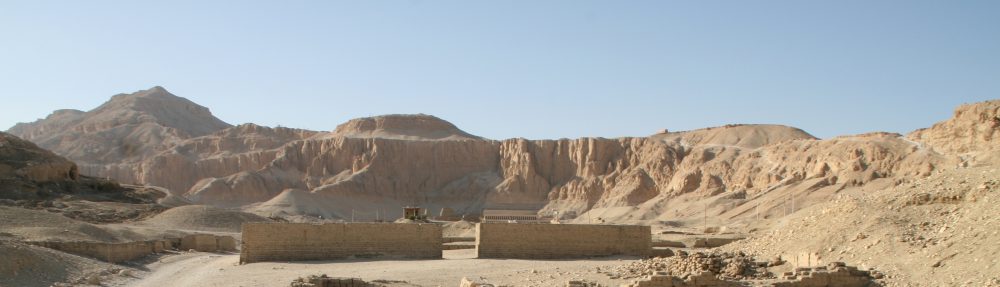
Today, the last team members will arrive, and we are all looking much forward to another exciting week starting on Saturday in the gorgeous setting of the Asasif in front of Deir el-Bahari.

Our conservation tent and a view to the Theban mountains.

More videos of the study day now online

By today, all presentations of our Study Day are now available as videos on LMU cast – for free of course.

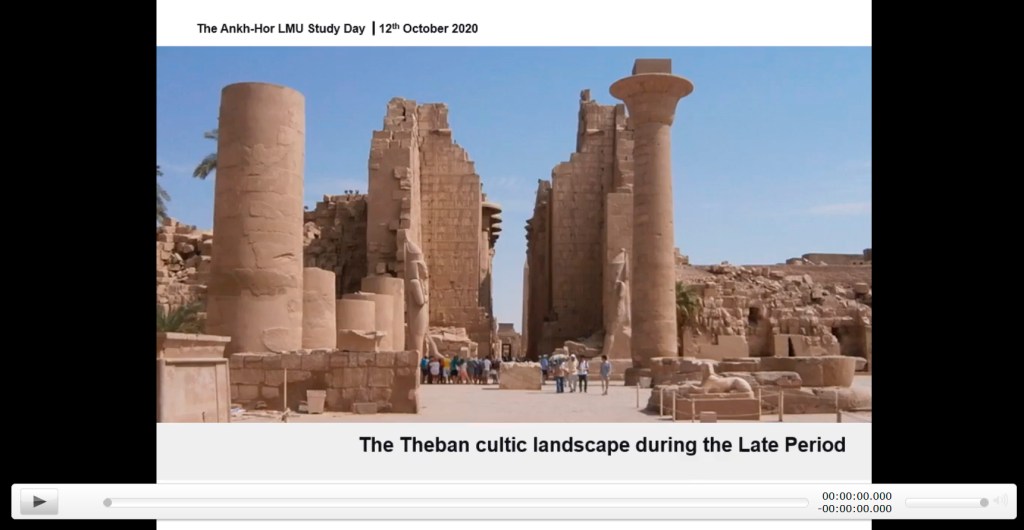
Check out Veronica’s video!

I am especially happy that despite of the technical problems on October 12, we can now introduce the presentation by Veronica Hinterhuber about “The Theban cultic landscape in the Late Period”. This lecture makes it very clear, how much attention we always have to pay to the embeddedness of a necropolis into the general sacred landscape. And in Late Period Thebes, this is very evident.

Learn about creating 3D models by Hassan!

Hassan Ramadan Aglan nicely points out the potential of 3D models of Egyptian tombs – taking the tomb of Ankh-Hor as a case study, but also showing some examples from the tombs he studied for his PhD, located at Dra Abu el-Naga.

I hope these free videos are as well perceived as the Study Day!

Many thanks again to all presenters and also to all participants!

Announcing the first online study day of the Ankh-Hor project

I am very proud to announce the first study day of the LMU Ankh-Hor Project which will run online using Zoom on October 12 2020. This online format has many advantages – participation is free and we hope to reach many people worldwide interested in Theban archaeology, the Late Period and Ptolemaic times and funerary customs. Participants may also attend just individual time slots – just have a look at the preliminary programme. Please note that registration is mandatory via: https://eveeno.com/109463542

The main aim of the study day is to introduce the lines of research currently carried out by the LMU project working on TT 414 in the Asasif, high lightening the potential of this monumental Late Period tomb for our general understanding of the Theban necropolis.

I am especially delighted that the excavator of TT 414, Manfred Bietak, will present in a key lecture the discovery of the tomb in the 1970s – an exciting excursion back in time!

TT 414 throughout the decades: from its scientific discovery in the 1970s to the 2000s.

Research on TT 414 continues to bring interesting and highly relevant findings to light – we very much hope that despite of covid-19, we will soon be able to work again in the Asasif. Join us all on October 12 for a virtual tour through one of the intriguing monumental tombs of the Saite period in western Thebes with a complex life history!

Summarising the main work tasks and aims of the Ankh-Hor Project

The last days and week have been very hot here in Munich – of course not as hot as in Luxor and Egypt, but enough for a real summer feeling.

Since I was originally scheduled to arrive in Egypt this weekend, this is at least some comfort. Due to the current covid-19 situation, our 2020 season working on the tomb of Ankh-Hor had to be cancelled and we very much hope we will be able to return to Asasif in 2021.

Since I am missing the daily view of the splendid Theban necropolis, I just thought I make a very short video. These 6 minutes illustrate the main work tasks and the main aims of the Ankh-Hor Project.

https://cast.itunes.uni-muenchen.de/vod/playlists/nCrNSJLINC.html

I hope you enjoy it and let’s all keep our fingers crossed that the virus will soon be under control – worldwide and of course in Egypt. Wishing all of you a very nice summer and please stay safe!

Media coverage for the Ankh-Hor Project

Very proud and honoured: our work in the Asasif on the finds from the TT 414 has made it into an Austrian newspaper – an article in “Die Presse” presented some information about the Ankh-Hor project (print version 06/04/2019, online since 09/04/2019), based on an interview I gave in Vienna two weeks ago.

On this occasion, I stressed the rich potential about the coffins from the tomb of Ankh-Hor – not only for establishing a typology for Ptolemaic coffins and for discussing coffin workshops at Thebes, but especially for discussing the diverse re-use of TT 414, burial chambers and coffins. The best example is of course the 26th Dynasty coffin Reg. No. 590 of Iret-her-rw, which was re-used by Wah-ib-re in Ptolemaic times.

There are still plenty of information to unveil from the tomb of Ankh-Hor.

Media coverage like this article and also the recent blog post at DerStandard.at are very nice rewards for our busy and successful 2019 season – and it also helps to keep the motivation high. Among others, for writing proposals and applications which will keep me busy in the next months. Money does matter – not only for death and burials as you can read in the “Die Presse” article but also for researching complex burials like the multiple ones in TT 414.