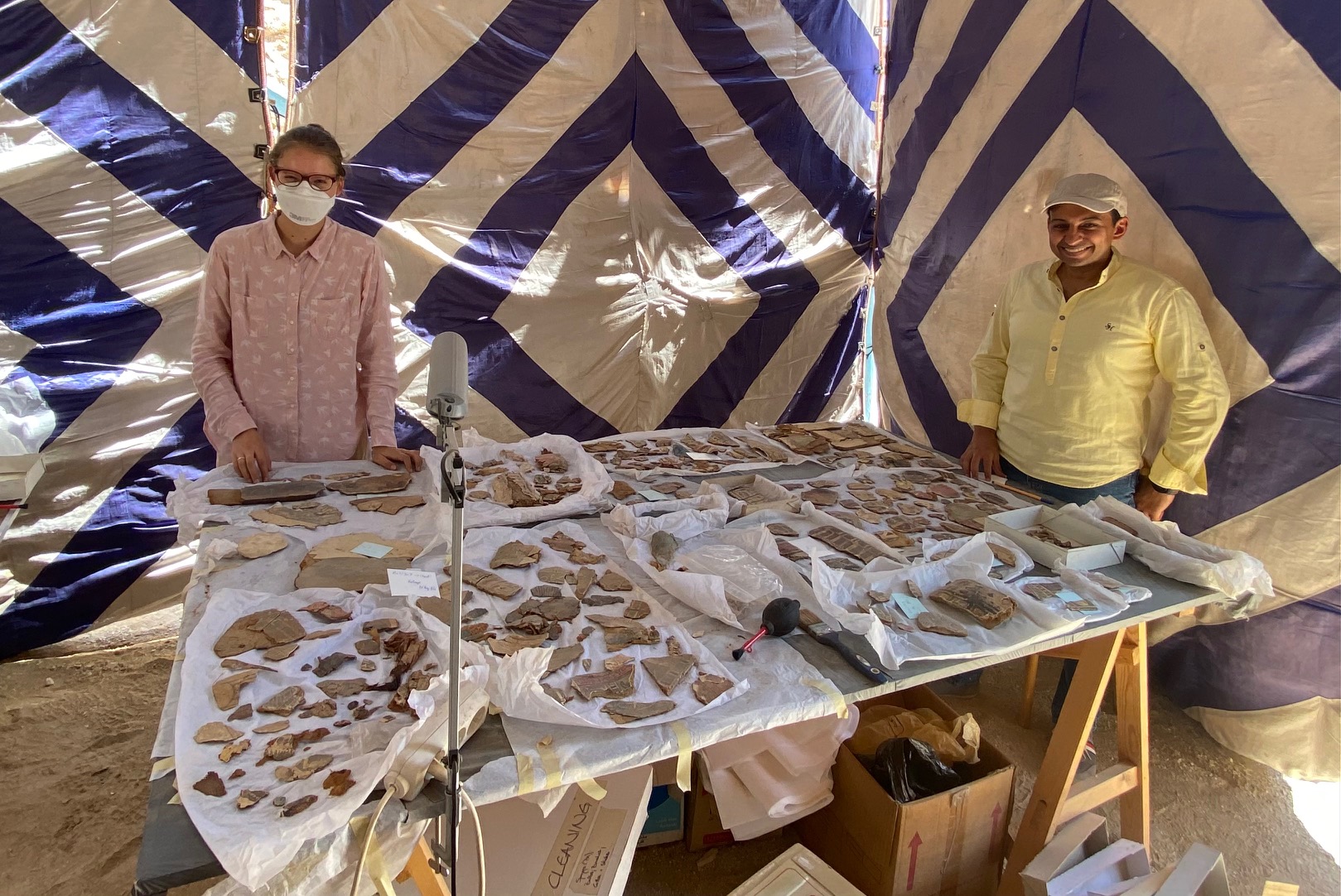
Week 3 has just started and Ladina and Hassan are busy with documenting 30th Dynasty/early Ptolemaic coffins from the tomb of Ankh-Hor (TT 414), while Karima and Mohamed continue with some later Ptolemaic painted fragments.
Ashraf, Hassan and Ladina are busy sorting, cleaning and documenting coffin fragments.
Week 2 brought a lot of progress; I was able to make numerous joints of small fragments to known, registered pieces. My focus was on Ptolemaic coffins around the family of Wesjr-wer – and here, in addition to the painted wooden coffins, also on the cartonnage coffins. A real challenge are both wooden and cartonnage coffins, where the text fields have unfortunately remained empty, so we have no information about the owners.
The white painted with black text outer surfaces of the lower parts of bivalve cartonnage coffins are still a big puzzle – but I have already found many joints!
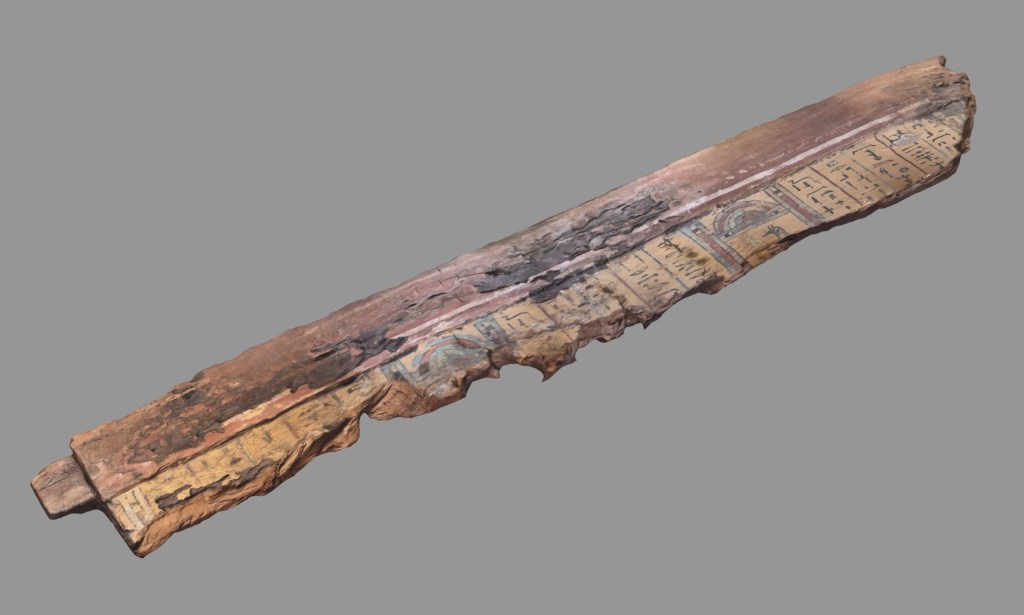
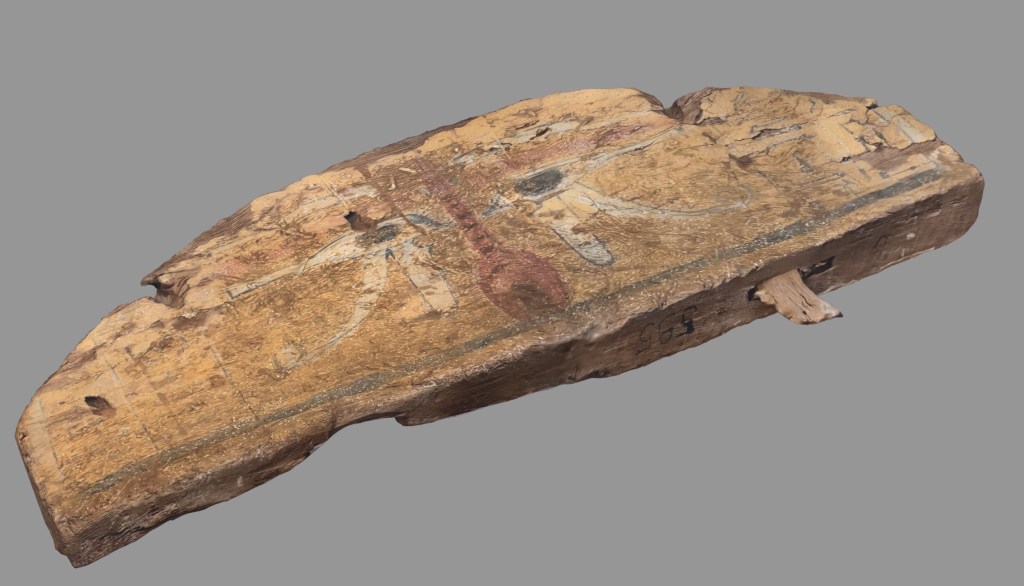
As a special highlight, I also documented the qrsw coffin of one of Ankh-Hor’s relatives, Psametik-men-em-Waset, Reg. 595, in 3D. The piece of which several boards and the front side are preserved had already been documented with our full-frame camera in 2018, but I wanted to take full advantage of the new possibilities offered by the rapid development of video-based photogrammetry with LiDAR sensors on mobile devices and the Scaniverse app developed by Toolbox AI. The scans also allow us to highlight technological features and details of the wood structure.
Screenshot of 3D scan of one of the lateral sides of Reg. 595 which shows nicely the damages of the wood and painted surface.Sceenshot of the 3D scan of the front side of the vaulted lid of the qrsw coffin Reg. 595.
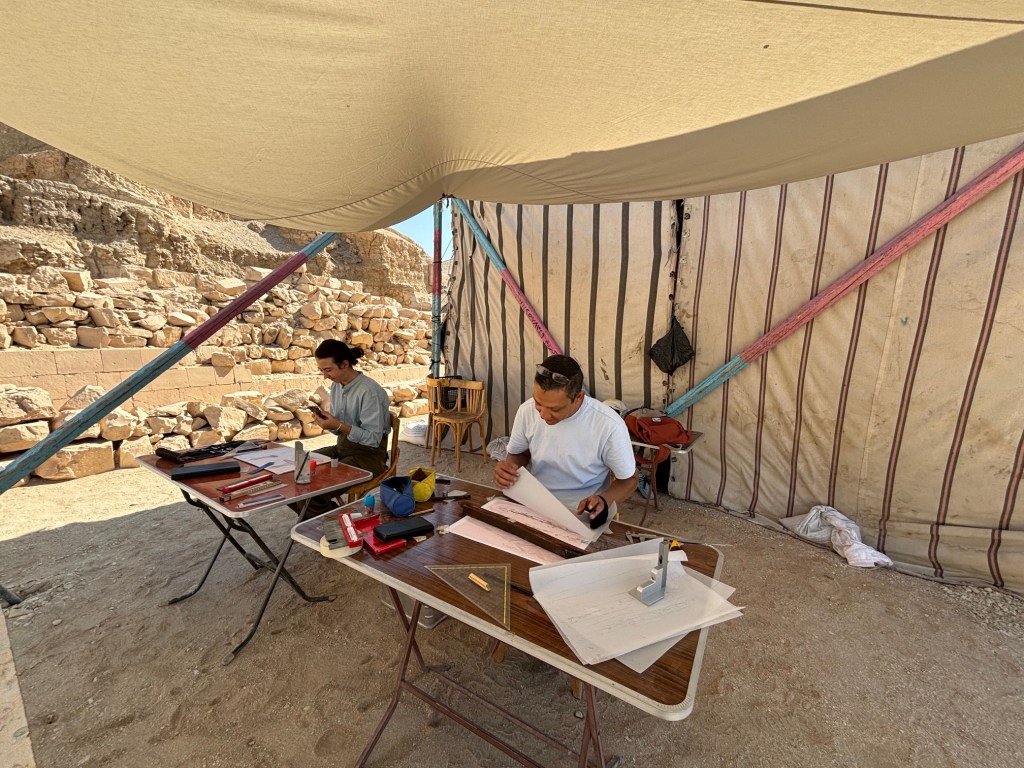
Last but not least, Hassan and Ladina made detailed drawings of fragments of canopic boxes from TT 414. These drawings will be used in the final publication and perfectly complement our photographic documentation and the 3D scans.
Technical drawings remain necessary for some selected wooden pieces from TT 414.
All in all, our 2024 season continues to be very productive, and I am grateful to all team members for their commitment and enthusiasm. There are some really great objects we are working on and there are still a lot of them waiting for us in the coming weeks!
Today four weeks ago we closed the 2023 season of the Ankh-Hor project in Luxor. Time for a little review of a very successful season.
Work was conducted from September 5 to October 5, 2023, with our very helpful SCA Inspector Mahmoud Sayed Abdelhady. The major goal was to continue the cleaning, consolidation, and documentation of the large number of objects excavated in the 1970s from TT 414, the monumental tomb of Ankh-Hor, High Steward of the Divine Adora-trice Nitocris (26th Dynasty).
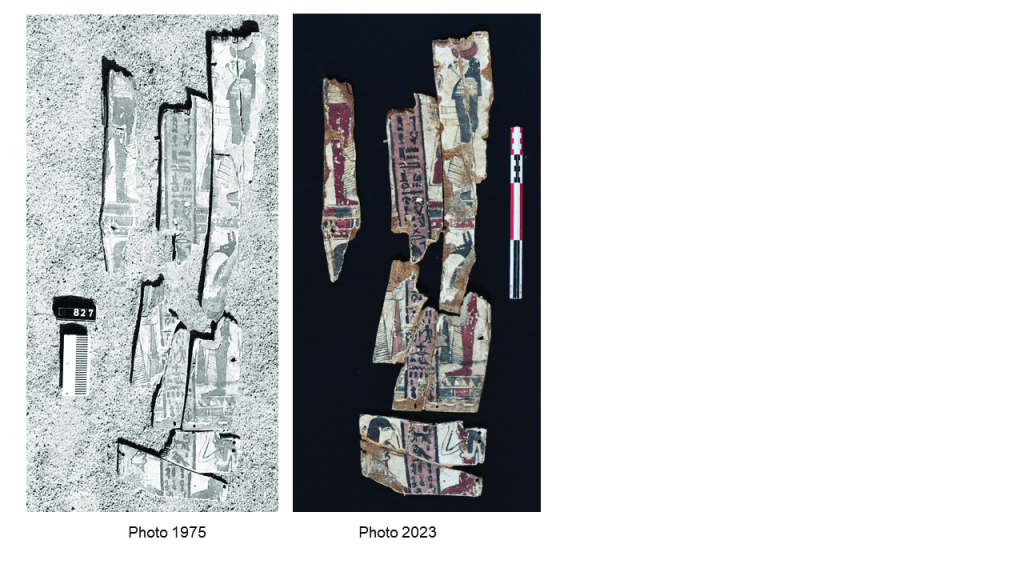
Several previously not identified pieces were newly recognised as matches to coffins documented by the Austrian mission in the 1970s. Some of these were joined by our conservators Mohamed and Karima to the already documented pieces. One example is Reg. No. 827 – Fig. 1 shows the state of documentation in the 1970s compared to 2023; this season, we found a small new piece matching to the instep of the lid. All pieces of Reg. No. 827 were cleaned and consolidated.
Fig. 1: Reg. 827, a fragmented Ptolemaic coffin lid. Left the state in 1975, to the right our new match in 2023.
In general, all finds studied in 2023 were digitally photographed and entered in a database, created by File Maker Pro. In total, more than 180 individual objects (mostly coffins and cartonnage elements) were studied and documented by more than 2400 photos. These new photos are suitable for publication and show the colours of the pieces, in contrast to the previous documentation in the 1970s (see Fig. 2).
Fig. 2: Reg. 521, one of the examples showing the benefits of high-resolution photography in full colour.
Since many the painted objects from TT 414 have darkened surface, infrared photography was used to make the original decoration visible (with a Sony Cybershot DSC-F828, an IR-filter and a small magnet). In 2023, this method was applied to a total of 95 objects.
We introduced a new method of documentation in 2023. The app Scaniverse (see https://scaniverse.com/) was used to capture objects in 3D. This photogrammetry application is ultrafast, highly accurate and very easy to use. 170 objects from TT 414 were captured with metrically accurate 3D models this season – simply fantastic!
Ashraf and I with the box of objects we transported in 2023 to the magazine (photo: P. Heindl).
One of the highlights of this season was the transport of objects to the magazine of the West Bank. In addition, we were able to work on coffins we transported to the magazine in earlier years. My personal highlight was the new documentation of one of my favourite coffins from TT 414, of Reg. 655, with infrared photography and with a 3D model.
3D model of coffin Reg. 655 created with the app Scaniverse
The conservators of the LMU Munich Ankh-Hor Project in the 2023 season were the specialists for wood, Mrs. Karima Mohamed Sadiq and Mr. Mahmoud Mohamed Mahmoud. They did a fantastic job, both at our site and in the magazine of the West Bank. A total of 108 wooden and painted objects, mostly coffins, comprising 294 individual pieces, were successfully cleaned and consolidated in 2023.
To conclude, the fifth season of the LMU Ankh-Hor Project was carried out successfully, with much progress regarding the consolidation and documentation of wood and cartonnage coffins from TT 414. Thanks to the transfer of objects to the magazine and the placement of studied finds in sugar bags in corridors of Tomb I, much space was gain in the mission’s magazine which is crucial for the future jigsaw puzzle of coffin fragments, both in wood and cartonnage. New genealogical information regarding coffin owners were unearthed and the stylistic assessment of Ptolemaic cartonnage coffins advanced in 2023 in many aspects, including reconstructing new cartonnage coffins.
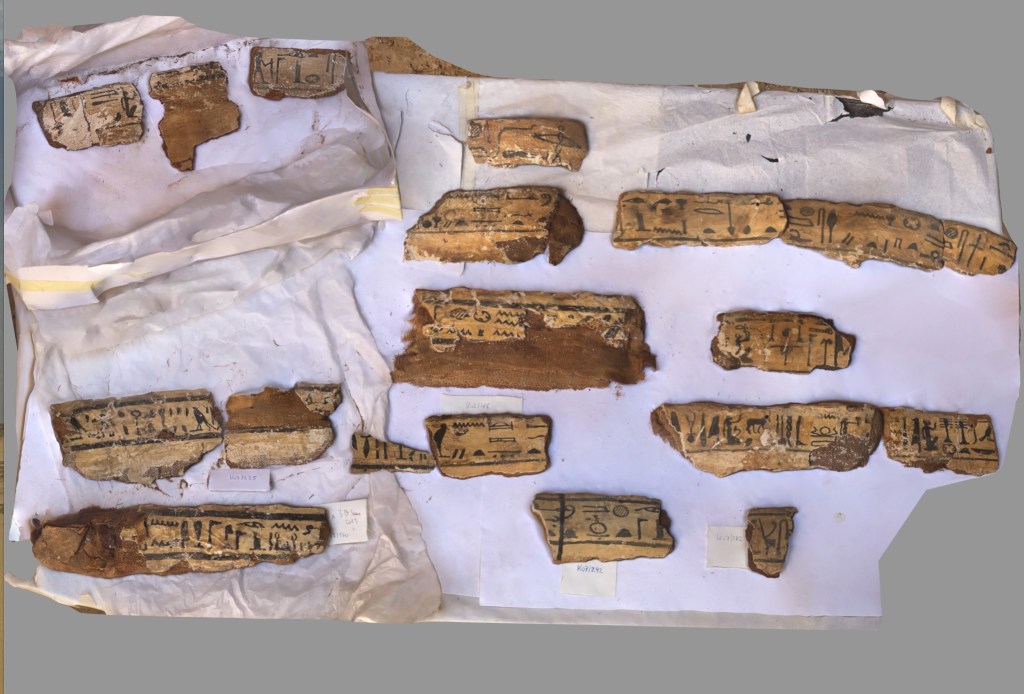
The rich potential of our work on the cartonnage coffins can be illustrated with Reg. 23/04. I was able to match several fragments of the edge of the base of a cartonnage coffin which was previously not documented (Fig. 3). Based on the father’s name, the titles and the close similarity with Reg. 860, the coffin of Horakhbjt, I would like to propose to identify the owner of Reg. 23/04, Wesjrwer, as the previously unknown brother of Horakhbjt.
Fig. 3: Reconstruction of nine fragments of the edge of a cartonnage coffin of Wesjrwer.
Since not all fragments of wooden and cartonnage coffins from TT 414 are yet consolidated and documented, our work needs to be continued in the next season.
For now, I would like to express my gratitude to all of our Egyptian colleagues without whom work would not have been possible. I am very grateful to all team members of the 2023 season: Patrizia Heindl, Caroline Stadlmann, Ahmed Elmaklizi, all LMU Munich, and Karima Mohamed Sadiq and Mohamed Mahmoud Mohamed Mahmoud as the conservators of the Ministry of Antiquities and Tourism. Ashraf Hosni Teegi did another great job as the head of logistics. Many thanks to all and we are all very much looking forward to the next season!
On the last day of week 2 of the 2023 season of the Ankh-Hor Project, there was much excitement! Inspired by my colleagues from the South Asasif Conservation Project, I played a bit with my newly installed app Scaniverse – a wonderful tool to capture objects in 3D. With all my experience using photogrammetry in the past years in Sudan (and some earlier trials for material from TT 414), this was a stunning exercise – Scaniverse is ultrafast, highly accurate and very easy to use. It offers new perspectives of how we document our objects from TT 414 – in addition to ordinary 2D images, now capturing the objects with metrically accurate 3D models becomes feasible with little time expenditure. Simply fantastic!
My trial piece is also a scientifically important object. This week, Mohammed and Karima cleaned and consolidated two parts of the fragmentarily preserved tomb group of an important family member of Ankh-Hor, the lady Her-Aset. We do not know the name of her husband, but his title – based on the known facts, it is very likely that she married one of Ankh-Hor brothers and was thus closely related to the original owner of TT 414. This of course explains why she was buried in TT 414 as well.
Her-Aset had a nice wooden stela as part of her funerary equipment. The larger part of this stela is now in the British Museum – see my earlier post on the conservation of this piece back in 2018.
Now in 2023, we are back working on Her-Aset’s tomb group. The first piece our conservators consolidated from this group is a fragment of the inner anthropoid coffin of Her-Aset, Reg. 536.
Unfortunately, little is left of the once beautiful inner coffin of Her-Aset. Reg. 536 is the only fragment found in TT 414.
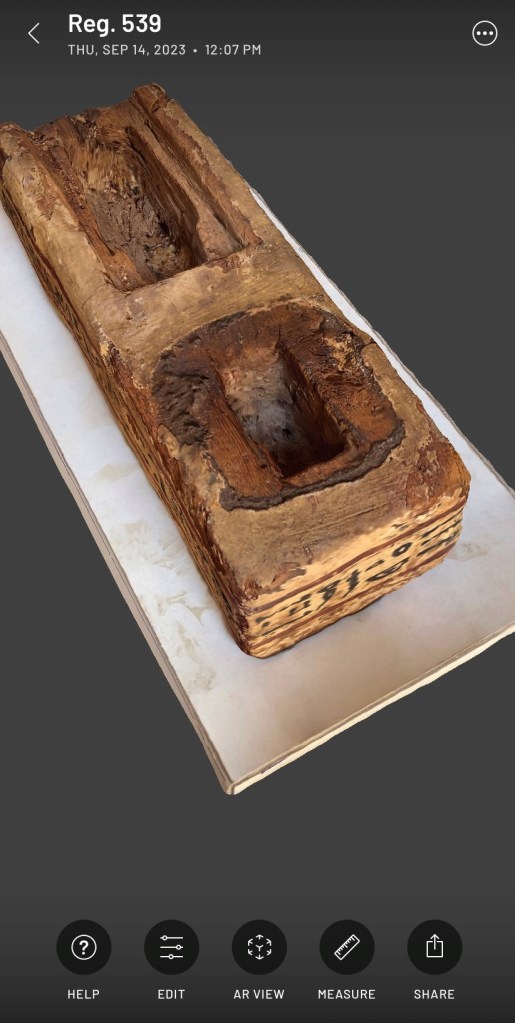
The other object is the nicely coloured and inscribed pedestal of a Ptah-Sokar-Osiris statue of Her-Aset. Reg. 539 gives her name and title within the framework of an offering formula. Karima and Mohammed finished its consolidation (it was in a very fragile state) just today and after I took the standard 2D photos, I thought that this would be the perfect trial piece for the app mentioned above.
Screenshot of my app with the 3D model of Reg. 539.
The result is great (see also the video of Reg. 539 captured with Scaniverse on an iPhone 11 and processed with Detail Mode) – and please keep in mind that it was the first time ever I used the app and that it only took a few seconds to take the photos for this model. In addition to the ordinary photos, the shape and especially the cavities on the top side of the pedestal are now captured in a detail way and in 3D. One cavity is of course the tenon hole for the now lost funerary figure of the god Ptah-Sokar-Osiris – should we ever be able to relocate this statue in one of the museums around the world, we could join it with our 3D model 😉. The larger cavity is mummy-shaped and nicely shows that Ptah-Sokar-Osiris statuettes in the Late Period sometimes contained a package of viscera/mummification material and are closely related to corn mummies.
We will explore the application of Scaniverse to document our finds from TT 414 further and will keep you of course posted!



 The Ankh-Hor Project