Much progress in week 3 of the 2023 season

This week just flew by very quickly – we made much progress in many respects.

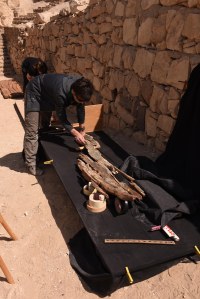
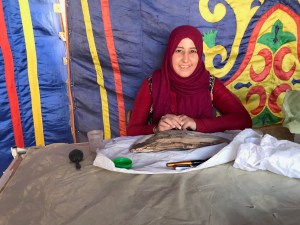
The consolidation and cleaning of coffins from TT 414 was carried out continuously by our conservators Karima and Mohammed. They managed to clean seven additional coffins this week, comprised of more than 60 individual pieces. Very time consuming was therefore the puzzling with the fragments and gluing them back together after cleaning.

This week, Mohammed and Karima had to fit many pieces of fragmented coffins together.

One case study of these working tasks is shown here – Reg. 825 is a nice example of a looted inner anthropoid coffins with clear damages caused by the robbers. Karima and Mohammed managed to fit the fragments back together in a way that also the original shape of the lid becomes visible again.

Reg. 825 was one of the coffins successfully cleaned, glued and documented in week 3.

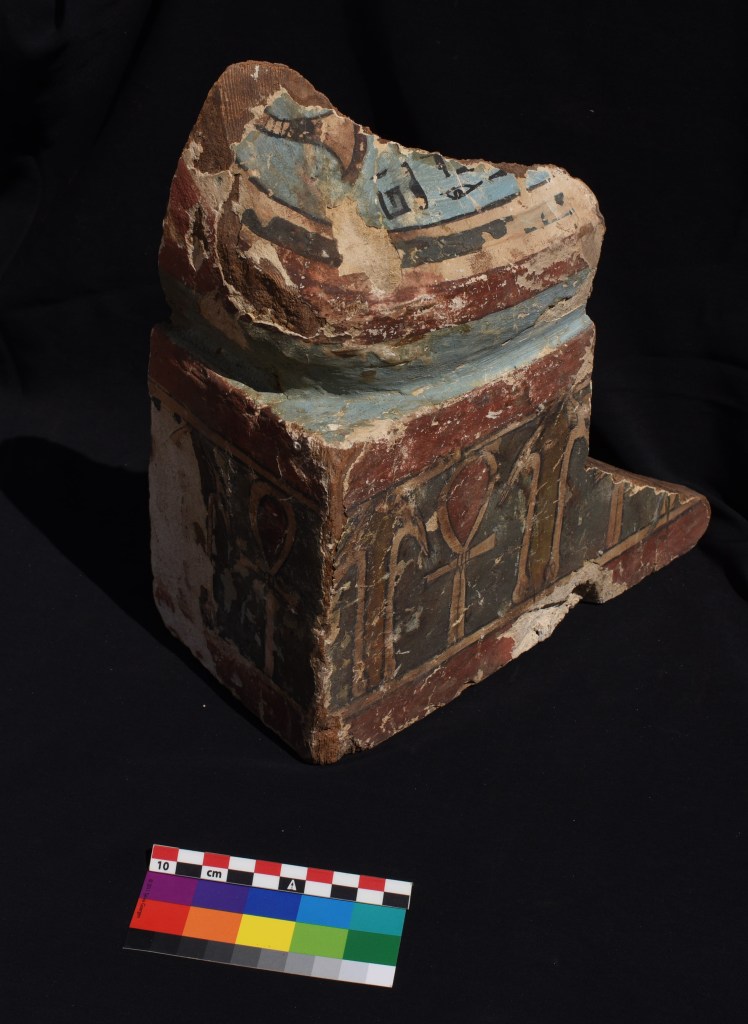
Another great achievement in terms of consolidation was the work by Mohammed on a very fragile pedestal of a 26th Dynasty Ptah-Sokar-Osiris statue from the tomb of Ankh-Hor. The piece is not inscribed, but covered with linen and painted in yellow, red and blue. Mohammed fixed all of the remaining painted parts. The 3D model I created of the object with Scaniverse shows in great accuracy the “footprint” of the statue – the tenon hole, but also the shape of the lower base of the figure. The almost square cavity in front of the pedestal was closed with a lid on which we traced the negative of a falcon statue.

3D model of Reg. 23/02 (created with Scaniverse) showing all the details of this 26th Dynasty Ptah-Sokar-Osiris-pedestal. The small lid of the cavity was removed for this scan.

This week the work on the cartonnage coffins from TT 414 really picked up speed. To begin, Ahmed and Caroline, our student assistants, searched and sorted through several boxes of fragments. We focused on the reconstruction of a wonderful two-part coffin of the Ptolemaic Amun priest Horakhbjt, Reg. 860- its painting is exquisite and large fragments were documented back in the 1970s. However, we realised that most of these fragments are currently missing. The good news is: I have now been able to relocate numerous pieces; they were scattered in dozens of boxes in the magazine.

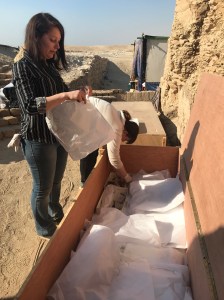
Ahmed and Caroline did a great job sorting through boxes with cartonnage fragments from TT 414.

I show you here a particularly charming fragment from the lid: just check out the details of the figure of Anubis and the way he is here depicted bent over the mummy on the lion bed.

One small fragment from the lid of Reg. 860 – unusual is the representation of Anubis in this scene with the mummy bier.

I did anticipate that work on Reg. 860 will be time-consuming – maybe not as much as it turned out to be, but I am still optimistic that we will manage to document much of this important piece during this season. In addition, I managed to find matching pieces to a lot of other cartonnage coffins. The most exciting one is maybe the beautiful lid of the cartonnage of the priest Twt. Just last year, I managed to identify this cartonnage coffin and now we have a full representation of Twt kneeling in front of an offering table in delicate painting.

New matching pieces of the cartonnage coffin of Mr. Twt – the lower part of the Ba-bird and of Twt himself were newly found this week.

Last but not least, this week was also very successful in using 3D scanning with Scaniverse to document objects, fragments of cartonnage coffins and wooden coffins from TT 414. More than 50 3D scans now complement our documentation and will allow us to continue the jigsaw puzzle also back home after the season.

A short summary of the 2022 season

Winter has finally arrived in Germany and being back on the desk and in the classrooms at LMU, it is especially nice to reflect a bit on our 2022 season of the Ankh-Hor project in sunny Luxor. It was an extremely pleasant and productive season, and I am grateful to all team members!

The major goal of the 2022 season was to continue the cleaning, consolidation, and documentation of the large number of objects excavated from TT 414, the monumental tomb of Ankh-Hor, High Steward of the Divine Adoratrice Nitocris (26th Dynasty), by the Austrian mission directed by Manfred Bietak. The focus was on wooden coffins and cartonnage elements from TT 414 and included both Late Period pieces and Ptolemaic ones. Work was conducted from September 27 to October 27, 2021 (with our amazing SCA Inspector, Saad Kenawy Mohamed).

The detailed documentation of objects from TT 414 resulted, thanks to the great efforts of Hassan, Saad and Patrizia, in a total of 147 drawings during the 2022 season, comprising wooden objects, stamped mud bricks (deriving not from TT 414), shabtis and pottery.

Fig. 1: Saad, Patrizia and Hassan were a great and very effective drawing team (photo: J. Budka).

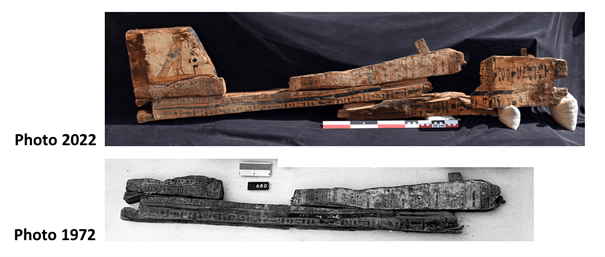
Much progress was also made in assigning previously not identified pieces of painted wooden coffins to specific coffins documented by the Austrian mission in the 1970s. One important example is Reg. 680 for which four new matching pieces were found. However, for this important coffin of the founder of the 30th Dynasty reuse of TT 414, Pa-di-Amun-neb-nesut-tawy I, there are still two missing pieces from the left side of the coffin and its foot part which were documented in the 1970s. Fig. 2 shows the comparison between the status of the right side of the upper part of the coffin in 1972 and in 2022 with three matching fragments. This coffin is thus a good example for the challenges in our work – there are still missing pieces for important coffins and the identification of all fragments is not yet fully accomplished.

Fig. 2: Comparison of part of coffin Reg. No. 680 between status in 1972 and 2022 – note three new matching pieces to the right side of the lid.

Many painted wooden coffin fragments were cleaned and consolidated in the 2022 season by our conservators Antje Zygalski and Noura Mustafa El-Taher. Noura did an amazing job in reconstructing free standing elements of coffins in the shape of djed-pillars and Isis-symbols.

Fig. 3: Noura working on the fragments of djed-pillars and Isis-symbols. She managed to reconstruct several pieces out of broken fragments (photo: J. Budka).
Fig. 4: Some examples of the newly reconstructed Isis-symbols (photo: J. Budka).

The best example that we were able to identify new owners of coffins during the 2022 is Reg. No. 689, found in the debris in the burial chamber of Ankh-Hor. The lady Takerheb is now confirmed as the owner of this piece.

During the 2022 season, also some new names of persons buried in TT 414 were identified. For the 26th Dynasty, a possible new female relative of Ankh-Hor was recorded. The fragment of a new anthropoid coffin, K07/243, gives the name Ta-dj-Iset (a common name in the 25th and 26th Dynasties), previously unknown from TT 414. Since there are several Pa-di-Iset attested in Ankh-Hor family, this new female might extend the family tree – for more information, I will need to identify matching pieces to this newly recorded coffin fragment.

In addition to the stylistic assessment of the cartonnages from TT 414, much progress was done this season in identifying the owners of these trappings. Thanks to infrared photography, some names and titles became readable and allow to attribute cartonnage elements to Ptolemaic individuals already known from other objects, for example a new cartonnage element is attested for G 148, Ta-sherit-Khonsw, with K08/85.

One particular important identification of a new cartonnage element is the one for Twt, an individual otherwise only attested by his outer anthropoid coffin in yellow-red on black-style (Reg. No. 510). This also offers us the possibility to compare the motifs and styles on coffins and cartonnages.

New coffins were also assigned to known persons buried in TT 414. As one example, the inner anthropoid coffin fragment of Imhotep (G 16) was identified with Reg. No. 19/04 and is now a new addition to his set of coffins with an outer coffin in black-yellow style, Reg. No. 759.

Fig. 5: Foot part of the inner coffin of Imhotep, already documented in 2019, but now newly assigned to its owner (photo: C. Geiger, ©Ankh-Hor Project).

To conclude, several new observations on the material from TT 414 are possible as direct results of the 2022 season, in particular in three main thematic fields, first of all because of the extended application of infrared photography: 1) genealogical information and new coffin owners, 2) additions to existing tomb groups as well as 3) a better understanding of the coffin design and the main motifs, also in relation to cartonnage elements.

Despite of all this progress, large amounts of fragments of coffins and cartonnage from the Late Period to Ptolemaic and also Roman times remain to be cleaned, are partly in need of reconstruction and of full documentation. Our work therefore needs to be continued in the next season. Our 2022 results hopefully show that these efforts are immensely worthwhile.

New book: The case study of Kalutj/Nes-Khonsu of the family of Pa-di-Amun-neb-nesut-tawy from TT 414

It gives me great pleasure to announce a new monograph: The book “The family of Pa-di-Amun-neb-nesut-tawy from Thebes (TT 414) revisited” has just been published and is also available open access.

Together with my main co-author, Tamás Mekis, and with contributions by Malcolm Mosher, Jr. and Marc Étienne, we provide fresh material about the identity of one of the key figures of the Pa-di-Amun-neb-nesut-tawy family who reused the Saite tomb of Ankh-Hor (TT 414) in the Asasif from the 4th century BCE onwards.

It is the woman Kalutj/Nes-Khonsu who was until now listed in the genealogical register of TT 414 as Pa-di-Amun-neb-nesut-tawy’s daughter and wife of one of his sons, Hor. By examining objects found by the agents of the consuls in the 19th century CE and the ones found by the Austrian mission in the 1970’s in TT 414 and in wider Theban context, we managed to identify Kalutj/Nes-Khonsu, wife of Hor, as another, until now overlooked individual. The examination of the funerary assemblage of Kalutj/Nes-Khonsu and of objects belonging to her husband, daughter and sons revealed not only details of the Late Dynastic and Ptolemaic burial customs in Thebes but also additional information on the priesthood of Khonsu and of the sacred baboons in this era.

This new identification of a previous overlooked person demonstrates that the finds from TT 414 are still far from being processed in its totality.  We hope that our publication contributes to awareness of the richness and creativity of Late Period Thebes in regard to funerary and temple rituals and to the fact that great potential still lies in the combination of data from previous excavations like the Austrian mission in TT 414, new data like the LMU Ankh-Hor project, and objects stored in museums and collections.

Looking much forward to feedback and discussion of our theory, I would like to thank my co-authors and first of all Tamás Mekis – it was a great pleasure to collaborate on this project and we already have ideas for the next publication! The material from TT 414 is a real gold mine when it comes to questions about funerary assemblages of Late Dynastic/Ptolemaic Thebes and there’s still much work ahead of us.

Summary of week 2 of the 2021 season

We just finished another successful week of our 2021 season. Cleaning, consolidation and documentation of small finds, ceramics, shrines and wooden coffins from TT 414 continued.

Consolidation of Reg. No. 702, the coffin of Imhotep.

Among other things, work focused on the lower part of a Ptolemaic painted wooden anthropoid coffin. This coffin, Reg. No. 702, was found in the debris of the original burial chamber of Ankh-Hor. It belongs to a priest of Amun in Karnak Imhotep, called Padiaes. His family is well-known, and he was one of the grandsons of the famous Padiamunnebnesuttawy I, founder of the reuse of TT 414 in the 4th century BCE. For me, it is still puzzling that until now, we only have Imhotep’s coffin preserved and nothing else. Because of the intact state of the lower part of this coffin, this is quite surprising. I am still hoping to find some cartonnage pieces belonging to Imhotep and after the field season, I will also check museums and collections in Europe – maybe part of his funerary assemblage was removed from the tomb in the 19th century by the antiquities dealers.

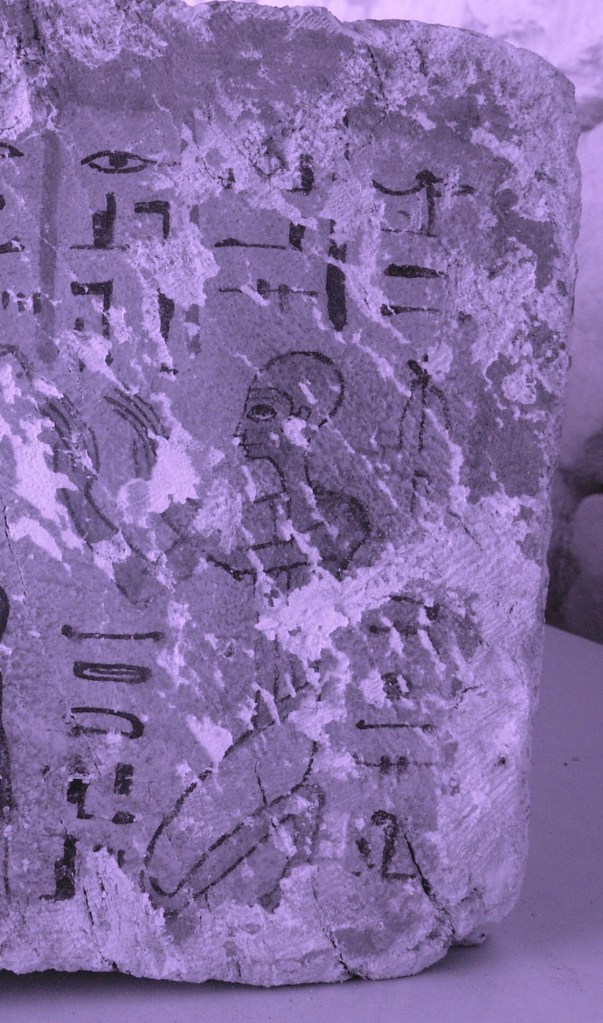
His coffin is now fully consolidated and documented. Cajetan took great pictures with our full-frame camera and we also used my infrared camera for the text and decoration. The results for this piece are amazing – the painted figure of Imhotep is now clearly visible as are the other figures and texts! The footboard of this coffin shows a very unusual design with an important text excerpt from an Osirian liturgy – this was previously unknown, and I will come back to this in a later blog post. Really exciting!

Unprocessed infrared photo of footboard of Reg. No. 702 with kneeling figure of Imhotep.

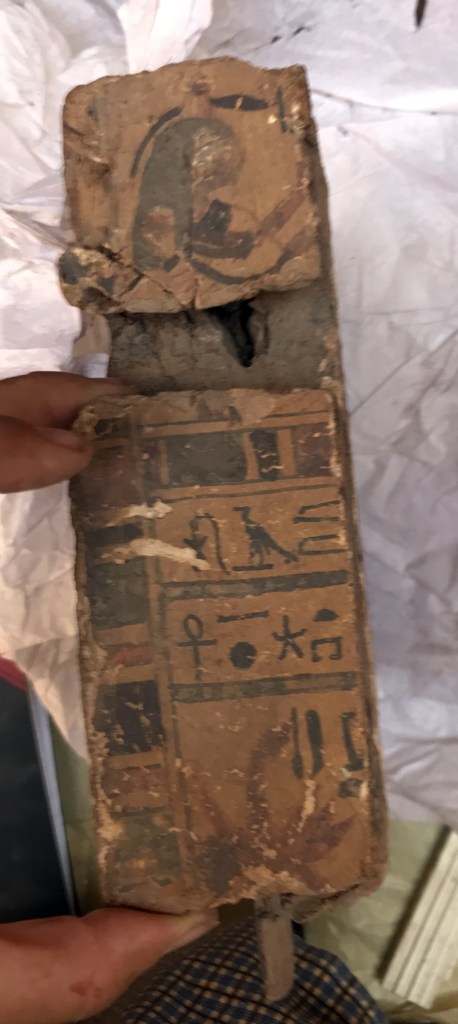
Just as an example of the progress I am making in sorting the finds in the magazine, I found another joining pieces for the important coffin Reg. No. 661. In 2019, I was already extremely happy to find more parts of the lid of this painted coffin. This week, I finally located one of the missing pieces from the foot board, showing a motif from the Litany of the Sun.

This piece of Reg. No. 661 was newly identified and already consolidated.

All in all, so many new details, joining pieces and new personal names came up already in our first two weeks of the 2021 season that I will be more than busy processing all this data after fieldwork!

Since some of the 2021 team members will be already leaving back home to Munich respectively Vienna tomorrow, I must thank all the 2021 team: everybody did a great job, it has been a fantastic season so far and I am very happy that we still have two weeks to go! Numerous pieces of our large jigsaw puzzle are still waiting to be correctly placed and interpreted.

 For some impressions of our current season, please also have a look at the photo gallery.

Announcing the first online study day of the Ankh-Hor project

I am very proud to announce the first study day of the LMU Ankh-Hor Project which will run online using Zoom on October 12 2020. This online format has many advantages – participation is free and we hope to reach many people worldwide interested in Theban archaeology, the Late Period and Ptolemaic times and funerary customs. Participants may also attend just individual time slots – just have a look at the preliminary programme. Please note that registration is mandatory via: https://eveeno.com/109463542

The main aim of the study day is to introduce the lines of research currently carried out by the LMU project working on TT 414 in the Asasif, high lightening the potential of this monumental Late Period tomb for our general understanding of the Theban necropolis.

I am especially delighted that the excavator of TT 414, Manfred Bietak, will present in a key lecture the discovery of the tomb in the 1970s – an exciting excursion back in time!

TT 414 throughout the decades: from its scientific discovery in the 1970s to the 2000s.

Research on TT 414 continues to bring interesting and highly relevant findings to light – we very much hope that despite of covid-19, we will soon be able to work again in the Asasif. Join us all on October 12 for a virtual tour through one of the intriguing monumental tombs of the Saite period in western Thebes with a complex life history!

The 2019 season in retrospect

Today I will be a bit selfish. Quite a lot actually, to be honest. I’ve just reached my Munich office through wind and sleet, getting ready for a day full of meetings and administrative matters.

No complains here, honestly – but I think it’s just about time to review the 2019 season at Asasif – my personal doping for motivation on this gray and rainy day here in Munich – and hopefully also of interest for all friends of the Ankh-Hor Project!

Although there is our photo gallery of the 2018 and 2019 seasons (and be sure to check these out), here come my personal favorite pics of this year in Asasif:

Group picture from the start of our season.

Construction work at the site.

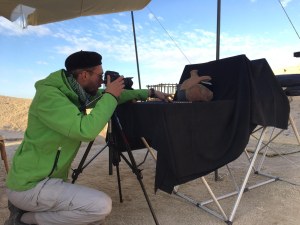
Object photography…

Very photogenic pottery vessels!

More photography…

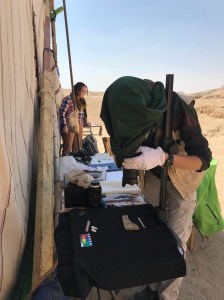
The hidden photographer!

Mona and Hassan…

Hassan and me…

Ashraf and Mahmoud…

My coffins and me…

Gettin coffin fragments ready for photography

Next coffin please…

Conservation work…

Iman doing a great job

Packing coffins for the transport

And the men behind the scenes: Yussuf and Ragab

With this great motivation and many thanks to all team members, today’s desk work should be doable :-)!