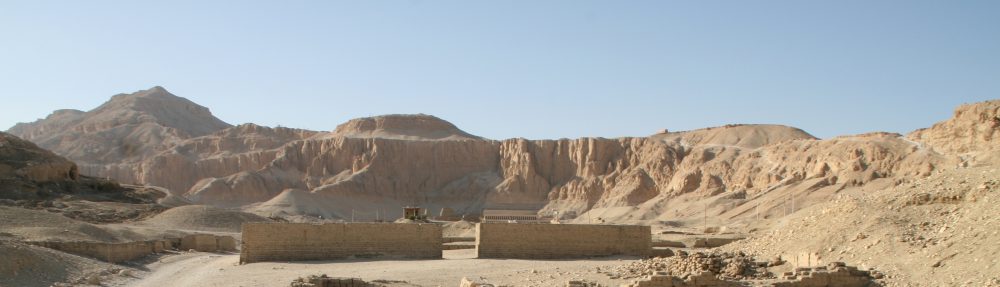
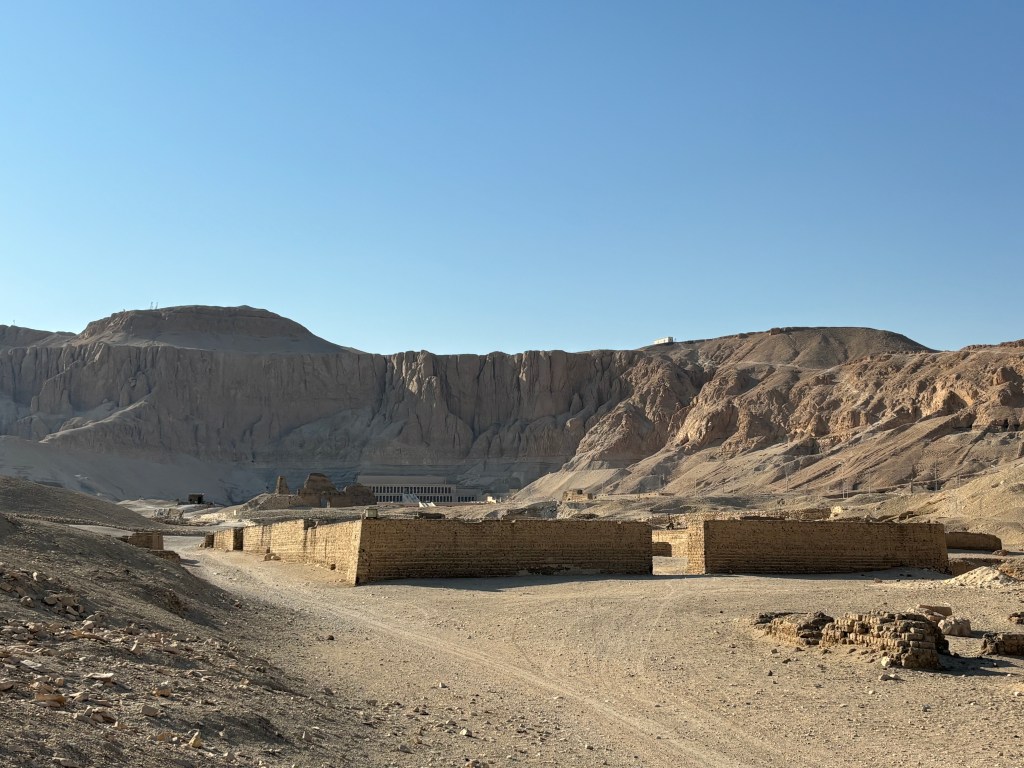
Tomorrow will be the day: we will open the 2024 season of the LMU Ankh-Hor project and will be working until the end of October. It’s very exciting to be back in Asasif!
The tomb of Anch-Hor this afternoon in the Asasif
As last year, the focus of our work will be on conservation, cleaning and documentation. Our conservation programme will focus on Ptolemaic wooden coffins and cartonnages, but will also include other painted and inscribed objects from the tomb of Ankh-Hor, TT 414.
We will keep you updated on our progress over the next five weeks!
Today four weeks ago we closed the 2023 season of the Ankh-Hor project in Luxor. Time for a little review of a very successful season.
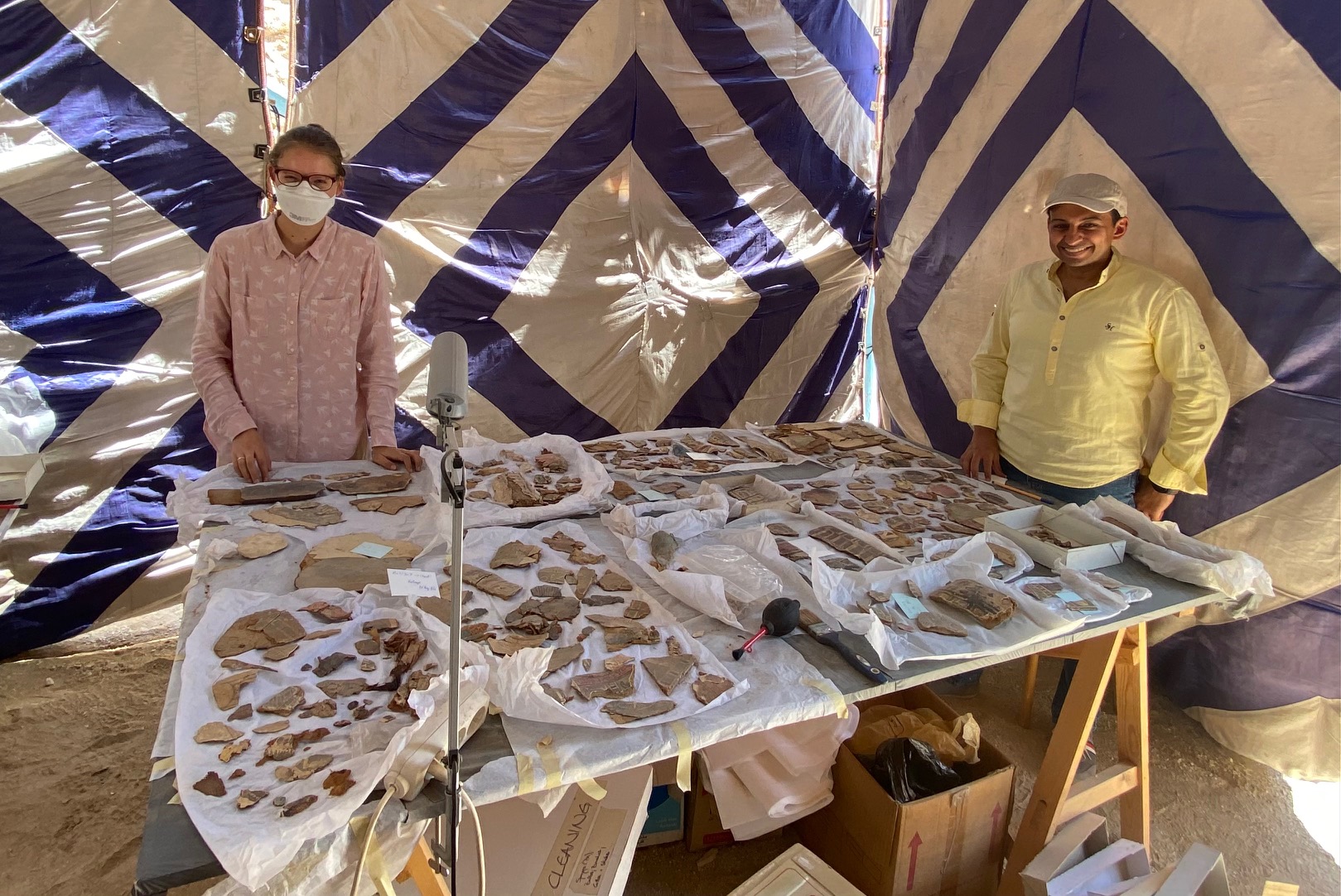
Work was conducted from September 5 to October 5, 2023, with our very helpful SCA Inspector Mahmoud Sayed Abdelhady. The major goal was to continue the cleaning, consolidation, and documentation of the large number of objects excavated in the 1970s from TT 414, the monumental tomb of Ankh-Hor, High Steward of the Divine Adora-trice Nitocris (26th Dynasty).
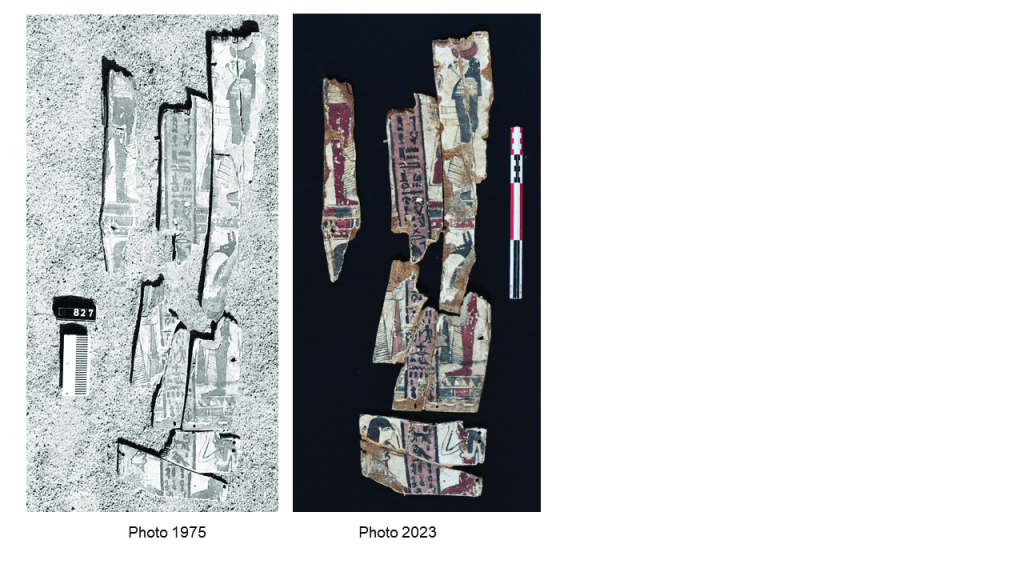
Several previously not identified pieces were newly recognised as matches to coffins documented by the Austrian mission in the 1970s. Some of these were joined by our conservators Mohamed and Karima to the already documented pieces. One example is Reg. No. 827 – Fig. 1 shows the state of documentation in the 1970s compared to 2023; this season, we found a small new piece matching to the instep of the lid. All pieces of Reg. No. 827 were cleaned and consolidated.
Fig. 1: Reg. 827, a fragmented Ptolemaic coffin lid. Left the state in 1975, to the right our new match in 2023.
In general, all finds studied in 2023 were digitally photographed and entered in a database, created by File Maker Pro. In total, more than 180 individual objects (mostly coffins and cartonnage elements) were studied and documented by more than 2400 photos. These new photos are suitable for publication and show the colours of the pieces, in contrast to the previous documentation in the 1970s (see Fig. 2).
Fig. 2: Reg. 521, one of the examples showing the benefits of high-resolution photography in full colour.
Since many the painted objects from TT 414 have darkened surface, infrared photography was used to make the original decoration visible (with a Sony Cybershot DSC-F828, an IR-filter and a small magnet). In 2023, this method was applied to a total of 95 objects.
We introduced a new method of documentation in 2023. The app Scaniverse (see https://scaniverse.com/) was used to capture objects in 3D. This photogrammetry application is ultrafast, highly accurate and very easy to use. 170 objects from TT 414 were captured with metrically accurate 3D models this season – simply fantastic!
Ashraf and I with the box of objects we transported in 2023 to the magazine (photo: P. Heindl).
One of the highlights of this season was the transport of objects to the magazine of the West Bank. In addition, we were able to work on coffins we transported to the magazine in earlier years. My personal highlight was the new documentation of one of my favourite coffins from TT 414, of Reg. 655, with infrared photography and with a 3D model.
3D model of coffin Reg. 655 created with the app Scaniverse
The conservators of the LMU Munich Ankh-Hor Project in the 2023 season were the specialists for wood, Mrs. Karima Mohamed Sadiq and Mr. Mahmoud Mohamed Mahmoud. They did a fantastic job, both at our site and in the magazine of the West Bank. A total of 108 wooden and painted objects, mostly coffins, comprising 294 individual pieces, were successfully cleaned and consolidated in 2023.
To conclude, the fifth season of the LMU Ankh-Hor Project was carried out successfully, with much progress regarding the consolidation and documentation of wood and cartonnage coffins from TT 414. Thanks to the transfer of objects to the magazine and the placement of studied finds in sugar bags in corridors of Tomb I, much space was gain in the mission’s magazine which is crucial for the future jigsaw puzzle of coffin fragments, both in wood and cartonnage. New genealogical information regarding coffin owners were unearthed and the stylistic assessment of Ptolemaic cartonnage coffins advanced in 2023 in many aspects, including reconstructing new cartonnage coffins.
The rich potential of our work on the cartonnage coffins can be illustrated with Reg. 23/04. I was able to match several fragments of the edge of the base of a cartonnage coffin which was previously not documented (Fig. 3). Based on the father’s name, the titles and the close similarity with Reg. 860, the coffin of Horakhbjt, I would like to propose to identify the owner of Reg. 23/04, Wesjrwer, as the previously unknown brother of Horakhbjt.
Fig. 3: Reconstruction of nine fragments of the edge of a cartonnage coffin of Wesjrwer.
Since not all fragments of wooden and cartonnage coffins from TT 414 are yet consolidated and documented, our work needs to be continued in the next season.
For now, I would like to express my gratitude to all of our Egyptian colleagues without whom work would not have been possible. I am very grateful to all team members of the 2023 season: Patrizia Heindl, Caroline Stadlmann, Ahmed Elmaklizi, all LMU Munich, and Karima Mohamed Sadiq and Mohamed Mahmoud Mohamed Mahmoud as the conservators of the Ministry of Antiquities and Tourism. Ashraf Hosni Teegi did another great job as the head of logistics. Many thanks to all and we are all very much looking forward to the next season!
Just one week ago, I had the pleasure of working on coffins from the tomb of Ankh-Hor in the main magazine of the Egyptian authorities on the West Bank – we brought them there in the 2000s and I had the chance to open some boxes for the first time since 15 years. This really was exciting!
All in all, thanks to the support of our Egyptian colleagues, I spent three days of work (Oct. 1-3, 2023) in the magazine of the West Bank. The main aim was to join newly found fragments to coffins which were transported in previous years to the magazine. This was one Ptolemaic painted coffin transported in 2007, Reg. 655. One joining piece could be fitted to the inner part of the shoulder of this coffin. I also relocated several loose fragments of the lid in our magazine, but these are not matching to each other, illustrating the destruction of the lid of the coffin when looters removed by force the mummy from within.
Mohamed Mahmoud showing the match of the coffin fragment to the shoulder of Reg. 655.
I documented the complete coffin Reg. 655, owned by a Ptolemaic priest with the name of Padiaes, using infrared photography – a technique I did not use back in 2007 and which is therefore a great complementary documentation. This allowed to trace not only all the texts but also small details of the drawings of the figures. Like in 2007, I am just really thrilled by the execution of these details!
Detail of the kneeling figures of Padiaes on a new infrared photo.
Using the app Scaniverse, the coffin of Padiaes was also captured in 3D. I made one scan with the fitting face part of the coffin lid, comprising of mask and wig, and one without it. These 3D models will allow us to digitally reconstruct the complete coffin, ideally also placing the not-fitting fragments of the lid in their original position.
Screenshot of 3D model of Reg. 655.
The second coffin for which matching pieces were found in the past years is Reg. 656, the beautiful coffin of the temple singer Aset-em-Akhbit III transported to the magazine just in 2021. Our conservators joined one fitting piece to the lateral side of the lid. Reg. 656 was, like Reg. 655, scanned in 3D and documented in its new shape with our full-frame camera.
Karima Mohamed joining the two fragments of Reg. 656 together.Documentation of the new shape of Reg. 656 after placement of the new matching fragment.
Apart from the matching of joining pieces to these two coffins, our goal for the work in the magazine was to update the documentation of the objects. I managed to study a total of 18 objects, making high-resolution photos, 3D scans and infrared photography. My personal highlight was the reunion with the inner coffin of Wakhibre, one of the rare in situ burials of the 30th Dynasty excavated in Thebes and a very special piece.
For facilitating this important work in the magazine of the West Bank, I am very thankful to Ahmed Hassan, Chief Director of the Magazines of the West Bank as well as to Ahmed Ezz, Director of the Magazine. I am grateful to our conservators Karima Mohamed and Mohamed Mahmoud for their excellent job fitting the joining pieces to Reg.655 and Reg. 656. I would also like to thank Nefisa Elazab Mohamed who functioned as an inspector during my work in the magazine and was very helpful. I hope to be back there in the next season – 3D scans and infrared photos are waiting for other objects from the tomb of Ankh-Hor!
To all who celebrate around the world, a very happy Mawlid an-Nabi! Because of this holiday, our week 4 ended already yesterday and we could catch up with some paperwork working today from home.
In week 4, our conservators Karima and Mohammed continued with the consolidation and cleaning of coffins from TT 414, focusing on Ptolemaic pieces. They managed to clean fragments of 16 coffins this week, comprising partly a large number of individual pieces. Like last week, puzzling with the fragments and gluing them back together after cleaning was very time consuming. One of my favourite coffins they finished this week is Reg. 829 – the beautiful base of a wooden anthropoid coffin showing a felid skin on the exterior.
The beautiful bottom side of the cartonnage coffin Reg. 829.
I am particularly proud that I managed to relocate the fragments of the edges of the coffin – this is new information which was not yet recorded in the previous documentation in the 1970s.
Interior of Reg. 829 with placement of fragments of the coffin edges.
Not only the coffin is remarkable, but also its owner. Reg. 829 was owned by the god’s father and prophet of Amun in Karnak, sakh-wedjat and prophet of Sobek who dwells in Qus Hor-pa-bjk. He belongs to a very interesting, but also quite complicated priestly family which was active most probably during mid-Ptolemaic time. All the family members buried in TT 414 had very similar wooden coffins as well as cartonnage coffins – this produces several challenges in identifying the individuals. Both the female and male members of the family show a little variety of titles but share very common names; this caused already confusion in the 1970s when Elfriede Reiser-Haslauer tried to reconstruct the family tree.
Very interesting is the connection of the family to Sobek of Qus – this is something we can trace already since the time of Pa-di-Amun-neb-nesut-tawy I who started reusing TT 414 in the fourth century BCE (Budka and Mekis 2022). Tamas Mekis and I have proposed that maybe the ancestors of Pa-di-Amun-neb-nesut-tawy I moved to Qus during the Second Persian Period and returned to Thebes during the Nectanebid Period, bringing the cult of the gods of Gesy with them. The cult of Sobek in Karnak is both connected to Amun as well as to Osiris (see Budka and Mekis 2022 with references; for Sobek and his cult in general see Kockelmann 2017) – and, as Hor-pa-bjk illustrates, the Sobek cult was an integral part of the duties of the Karnak priests reusing TT 414, even many generations after Pa-di-Amun-neb-nesut-tawy I.
Coming back to the coffin assemblage of Hor-pa-bjk, I completely agree with Reiser-Haslauer (1982) – although final proof is still lacking, it is very tempting to identify Hor-pa-bjk as the brother of Hor-akh-bjt, owner of the cartonnage coffin Reg. 860, which shows a very similar felid skin on the bottom in an almost identical style.
We know that Hor-pa-bjk also had a cartonnage coffin like his presumed brother (and his father, mother and sister-in-law…) – it most probably also showed a zodiac on the interior of the lid. Since the cartonnage coffins from TT 414 are even stronger fragmented than the wooden ones, I am still sorting through fragments and trying to make sense of this large jigsaw puzzle.
My workplace was very chaotic at times this week – just too many mixed up little fragments to sort through!
As one of the most important results this week, I believe that I managed to identify another brother of Hor-pa-bjk and Hor-akh-bjt by means of a very fragmented cartonnage coffin which is again similar to Reg. 860. This would most probably be the eldest son of Nes-ba-neb-Djedet – a previously unrecorded Wesjr-wer III, named after his grandfather Wesjr-wer II. Thus, with the family tree around Hor-pa-bjk increasing, I am positive that we will soon be able to answer some of the open questions.
This small case study hopefully illustrates why all this work with the gigantic puzzle of fragments from the tomb of Ankh-Hor is worth doing – not only to reconstruct the actual objects from TT 414, but also to gain more information about the priesthood of Karnak in Ptolemaic times.
References:
Budka, J. and T. Mekis 2022. The family of Pa-di-Amun-neb-nesut-tawy from Thebes (TT 414) revisited. The case study of Kalutj/Nes-Khonsu (G108 + G137) (with contributions by Marc Etienne and Malcolm Jr. Mosher), Archaeopress Egyptology 42, Oxford [open access].
Kockelmann, H. 2017. Der Herr der Seen, Sümpfe und Flußläufe. Untersuchungen zum Gott Sobek und den ägyptischen Krokodilgötter-Kulten von den Anfängen bis zur Römerzeit. Ägyptologische Abhandlungen 74, Wiesbaden.
Reiser-Haslauer, E. 1982, C. Die Familien um Wsjr-wr und Ns-bA-nb-Ddt (spätptolemäisch), 257, in: M. Bietak and E. Reiser-Haslauer, Das Grab des Anch-Hor, Obersthofmeister der Gottesgemahlin Nitokris, Band II. Mit Beiträgen von Joachim Boessneck, Angela von den Driesch, Jan Quaegebeur, Helga Liese-Kleiber und Helmut Schlichtherle und Relief- und Fundzeichnungen von Heinz Satzinger, Untersuchungen der Zweigstelle Kairo 5, Wien.
This week just flew by very quickly – we made much progress in many respects.
The consolidation and cleaning of coffins from TT 414 was carried out continuously by our conservators Karima and Mohammed. They managed to clean seven additional coffins this week, comprised of more than 60 individual pieces. Very time consuming was therefore the puzzling with the fragments and gluing them back together after cleaning.
This week, Mohammed and Karima had to fit many pieces of fragmented coffins together.
One case study of these working tasks is shown here – Reg. 825 is a nice example of a looted inner anthropoid coffins with clear damages caused by the robbers. Karima and Mohammed managed to fit the fragments back together in a way that also the original shape of the lid becomes visible again.
Reg. 825 was one of the coffins successfully cleaned, glued and documented in week 3.
Another great achievement in terms of consolidation was the work by Mohammed on a very fragile pedestal of a 26th Dynasty Ptah-Sokar-Osiris statue from the tomb of Ankh-Hor. The piece is not inscribed, but covered with linen and painted in yellow, red and blue. Mohammed fixed all of the remaining painted parts. The 3D model I created of the object with Scaniverse shows in great accuracy the “footprint” of the statue – the tenon hole, but also the shape of the lower base of the figure. The almost square cavity in front of the pedestal was closed with a lid on which we traced the negative of a falcon statue.
3D model of Reg. 23/02 (created with Scaniverse) showing all the details of this 26th Dynasty Ptah-Sokar-Osiris-pedestal. The small lid of the cavity was removed for this scan.
This week the work on the cartonnage coffins from TT 414 really picked up speed. To begin, Ahmed and Caroline, our student assistants, searched and sorted through several boxes of fragments. We focused on the reconstruction of a wonderful two-part coffin of the Ptolemaic Amun priest Horakhbjt, Reg. 860- its painting is exquisite and large fragments were documented back in the 1970s. However, we realised that most of these fragments are currently missing. The good news is: I have now been able to relocate numerous pieces; they were scattered in dozens of boxes in the magazine.
Ahmed and Caroline did a great job sorting through boxes with cartonnage fragments from TT 414.
I show you here a particularly charming fragment from the lid: just check out the details of the figure of Anubis and the way he is here depicted bent over the mummy on the lion bed.
One small fragment from the lid of Reg. 860 – unusual is the representation of Anubis in this scene with the mummy bier.
I did anticipate that work on Reg. 860 will be time-consuming – maybe not as much as it turned out to be, but I am still optimistic that we will manage to document much of this important piece during this season. In addition, I managed to find matching pieces to a lot of other cartonnage coffins. The most exciting one is maybe the beautiful lid of the cartonnage of the priest Twt. Just last year, I managed to identify this cartonnage coffin and now we have a full representation of Twt kneeling in front of an offering table in delicate painting.
New matching pieces of the cartonnage coffin of Mr. Twt – the lower part of the Ba-bird and of Twt himself were newly found this week.
Last but not least, this week was also very successful in using 3D scanning with Scaniverse to document objects, fragments of cartonnage coffins and wooden coffins from TT 414. More than 50 3D scans now complement our documentation and will allow us to continue the jigsaw puzzle also back home after the season.
When you photograph numerous fragments of coffins every day and hold them in your hand, your eye for small details becomes sharper. One example for this is a small observation I made over the last days, and which I would like to share. It concerns the execution of individual motifs within designs arranged symmetrically along a central axis on Ptolemaic coffins from TT 414. More specifically, I am talking about pairs of jackals and the way they are represented on the same coffin. Three examples out of a larger set of coffins will hopefully illustrate why I am intrigued by these figures.
In general, two jackals, arranged symmetrically on various pieces of ancient Egyptian funerary art, are very common motifs, especially as guardian figures on coffins but also on stelae. In Thebes, the typical design of the coffin lid on the upper surface of the feet during the Late Period and Ptolemaic times shows two jackal-shaped Wep-wawet deities recumbent on a shrine on each side. The jackals commonly have a scepter between their paws and a flail above their back.
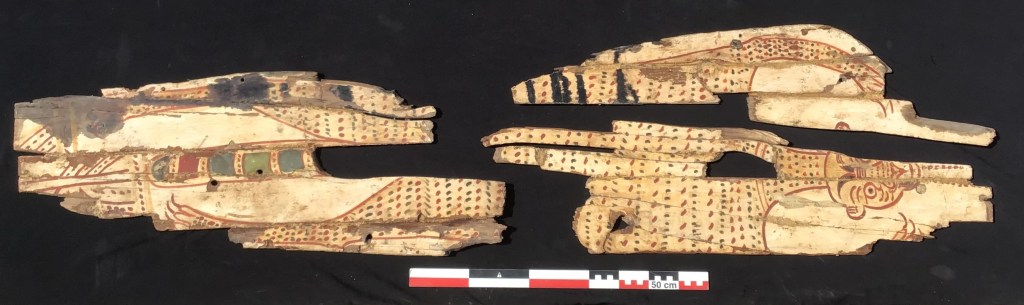
Let’s now have a look at my examples from TT 414. K07/125 is the lid of the top part of the feet of a Ptolemaic coffin. The pair of recumbent jackals flank a central vertical line of text which mentions Wep-wawet. The shrines of the jackals are not preserved, but above the jackal figures on each side are five uraei with sun discs on their head – representing the toes of the deceased.
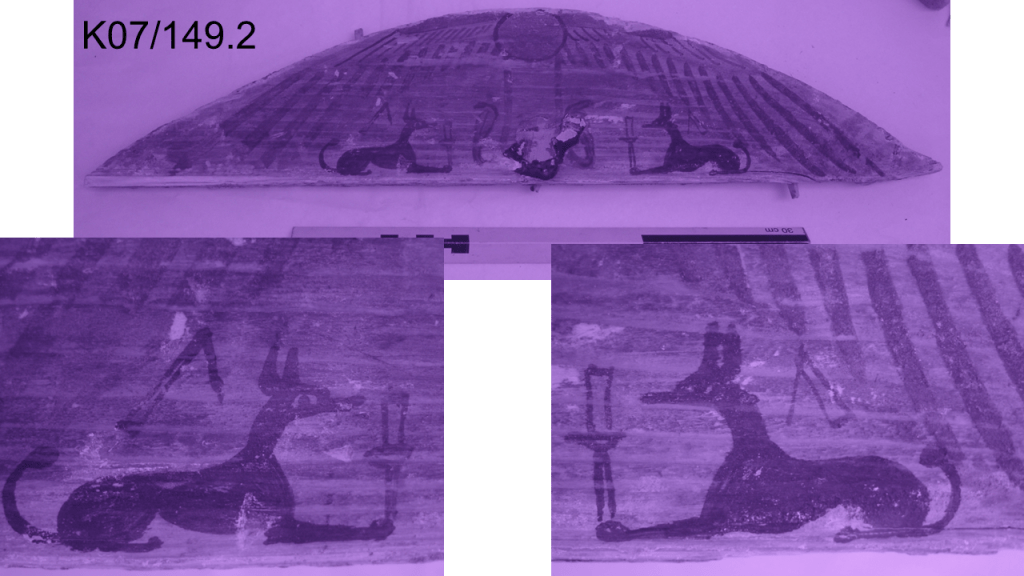
The jackals themselves are depicted very differently – in particular the shape of the heads and snouts as well as the size and shape of the visible eye are very different. That this is not a unique feature becomes obvious when we look at two other examples. Two fragments of two qrsw-type coffins show pairs of jackals in a similar arrangement – in one case recumbent, in the other sitting – flanking the central sun disc and vertical text line, very similar to the design of stelae.
The figures I have compose illustrate how different the jackals are on the left sides to the one on the right sides. It’s mostly again differences regarding the shape of the head, snout and eye, but on K07/149 the right jackal also shows a much stockier body. If I would show you the pictures isolated – would you have guessed that it comes from the same object? This piece also shows small differences in the execution of the uraei and the space arrangement of the scenes differ slightly.
How can we explain these differences? It seems rather unlikely that different painters were involved in these minor motifs but of course this is a possibility. Perhaps there was a lot of freedom in how exactly standard motifs had to be executed on coffins during Ptolemaic times, perhaps not much accuracy was given to small details but rather to the complete design of coffins. Or could the deviations also be related to simply “natural” differences that depend on the direction of painting (animals facing to the right or to the left)?
Be it as it might, the pairs of jackals on coffins from TT 414 illustrate the complexity of coffin design in Ptolemaic Thebes and that a symmetrically arranged motif is executed in anything but the same way. This makes the study of these objects such a fascinating task.
This week has been extremely productive, and we made much progress in our work tasks. In terms of conservation, the consolidation and cleaning of objects from TT 414 progressed very well thanks for the efforts of our conservators Karima and Mohammed. The focus was on Ptolemaic painted coffins and for many of them, matching pieces could be glued together. Despite of this time-consuming task of gluing, already 38 registered numbers with more than 70 individual pieces have been treated by our conservation team until today.
Mohammed fitting together two broken pieces of a Ptolemaic coffin lid.Karima cleaning and consolidating another fragment from this coffin lid.
My tasks are currently to prepare the objects chosen for consolidation according to priorities, photographing them (with our full-frame camera for high resolution photos as well as with infrared photography where necessary) and identifying fragments without object numbers.
Photographing is one of the main steps of documentation in our project.Reg. 07/58, the lower part of a Ptolemaic coffin after cleaning.
For one coffin fragment, the base of an inner anthropoid coffin (Reg. 07/58), I noticed a very interesting detail. There is a substantial amount of black goo (bitumen/resin) on the interior of this coffin – a common feature in our corpus, especially for the Ptolemaic coffins. Although this substance partially obscures the decoration of painted pieces, it is also an interesting archive of information in itself. For example, back in 2021, we documented the so-called “beetle coffin”, where a number of beetles were stuck into the resin/bitumen. There are other examples in which the negative traces of the mummy and/or of rolls of papyrus are traceable in the black goo. For Reg. 07/58, we can reconstruct that the mummy was covered in a bead net and this net has left an imprint in the resinous substance.
Detail of imprint of bead net in the black goo covering the interior of Reg. 07/58.
Thus, although only very fragmentarily preserved, this coffin fragment offers quite some interesting information on the burial which was once placed in it and got looted prior to the excavation of TT 414.
Newly documented pieces are getting measured and described as well. With the exciting new possibility of 3D scanning with Scaniverse, we will complement our documentation with this useful asset.
Finally, despite of all the digital documentation, we also use traditional methods like drawing for small objects and wooden pieces where the illustration of the construction is highly relevant. This working task was started during week 2 as well, thanks to the arrival of Patrizia Heindl.
First drawings of objects from TT 414 were realised this week thanks to Patrizia.
More team members will arrive later today, and I am very much looking forward to week 3 of our 2023 season.
We successfully opened the 2023 season of the LMU Ankh-Hor project earlier this week. Although we only had three working days in Week 1, we made great progress with our prime working tasks. Ashraf and Hassan cleaned the area and many boxes with objects from the tomb of Ankh-Hor (TT 414), Mohammed and Karima consolidated already 20 pieces of painted coffins.
One particular challenge for Mohammed was a fragment of a 26th Dynasty qrsw-coffin (a coffin in the shape of a shrine with vaulted lid and corner posts). This piece (Fig. 1) was reused as building material in the Lichthof of TT 414 in the later reconstruction phase of this part of the tomb during the 30th Dynasty. The builders in the 4th century BCE used mainly mud bricks and wood – and for the latter, plenty of broken 26th Dynasty coffins were available as suitable building material (especially as architraves).
Fig. 1: The consolidated fragment of a qrsw-coffin from TT 414.
Thus, although the original object Mohammed consolidated is in a very pure condition and we cannot identify its owner, the piece tells us a lot about the life history of TT 414.
I was busy in the last days sorting the coffin fragments according to priorities for consolidation and cleaning. Several of them are still not assignable – find labels are missing and the texts are not readable. Some of the fragments we are dealing with were never registered before and require full documentation. For the unclear pieces because they are not readable, I take infrared photos and try to identify the objects back home with the help of the database. We are using this technique since 2021 and have wonderful results – for most of the painted coffins with stains on the surface or darkened surfaces, the original decoration becomes visible again.
I had a particularly successful experience yesterday: A piece whose inscriptions I could not read until yesterday suddenly became clear (Fig. 2). Based on the texts (especially the name of its owner), it was an easy task to identify the coffin fragment as Reg. 762. It also turned out that this coffin was actually much nicer decorated than a first glance of the darkened surface would indicate.
Fig. 2: Reg. 762 – working photo and detail with infrared photo. Note the difference infrared photography makes in tracing the original decoration of this piece.
Furthermore, and this shows the enormous potential of infrared photography for the LMU Ankh-Hor project, more genealogical data became available for the owner of this coffin. Back in the 1970s, the names of the parents were not readable. But now they are! And it seems as if we have another, previously unknown family member of the famous Hor and Kalutj/Nes-Khonsu family! But this is so exciting that I have to ask all of you for a little patience – there will be a separate blog post about this (soon insha’allah).
Today was the opening day of our 2023 season of the LMU Ankh-Hor Project. All went very smooth, thanks to the great colleagues in the inspectorate in Luxor and on the west bank and first of all our wonderful inspector Mahmoud Sayed. We are currently a small team, but more team members will arrive next week. This year’s focus will be on conservation and documentation of wooden painted coffins and cartonnage cases from TT 414, the tomb of Ankh-Hor.
All set up for work in the Asasif – our conservation tent early in the morning.
Like in the last years, we have again a very comfortable, spacious conservation tent set up as well as smaller tents for documentation and drawing of objects. All working steps are by now already routine – I started sorting Late Period and Ptolemaic coffins according to priorities and took first photos of selected pieces.
I am very happy that our two Egyptian conservators, Mohammed Mahmoud and Karima, started their work already today. Both are experts for wood and have an extensive working experience here in Thebes but also at other sites in Egypt. Mohammed has worked with us already in 2021 and is thus very familiar with the material from TT 414.
Mohammed set up the working spaces and continued seamlessly with his conservation work from 2021.Karima is joing us for the first time and had a great first day like all of us!
Today, already several fragmented Ptolemaic coffins were successfully cleaned and consolidated – a wonderful start and a very nice outlook for the next weeks!
It is a great pleasure to have been invited by the Collegium Aegyptium, the friends of the Institute of Egyptology and Coptology at LMU Munich to give a lecture about my Ankh-Hor Project.
My talk later today will be in German and focuses on the questions of Ptolemaic wooden coffins and cartonnage fragments from TT 414.
It is the first time that I present some preliminary remarks on the cartonnage cases from the tomb of Ankh-Hor. There is evidence for various types of cartonnages from the 30th Dynasty well into the Ptolemaic era. I will discuss some of the results from the 2022 season.
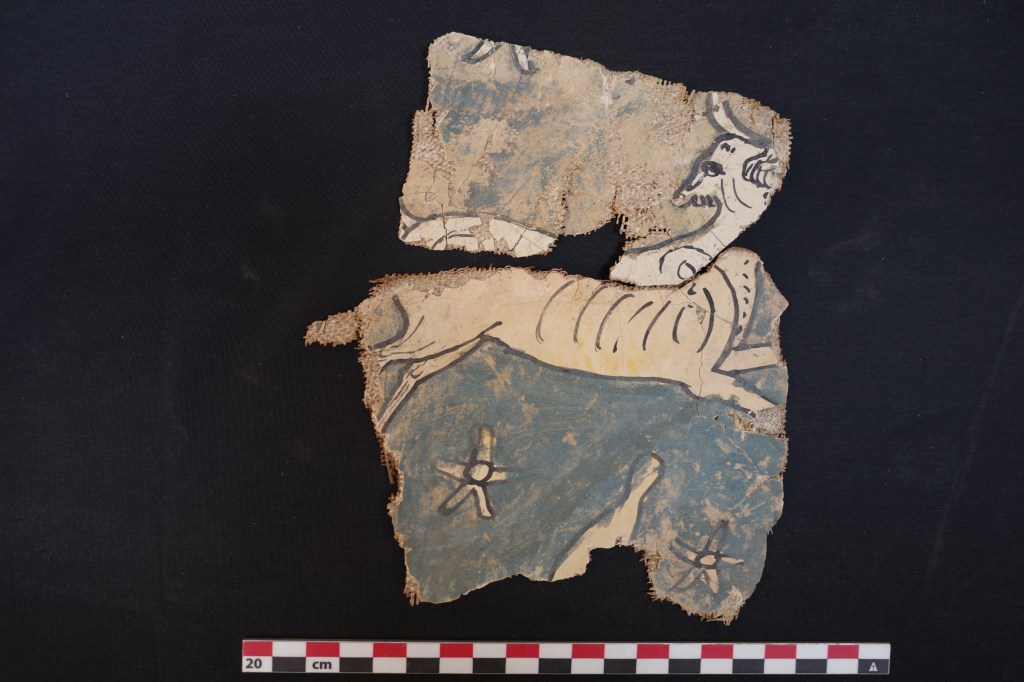
One particularly interesting topic, that I will briefly mention today in my lecture is the appearance of zodiac representations on the interior of lids of cartonnage coffins.
Interior decoration of the lid of a cartonnage coffin from TT 414 with the Taurus zodiac sign.
The recent publication by Daniela Mendel (2022) is an excellent collection and comparison of representations of astronomical ceilings and zodiacs in Ptolemaic and Roman temples, coffins and sarcophagi as well as tombs. Due to the poor state of publication on Ptolemaic cartonnage coffins from Thebes, there is no reference in the book to cartonnage examples of zodiac representations. It is well known that the wooden coffins of the famous Soter family from Thebes include representations of the sky with zodiac – but as the material from TT 414 shows, there were already examples well before the Roman era.
There is still so much work and research to be done – and hopefully we will be back in Luxor for the 2023 season of the Ankh-Hor Project soon. For now, I am very much looking forward to tonight’s lecture and hope for some constructive feedback and questions.
Reference
Mendel, D. 2022. Die Geographie des Himmels: eine Untersuchung zu den Deckendekorationen in ägyptischen Tempeln der griechisch-römischen Zeit und zeitgleichen Darstellungen auf Särgen und in Gräbern. 3 vols. Studien zur spätägyptischen Religion 37. Wiesbaden: Harrassowitz








 The Ankh-Hor Project