Summary of week 3: more than TT 414

A very busy and successful week just came to an end – more team members have left today, and we will finish off the 2021 season in a small group with one more week to go!

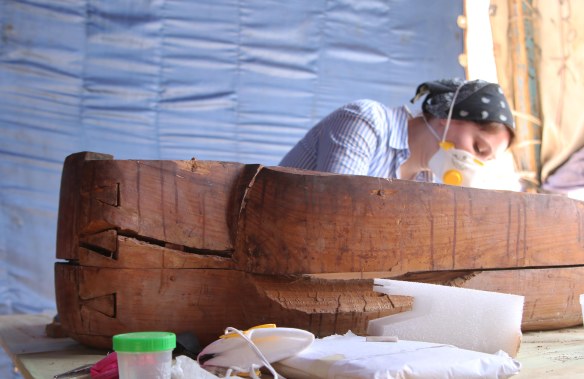
We started into the week with a very pleasant and productive visit by my dear friend and colleague Salima Ikram. We have been working together on some embalming deposits this season for the South Asasif Conservation Project. Salima kindly passed by to have a look at the black goo – bitumen and resin – in the interiors of our coffins from TT 414. One lower part of an anthropoid Ptolemaic coffin was particularly interesting.
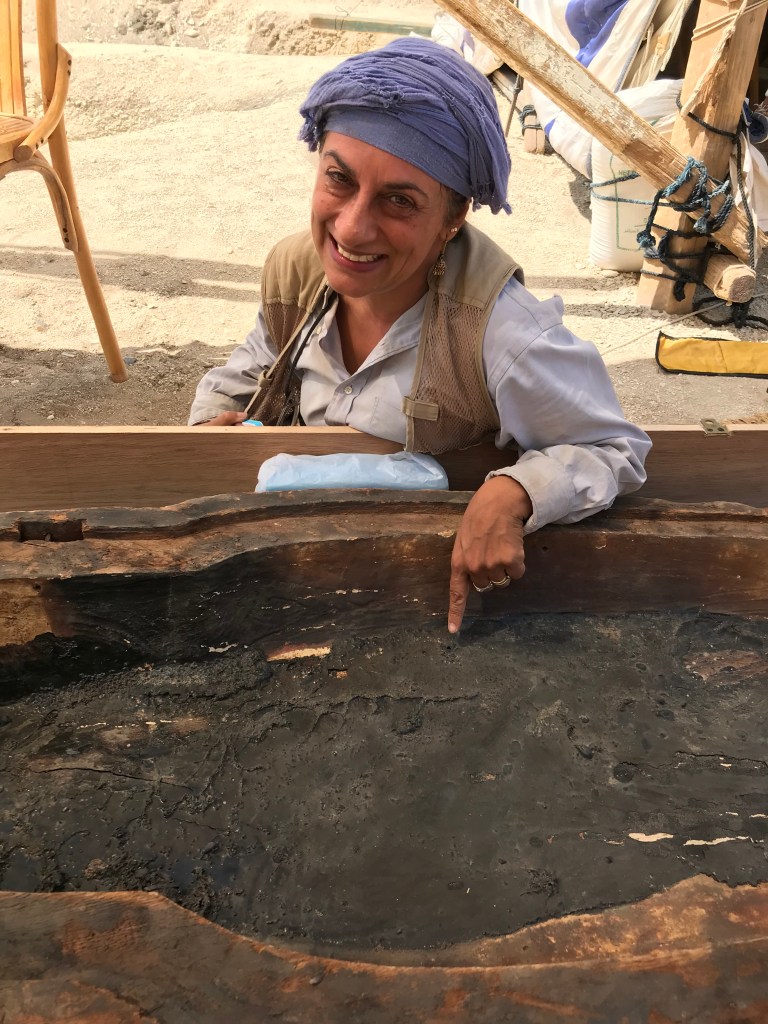
Salima and our “beetle coffin”.

A number of beetles were stuck into the resin/bitumen – did they enter the coffin together with the mummy? According to Salima, these are darkling beetles, Pimelia nilotica in Egypt. Since these feed on animal (and human) tissue, it is indeed likely that they entered the coffin when the mummy was put there, presumably before the funerary ceremony when the pouring of the black goo took place. However, many questions are still open, and we cannot exclude a reuse of this coffin and a more complex story behind the “coffin beetles”. This is even more true since we documented smaller fragments of lower bases of coffins with similar findings – less well preserved, but also with clear remains of beetles stuck to the resin in the coffin.

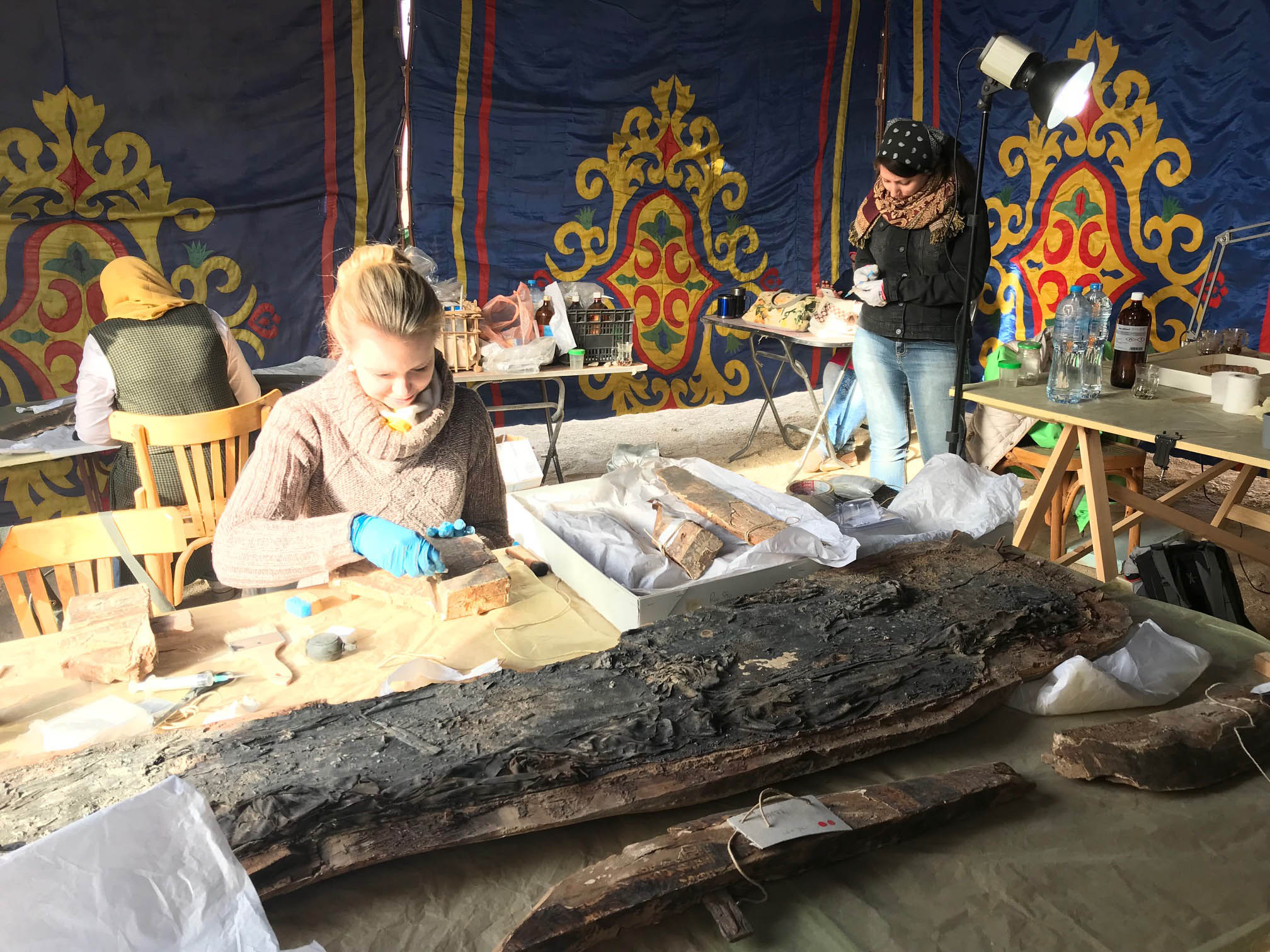
The focus of this week was preparing the coffins and other objects which we will transport to the study magazine of the Egyptian authorities next week. Here, one particular challenging piece is the once beautiful 26th Dynasty coffin of Psammetik-men-em-Waset, Reg. No. 591. He bears the same name like one of the brothers of Ankh-Hor, but belongs to the family of Nes-Menw which is closely related to the family of Ankh-Hor. Maybe the owner of our coffin was the grand-nephew of Ankh-Hor, making his coffin set of an inner anthropoid coffin and a qrsw-coffin extremely relevant for understanding late 26th Dynasty tomb groups. The piece we are currently working on is an anthropoid wooden coffin with a layer of linen which was painted in white and decorated with texts in blue and green. Unfortunately, the linen was almost completely detached from the wood and the painted layer has suffered much in the last decades in the provisional storage place.

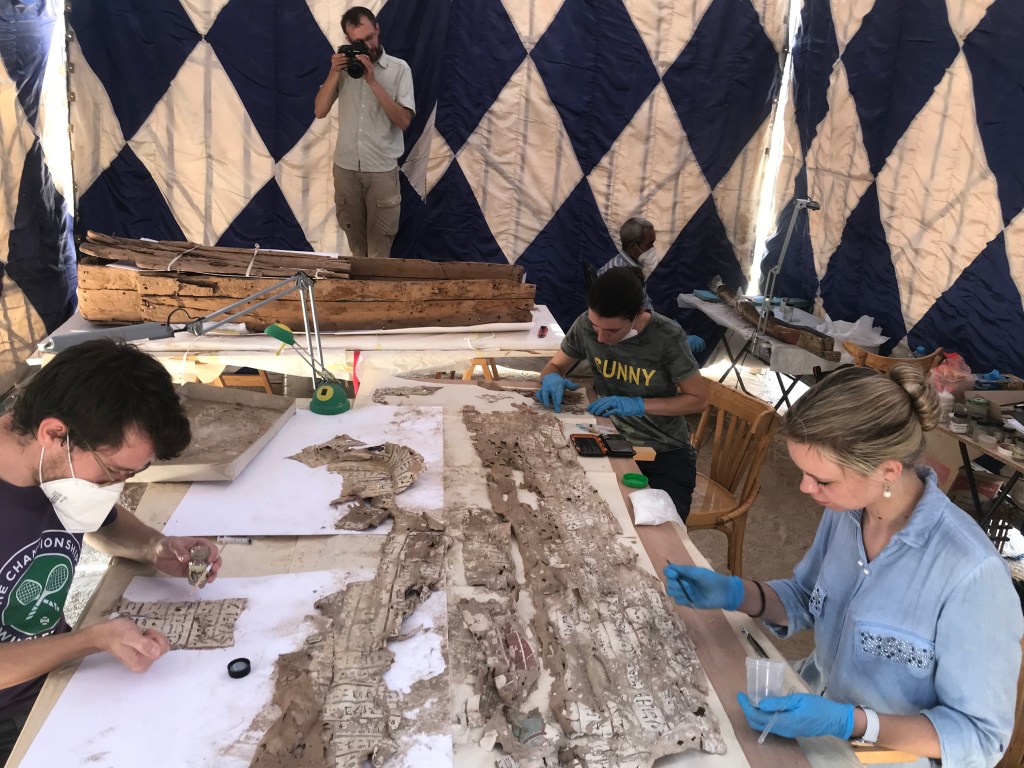
Our team of conservators is still busy with consolidating this important piece from TT 414.
Many challenges in the conservation tent: the painted linen/cartonnage of the 26th Dynasty coffin in the front, the undecorated 25th Dynasty Kushite coffin in the back.

However, this week was also occupied with documentation work of coffins which were not found in TT 414 and are dating to other periods than the 26th Dynasty to Ptolemaic times. One of them was a poorly preserved 25th Dynasty wooden coffin of an anonymous Kushite lady found in Tomb VII – one of the most important findings within the Austrian concession with intact burials of Kushites (for details see one of my earlier articles). The coffin fully consolidated this season was found in burial chamber 3 together with three infant coffins and one painted and inscribed coffin of a Kushite male with the name Irw.

In situ situation in Tomb VII of the Austrian concession with a pile of Kushite coffins (after Budka 2007), including the one of an anonymous female consolidated this year.

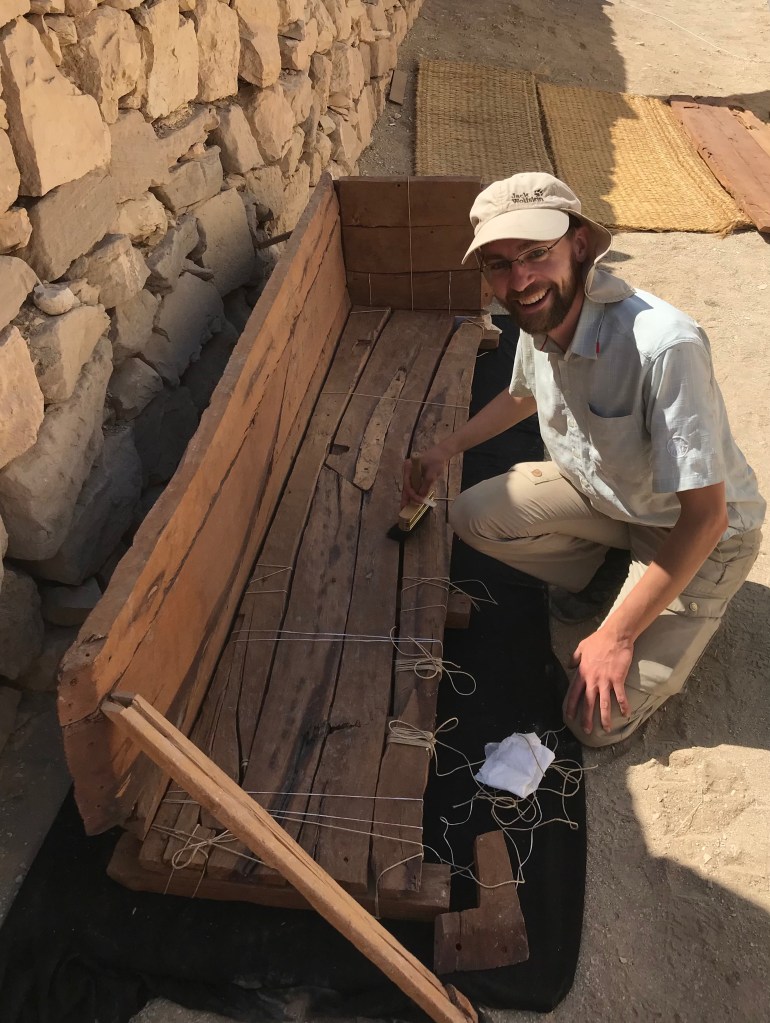
Another important find from the Austrian mission was made in 1971 in one of the Middle Kingdom shaft tombs in the bed of the causeway of Thutmose III. It is a complete, undecorated Middle Kingdom rectangular coffin which was a big challenge to photograph. Cajetan managed to put the piece together and assembled the coffin box with the help of some external supports for photography.
Last, but not least, several new joints to Ptolemaic coffins from TT 414 were made this week based on new infrared photography. One of my favourite pieces belongs to a woman with the name of Mutirdis – we knew already some fragments of her lid and side boards, but I managed to identify three additional pieces from the pedestal and foot part. Like it is the case for several other Ptolemaic pieces, reconstructing this beautifully decorated coffin will clearly take another season but is full of potential!

One of the newly identifed pieces of a Polemaic coffin of Mutirdis.

For now, I am very happy and thankful to all the team and looking forward to our last week which will focus on consolidation work and reorganising the space within the provisional magazine.

Summary of week 1 of the 2021 season

We just finished a first, very successful week of our 2021 season. We started off with cleaning, dusting, and sorting things and are now well underway to document small finds, ceramics, shrines as well as wooden and cartonnage coffins.

The painted coffins from TT 414 belong both to primary burials of the family of Ankh-Hor and to secondary burials of Amun priests, mostly dating to the 4th and 3rd centuries BCE, which appear as relatively wealthy. Most of the material derives from the secondary use of the tomb. I am still busy collecting fragments which can be dated stylistically and because of the technique to the 26th Dynasty – these are usually very small pieces, sometimes just small splitters of the painting.

Example of small fragments of 26th Dynasty coffins including a piece from the outer coffin of Ankh-Hor (bottom right).

These are nevertheless important to reconstruct the original burials in TT 414 – yesterday, I found one loose fragment of the foot pedestal of the outer coffin of Ankh-Hor himself. This foot part is in a very fragile condition and will be consolidated later this season, including fixing the loose fragments back in place. Among the most interesting finds is another 26th Dynasty coffin giving the female name of a Mutirdis – a common name in this era, but I still do not know to which specific person this coffin once belonged. During the Austrian excavations in the 1970s and 1980s, no Mutirdis from the 26th Dynasty was recognised in the material from TT 414 – another example why our current work is so important to understand the complete phases of use in the monumental tomb of Ankh-Hor!

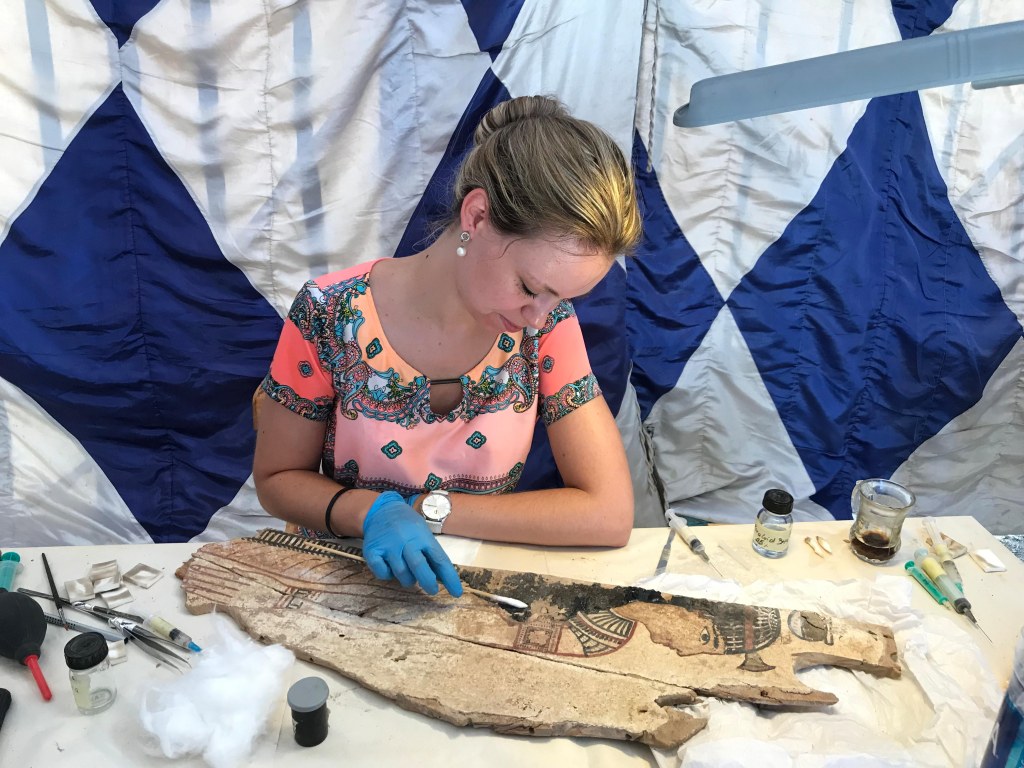
Jessica working on one of the late Ptolemaic coffin fragments.

The Ptolemaic wooden and cartonnage coffins are much better preserved and are currently treated by our conservation team. Since 2018, our conservation programme is conducted in cooperation with the Austrian Archaeological Institute (OeAI) of the Austrian Academy of Sciences. This year, our team is comprised of four young conservators, all graduates including one current student of the University of Applied Arts in Vienna. We are kindly supported by one of the experienced Egyptian conservators from the West Bank. The team finished already a considerable number of pieces in week 1 and these objects are now ready for their final photographic documentation with a full-frame camera with high resolution (Nikon D810 with a 35mm objective lens).

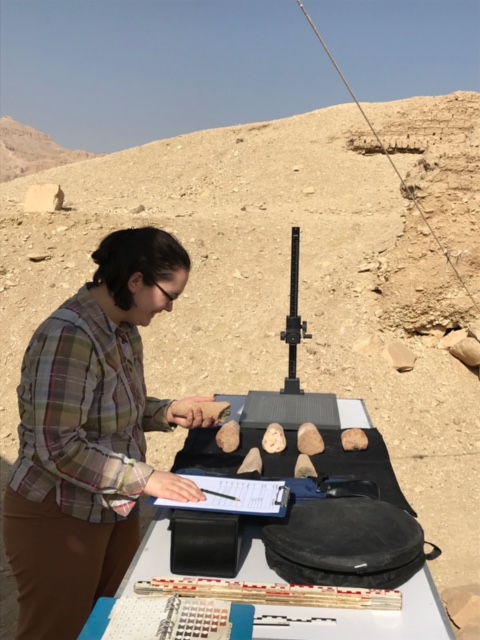
In terms of documentation, the Egyptologists of our team concentrate on ceramics and small finds. This week, Hassan and Patrizia were both busy with funerary cones. Patrizia, who is about to finish her PhD about Late Period statuary, wrote some years ago her BA thesis about funerary cones and thus shares my own enthusiasm for these intriguing objects which still pose some questions in the Late Period. Drawing these cones (among others funerary cones of Monthemhat, Padineith and Pabasa), Patrizia does not only focus on the stamped end but also on technical features, remains of colours and other details.

Although very challenging objects to draw, we love Late Period funerary cones! And Patrizia is doing a perfect job here.

Our youngest Egyptologist is Caroline, a MA student from LMU Munich. She is very talented and enthusiastic and started with drawing Late Period and Ptolemaic vessels. Later this season, she will join me working for the South Asasif Conservation Project.

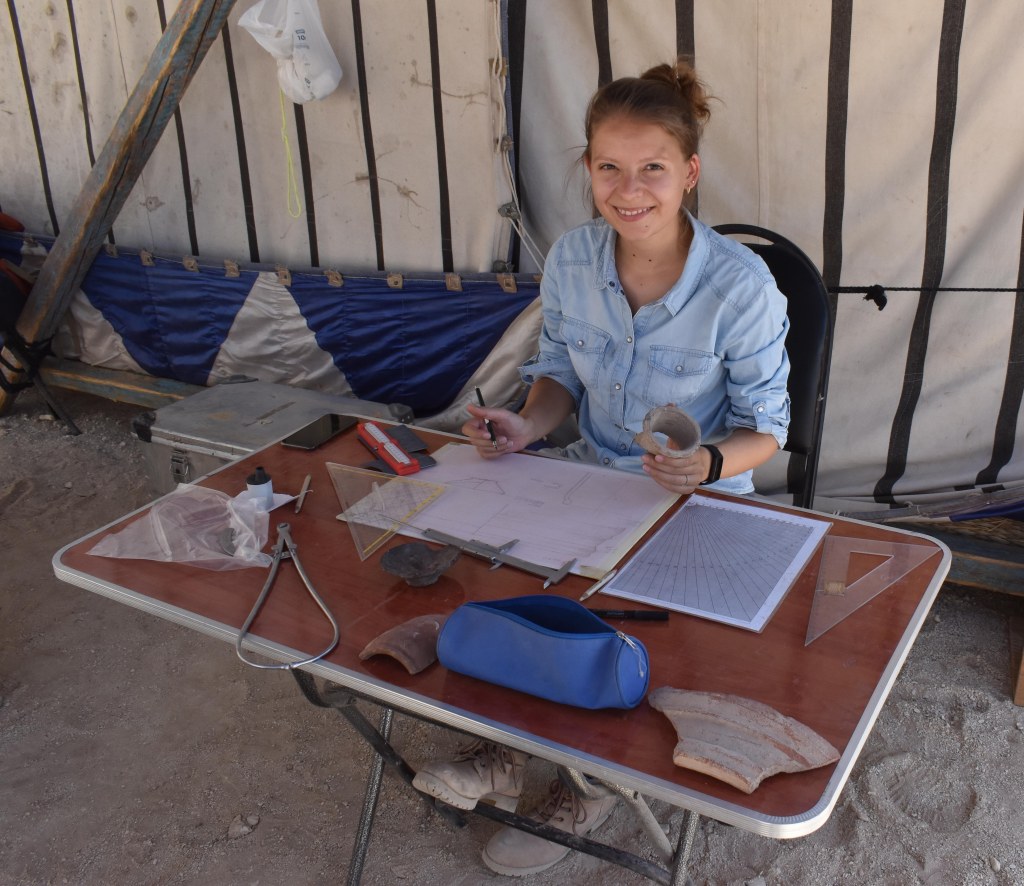
Caroline very quickly adapted to our “drawing office” at the site and made already a good number of pottery drawings in her first week.

It is wonderful that the two sites, Ankh-Hor and South Asasif, share so many similarities in terms of re-use – Caroline will thus be perfectly prepared, knowing the most common vessel types already from our mission.

Today, the last team members will arrive, and we are all looking much forward to another exciting week starting on Saturday in the gorgeous setting of the Asasif in front of Deir el-Bahari.

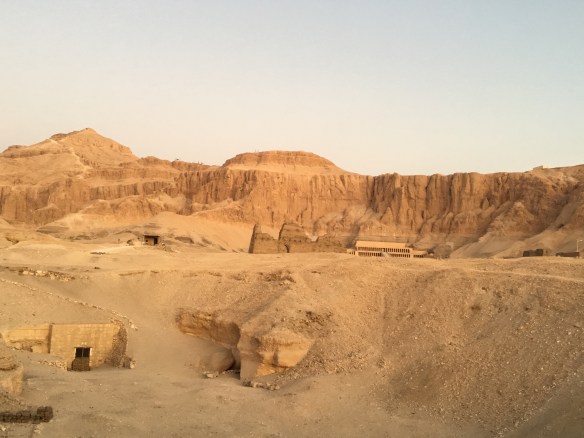
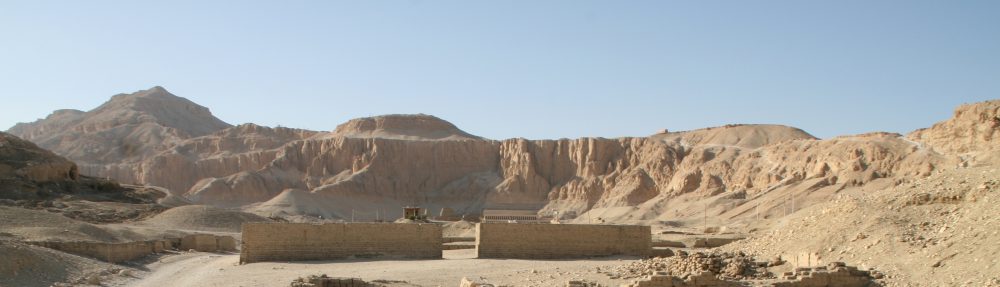
Our conservation tent and a view to the Theban mountains.

Summer in Luxor, Munich and Vienna

Time flies by – on such a rainy day like today in Munich, summer really seems to be over… My recent study season in Luxor was very successful and despite of the high temperatures really productive.

The necropolis of Asasif on an early August morning.

The South Asasif Conservation Project directed by Elena Pischikova had made fantastic discoveries this season and the corresponding ceramics were exciting to process. Of course I was especially looking for parallels for TT 414, the tomb of Ankh-Hor. This season, not only nice comparisons from the second heyday of the Asasif during the 4th and 3rd centuries BC showed up, but also intriguing pieces from a little understood period, the late 26th Dynasty and the 27th Dynasty. Especially the latter are important because, as clearly stated by Wolfram Grajetzki already some years ago: „The period of the first Persian domination remains something of a mystery for archaeology in Egypt. There are very few monuments and even fewer tombs that can be securely dated to this time“ (Grajetzki 2003, 117). Especially within Thebes, burials attributable to the Persian Period (27th Dynasty) still remain an enigma and are difficult to date (see Aston 1999), but ceramics from both Southern and Northern Asasif clearly attest to the funerary activities during that time. Much more research is required here!

For now, some post-excavation work is necessary for the 2019 South Asasif season and I am busy with entering data into the database. Next week, Vienna is calling and the focus will be more on Sudan and the MUAFS project. All in all, this summer was not only hot in terms of temperatures, but also extremely interesting and inspiring for my projects in Asasif and beyond.

References

Aston, David A. 1999. Dynasty 26, dynasty 30 or dynasty 27? In search of the funerary archaeology of the Persian period, in: Studies in Ancient Egypt in honour of H. S. Smith, ed. by Anthony Leahy & John Tait, London, 17–22.

Grajetzki, Wolfram. 2003. Burial Customs in Ancient Egypt: Life in Death for Rich and Poor, London.

Dissemination of the rich potential of the Ankh-Hor Project

Good news within the summer break: Our study of neglected finds from the tomb of Ankh-Hor in Asasif, TT414, in Egypt is highlighted in the latest issue of the The Project Repository Journal (July 2019, pp. 42-43).

Our aimed reconstruction of the complete use life of the tomb from the 6th century BC until Roman and Coptic times will provide new information about the people buried in TT 414 and also allows high lightening important new aspects of Egyptian funerary customs throughout the ages.

TT 414 has a huge potential to serve as a case study to analyse various attitudes of later generations towards the original owners of monumental Theban burial places – this can be best illustrated by the recycling of coffins. For the understanding of the complete, very complex use life of TT 414 a more in depth study is therefore much needed and will be carried out in the next years. At present, large amounts of coffins, fragments of coffins and cartonnage from TT 414, dating from the Late Period to Ptolemaic and Roman times, still remain to be cleaned, consolidated and fully documented. These tasks require time and financial support, but will definitly contribute to writing a new chapter of Theban funerary archaeology.

TT 414 as monumental jigsaw puzzle with huge potential

The rich potential of the thousands of finds from TT 414, the tomb of Ankh-Hor, for understanding the funerary culture of Late Period and Ptolemaic Thebes as well as family relations and more was recently the focus of an interview I gave to the Austrian Academy of Sciences.

Screenshot

The interview was published yesterday in German – more media coverage of the project which makes me very proud. Besides the interesting re-use of coffins I also mentioned the fascination history of the use and re-use of the “Lichthof” in TT 414. A blog post about this aspect of the tomb of Ankh-Hor will follow shortly.

Coffin transport accomplished

Week 3 passed by even faster than the first two weeks of our field season. The closing of the 2019 season of the Ankh-Hor Project is already approaching and today we finished one major task thanks to a lot of people involved.

As planned, we transported today four large wooden boxes with five fully documented and consolidated coffins from TT 414 to the magazine of the Ministry here at the West Bank – including Mr. Twt’s coffin and the 26th Dynasty coffin of Iret-her-rw, re-used by Wah-ib-Re in Ptolemaic times. The moving of large sized objects successfully cleaned and studied is urgently necessary in order to have more space in our temporary magazine here in Asasif, in Tomb I.

Although it’s always a bit strange for me to say goodbye to objects we spent so much time with, today’s accomplishment is of course completely positive and nicely illustrates the successful outcome of this season. After all the hard and enthusiastic work by our team of conservators and the hundreds of photos taken for photographic documentation, moving the nicely painted coffins from TT 414 after 45 years of excavation to a proper storage place is very satisfying.

Today, I think most happy of all of us were our workmen Ashraf, Mohammed and Mahmoud – after handling these heavy boxes almost daily during the last 3 weeks, carrying them in and out, in and out again, they were smiling a lot once the boxes were on top of the cars and then gone.

Finally, special thanks go to our inspector Hannan and to all of the local inspectorate for making today’s transport so smooth and easy – much appreciated!

And of course I already have plans for the new space now available in Tomb I – I will be busy with re-arranging things in the next days, there is still so much to do.

Summary of week 2 of the Ankh-Hor Project

Another week of our 2019 season just ended – and was altogether again very successful.

The main tasks this week were the cleaning and consolidation of Ptolemaic coffins from TT 414. Our group of conservators was busy with both black-yellow-red outer anthropoid Ptolemaic coffins like the one of Twt and nicely multi-coloured painted coffins like the one of Iret-Hor dating to the 26th Dynasty.

Re-organising the magazine is also well in progress; I am currently sorting the large number of coffins which are still in urgent need of consolidation according to priorities.

Photographing objects and in particular the consolidated coffins and coffin fragments also continued and required some sportive activity as well as creative solutions regarding the photo-set up by Cajetan.

Thanks to Mona and Hassan, a number of both Late Period and Ptolemaic pottery vessels from TT 414 was successfully drawn, nicely rounding up our concise study of all objects from all periods of use of the tomb of Ankh-Hor.
Last but definitely not least, many thanks go to Mohammed, Mahmoud and Ashraf – without our workmen the work which requires handling and carrying large boxes and heavy wooden pieces would not be possible.


I am, as always, very grateful to all team members and looking much forward to week 3 starting on Saturday, now wishing a nice weekend to everybody – here in Egypt and beyond!

Some aspects of the re-use of coffins in Ptolemaic Thebes

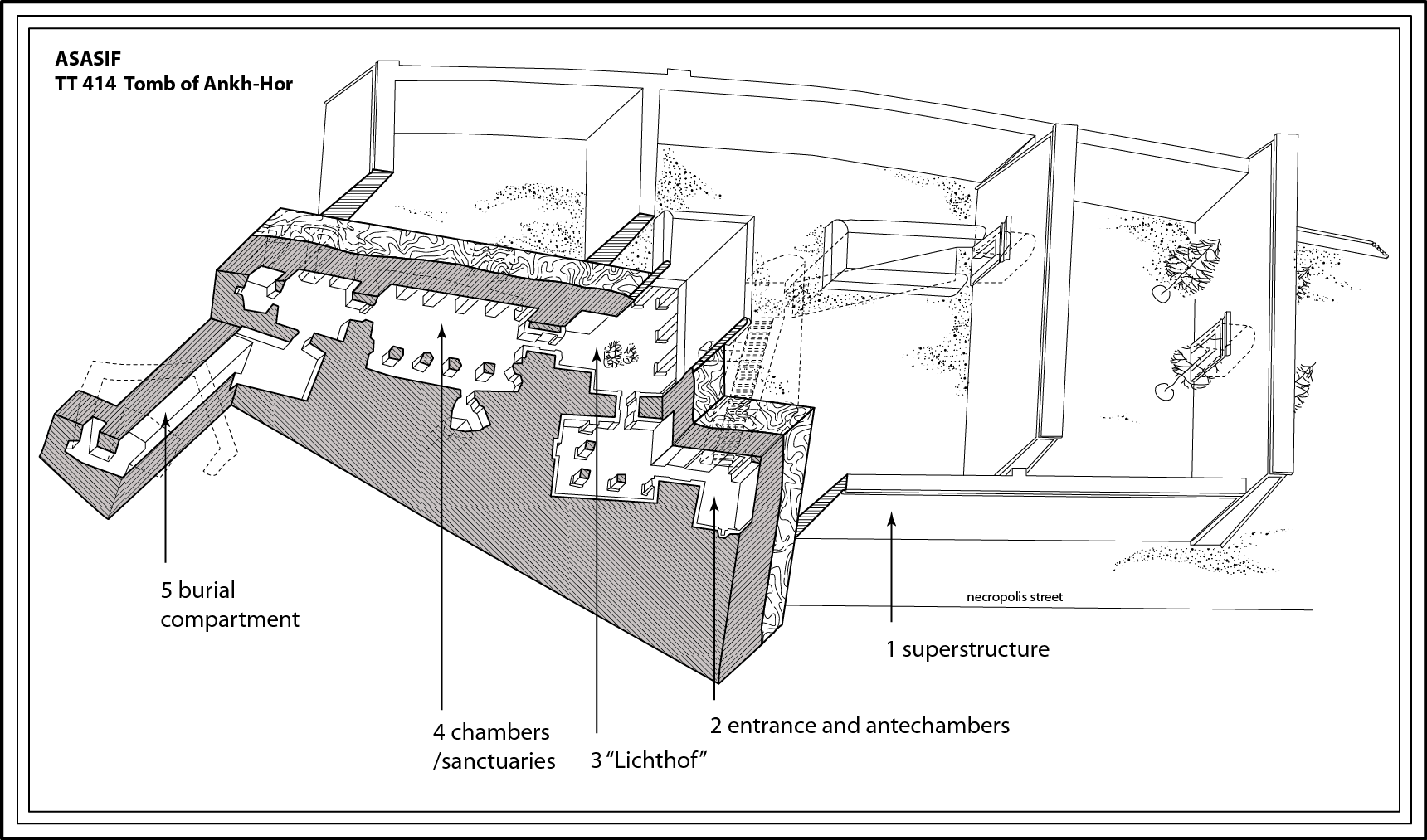
TT 414, the monumental tomb of Ankh-Hor, High Steward of the Divine Adoratrice Nitocris during the 26th Dynasty (6th century BCE), is one of the so-called temple tombs of the Late Period in Asasif with a temple-like superstructure and complex cultic rooms and halls.

Isometric plan TT 414

Within the current Ankh-Hor Project of LMU Munich we are focusing on the complete use-life of the tomb which lasted over centuries well into the Roman and Coptic periods. We also include the various ancient and more recent plundering phases of TT 414 which are well attested. One aspect is particularly noteworthy: TT 414 has the potential to serve as a case study to analyse various attitudes of later generations towards the original owners of Theban burial places. For example, several Late Period coffins had been found in the pillared hall of TT 414, thus not in their primary position within the burial chambers at the bottom of the various shafts, but within one of the cultic rooms or sanctuaries. In the entrance area to the pillared hall, a well preserved lower part of a coffin, Reg. No. 590, was discovered, seemingly out of place for a 26th Dynasty coffin.

Budka_Fig_7 neu

Location of Reg. No. 590 in Room 4 of TT 414 (after Budka 2010).

Already back in the 1970s, the excavators suspected that these coffins had just been re-used in the Ptolemaic period when people started to make use of the pillared hall as a burial place (in addition to the shafts). In 2009, I could confirm this by an exceptional in situ-find that came to light during the cleaning of the coffin Reg. No. 590 (Budka 2010): We discovered in the interior of this 26th Dynasty coffin for a man named Iret-her-rw, called Nes-ba-neb-djedet, an intact mummy label with a demotic docket (see Budka and Mekis 2017). This Ptolemaic mummy label identifies the mummy placed in this coffin as a man with the name Wah-ib-Re. Recently, I could trace together with my colleague Tamás Mekis a fragmentary cartonage in the Louvre (Louvre N 4603) which probably belongs to this person and must derive from TT 414 as well (Budka and Mekis 2017).

This allows tackling two important aspects:

1) The destroyed mummy placed in the coffin Reg. No. 590 illustrates the well-known fact that in the 19th century AD, Egyptian mummies were systematically damaged during the search for gilded parts, cartonages, amulets and other finds. Objects like the cartonage Louvre N 4603 came via antiquity dealers to large European museums. Like for Wah-ib-Re, it is therefore possible to find various objects from people buried in TT 414 in these museums (see, e.g. Budka, Mekis and Bruwier 2013).

2) The Ptolemaic mummy label found in the 26th Dynasty coffin in TT 414 attests to the re-use of wooden coffins from the original phase of use of monumental temple tombs like TT 414 some 300 years later. Whether this re-use had simply practical reasons and a financial motivation, or whether this recycling was also associated with a more complex set of meanings must remain open for now, providing a number of possible lines of further research.

IMG_3688

Final cleaning of Reg. No. 590 is well in progress.

I am personally very delighted that this not only beautifully painted, but also intriguing coffin, Reg. No. 590, which already has had such a multifaceted biography, now entered another aspect of its life history: it is getting a last cleaning and consolidation in order to be transported to the main magazine here on the West Bank as final resting place.


References

Budka, Julia 2010.  Varianz im Regelwerk. Bestattungsabläufe im Monumentalgrab von Anch-Hor, Obersthofmeister der Gottesgemahlin Nitokris (TT 414), Ägypten & Levante 20, 49–66.

Budka, Julia, Tamás Mekis and Marie-Cécile Bruwier 2013. Re-use of Saite temple tombs in the Asasif during the early Ptolemaic time – the tomb group of Mw.t-Mnw from TT 414, Ägypten & Levante 22/23, 2012/2013, 209–251.

Budka, Julia and Mekis, Tamás 2017. The Family of Wah-ib-Re I (TT 414) from Thebes, Ägypten & Levante 27, 219‒240.

Start of week 2 in Asasif

The second week of the 2019 season of the Ankh-Hor project started off very successful – first of all, our last recruitment arrived! Team member Hassan Ramadan finally came from Berlin last night, joined us this morning and immediately started with illustrating objects, today some nice Chiotic amphorae.

The other tasks also continued as planned – cleaning and consolidation of coffins from TT 414 as well as their photographic documentation. The current focus of conservation work is on a very interesting lower part of a wooden anthropoid coffin from the 26th Dynasty which was re-used in Ptolemaic times – I will explain more about this special piece here shortly.

Busy with documentation and conservation of finds from TT 414

Meanwhile, we finished our first full working day of the Ankh-Hor Project in 2019. All worked out perfectly, working spaces, tents and tables were set up and documentation and conservation commenced today.

The nice and very spacious tent allows our large team of conservators a comfortable shady working space protected from the wind. Cleaning and consolidating coffins from TT 414 started with important pieces dating to the 30th Dynasty, including one quite complete inner coffin which belonged to a lady with the name Asetemakhbjt.

Mona and Cajetan documented various objects today, including pottery and funerary cones as well as coffin fragments.

I myself started re-organising the magazine further, still hunting for joining pieces in our large jigsaw puzzle – and really found some already today: more pieces joining one of our Roman coffins, hurray.

All in all, the next weeks here in Asasif will be exciting and of course busy – the 2019 season of the Ankh-Hor Project really started off very promising!