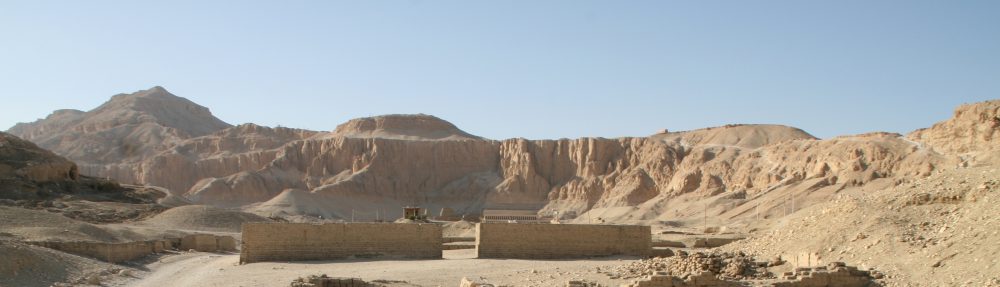
End of a long journey

Today was the day: after one of the main pieces of our 2024 season was successfully consolidated, documented in 3D and with infrared photos, the foot part of the outer coffin of Ankh-Hor could be transported to the magazine of the Westbank today. My thanks go to my team and especially to the local authorities. The coffin fragment, which was excavated in the 1970s, then published by Bietak and Reiser-Haslauer in 1982 and left on site in our tomb magazine, is now in the same place as the inner coffin of the owner of TT 414.

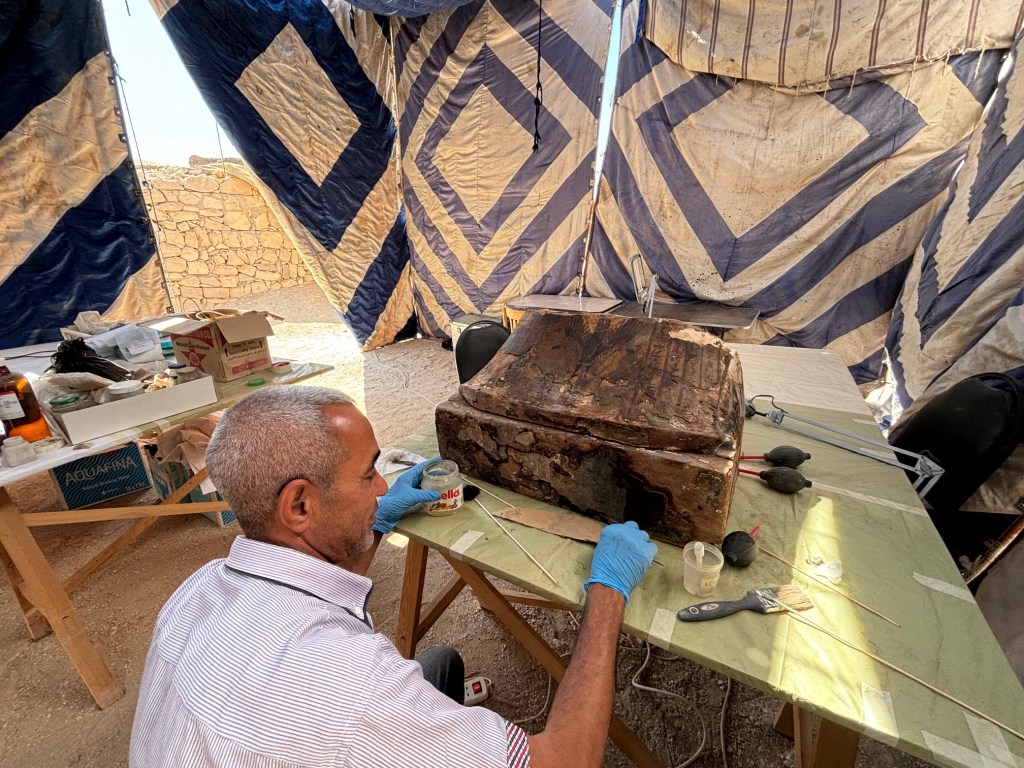
At the start of the season, it was still completely covered with dust and very fragile. Mohamed did a great job consolidating it!
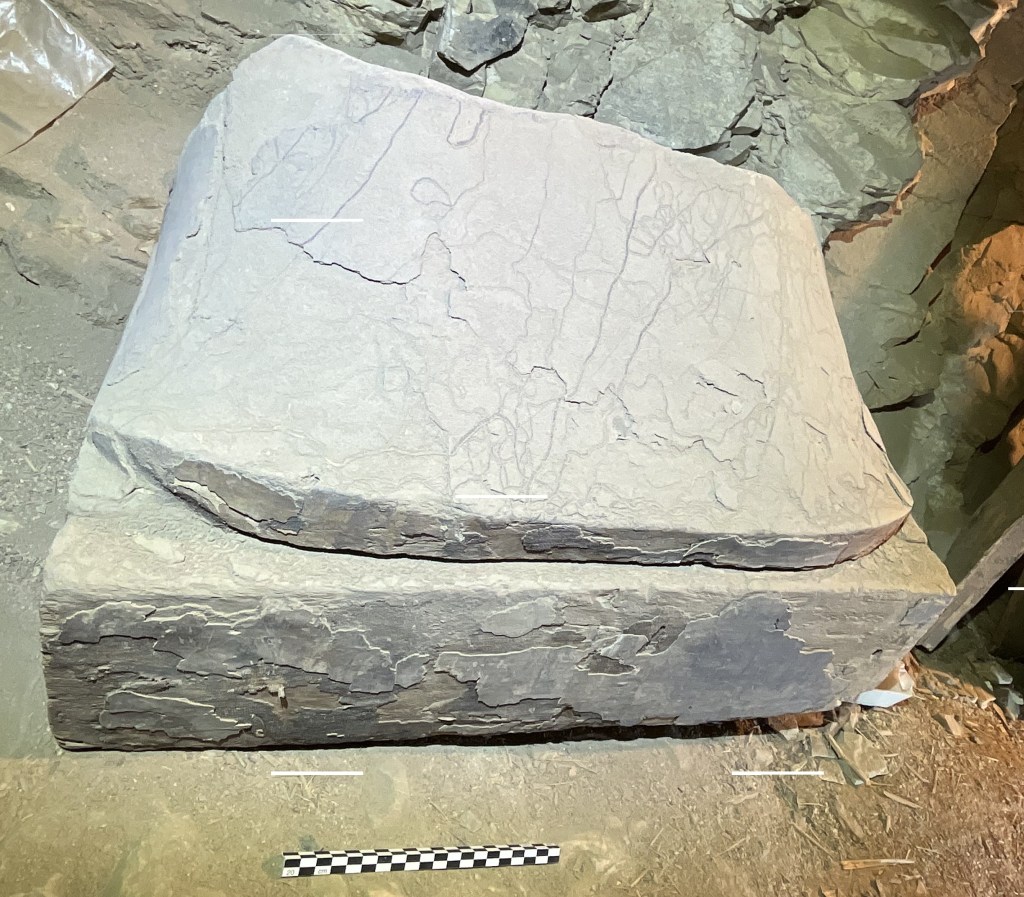
Reg. 697 at the start of our season, fully covered in dust.

Because very little of this once beautiful 26th Dynasty coffin has survived, I am very pleased that we now have a 3D model and full-format photos of the piece.

Video of the new 3D model of Reg. 697

Thanks to the infrared photos, some details can now be recognised even better than during the excavation in the 1970s. Just look at this beautiful, winged figure of the goddess Nut and all the details of her garment!

Some new details of Reg. 697 become visible thanks to infrared photos

Another small thing I noticed during the documentation: A text column on the right of the foot part also mentions Ankh-Hor’s mother, Shep-en-wen. However, the hieroglyphic spelling is very interesting – she uses as a personal classifier the same sign as her son, Gardiner sign A51 and not a more typical female hieroglyph.

Title and name of Ankh-Hor’s mother.

This markedly contrast to Reg. 868, a coffin fragment attributed to Ankh-Hor’s sister whose name is unknown. Here, for the name of Shep-en-wen a typical female classifier was used.

Coffin of Ankh-Hor’s sister with a different writing of the mother’s name.

The same person was therefore classified in very different ways, which also shows how complex the concept of identity was in Late Period Egypt and that the mother is probably meant here primarily in her relationship to the son, the owner of the tomb. This was then simply solved graphically with a close connection and the same hieroglyph. Whereas Reg 868 maybe shows her in relation to her daughter.

These interesting and playful variations show that language is always gendered in many different ways – no matter how controversial this may be today. The Egyptian hieroglyphic script writing with its pictorial aspects is of course a particularly good example here.
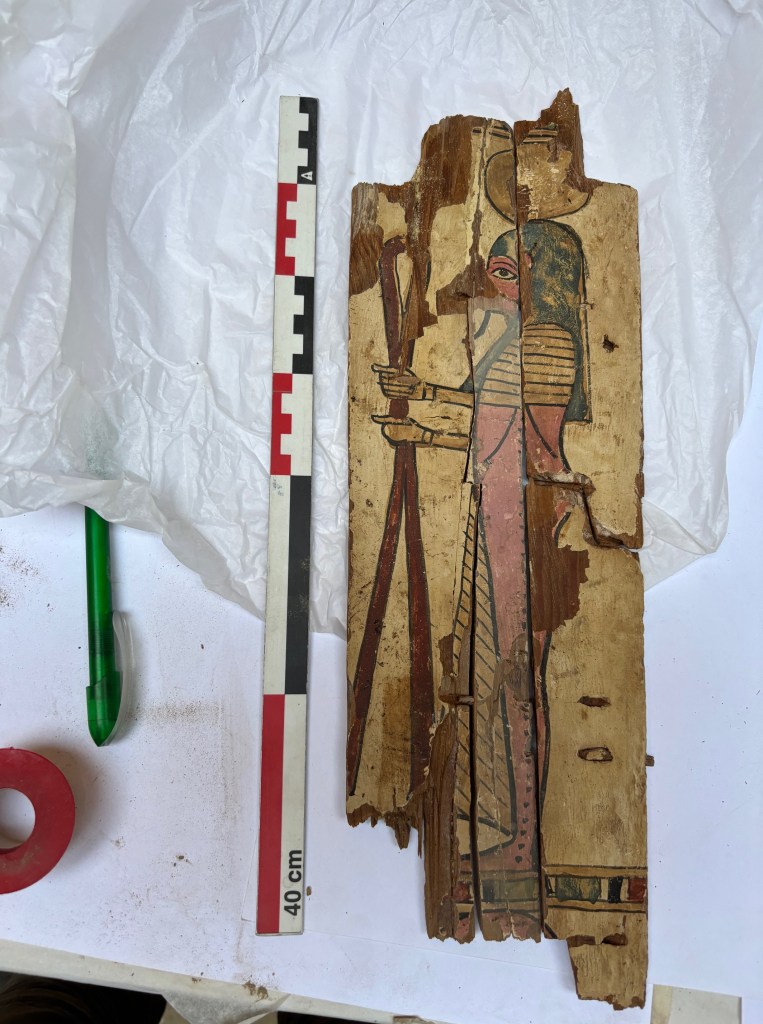
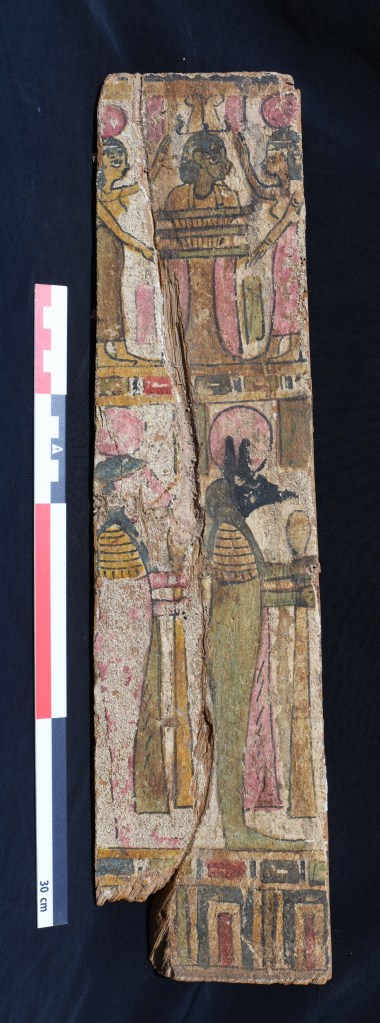
An update on work on painted wooden objects from TT 414

Week 4 of our 2024 season has just ended and in the meantime we have made much progress in documenting, consolidating, drawing and photographing wooden objects from the tomb of Ankh-Hor (TT 414). Ladina and Hassan did a great job documenting the last 30th Dynasty/early Ptolemaic coffins from TT 414 which have never been recorded before. This means that all the pieces from the tomb are now at least provisionally numbered and photographically documented. However, the search for joining pieces continues, I was also very successful here this week.

Here are two examples: The painted wooden coffin Reg. 830 is very fragmented; I managed to relocate most pieces and Karima and Mohamed, our conservators cleaned them. However, yesterday I found another piece that we could fit in.

The time-consuming search through all the boxes is still worthwhile: the newly found fragment is the second from the right, recognisable by its dusty surface.

Already in 2023, I documented one fragment of the side of a canopic box, K07/298. In our week 1 of this season, I was very happy to find a joining piece on the left side, at the bottom. However, only this week I relocated the missing corner piece above. All 3 fragments are now joined and fully cleaned and consolidated.

Last year, only the right fragmented was documented; both fragments to the left are new pieces found in different boxes this year

Another task was scanning objects in 3D. Hassan was very busy, with the help of Islam, documenting corner posts of a canopic box. A very challenging piece which required various set-ups!

Hassan and Islam scanning one of the corner posts.
Me scanning a Ptolemaic coffin fragment.

I have continued to document coffins, including quick 3D scans to document my new joints of Ptolemaic coffins.

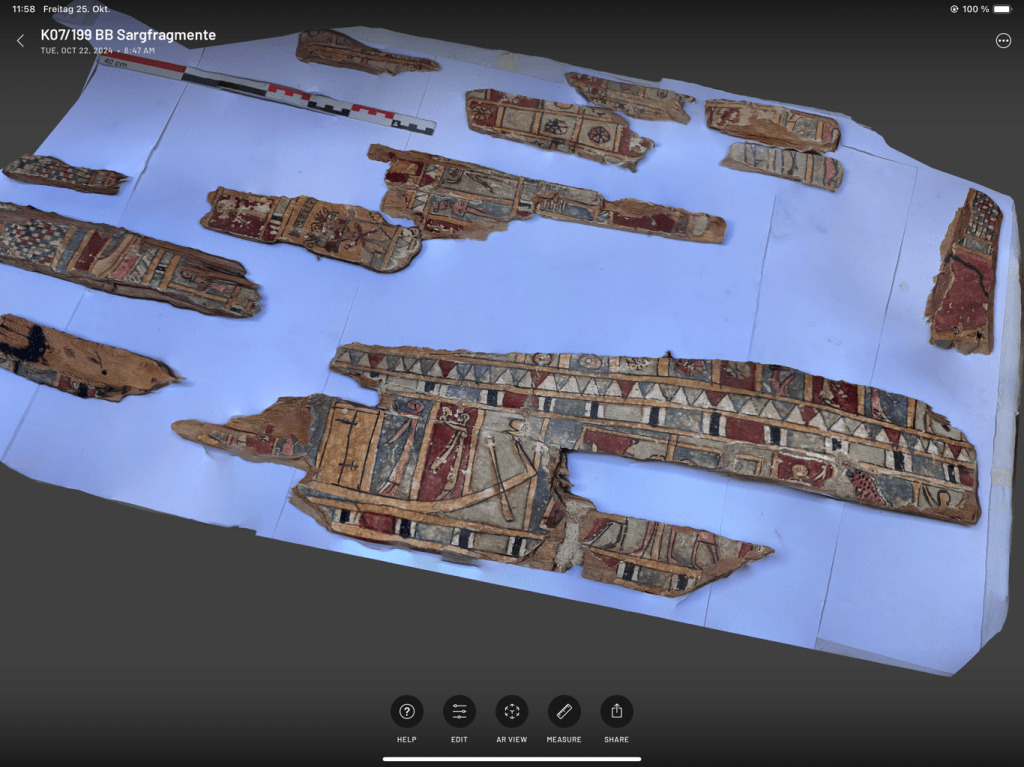
Screenshot of a quick 3D scan of newly assembled coffin fragments from various boxes.

This is a nice example – a new assemblage of a coffin lid, very fragmented but reassembled from various provisional numbers – these had been scattered in several boxes and I remain optimistic that I will find more pieces.

Week 5 awaits us and there is still a lot to do.

Work progress on the coffins of TT 414

Week 3 has just started and Ladina and Hassan are busy with documenting 30th Dynasty/early Ptolemaic coffins from the tomb of Ankh-Hor (TT 414), while Karima and Mohamed continue with some later Ptolemaic painted fragments.

Ashraf, Hassan and Ladina are busy sorting, cleaning and documenting coffin fragments.

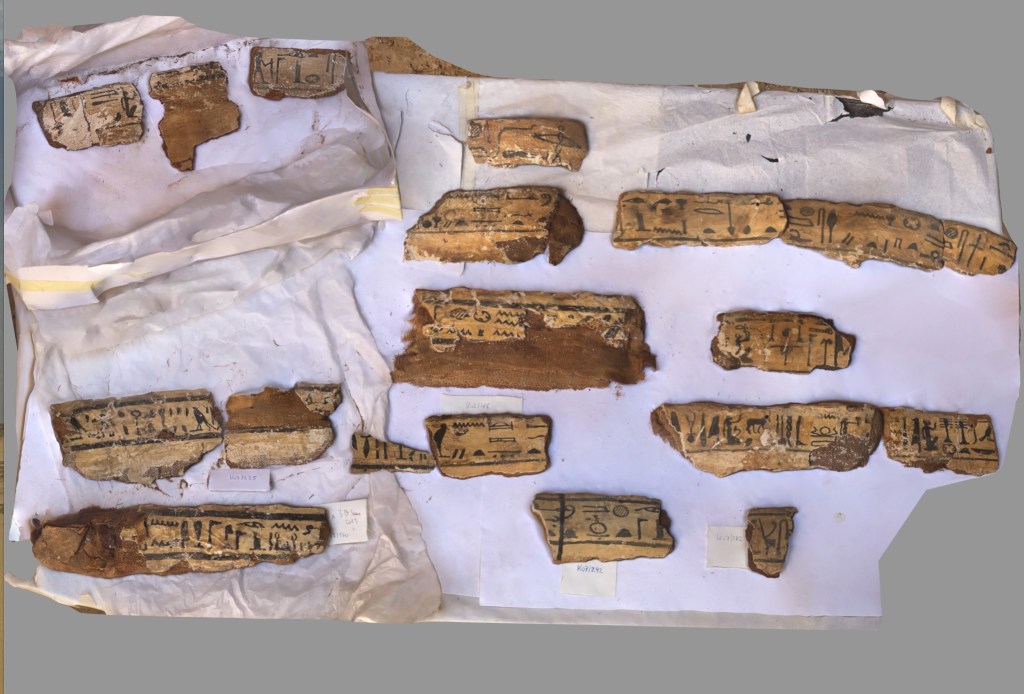
Week 2 brought a lot of progress; I was able to make numerous joints of small fragments to known, registered pieces. My focus was on Ptolemaic coffins around the family of Wesjr-wer – and here, in addition to the painted wooden coffins, also on the cartonnage coffins. A real challenge are both wooden and cartonnage coffins, where the text fields have unfortunately remained empty, so we have no information about the owners.

The white painted with black text outer surfaces of the lower parts of bivalve cartonnage coffins are still a big puzzle – but I have already found many joints!

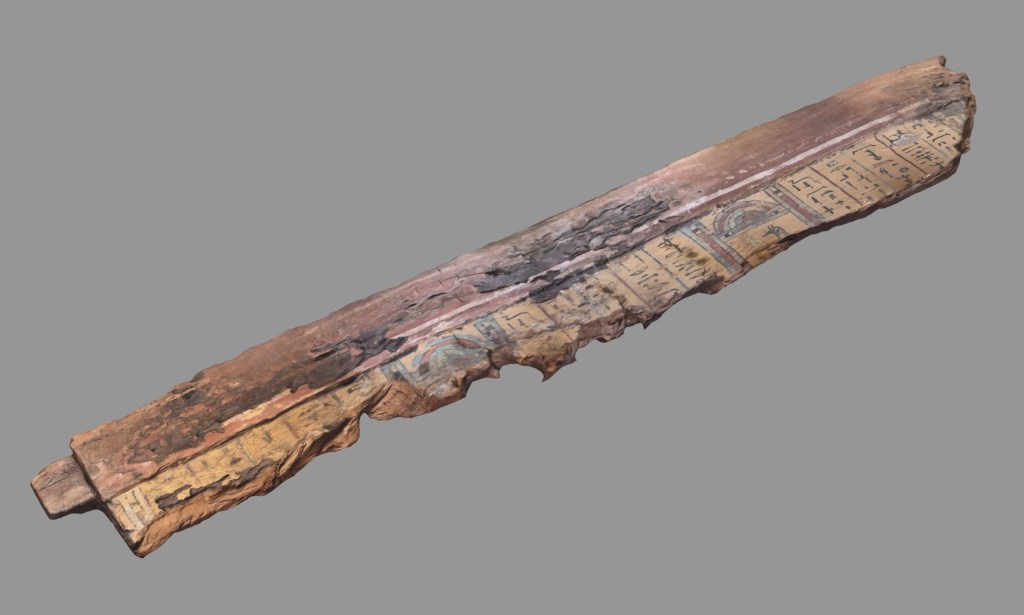
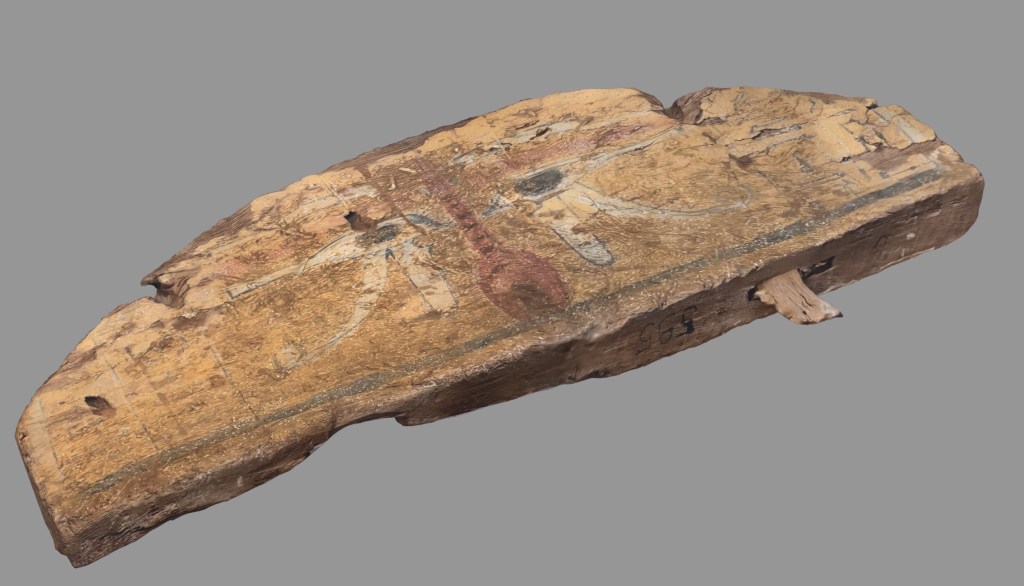
As a special highlight, I also documented the qrsw coffin of one of Ankh-Hor’s relatives, Psametik-men-em-Waset, Reg. 595, in 3D. The piece of which several boards and the front side are preserved had already been documented with our full-frame camera in 2018, but I wanted to take full advantage of the new possibilities offered by the rapid development of video-based photogrammetry with LiDAR sensors on mobile devices and the Scaniverse app developed by Toolbox AI. The scans also allow us to highlight technological features and details of the wood structure.

Screenshot of 3D scan of one of the lateral sides of Reg. 595 which shows nicely the damages of the wood and painted surface.
Sceenshot of the 3D scan of the front side of the vaulted lid of the qrsw coffin Reg. 595.

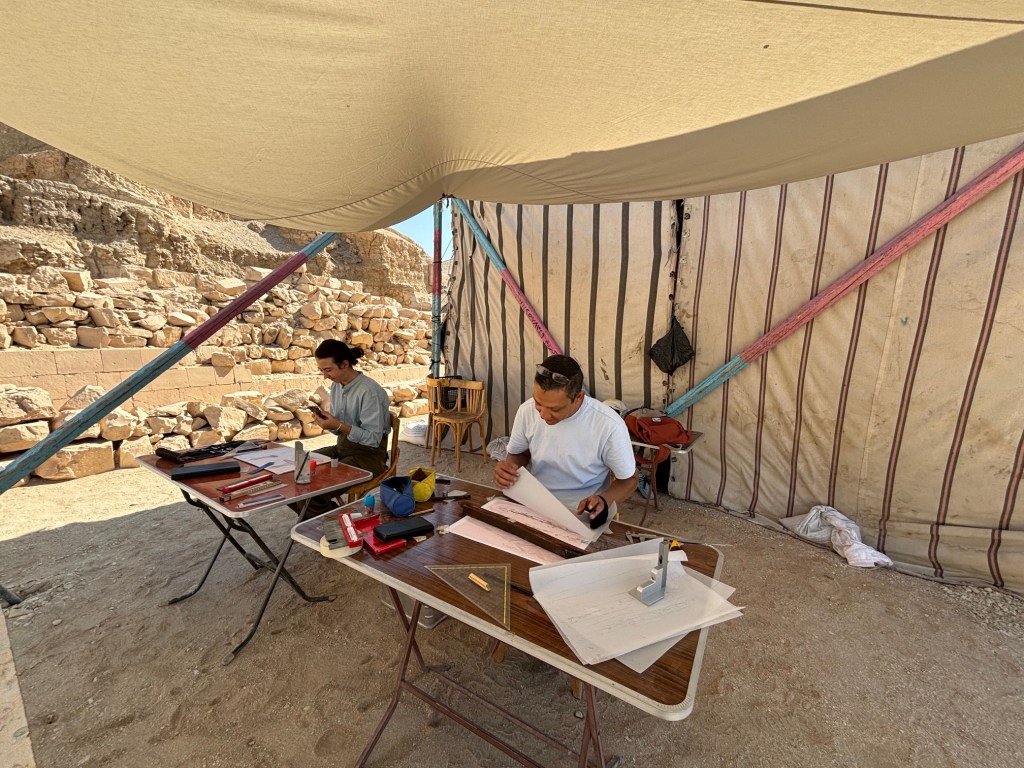
Last but not least, Hassan and Ladina made detailed drawings of fragments of canopic boxes from TT 414. These drawings will be used in the final publication and perfectly complement our photographic documentation and the 3D scans.

Technical drawings remain necessary for some selected wooden pieces from TT 414.

All in all, our 2024 season continues to be very productive, and I am grateful to all team members for their commitment and enthusiasm. There are some really great objects we are working on and there are still a lot of them waiting for us in the coming weeks!

Wife or Granddaughter? Who was T3-khj-bj3t?

Among the mass of coffin fragments from TT 414, the tomb of Ankh-Hor, one stands out in particular: a coffin of a woman with both demotic and hieroglyphic inscriptions.

Reg. 770 was published by one of the experts on Demotic, Jan Quaegebeur in Anch-Hor II. He focused on the front board of the foot section, which shows the demotic inscription. However, the board of the corresponding coffin lid – with a vertical hieroglyphic inscription line – was not published as a drawing or photo.

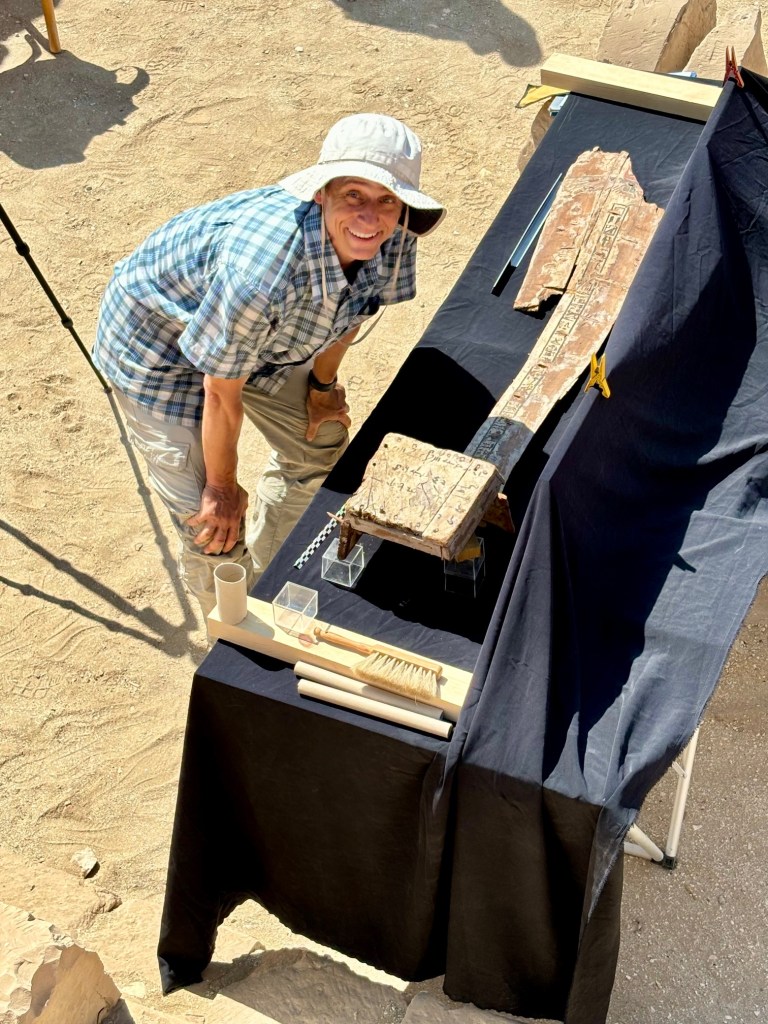
This season, our conservator Mohamed cleaned and fixed the very fragile lid fragment and I could document it together with the foot part. Our aim is to present this unique piece in the planned publication of all coffins from TT 414.

Happy moment – joining the footpart of Reg. 770 with the lid fragment (photo: L. Soubeyrand).

The coffin owner is a woman with the typical Theban name T3-khj-bj3t, daughter of Wesjr-wer/Osoroeris and T3-njt-Khonsw/Tachonsis. This filiation is given in the demotic text, translated by Quaegebeur (1982, 259) as follows:

May your Ba live in eternity and forever: T3-khj-bj3t daughter of Osoroeris born of Tachonsis”.

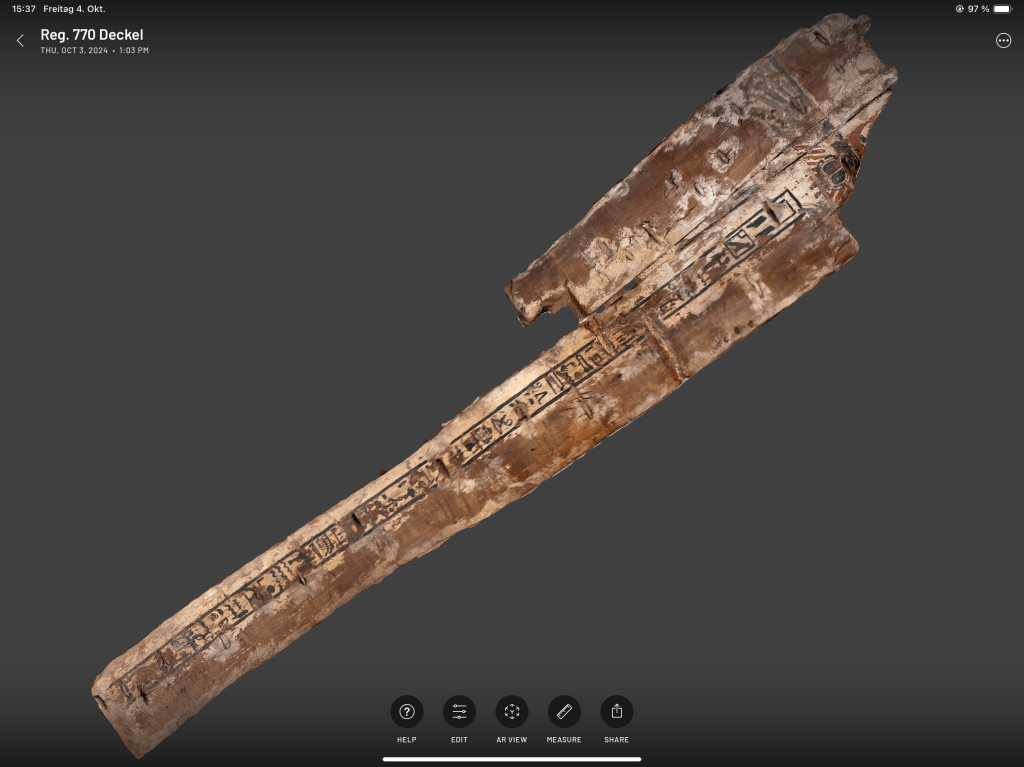
Screenshot of the new 3D model of the lid fragment of Reg. 770 with the hieroglyphic inscription.

The vertical text on the lid only mentions the mother’s name, not the father’s.

T3-khj-bj3t belongs to a Ptolemaic family attested by several wooden painted coffins from TT 414, especially Reg. 800 and Reg. 828 with hieroglyphic texts. However, there is one problem: we do not know whether our coffin owner of Reg. 770 was the wife or the granddaughter of the owner of Reg. 800, Wesjr-wer. It is possible that a woman named Ta-Khonsu, daughter of T3-khj-bj3t, named her own daughter after her mother. Quaegebeur has also expressed the opinion that the ‘granddaughter’ scenario is perhaps more likely than that of the wife, since Reg. 770, unlike Reg. 800 (and Reg. 828), also bears a demotic inscription in addition to the hieroglyphic one and might thus be of later date.

Well – as I will also be working on Reg. 800 this season, perhaps a solution will emerge. I am also very much hoping for additional information based on cartonage coffins that have not yet been included in the scenario, but which are attested for several members of this family.

Whether wife or granddaughter – the coffin Reg. 770 still raises exciting questions today and I am very pleased that we have now documented it in the best possible way. A more precise dating will hopefully be possible soon.

Reference

Quaegebeur 1982 = Jan Quaegebeur, VIII. Demotic Inscriptions on Wood from the Tomb of Anch-Hor, in: M. Bietak/E. Reiser-Haslauer, Das Grab des Anch-Hor II, Vienna 1982, 259-266.

Short summary of week 1, 2024 season

One week has already passed since we opened our season for the LMU Ankh-Hor project.

Our beautiful large tent is the centre of our conservation programme, which will focus on Ptolemaic wooden coffins and cartonnages, but will also include other painted objects from the tomb of Ankh-Hor, TT 414. One of our conservators, Mohamed Mahmoud , has already successfully cleaned and stabilised the very fragile foot part of Ankh-Hor’s outer coffin.

This piece has already been published in the Anch-Hor II Volume, but is nevertheless one of the historically very important pieces, as it is direct evidence for the tomb owner of TT 414 and thus one of the well-dated wooden coffins of the 26th Dynasty in Thebes. I am very pleased that this very delicate and important piece has finally been consolidated.

In addition to conservation, we are mainly working on finding joining pieces for objects, which I have already done very well this week with cartonnages. We produce full-format photos, infrared photos and 3D scans for documentation purposes. Ladina Soubeyrand and Hassan Aglan also make publishable drawings of important pieces. This week they have been working mainly on Ptah-Sokar-Osiris statuettes and qrsw coffins. And they do a really good job!

All in all, it was a very successful start to the 2024 season – we still have a lot to do in the next four weeks, but some of the really nice objects with high information content about the Late Egyptian funerary culture in Thebes make the whole thing a great pleasure.