We successfully closed our 2022 season yesterday – Patrizia and Hassan are already on their way back to Germany, I will spend some more days here in Luxor, continuing my work for the South Asasif Conservation Project.
I am also busy with writing up the report of this fruitful season of the Ankh-Hor Project – so much work was done, almost 150 drawings of small finds were accomplished, dozens of objects were recorded for the first time, several new matching pieces were found to coffins, a large number of wooden objects was cleaned and hundreds of photographs taken. All this rich documentation will require post-season processing back home and I will also summarise the most important results in an upcoming blog post.
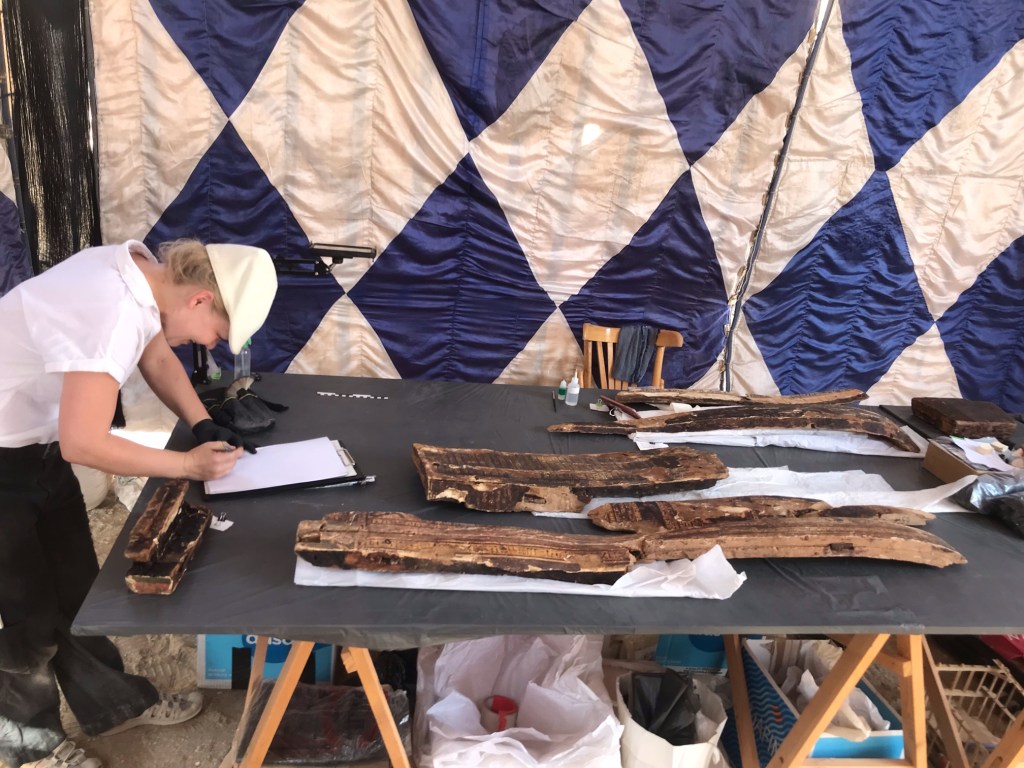
The last few days have proven it again – everything we have achieved here in 2022 has been great teamwork. Everyone thought along and not only did their job well, but also helped others like Patrizia and Hassan here with taking photos of reconstructed coffins (photo by H. Aglan).
I am very grateful to the entire team of the 2022 season and would like to say a special thank you to our inspector Saad and the Egyptian conservator Noura – it was a pleasure and an honour! To be continued, we’ll be back next year.
It is well known that Ptolemaic mummies were typically equipped with trappings made of cartonnage. The most common cartonnage elements are a helmet-style funerary mask, a foot case and several panels along the body. Such elements are commonly displayed in museums and collections worldwide (and frequently found as objects sold on the art market). Several aspects like the manufacture process or stylistic features of such cartonnages have already been discussed by scholars, with a clear focus on funerary masks in Ptolemaic times (see e.g. Stadler 2004, Vandenbeusch et al. 2021).
In Theban funerary archaeology, little research has been done on Ptolemaic cartonnages. Such elements are mentioned frequently in excavation reports, but a concise assessment, including a study of the diachronic development in Ptolemaic times, still needs to be undertaken. Seminal, but only preliminary work was conducted by the late Gabor Schreiber (Schreiber 2006).
The rich corpus of cartonnage elements from TT 414 was also neglected and remains to be studied in detail and of course published. This material from the tomb of Ankh-Hor covers a long and intriguing period. Cartonnage trappings are already known from the in situ burial of Wahibre I (Bietak and Reiser-Haslauer 1982) and thus seem to start in the 30th Dynasty with a peak in early Ptolemaic times. In mid- to late Ptolemaic times cartonnage coffins replacing wooden coffins are attested from TT 414, allowing to compare the iconography of wooden coffins with that of cartonnage pieces.
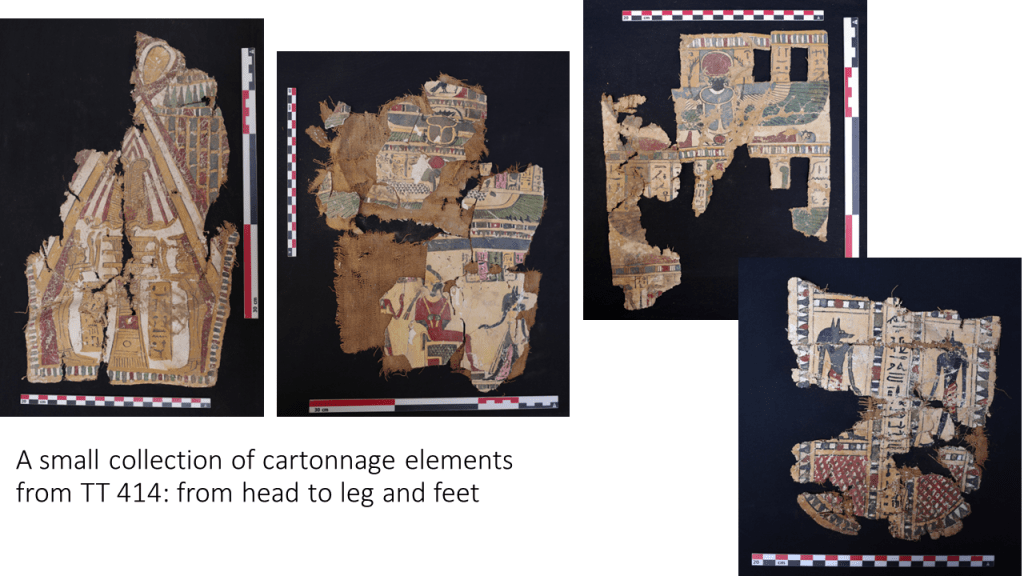
During the current 2022 season of the LMU Ankh-Hor project, I managed to get a good overview of all the cartonnage elements from TT 414. It became obvious that there are many matching pieces throughout several boxes – it is a large jigsaw-puzzle very much comparable to the wooden coffin fragments. Many cartonnage elements belong to funerary masks, but also foot cases and trappings placed on the mummified body are well attested. Among my favourite elements are pectorals in the shape of broad collars. These usually show alternating dotted and floral motifs and include the representation of a winged scarab and falcon heads on the sides. Representations of the goddess Nut spreading her wings are also attested – thus a range of motifs also known from various types of coffins. In line with this, many of the cartonnage elements are decorated on both sides. Some cartonnage trappings also show actual scenes like the deceased being led by Anubis to Osiris (Fig. 1).
Fig. 1: examples for the high quality but fragmentation of the cartonnage elements from TT 414.
In addition to the stylistic assessment of the cartonnages from TT 414, much progress was done this season in identifying the owners of these trappings. Thanks to infrared photography, some names and titles became readable and allow to attribute cartonnage elements to Ptolemaic individuals already known from other objects.
One of my personal highlights is the identification of a new cartonnage element for Mr. Twt – an individual otherwise only attested by his outer anthropoid coffin in yellow-red on black-style (Fig. 2). Already in 2019, I was convinced that there must be other objects belonging to Twt – well, here we are, three years later with new evidence of cartonnage trappings.
Fig. 2: We can now assign cartonnage trappings to Twt, owner of coffin Reg. No. 510. This also offers us the possibility to compare the motifs and styles on coffins and cartonnages.
These are just the first tentative steps into a very promising fields! Updates will follow, work continues!
References
Bietak, Manfred and Elfriede Reiser-Haslauer 1982. Das Grab des ‘Anch-Hor vol. II. Wien: Verlag der Österreichischen Akademie der Wissenschaften.
Schreiber, Gábor 2006. Ptolemaic cartonnages from Thebes. In Győry, Hedvig (ed.), Aegyptus et Pannonia III: Acta symposii anno 2004, 227-246. Budapest: MEBT-ÓEB.
Stadler, Martin Andreas 2004. Ägyptische Mumienmasken in Würzburg (Schenkung Gütte). Wiesbaden: Reicher.
Vandenbeusch, Marie, Daniel O’Flynn, and Benjamin Moreno 2021. Layer by layer: the manufacture of Graeco-Roman funerary masks. Journal of Egyptian Archaeology 107 (1-2), 281-298.
We have just completed week 3 of our field season 2022. We managed to make good progress on many of our work tasks. I had to go back to Germany for other important tasks, but thanks to Patrizia, Hassan and Ashraf as well as the support from the local authorities, the remote supervision from Munich is really easy.
Most importantly, Patrizia arrived last weekend and started her work in week 3 which focuses this year on drawing special objects like stamped bricks and unclear painted mud fragments.
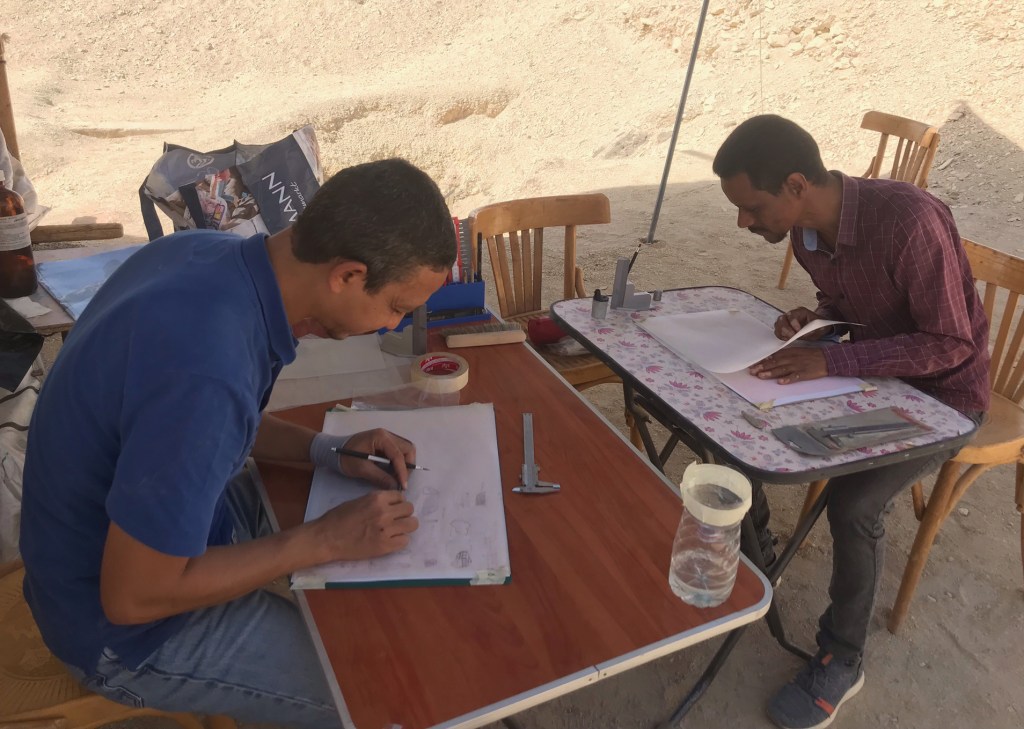
Patrizia and Hassan busy drawing various kinds of small finds.
Strengthened by Hassan Ramadan and our inspector Saad Knawy, the drawing team of this season is extremely effective and covers all categories of small finds – from ceramics to mud shabtis, faience shabtis, wooden statues and boxes as well as a few selected coffin fragments.
Our inspector Saad is making great progress in drawing small finds (photo: P. Heindl).
The conservation team continued its work – Antje Zygalski focused on the reconstruction of a Middle Kingdom rectangular coffin which was found in one of the shaft tombs in the Austrian concession while Noura was busy cleaning Ptolemaic coffin fragments from TT 414.
Antje working on the Middle Kingdom coffin (photo: P. Heindl).
I managed to complete the documentation of the most important boxes with cartonnage fragments – there are already some exciting new data gained from this which I will share in a separate blog post. Much progress was also made in documenting Ptolemaic wooden coffins by photography. It was already highlighted that one of my most favourite coffins from TT 414, Reg. No. 657, is adding fresh ideas about the tomb group of Isetemkheb and the family of Wahibre I.
The conservation, cleaning, photography and drawing of the rich material from the tomb of Ankh-Hor in the 2022 season has already provided very interesting results – and we have two more weeks to go, so stay tuned for more exciting news!
One of the main aims of the current Ankh-Hor Project is to reconstruct the original tomb groups of the persons buried in TT 414. Much progress was made in the 2022 season already, and the last days were extremely productive in this respect.
Our conservator Antje Zygalski finished the consolidation of a beautiful painted wooden inner anthropoid coffin (Reg. No. 657), the sistrum player of Amun, Isetemkheb. I managed to identify new joints to the previously registered pieces and together with new infrared photos (Fig. 1), we have now a rich data set for a detailed study of this fragmented coffin.
Fig. 1: Example of details from the fragmented coffin lid Reg. No. 657, now visible thanks to infrared photos.
The lady Isetemkheb was labelled as G10 by Elfriede Reiser-Haslauer in the genealogical register (Reiser-Haslauer 1982, 268). Thanks to the names of her parents, several objects can be attributed to her:
A beautiful and unusual Ptah-Sokar-Osiris statue – its pedestal is Reg. No. 695 and still here in Egypt, the statue was in Paris (Louvre N 670) and is now in Warsaw Inv.No. 143346 (Lipinska 2008)
A colourful painted canopic box in London (BM EA 8532, see Budka, Mekis & Bruwier 2013)
A gilded hypocephalus in Paris (Louvre N 3524, Mekis 2020, No. 1, 148-149)
A Book of the Dead papyus in Turin (cat.no. 1793, TM 57048)
Together with the inner coffin, this makes a substantial tomb group which finds close parallels with other 30th Dynasty/early Ptolemaic burial assemblages from the tomb of Ankh-Hor (Budka, Mekis & Bruwier 2013). The fact that her objects are distributed throughout European museums is also something we already know very well from other tombs groups from TT 414.
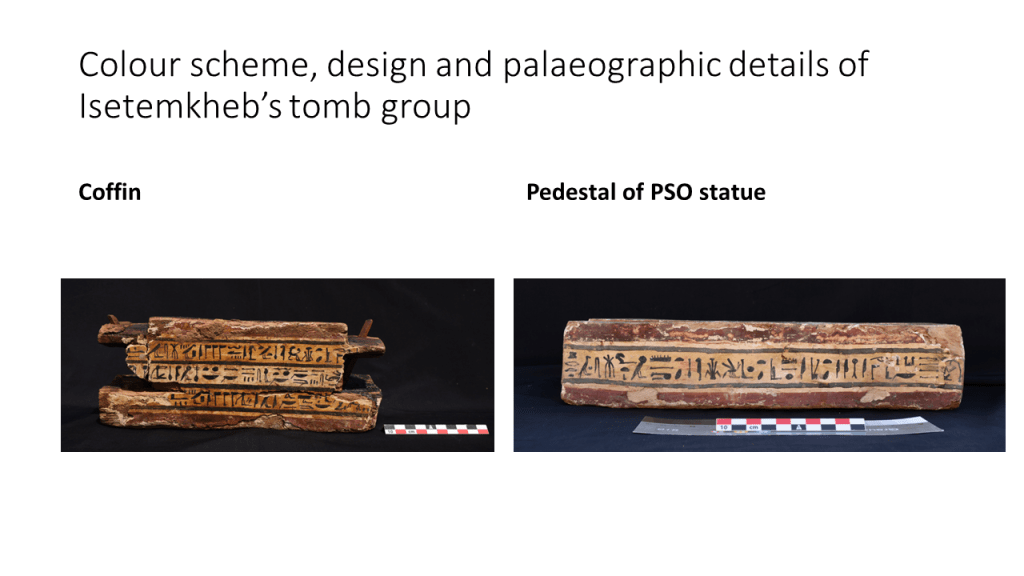
What I find especially remarkable are close parallels between the inner coffin, in particular the front panel of the foot part of the lid, and the pedestal of the Ptah-Sokar-Osiris statue (Fig. 2). This allows us to speculate that both objects were produced in the same workshop.
Fig. 2: A comparision between the foot part of the lid of the coffin of Isetemkheb and one side of her pedestal for the Ptah-Sokar-Osiris statue now in Warsaw.
The inner anthropoid coffin of Isetemkheb is in many respects remarkable – although the bier scene with the mummy is only partly preserved, it is very likely that we have another so-called Lamentation coffin (see Kucharek and Coenen 2021). Directly next to the bier on its left side, part of the speech of Isis is preserved, the typical phrase come to your house, “mj r pr=k”.
Coffin Reg. No. 657 is one of the eleven colourful painted coffins found in the debris in the burial chamber of Ankh-Hor. Here, a group of six female inner anthropoid coffins is especially noteworthy (Reg. Nos. 656, 657, 658, 659, 661 and 696). According to its design and colour scheme as well as the execution of its hieroglyphs, the coffin of Isetemkheb is very similar to the Reg. Nos. 656 and 658 as well as Reg. No. 655 of a male owner. These parallels seem relevant for dating the coffin as I will outline below.
After all these general comments on her tomb group, there is of course one essential question: who was this sistrum player Isetemkheb? This remained unclear for many years, no relatives other than her parents were known and her connection to the priestly family using TT 414 in early Ptolemaic times was mysterious. Back in 2017, Tamás Mekis and I proposed to identify her as the previously unknown wife of Wah-ib-Re I, the famous owner of the in situ burial in Room 10 of TT 414 (Budka and Mekis 2017). Tamás included an updated family tree of her and her husband in his PhD thesis, making it clear that Isetemkheb G11 of Elfriede Reiser-Haslauer is identical with our Isetemkheb G10 (Mekis 2020, 150). We can now reconstruct three of her sons and several descendants of these.
Although I still believe that this identification of Isetemkheb as the wife of Wah-ib-Re I is correct and built on strong evidence, a new look on her coffin raises several questions. This coffin is completely different from the coffin assemblage of her husband; rather, it finds a particular close parallel in the inner coffin of one of the nephews of her husband, Padias, Reg. No. 655 (Fig. 3). Could this imply that she survived Wah-ib-Re I for almost one generation? Could this maybe also explain why she was not buried in the same compartment?
Fig. 3: Comparison of the shoulder part of the lid of Isetemkheb with the one of Padias.
All in all, some of these questions might remain impossible to answer – but our new reassessment of the finds from TT 414 allows us to address them and to think further about the complexity of the reuse of the tomb of Ankh-Hor by the large Padiamunnebnesuttaui family.
References
Budka and Mekis 2017 = J. Budka and T. Mekis, The Family of Wah-ib-re I (TT 414) from Thebes, Ä&L 27 (2017), 219–239.
Budka, Mekis and Bruwier 2013 = J. Budka, T. Mekis and M.-C. Bruwier, Reuse of Saite temple tombs in the Assasif during the early Ptolemaic Time, Ä&L 22/23 (2013), 209–251.
Kucharek and Coenen 2021 = A. Kucharek and M. Coenen 2021. The Lamentations of Isis and Nephthys. Fragmentary Osirian papyri, Part I (The Carlsberg Papyri 16, CNI Publications 46). Copenhagen: Museum Tusculanum Press 2021.
Lipinska 2008 = J. Lipinska, An Unusual Wooden Statuette of Osiris, in S.H. D’Auria (ed.) Servant of Mut. Studies in Honor of Richard A. Fazzini (Probleme der Ägyptologie 28): 166–169. Leiden/Boston: Brill 2008.
Mekis 2020 = T. Mekis, The hypocephalus: an ancient Egyptian funerary amulet. Archaeopress Egyptology 25. Oxford: Archaeopress 2020.
Reiser-Haslauer 1982 = E. Reiser-Haslauer, IX. Genealogisches Register, 267–284, in: M. Bietak and E. Reiser-Haslauer, Das Grab des Anch-Hor, Obersthofmeister der Gottesgemahlin Nitokris, Band II. Mit Beiträgen von Joachim Boessneck, Angela von den Driesch, Jan Quaegebeur, Helga Liese-Kleiber und Helmut Schlichtherle und Relief- und Fundzeichnungen von Heinz Satzinger, UZK 5, Vienna 1982.
It is always a miracle that the time on an excavation goes by even faster than at home. Week 2 of our field season 2022 just ended and was very successful in many respects.
Most importantly, the new conservator of the project has arrived and joined the team this week. Antje Zygalski is a researching conservator for archaeological wooden objects (furniture, sculptures, panel paintings etc.) and a preventive conservator for archaeological and historical objects. She has started her work and is now very productive cleaning and consolidating coffin fragments from TT 414.
Antje busy documenting already cleaned pieces from a Ptolemaic wooden painted coffin.
We also have an Egyptian conservator, Noura, as a new team member who is helping us with the cleaning of the large number of objects (I need to take a working pic of her next week 😉).
Hassan Ramadan continued the documentation of various small finds by drawing in week 2. He also introduced our inspector Saad Knawy to the archaeological illustration of objects – Saad got an intense training with Late Period clay shabtis and is already making great progress.
Hassan and Saad produced a considerable amount of drawings of objects in week 2.
From now until the end of the season, Hassan will focus mostly on wooden objects like shrines and pedestals for stelae – he has already much experience with this kind of material from TT 414.
Fragmented shrines and other wooden objects are documented in detail by Hassan.
I started the week with finding more fitting pieces of coffins as well as identifying unnumbered ones and photographing these. I then proceeded to study and document fragmented Ptolemaic cartonnages. There are many boxes with small and sometimes larger pieces for which the challenge is to identify related pieces originally belonging to the same cartonnage element. Many of the pieces represent funerary masks of a well-known Theban Ptolemaic type. Larger fragments covering the body of the mummy are often decorated on both sides, with very interesting designs of the sky and deities on the interior.
The typical content of one of the dozens of boxes of cartonnage elements – here, there are mostly fragments from Ptolmaic funerary masks.
Infrared photography works perfect for pieces of cartonnage with darkened surfaces and I could identify some names and titles using this method. This allows me to attribute cartonnage elements to persons buried in TT 414 who are already known from their wooden coffins. In the 1970s, the fragmented cartonnage pieces could not be studied because of time restrictions – therefore this new study is of key importance to reconstruct the former burial assemblages. Apart from this great advancement in attributing cartonnage elements to Ptolemaic individuals using the tomb of Ankh-Hor as a burial place, the stylistic assessment, and the comparison of the design of cartonnages with the one of coffins is extremely promising and will take more time and a detailed study.
For now, we are very much looking forward to week 3 of our 2022 season! Conservation, cleaning, photography, study and drawing of the rich material from the tomb of Ankh-Hor will of course continue.







 The Ankh-Hor Project