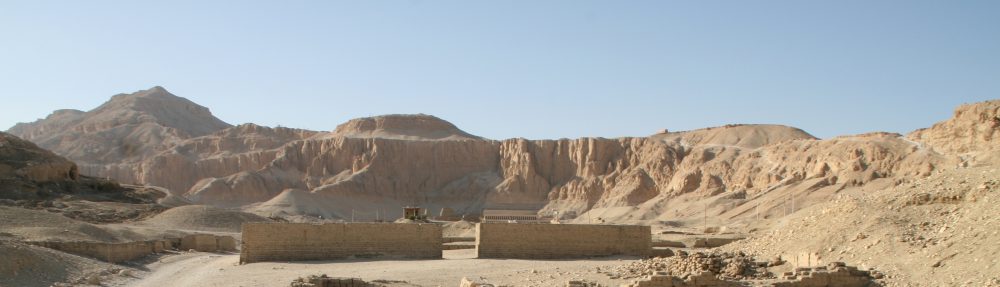
Our 2022 season was opened on Tuesday and thus we only have worked three days in the magazine in the Asasif. We cleaned all the area and our workplaces were set up including new tents. Hassan Ramadan is already busy with drawing small finds – jar stoppers, clay figurines, shabtis and wooden objects are waiting for him this season.

I was organising coffin fragments according to priorities for the conservation programme which will start next week. While sorting the material, I took a considerable number of infrared photos – this method allowed us already last year to identify several pieces because the decoration and the texts becomes much clearer and nicely readable. Amazingly, already on the first day I could identify three coffins by means of such photos!
In total, I could detect seven previously unidentified fragments as belonging to registered coffins in just two days. In addition to this great progress, the reading of the text and decoration also adds new information to several pieces.
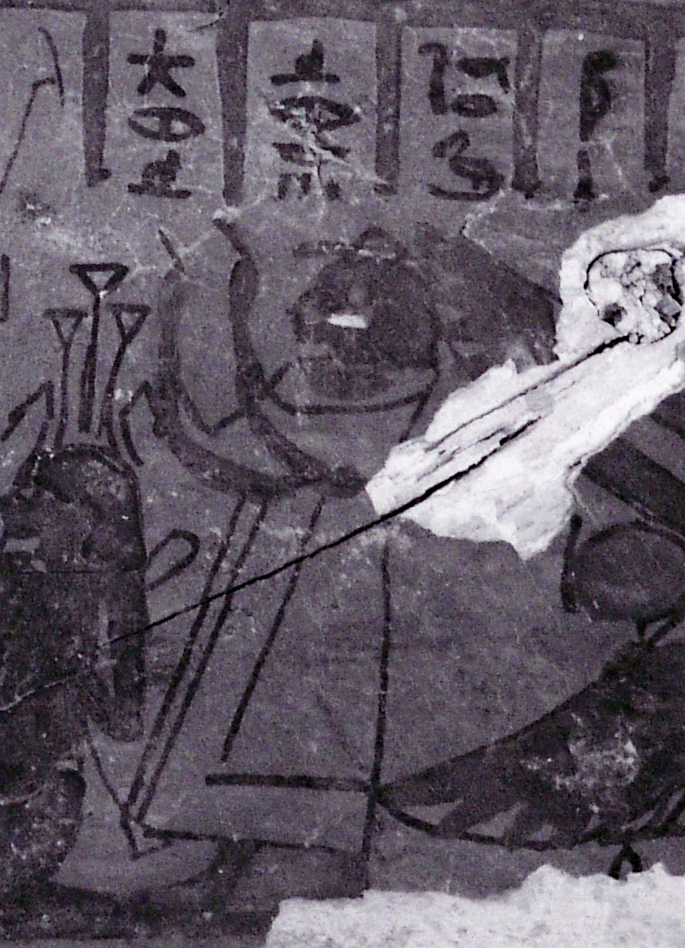
The best example here is Reg. No. 689, found in the debris in the burial chamber of Ankh-Hor. It is the front part of a pedestal of an inner anthropoid painted wooden coffin with an unusual decoration, showing three cartouches of Osiris, Isis and Horus above the binding of the heraldic plants of Upper and Lower Egypt. A ba bird is shown in adoration of the cartouches to the left; a human adoring figure is traceable on the right. Unfortunately, this side of the coffin board is very darkened, and the painting is difficult to see on an ordinary photograph.

When Elfriede Reiser-Haslauer studied this coffin in the 1970s, she therefore could not read the name of the human figure. She also made a question mark behind her identification as a male deceased, being unsecure of the gender of the darkened figure. Thus, this coffin was never included in the genealogical register of TT 414 created by Reiser-Haslauer (1982).
And here comes the magic moment 50 years later thanks to infrared photography. The decoration and texts become visible, and the name of the deceased is very clear: it is the nb.t pr Takerheb.
This lady is already attested from TT 414 by means of fragments of an outer anthropoid coffin in the typical early Ptolemaic black-and-yellow style, Reg. No. 780, also found in the debris of the burial chamber of Ankh-Hor. Thus, we now have new evidence of her complete set of coffins, the inner colourful painted one (Reg. No. 689) and the outer black-yellow one (Reg. No. 780). Her outer coffin also gives the title of a sistrum-player of Amun-Re and the names of her parents (see Reiser Haslauer 1982, G152).
This example hopefully illustrates both the great potential of our current work on the finds from TT 414 as well as the challenges we are facing – loads of material still need to be studied in detail! Thankfully we are just at the beginning of our 2022 season.
Reference:
Reiser-Haslauer 1982 = E. Reiser-Haslauer, IX. Genealogisches Register, 267–284, in: M. BIETAK/E. REISER-HASLAUER, Das Grab des Anch-Hor, Obersthofmeister der Gottesgemahlin Nitokris, Band II. Mit Beiträgen von Joachim Boessneck, Angela von den Driesch, Jan Quaegebeur, Helga Liese-Kleiber und Helmut Schlichtherle und Relief- und Fundzeichnungen von Heinz Satzinger, UZK 5, Vienna 1982.


 The Ankh-Hor Project