Back in 2018, the conservator of the Austrian Archaeological Institute, Daniel Oberndorfer, made some tests with infrared photography with very good results. In the case of painted coffins with stains on the surface or simply darkened surfaces, the original decoration became visible again. Sometimes these stains are also caused by bitumen applied to the surface. And since the pouring of bitumen above the coffin and the mummy was very common in Ptolemaic times, this seemed like a suitable way to deal with our large set of material from TT 414.
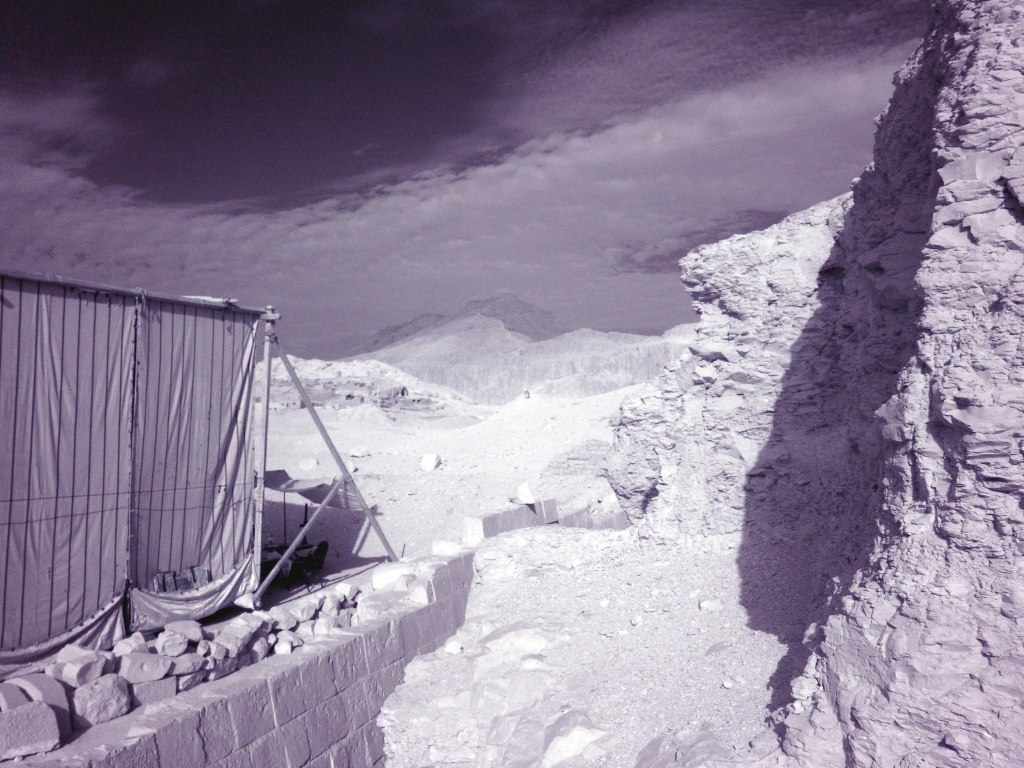
For the 2021 season, I therefore purchased a second-hand Sony Cybershot DSC-F828 camera. First tests with a magnet and the use of an IR-filter were extremely successful. The camera kit is also useful for landscape photography, site views turn out really nice – here is just a shot towards the mountain from our place of work.
But most importantly, for the wooden coffins, the photos are like magic and make things visible again! The decoration and the texts of some darkened pieces are much clearer and nicely readable. But also what appears as a “black coffin” because of its current surface, becomes visible as a formerly colourful piece completely covered with resin. The original JPGs and RAWs can be further processed and will assist us to fully document the design of the coffins from the tomb of Ankh-Hor.
I am very grateful to Daniel for introducing this new documentation method back in 2018 and super happy that I invested in my own new camera kit – the results are simply stunning! Especially for large fragments with important pieces of texts (and figurative panels) this will allow a fresh reassessment of the coffins from TT 414 – stay tuned for more very soon!
We just finished a first, very successful week of our 2021 season. We started off with cleaning, dusting, and sorting things and are now well underway to document small finds, ceramics, shrines as well as wooden and cartonnage coffins.
The painted coffins from TT 414 belong both to primary burials of the family of Ankh-Hor and to secondary burials of Amun priests, mostly dating to the 4th and 3rd centuries BCE, which appear as relatively wealthy. Most of the material derives from the secondary use of the tomb. I am still busy collecting fragments which can be dated stylistically and because of the technique to the 26th Dynasty – these are usually very small pieces, sometimes just small splitters of the painting.
Example of small fragments of 26th Dynasty coffins including a piece from the outer coffin of Ankh-Hor (bottom right).
These are nevertheless important to reconstruct the original burials in TT 414 – yesterday, I found one loose fragment of the foot pedestal of the outer coffin of Ankh-Hor himself. This foot part is in a very fragile condition and will be consolidated later this season, including fixing the loose fragments back in place. Among the most interesting finds is another 26th Dynasty coffin giving the female name of a Mutirdis – a common name in this era, but I still do not know to which specific person this coffin once belonged. During the Austrian excavations in the 1970s and 1980s, no Mutirdis from the 26th Dynasty was recognised in the material from TT 414 – another example why our current work is so important to understand the complete phases of use in the monumental tomb of Ankh-Hor!
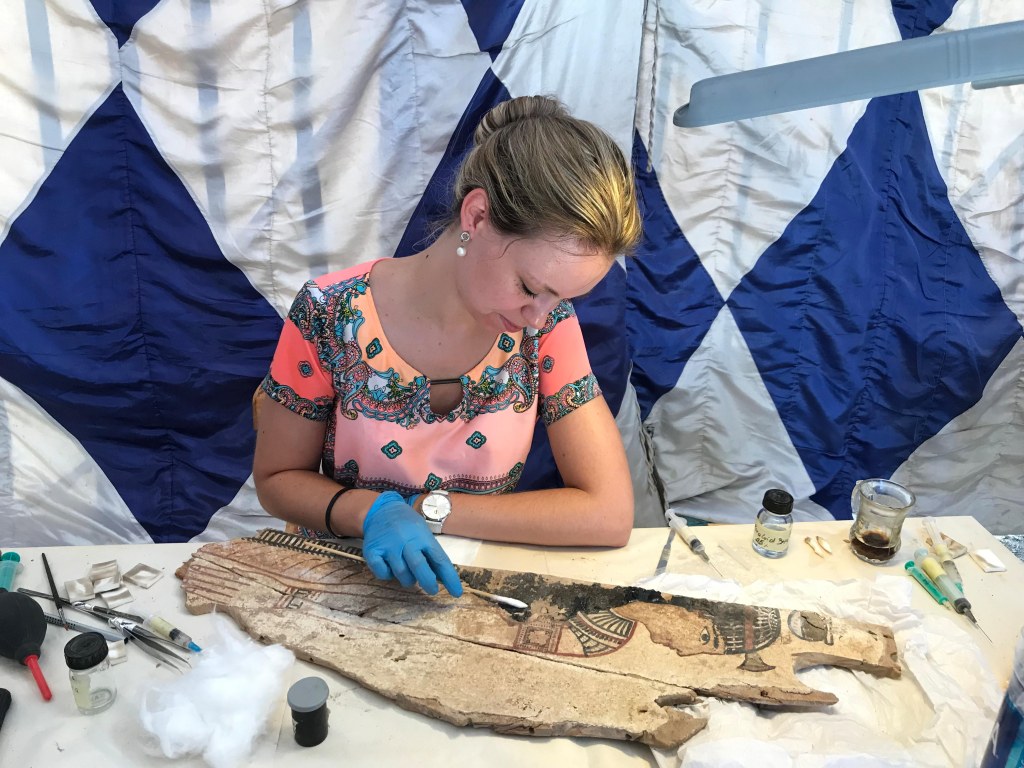
Jessica working on one of the late Ptolemaic coffin fragments.
The Ptolemaic wooden and cartonnage coffins are much better preserved and are currently treated by our conservation team. Since 2018, our conservation programme is conducted in cooperation with the Austrian Archaeological Institute (OeAI) of the Austrian Academy of Sciences. This year, our team is comprised of four young conservators, all graduates including one current student of the University of Applied Arts in Vienna. We are kindly supported by one of the experienced Egyptian conservators from the West Bank. The team finished already a considerable number of pieces in week 1 and these objects are now ready for their final photographic documentation with a full-frame camera with high resolution (Nikon D810 with a 35mm objective lens).
In terms of documentation, the Egyptologists of our team concentrate on ceramics and small finds. This week, Hassan and Patrizia were both busy with funerary cones. Patrizia, who is about to finish her PhD about Late Period statuary, wrote some years ago her BA thesis about funerary cones and thus shares my own enthusiasm for these intriguing objects which still pose some questions in the Late Period. Drawing these cones (among others funerary cones of Monthemhat, Padineith and Pabasa), Patrizia does not only focus on the stamped end but also on technical features, remains of colours and other details.
Although very challenging objects to draw, we love Late Period funerary cones! And Patrizia is doing a perfect job here.
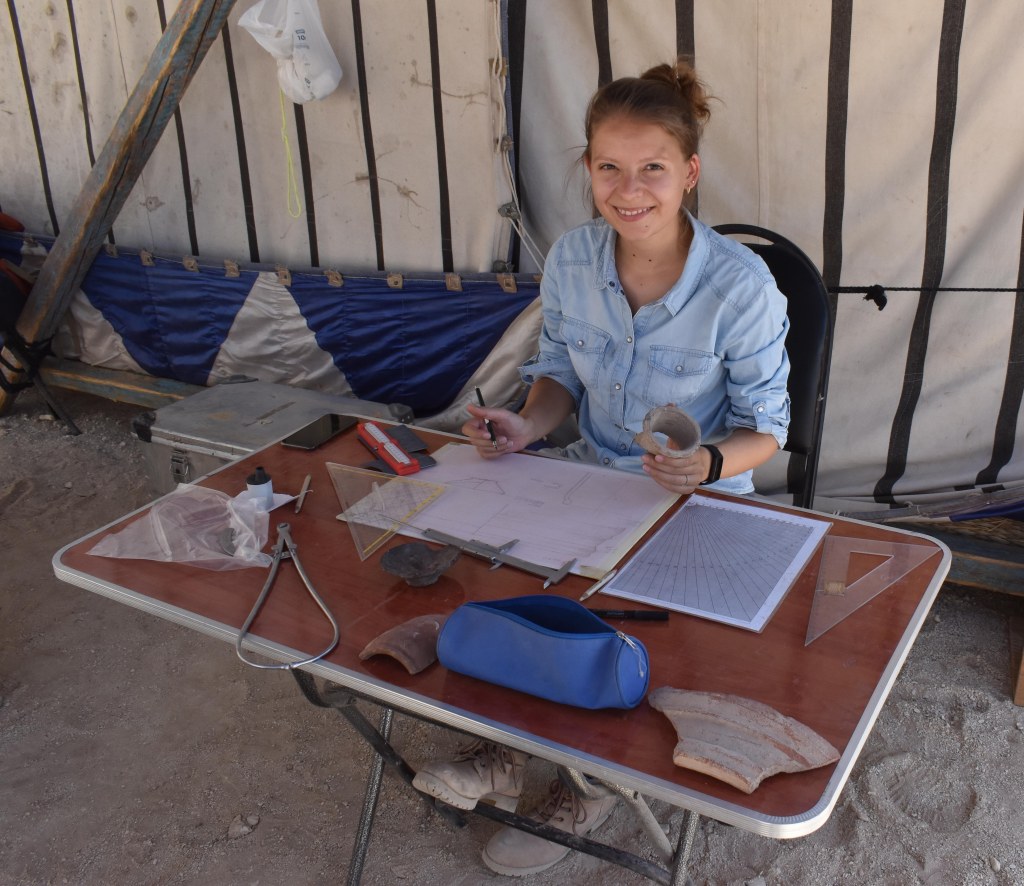
Our youngest Egyptologist is Caroline, a MA student from LMU Munich. She is very talented and enthusiastic and started with drawing Late Period and Ptolemaic vessels. Later this season, she will join me working for the South Asasif Conservation Project.
Caroline very quickly adapted to our “drawing office” at the site and made already a good number of pottery drawings in her first week.
It is wonderful that the two sites, Ankh-Hor and South Asasif, share so many similarities in terms of re-use – Caroline will thus be perfectly prepared, knowing the most common vessel types already from our mission.
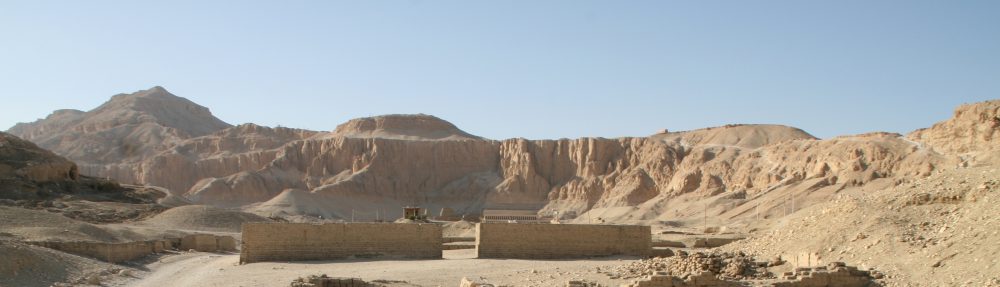
Today, the last team members will arrive, and we are all looking much forward to another exciting week starting on Saturday in the gorgeous setting of the Asasif in front of Deir el-Bahari.
Our conservation tent and a view to the Theban mountains.
Tomorrow will be the day: we will open the 2021 season of the LMU Ankh-Hor project. Not all members of the field season have yet arrived but will do so in the next days.
Thanks to much help by kind colleagues both in Cairo and in Luxor, I was able to get all paperwork done well in time. In addition, I joined the South Asasif Conservation Project directed by Elena Pischikova and started to work on the amazing amounts of pottery they unearthed in newly discovered tombs! I will continue to work in part-time for this mission and I am looking much forward to such an opportunity of a direct comparison between the South and the North Asasif. The parallels are really intriguing!
At our site in northern Asasif, we were already allowed to set up our beautiful conservation tent. Starting from tomorrow, this tent will be the centre of our conservation programme focusing on Ptolemaic wooden coffins and cartonages but including other painted objects as well.
We will keep you updated about our progress in the next four weeks!





 The Ankh-Hor Project