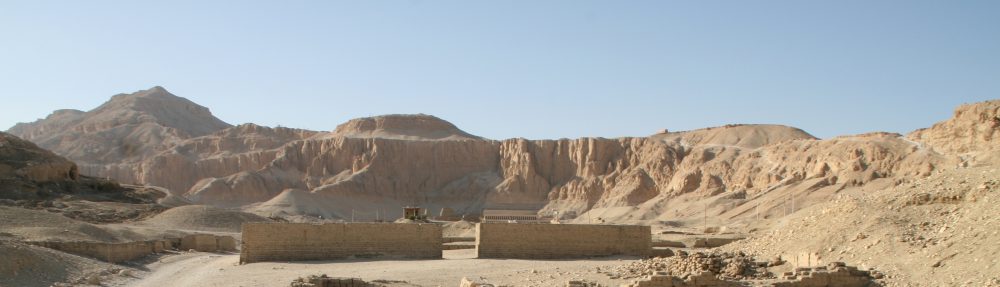
Today was the day: after one of the main pieces of our 2024 season was successfully consolidated, documented in 3D and with infrared photos, the foot part of the outer coffin of Ankh-Hor could be transported to the magazine of the Westbank today. My thanks go to my team and especially to the local authorities. The coffin fragment, which was excavated in the 1970s, then published by Bietak and Reiser-Haslauer in 1982 and left on site in our tomb magazine, is now in the same place as the inner coffin of the owner of TT 414.
At the start of the season, it was still completely covered with dust and very fragile. Mohamed did a great job consolidating it!
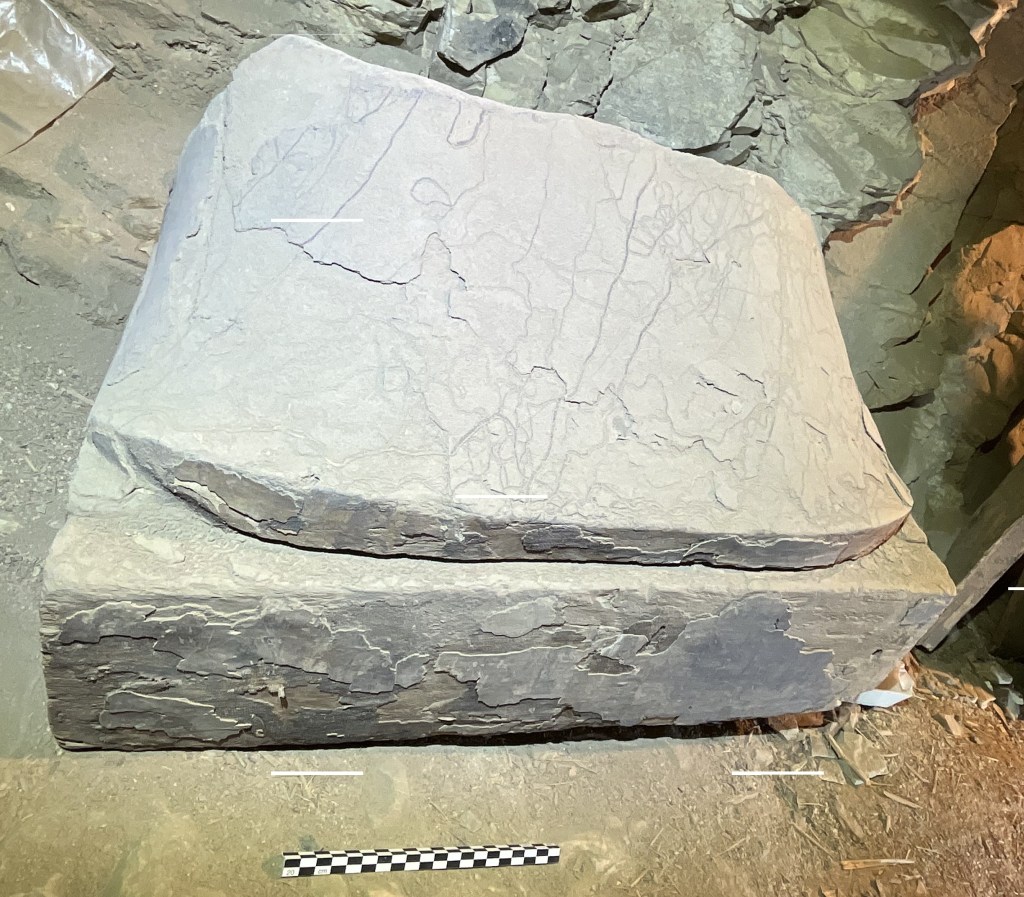
Because very little of this once beautiful 26th Dynasty coffin has survived, I am very pleased that we now have a 3D model and full-format photos of the piece.
Thanks to the infrared photos, some details can now be recognised even better than during the excavation in the 1970s. Just look at this beautiful, winged figure of the goddess Nut and all the details of her garment!

Another small thing I noticed during the documentation: A text column on the right of the foot part also mentions Ankh-Hor’s mother, Shep-en-wen. However, the hieroglyphic spelling is very interesting – she uses as a personal classifier the same sign as her son, Gardiner sign A51 and not a more typical female hieroglyph.

This markedly contrast to Reg. 868, a coffin fragment attributed to Ankh-Hor’s sister whose name is unknown. Here, for the name of Shep-en-wen a typical female classifier was used.

The same person was therefore classified in very different ways, which also shows how complex the concept of identity was in Late Period Egypt and that the mother is probably meant here primarily in her relationship to the son, the owner of the tomb. This was then simply solved graphically with a close connection and the same hieroglyph. Whereas Reg 868 maybe shows her in relation to her daughter.
These interesting and playful variations show that language is always gendered in many different ways – no matter how controversial this may be today. The Egyptian hieroglyphic script writing with its pictorial aspects is of course a particularly good example here.
 The Ankh-Hor Project