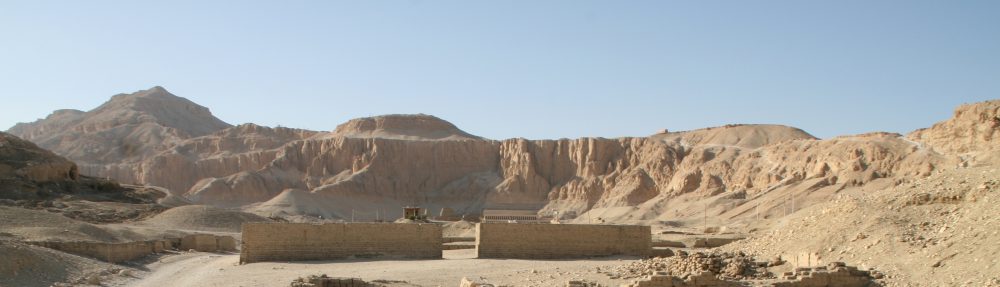
When you photograph numerous fragments of coffins every day and hold them in your hand, your eye for small details becomes sharper. One example for this is a small observation I made over the last days, and which I would like to share. It concerns the execution of individual motifs within designs arranged symmetrically along a central axis on Ptolemaic coffins from TT 414. More specifically, I am talking about pairs of jackals and the way they are represented on the same coffin. Three examples out of a larger set of coffins will hopefully illustrate why I am intrigued by these figures.
In general, two jackals, arranged symmetrically on various pieces of ancient Egyptian funerary art, are very common motifs, especially as guardian figures on coffins but also on stelae. In Thebes, the typical design of the coffin lid on the upper surface of the feet during the Late Period and Ptolemaic times shows two jackal-shaped Wep-wawet deities recumbent on a shrine on each side. The jackals commonly have a scepter between their paws and a flail above their back.
Let’s now have a look at my examples from TT 414. K07/125 is the lid of the top part of the feet of a Ptolemaic coffin. The pair of recumbent jackals flank a central vertical line of text which mentions Wep-wawet. The shrines of the jackals are not preserved, but above the jackal figures on each side are five uraei with sun discs on their head – representing the toes of the deceased.

The jackals themselves are depicted very differently – in particular the shape of the heads and snouts as well as the size and shape of the visible eye are very different. That this is not a unique feature becomes obvious when we look at two other examples. Two fragments of two qrsw-type coffins show pairs of jackals in a similar arrangement – in one case recumbent, in the other sitting – flanking the central sun disc and vertical text line, very similar to the design of stelae.
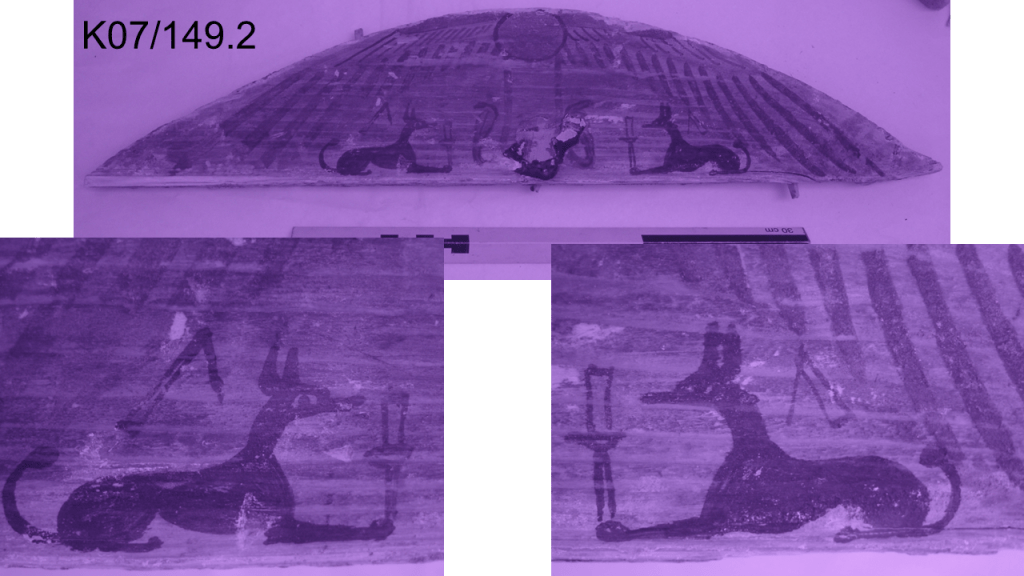
The figures I have compose illustrate how different the jackals are on the left sides to the one on the right sides. It’s mostly again differences regarding the shape of the head, snout and eye, but on K07/149 the right jackal also shows a much stockier body. If I would show you the pictures isolated – would you have guessed that it comes from the same object? This piece also shows small differences in the execution of the uraei and the space arrangement of the scenes differ slightly.

How can we explain these differences? It seems rather unlikely that different painters were involved in these minor motifs but of course this is a possibility. Perhaps there was a lot of freedom in how exactly standard motifs had to be executed on coffins during Ptolemaic times, perhaps not much accuracy was given to small details but rather to the complete design of coffins. Or could the deviations also be related to simply “natural” differences that depend on the direction of painting (animals facing to the right or to the left)?
Be it as it might, the pairs of jackals on coffins from TT 414 illustrate the complexity of coffin design in Ptolemaic Thebes and that a symmetrically arranged motif is executed in anything but the same way. This makes the study of these objects such a fascinating task.
 The Ankh-Hor Project